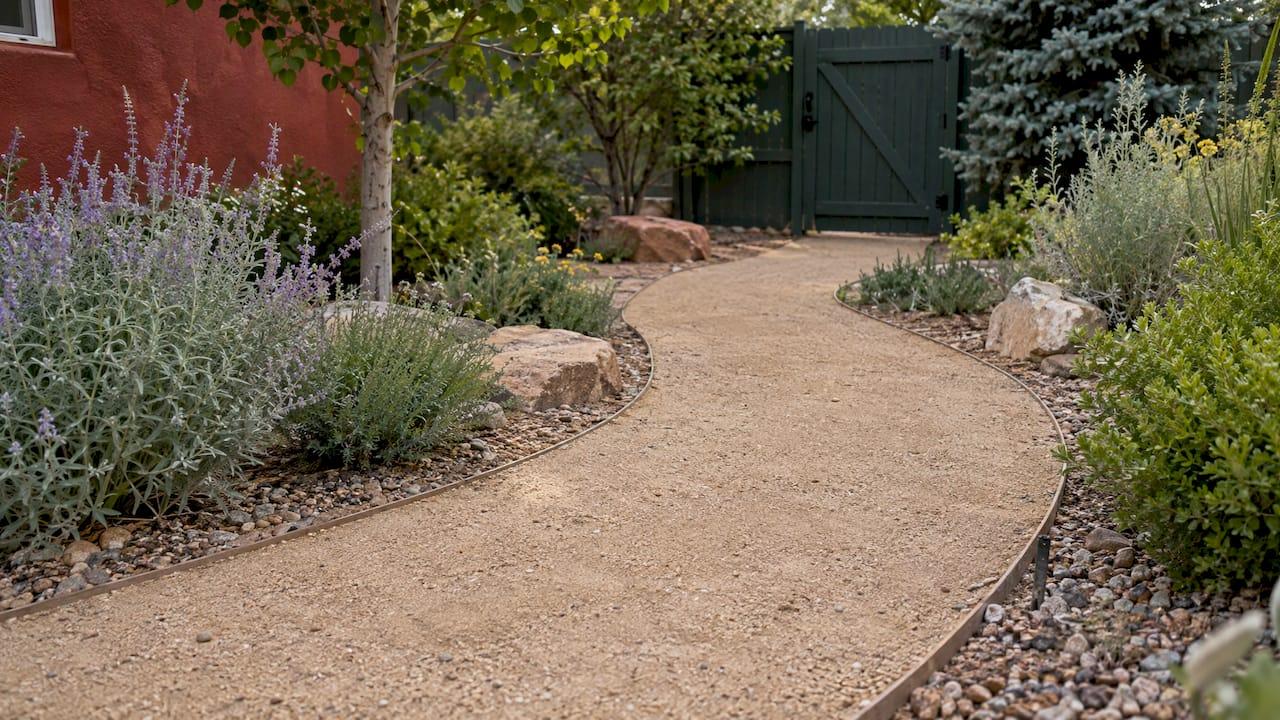
Decomposed granite (DG) is crushed, weathered granite fine enough to pack into a firm, permeable surface. It makes good walkways, patios, xeriscape beds and garden paths, and its results depend almost entirely on what sits under it: the grade, the compacted base, the edging and the stabilizer. Get those right and DG is a durable, low-water surface. Get them wrong and it ruts, washes out and grows weeds. If you want the grading, base work, edging and neighboring hardscape handled by one licensed crew under one contract, that is the kind of project we build every week in Utah.
TL;DR
- DG is granite weathered into fine gravel and rock dust, typically 3/8 inch or smaller, that compacts into a firm, permeable surface.
- Use stabilized DG (with a binder) for walkways and patios, and loose DG as mulch around trees and beds.
- A lasting path needs a compacted base, a slight slope for drainage, edging, and DG laid in thin compacted layers.
- One cubic yard covers roughly 108 square feet at 3 inches deep, and you should order extra because DG compacts by 20 to 25 percent.
- Maintenance is light: rake, fill low spots, pull the occasional weed and top up every few years.
Table of Contents
- What decomposed granite is and why landscapers use it
- Where DG works best in a yard
- DG vs. gravel: which surface for which job
- How to build a decomposed granite walkway
- How much decomposed granite do you need?
- What decomposed granite landscaping costs
- Weeds and maintenance
- Combining DG with other hardscape and landscaping
- Our perspective
- Plan your DG walkway or xeriscape with one crew
- FAQ
- Sources
What decomposed granite is and why landscapers use it
Granite that has weathered for a long time crumbles into a mix of sand, small pebbles and fine dust. That mix is decomposed granite. Landscape suppliers screen it to a consistent size, usually 3/8 inch or smaller, and sell it by the ton or cubic yard in warm tan, gold and light brown shades.
The dust is the point. Unlike round pea gravel, DG is angular and contains fines, so the pieces lock together when compacted. The UC Cooperative Extension Master Gardeners describe it as angular gravel that packs down to a nearly solid surface, which makes it more useful than round river-run gravel for paths and patios with heavy foot traffic.
There are three forms you will hear about:
- Natural (loose) DG: a long-lasting mulch around trees and garden beds, and a groundcover in xeriscape designs.
- Stabilized DG: DG mixed with a natural binder, moistened and compacted into a hard, resilient surface for paths and patios.
- Resin-coated DG: the most durable form, used where vehicles or accessibility standards come into play.
The three forms are described in Gardenista's DG overview.
The other draw is water. DG is permeable, so it absorbs most rainfall where it falls instead of sending it off as runoff the way concrete does. In a dry-climate yard like southern Utah's, that pairs naturally with xeriscaping, where the goal is a good-looking yard that needs very little irrigation.
Where DG works best in a yard
The best uses share a trait: foot traffic, gentle slopes and a design that wants a natural look.
Walkways and garden paths. This is the most common use and the most searched one. A stabilized DG path gives a smooth, quiet surface that suits side yards, garden trails and the route between a patio and a fire pit.
Patios and courtyards. Stabilized DG makes a firm surface that holds table and chair legs. It suits informal seating areas, especially next to planting beds.
Xeriscape beds and mulch areas. Loose DG around drought-tolerant plants lasts far longer than wood mulch, which breaks down in a season or two, and it needs no water itself.

Transitions. DG blends a formal landscape into a wilder one, so it is a natural filler between pavers, boulders and planting.
Where to plan more carefully. Steep slopes erode. The Waterwise Garden Planner says DG is prone to erosion on steep slopes and should generally not be used for steep pathways. On a hillside, a retaining wall or a stepped layout gives the DG a level place to sit. Heavy vehicle areas, such as a driveway, call for resin-coated DG or a concrete or paver surface instead.
DG vs. gravel: which surface for which job
People often lump the two together, but they behave differently underfoot and under rain.
| Decomposed granite | Crushed or pea gravel | |
|---|---|---|
| Particle mix | Fine dust plus small angular pieces | Fines mostly screened out |
| Surface | Compacts firm and smooth | Stays loose underfoot |
| Drainage | Moderate, and permeable | Fast |
| Best for | Walkways, patios, garden paths | Drainage areas, base layers, decorative beds |
| Comfort | Easy to walk on, wheelchair and furniture friendly when stabilized | Shifts under feet and furniture |
The short version: choose DG when you want a surface that feels like a path, and gravel when you want water to move through quickly or you need a base layer. Round gravel looks nice and is comfortable to walk on at small sizes, but angular DG holds together better where people walk daily.
If your project needs a surface that handles a vehicle every day, the answer is a different build entirely. Our guide to a three-layer driveway gravel system and the page on driveway base preparation explain what goes under a surface that carries a truck.
How to build a decomposed granite walkway
A DG walkway looks simple, and that is why the base layers get skipped. Here is the sequence that holds up, with what goes wrong at each step.
1. Lay out and excavate
Mark the path with string or paint and dig out the total depth you need: the base plus the DG layer. Remove sod and roots. Where it goes wrong: digging to a uniform depth on ground that is not level. The finished surface should have a slight slope, at least 1 to 2 percent, so water leaves instead of pooling. That is a grading job, and it is the part most homeowners underestimate. Our crew does excavation and grading in-house.
2. Build a compacted base
For foot traffic, use a compacted base of angular crushed stone or road base about 2 to 4 inches thick, compacted with a plate compactor. Harbor Soils reports that the most common failure it sees from Seattle-area contractors is rutting and washout when DG goes in without a proper base or stabilizer. The same principle appears in our guide to patio base compaction: the surface is only as stable as what is under it.
3. Add landscape fabric
DG paths are usually built over permeable landscape fabric, which keeps the DG and native soil separated over time and helps suppress weeds from below. Lap the seams and pin the fabric flat.
4. Set the edging
Edging is what keeps DG in place. Steel, brick or stone edging all work, and it is part of any standard installation. Set it before the DG goes in, at the height of the finished surface. Where the path meets a patio or driveway, a clean concrete or masonry border gives the DG a firm edge that will not migrate.
5. Spread stabilized DG in thin lifts
The Landscape Library recommends spreading DG in 1.5 to 2 inch lifts, lightly misting each lift and compacting it before adding the next. Stabilized DG is mixed by the supplier with a natural additive, so it can be moistened and compacted with a tamper into a hard, resilient surface.
For total depth, the UC Extension guide gives two inches as a practical minimum, and four inches if thick stones or pavers are set into the path. A final DG layer of 2 to 3 inches over the base suits most walkways.
6. Compact and let it cure
Finish with a final pass of the plate compactor, then keep traffic off while the surface cures. Stabilizer manufacturers publish specific cure times, so follow the product's instructions. Wait until the DG has dried after rain before walking on it: even stabilized DG behaves like wet, muddy soil right after rain.
This is the stage where doing it with a single crew pays off. The same people who graded the path set the base, edge the border and compact each lift, so nothing falls between trades.
How much decomposed granite do you need?
Coverage depends on depth, and compaction changes the math. According to Asphalt Tons' coverage guide, one cubic yard of DG covers about:
| Depth | Coverage per cubic yard |
|---|---|
| 2 inches | about 162 sq ft |
| 3 inches | about 108 sq ft |
| 4 inches | about 81 sq ft |
The same guide notes that DG compacts by roughly 20 to 25 percent, so a 3-inch compacted layer may need nearly 4 inches of loose material.
Worked example: a 4 ft by 40 ft path at 3 inches compacted. The path is 160 square feet. At 3 inches (0.25 ft) deep, that is 40 cubic feet, or about 1.48 cubic yards. Add a 20 percent compaction allowance and you need about 1.8 cubic yards of loose DG. Gravel Monkey's calculator works the same example out as about 2.4 tons, so you would order 3 tons, since DG weighs roughly 1.35 to 1.5 tons per cubic yard depending on grading.

That is DG only. The base rock under it is a separate order, and stabilizer is usually blended in by the supplier.
What decomposed granite landscaping costs
Material is the small part. Dgfloors puts a path at about $4 to $12 per square foot installed, with natural DG running about $40 to $80 per cubic yard in bulk. Harbor Soils notes that stabilized DG costs roughly twice as much per ton as loose DG, and resin-coated DG costs the most.
UC Cooperative Extension points out that labor costs often exceed material costs in a hardscape. That matters because the labor in a DG path is the excavation, the base and the compaction. Prices vary by site, access, slope and distance to your supplier, so a bid for your actual yard is the only reliable number.
If your plan combines DG with other hardscape, here are the published ranges for our related work:
- Paver patios and walkways: $8,000 to $25,000
- Retaining walls: $6,000 to $40,000
- Outdoor kitchens: $15,000 to $60,000
- Irrigation and sprinkler systems: $3,000 to $8,000
- Artificial turf: $8 to $20 per square foot
For a breakdown of what drives the paver number, see our paver patio cost guide.
Weeds and maintenance
DG discourages weeds, but nothing is weed-proof. Weed seed lands on top of any surface, and a well-built DG path keeps weeds down mainly through the fabric below, the compaction and the stabilizer. Southwest Boulder notes that soil stabilizers reduce weed growth, dust and erosion. A routine that keeps a DG surface looking sharp:
- Rake after storms. Smooth out any displaced material and fill low spots right away, before they collect water.
- Pull weeds when small. Seedlings that land on the surface come out easily before roots reach the fabric.
- Keep edging tight. Re-set any edging that has shifted so DG stays in the path.
- Top up every couple of years. A thin skim of fresh DG restores depth and color. Harbor Soils describes re-skimming fresh DG every couple of years as part of keeping a DG path looking its best.
- Mind the drainage. Keep gutters, downspouts and irrigation from dumping on the path. Our paver patio drainage checklist covers soil, slope and outlet, and the same logic applies to a DG path.
A seasonal walk-around helps too. Our spring maintenance checklist for hardscape and concrete is a good template for checking edges, borders and neighboring surfaces after winter.
UC Extension describes loose materials like DG as inexpensive and easier to install, with a maintenance routine like the one above. Stabilizing the surface and building it on a proper base reduces how much of that routine you will do.
Combining DG with other hardscape and landscaping
Most yards that use DG also use something else, and that is where coordination counts.
- DG path leading to a paver patio. The patio needs its own deeper base. Our guide to paver base depth shows how the two bases should meet so the transition does not settle.
- DG beside concrete. A concrete edge or apron gives a hard border and a place to stop the DG. See our gravel base for concrete slabs guide for the base under that concrete.
- DG on a slope. A retaining wall creates level terraces where DG stays put.
- DG with xeriscaping and irrigation. Drip lines and plantings are laid out before the DG goes down, so the fabric and DG are not cut open later.
- DG around a fence line. A DG strip along a fence makes a clean, low-water border.
Each of these touches a different trade: grading, concrete, masonry, fencing, irrigation and planting. That sequencing is the reason we run them with one crew.
Our perspective
We build outdoor spaces across Utah, and the pattern on DG projects is consistent: the material is the easy part. The grade, the base, the edging and the way the path meets the rest of the yard decide whether it still looks good in five years.
Because we handle earthwork, concrete, masonry, hardscape and landscaping with our own licensed crew, one person coordinates the whole project from the estimate to the finish. That means the path is graded with drainage in mind, the border is set before the surface goes in, and the irrigation, plantings and neighboring patio are planned together rather than argued over by separate subcontractors.
If you are planning DG as part of a larger yard, we recommend treating it as one project with one bid, not as a weekend task layered on top of someone else's work.
Jake
Plan your DG walkway or xeriscape with one crew
A to Z Construction is a licensed general contractor in Cedar City, Utah, with over 500 projects completed. We handle concrete, earthwork, masonry, hardscape, fencing and landscaping, including xeriscaping, irrigation and artificial turf, with a single point of contact and fixed bids. Share what you want your yard to do, and we will map the grading, base, borders and surrounding hardscape together.

See our landscaping services and hardscape services, or start from our main page to request an estimate.
FAQ
What is DG in landscaping?
DG stands for decomposed granite: weathered granite broken into fine gravel and rock dust, typically 3/8 inch or smaller. It compacts into a firm, permeable surface and is used for paths, patios, driveways (in resin-coated form) and xeriscape ground cover.
Do weeds grow on decomposed granite?
Some seeds can sprout on any surface, but a path built over landscape fabric with a compacted, stabilized layer keeps weeds to a minimum. Pull seedlings while they are small and top up the surface every couple of years to keep it dense.
What is the difference between decomposed granite and gravel?
DG contains fine dust that lets it compact into a smooth, firm surface, while crushed gravel has most of the fines removed, stays loose and drains faster. DG suits walkways and patios, and gravel suits drainage areas and base layers.
How much does one yard of decomposed granite cover?
About 162 square feet at 2 inches deep, 108 at 3 inches and 81 at 4 inches. Because DG compacts by 20 to 25 percent, order extra to reach your finished depth.
Can decomposed granite be used on a slope?
Only gentle ones. Steep paths erode, so a sloped yard is better handled with terraces and retaining walls that give the DG a level place to sit.
Sources
- Decomposed Granite: Hardscaping 101, Gardenista
- Gravel Pathways in the Garden, UC Cooperative Extension
- Pathway details, Waterwise Garden Planner
- Low-Cost Luxury: 9 Ways to Use Decomposed Granite, Gardenista
- Decomposed Granite in the PNW, Harbor Soils
- How to Install Decomposed Granite, The Landscape Library
- The Ultimate Guide to Using Decomposed Granite in Landscaping, US Rock
- Decomposed Granite Coverage, Asphalt Tons
- Decomposed Granite Calculator, Gravel Monkey
- Decomposed Granite Pathway Guide, dgfloors.com
- Planning Your Hardscape, UC The Real Dirt
- Landscaping With Decomposed Granite, Southwest Boulder