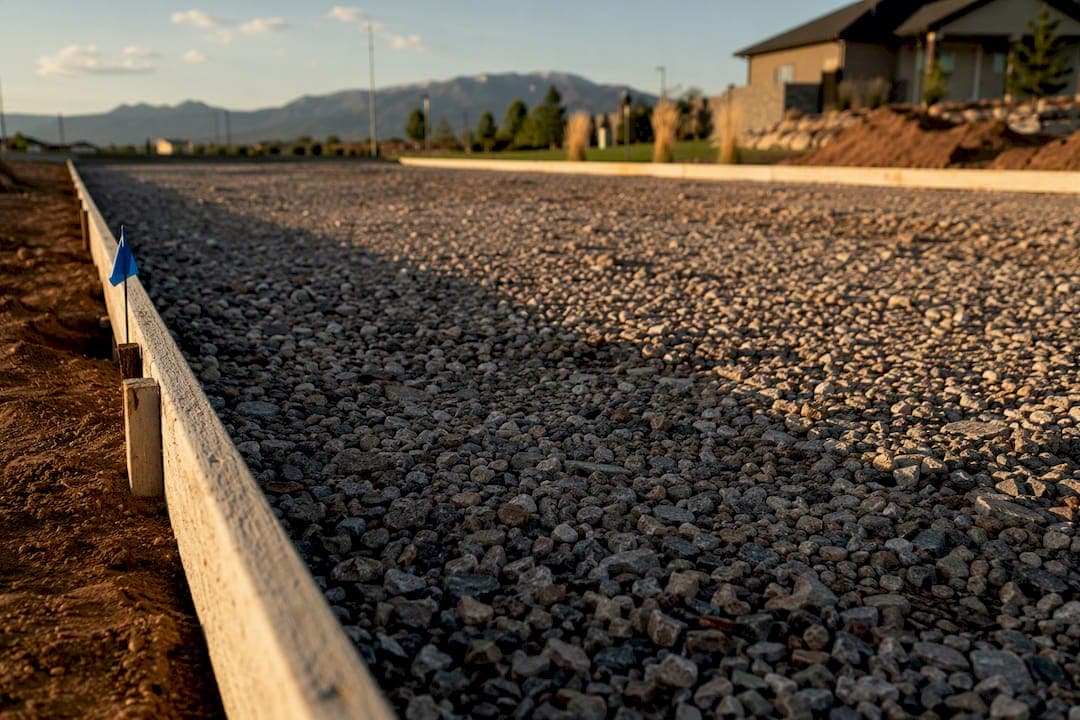
Nearly every residential concrete slab needs a compacted gravel base, typically 4 to 6 inches of open-graded crushed stone. AASHTO #57 is the standard choice for driveways, patios, and garage floors, with crusher run acceptable on dry sites that don't need a capillary break. Heavier loads, poor soils, or deep fill call for more depth and sometimes an engineer's sign-off.
TL;DR:
- A gravel base under concrete slabs must be at least four inches thick for residential driveways and patios, with heavier loads requiring up to six inches or more.
- The gravel layer primarily prevents capillary water rise, facilitates drainage, distributes structural loads, and provides a stable platform for finishing work.
- Using open-graded AASHTO #57 stone is ideal for capillary break and drainage, while crusher run is better suited for dry sites due to its tight packing and lack of true drainage.
- Proper compaction in multiple lifts is crucial, with a focus on verifying density, to ensure slab longevity and prevent cracking or settlement.
- Avoid using rounded stones like pea gravel or river rock, and never place gravel directly on existing concrete; the base always goes beneath the slab.
Table of Contents
- What a Gravel Base Actually Does Under Your Slab
- Which Gravel Is Best for a Concrete Slab Base?
- How Thick Should Your Gravel Base Be?
- How Do You Prepare and Compact a Gravel Base Correctly?
- Do You Need a Vapor Retarder Under Your Slab?
- What About Clay Soil, Deep Fill, or Frost Conditions?
- How Much Gravel Do You Need to Order?
- What a Contractor Checks That DIYers Usually Miss
- Where to Go Deeper on the Standards
- The Base Matters More Than the Concrete Mix
- Get Your Slab Base Done Right the First Time
- Sources
- FAQ
What a Gravel Base Actually Does Under Your Slab
A gravel base under a concrete slab isn't just filler between the dirt and the concrete. It does four specific jobs, and skipping any one of them is how slabs end up cracked, heaved, or sitting in a puddle every spring.
The first job is breaking capillary action with the right glass sand. Soil moisture wicks upward through fine material the same way a paper towel pulls water up from a spilled glass. Open-graded stone like AASHTO #57 has enough air space between particles that water can't climb through it the same way, which is why contractors call it a capillary break.
The second job is drainage. Water that lands on or near the slab needs somewhere to go besides sitting against the concrete. A properly placed gravel layer for concrete gives that water a path out instead of trapping it under the slab.
Third, the base spreads structural loads. Without it, a heavy truck tire or even a loaded dumpster can create a soft spot that settles unevenly, cracking the slab right above it. Fourth, it gives your crew a stable, level working platform to set forms and screed concrete accurately.
- Capillary break: stops groundwater from wicking into the slab
- Drainage: moves water away from the concrete instead of trapping it
- Load distribution: spreads weight evenly across the subgrade
- Working platform: keeps forms and finishing work level and stable
Which Gravel Is Best for a Concrete Slab Base?
AASHTO #57 stone is the go-to choice for residential and light commercial slabs, and for good reason. It's an open-graded aggregate, generally ranging from about 1.5 inches down to fine particles, with enough void space to drain freely and break capillary rise. It's the material most contractor guides recommend as the default for slab-on-grade work.
AASHTO #67 is the next size down, useful when you're working with a thinner base section or need a tighter, more consolidated platform under a thin slab. It still drains well, just with a smaller top-size stone.
Crusher run, also called dense-graded aggregate, packs tighter and compacts into a firmer surface than #57 or #67. The tradeoff is that it doesn't function as a true capillary break because the fines fill in the void spaces that would otherwise let water pass through. Crusher run works fine on dry, well-drained sites without moisture-sensitive flooring, but it's the wrong call under a garage floor slated for epoxy coating or a slab with a finished basement below it.
Recycled crushed concrete can work as a budget alternative if it's clean, well-processed, and free of rebar fragments and debris. What you want to avoid entirely is pea gravel, river rock, or straight sand. Rounded stone doesn't interlock the way angular crushed aggregate does, so it shifts and settles under load instead of locking into a stable matrix.
- AASHTO #57: open-graded, true capillary break, the residential standard
- AASHTO #67: smaller stone, good for thin sections
- Crusher run: compacts tight, but skip it under moisture-sensitive floors
- Recycled crushed concrete: fine if clean and properly graded
- Avoid: pea gravel, river rock, and sand-only bases
Pro Tip: Ask your supplier for "clean #57" specifically. Some yards sell a #57 mix with extra fines swept in from stockpile handling, which quietly turns your capillary break into a dense-graded material that behaves more like crusher run.
How Thick Should Your Gravel Base Be?
Base thickness isn't a single number. It scales with what's sitting on top of it and what's underneath it.
- Patios and sidewalks: 4 inches of compacted aggregate is typically enough for light foot traffic.
- Driveways and garage floors: Plan on 4 to 6 inches, matching the depth most residential slab guides recommend.
- Heavy-use or RV driveways: Bump that to 6 inches or more to handle the repeated weight of larger vehicles.
- Heavy equipment or industrial slabs: These often need 6 to 12 inches or deeper, sometimes built in structural lifts beneath the main bedding layer.
- Poor subgrade, deep fill, or expansive clay: Increase depth beyond standard ranges, and bring in a geotechnical engineer for anything load-bearing or large in scale.
The pattern here matters more than any single figure: thickness goes up as load goes up, and it goes up again when the soil underneath can't be trusted to stay stable on its own. If you're pouring a standard driveway, pairing base depth with the right slab thickness is what actually keeps the whole system from cracking prematurely.
How Do You Prepare and Compact a Gravel Base Correctly?
Getting this sequence right is the difference between a slab that lasts decades and one that cracks within two winters. Here's the order that actually works.
- Excavate to the right depth. Dig out an area equal to your slab thickness plus your base thickness, since excavation depth is always the sum of both layers, not just the base.
- Strip out all organic material. Roots, topsoil, and old sod decompose over time, creating voids under your slab. None of it belongs in the excavation.
- Compact and proof-roll the subgrade. Run a plate compactor over the native soil first, aiming for roughly 95% Standard Proctor density on a residential job. Then drive or roll a loaded wheel across it to find soft spots that need more compaction or removal.
- Place gravel in lifts, not all at once. Spread the aggregate in 2 to 3 inch layers, lightly dampening if the material is bone dry, and compact each lift before adding the next.
- Grade to final elevation and slope. Set the surface to the correct height off your forms, with enough pitch to shed water away from the structure.
- Run the pre-pour checklist. Confirm base depth, recheck compaction, place the vapor retarder if the project calls for one, and position reinforcement before the trucks arrive.
Pro Tip: Trying to compact 6 inches of gravel in one pass is the single most common DIY mistake. A plate compactor can only densify the top few inches effectively; anything thicker needs to go down in lifts or the bottom layer stays loose no matter how many passes you run over the top.
Do You Need a Vapor Retarder Under Your Slab?
A vapor retarder matters most when moisture-sensitive flooring is going down over the slab, think tile adhesive, vinyl, or epoxy coatings that fail if vapor pushes up from below. The common configuration places the retarder directly under the slab, on top of the compacted aggregate, so the two materials handle separate jobs: the stone breaks capillary rise from groundwater, while the polyethylene sheeting blocks vapor transmission through the base itself.
This is exactly where crusher run falls short. Because it compacts dense with fewer air voids, it doesn't interrupt capillary movement, which means a vapor retarder becomes more important, not less, if you're using it.
- Wet or low sites benefit from a perforated subdrain pipe wrapped in drainage stone
- Grade the surrounding yard to slope away from the slab
- Ask your supplier about vapor retarder class ratings if the flooring above is moisture-sensitive
- When in doubt on spec, check the project drawings or ask a contractor before pouring
What About Clay Soil, Deep Fill, or Frost Conditions?
Expansive clay swells and shrinks with moisture changes, and that movement transfers straight into a slab sitting on top of it. A thicker base, better moisture control around the perimeter, or soil stabilization with lime or cement can help, but this is genuinely a case where geotechnical advice pays for itself.
Deep fill sites need the fill material compacted in lifts, the same way you'd place gravel, or replaced outright if it's soft or organic. Increasing base thickness alone doesn't fix bad fill sitting several feet down.
Frost-susceptible soils need attention at the edges especially, since frost heave concentrates at slab perimeters and footings. Maintaining drainage away from the slab reduces how much water is available to freeze and expand in the first place.
- Expansive clay: consider stabilization and always keep drainage moving away from the slab
- Deep fill: compact in lifts or consult an engineer before pouring over it
- Frost zones: protect footings and edges, and don't let water pool near the perimeter
- Call a geotechnical engineer or licensed contractor once the project involves structural loads, unstable fill, or a slab you can't afford to have fail
How Much Gravel Do You Need to Order?
The math is simpler than it looks. Take your area in square feet, multiply by your depth in inches, then divide by 324 to get cubic yards.
- 100 square feet at 4 inches deep: roughly 1.25 cubic yards of aggregate.
- 100 square feet at 6 inches deep: roughly 1.85 cubic yards.
- Add 10 to 15% extra to cover uneven subgrade, low spots, and compaction loss, since gravel settles once it's compacted and always eats up more volume than the flat math suggests.
- Give your supplier exact spec language: ask for "3/4 inch clean #57 stone" or "CR6" by name rather than just "gravel," since yard terminology varies by region.
Costs vary widely by region and delivery distance, so treat any number you see online as a rough starting point rather than a quote. If you're budgeting a full driveway pour, our driveway cost guide breaks down where the bigger cost swings actually come from.
What a Contractor Checks That DIYers Usually Miss
On every job site, the base gets checked before a single yard of concrete gets ordered. That means verifying subgrade compaction with a plate compactor and proof roll, confirming lift thickness as gravel goes down, and grading for positive drainage before forms ever go in.
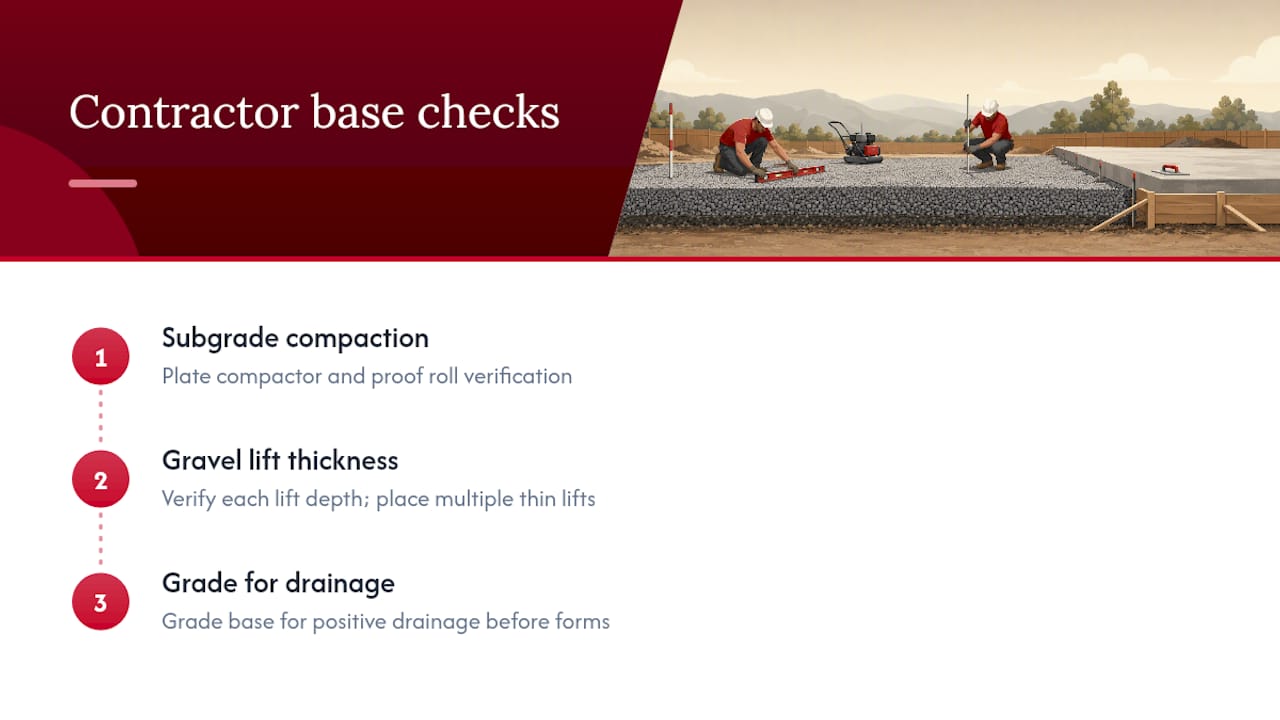
The most common DIY mistakes we see repeated: skipping subgrade compaction entirely, ordering gravel by guesswork instead of the area-and-depth math, and compacting one thick lift instead of several thin ones. Any contractor worth hiring should be able to tell you their compaction targets and how they verify them on-site, whether that's a straightforward concrete slab project or a full foundation and earthwork scope.
Where to Go Deeper on the Standards
For specification-level detail beyond this guide, ACI's slab construction guidance covers base prep and vapor retarder placement. For step-by-step calculation help, the subgrade preparation guide referenced throughout this article is worth bookmarking.
The Base Matters More Than the Concrete Mix
Homeowners spend an enormous amount of energy debating concrete mix ratios and curing times, and almost none debating what's underneath the slab. That's backwards. A mediocre pour on a properly compacted #57 base will outlast a perfect pour sitting on loose fill or uncompacted crusher run, every time.
The conventional advice on this topic tends to flatten everything into one number, "just do four inches of gravel," without explaining that the number is conditional on soil, load, and drainage. That oversimplification is why so many DIY slabs crack within a few years: the depth was fine, but the material choice or the compaction sequence wasn't.
If there's one thing to prioritize first, it's compaction verification, not material selection. A dense-graded crusher run base that's properly compacted in lifts will outperform a #57 stone base that got dumped in one thick layer and never checked. Material matters, but process is what actually determines whether the slab above it stays flat.
— Jake
Get Your Slab Base Done Right the First Time
A DIY gravel base can absolutely work if you follow the compaction sequence closely, but a lot of homeowners find out too late that a rushed lift or an undersized base means redoing flatwork a few years down the road. Some contractors handle the entire process in-house, from excavation and subgrade compaction through the final pour, streamlining responsibility and communication.
Having one crew handle earthwork, base prep, and the concrete itself can help avoid finger-pointing between subcontractors if something goes wrong, and reduce scheduling gaps waiting for the next trade to arrive. If you're planning a driveway, patio, or garage slab and want it assessed before you order gravel, request a free hardscape estimate from a licensed contractor for guidance on depth, material, and cost for your site.
Sources
- What Gravel Goes Under a Concrete Slab? A Contractor's Guide to Slab Base Material
- Concrete Slab Base Preparation: Complete Subgrade Guide
- Sub-Base Preparation for Concrete – Complete Guide
FAQ
How thick should a gravel base be for a concrete driveway?
Most residential driveways need 4 to 6 inches of compacted AASHTO #57 stone, increasing to 6 inches or more for heavy vehicles or RV traffic.
Do you really need gravel under concrete?
Yes, for nearly every slab poured over native soil, since the gravel base handles drainage, capillary break, and load distribution that concrete alone can't provide.
Can I put gravel straight onto concrete?
No, that question usually confuses the order of operations. Gravel goes down first as the base, then the concrete gets poured on top of the compacted, graded aggregate.
How much gravel under a 4 inch concrete slab?
Plan on 4 to 6 inches of compacted base under a 4 inch slab for typical residential use, which works out to roughly 1.25 to 1.85 cubic yards per 100 square feet depending on the depth chosen.