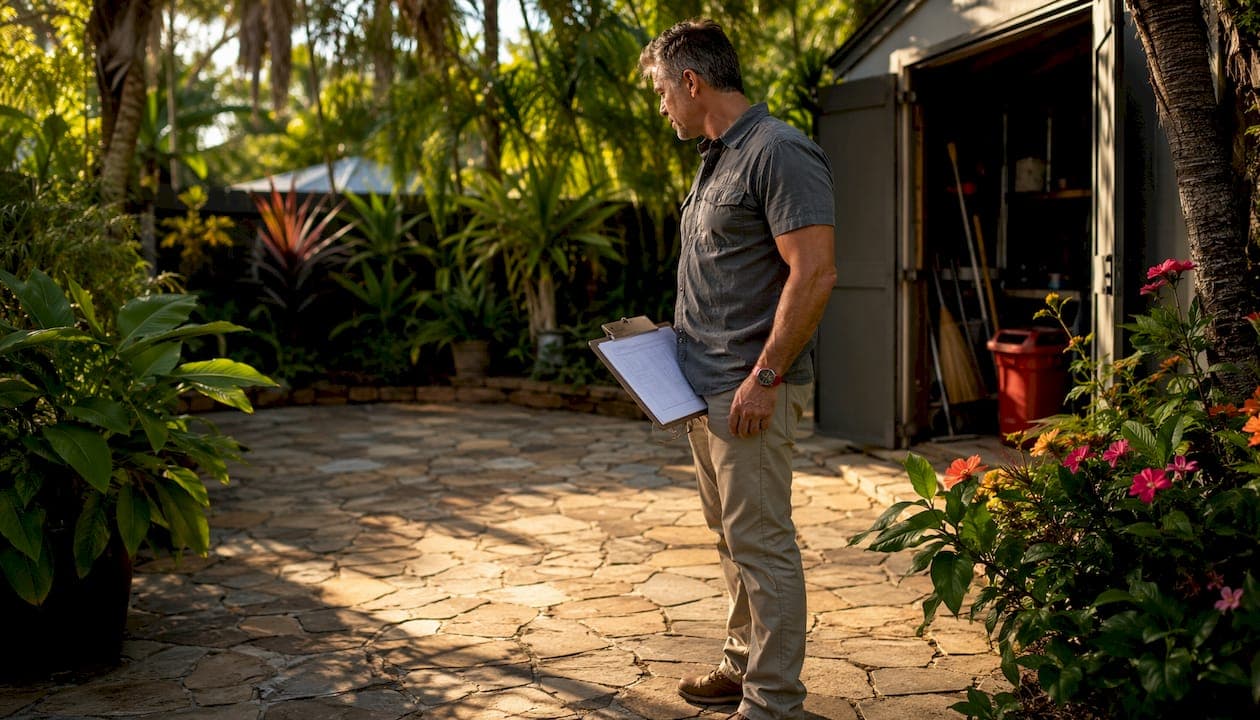
A typical installed paver patio has a moderate to high cost per square foot nationally, with most homeowner projects varying widely in total cost depending on size, material, and site conditions. A 12x12 patio (144 sq ft) with concrete pavers comes in around $1,700–$4,000 installed, while a 20x20 (400 sq ft) mid-range project typically costs $6,400–$11,200. Push to 500 sq ft with premium stone and you're looking at $10,000–$25,000 or more.
Three factors drive most of the variance in any paver patio cost estimate:
- Materials: Concrete pavers start at a moderate installed cost per square foot; natural stone can be considerably more expensive.
- Base preparation: Excavation, compacted gravel, and drainage together often represent the largest single cost category on a well-built job.
- Labor: Labor and base prep typically make up the majority of total installed cost, which is why two bids for the same patio can differ significantly.
Natural stone installed pavers are at the high end of the cost range; budget concrete pavers can be more affordable for simple layouts on flat ground. The sections below break down every variable so you can build a realistic budget before you call a single contractor.
Table of Contents
- How much does a paver patio cost by size?
- What does each project type actually cost?
- How paver material choice changes your installed price
- What actually drives the biggest cost differences between bids?
- Where does the money actually go? A line-item breakdown
- Should you DIY or hire a professional?
- How long does a paver patio installation take?
- How to get an accurate contractor estimate
- Why hire a licensed general contractor for your paver patio?
- How much does paver patio cost vary by U.S. region?
- What does paver patio maintenance actually cost?
- Key Takeaways
- The part most homeowners underestimate
- A-to-zconstruction handles paver patios from excavation to final sealing
- Useful sources and cost calculators
- FAQ
How much does a paver patio cost by size?
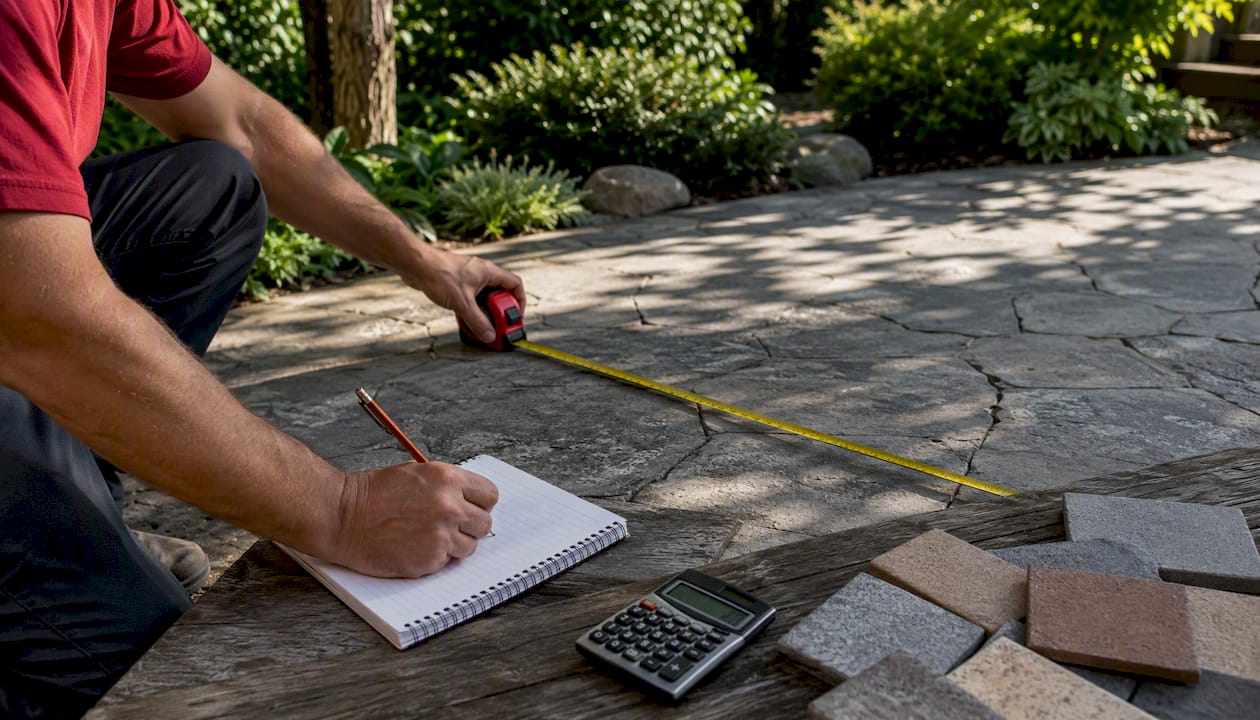
Size is the fastest way to ballpark a project total. The table below uses mid-range concrete pavers as the baseline, which is the most common choice for residential patios.
| Patio Size | Square Footage | Low Estimate | Mid Estimate | High Estimate |
|---|---|---|---|---|
| 12x12 | 144 sq ft | $1,700 | $2,800 | $4,000 |
| 200 sq ft | 200 sq ft | $2,400 | $3,800 | $5,000 |
| 20x20 | 400 sq ft | $6,400 | $9,600 | $11,200 |
| 500 sq ft | 500 sq ft | $8,000 | $12,000 | $16,000 |
| 800+ sq ft | 800 sq ft | $12,800 | $16,000 | $25,000+ |
Smaller patios carry a higher cost per square foot because contractors still mobilize equipment, deliver materials, and set up crew for a full day regardless of how small the footprint is. A 100 sq ft patio might cost $1,200–$2,000 installed while a 500 sq ft job on the same property could drop to $6,000–$10,000, simply because fixed costs spread across more area.
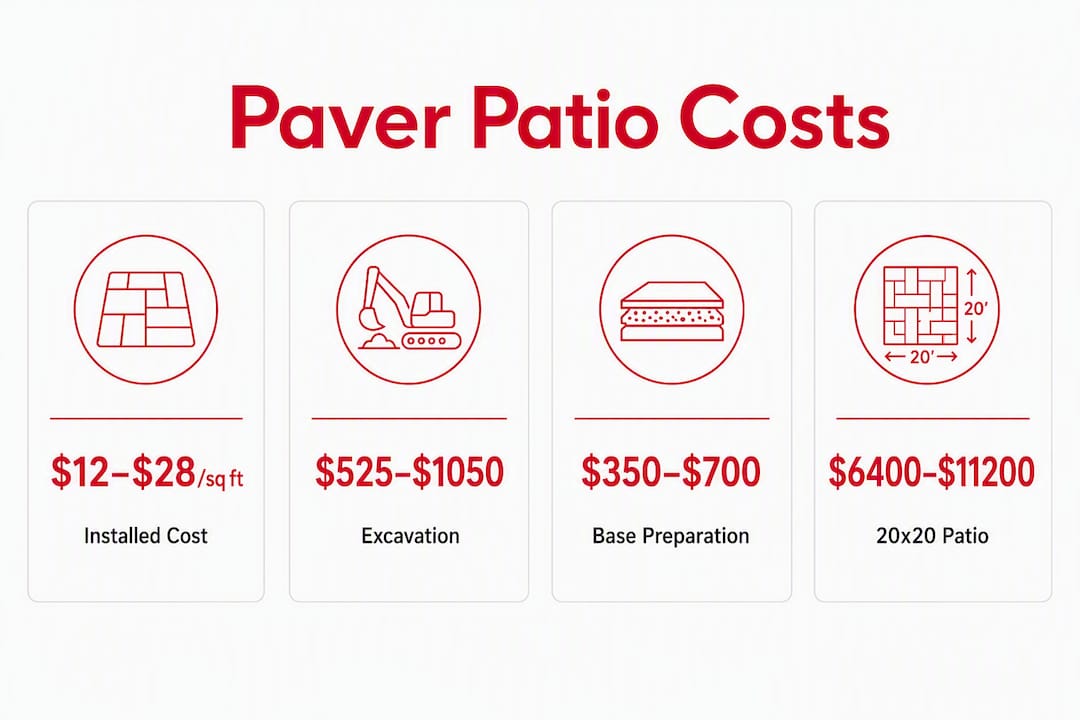
Pro Tip: Add 10–15% to your material budget for edge cuts, pattern waste, and any broken pavers. If you're removing an existing concrete slab, budget an additional $1–$3/sq ft for demolition and disposal before the new install even begins.
What does each project type actually cost?
Not every patio is the same scope. Here's how the three most common project types shake out in practice:
-
Basic seating patio ($12–$18/sq ft installed): A single-level rectangular or square patio with a running-bond or grid pattern, standard concrete pavers, and no add-ons. This is the most common first patio for homeowners. Expect clean, functional, and durable, with nothing fancy.
-
Mid-range outdoor living ($18–$28/sq ft installed): Multiple zones, a fire pit or fire ring, a step or two, and possibly a small retaining wall on a sloped site. A fire pit adds roughly $800–$3,000 depending on whether it's a simple ring or a built-in gas feature. Retaining walls on sloped sites can add $3,000–$10,000 or more depending on height and length.
-
High-end outdoor living ($28–$50+/sq ft installed): Integrated outdoor kitchen rough-in, built-in seating walls, large-format porcelain or natural stone, landscape lighting, and engineered drainage. An outdoor kitchen rough-in alone typically adds $5,000–$15,000 to the base patio cost. At this level, you're not just buying a patio; you're building an outdoor room. See A-to-zconstruction's hardscape services for the full scope of what integrated outdoor living can include.
How paver material choice changes your installed price
Material selection is the second-biggest lever after size. Here's how the main categories compare on installed cost and practical performance:
| Material | Installed Cost ($/sq ft) | Durability | Freeze-Thaw Performance | Maintenance |
|---|---|---|---|---|
| Budget concrete pavers | $8–$18 | Good | Good (if quality) | Low |
| Standard concrete pavers | $12–$20 | Very good | Very good | Low |
| Brick pavers | $14–$25 | Excellent | Excellent | Low–Medium |
| Porcelain pavers | $18–$30 | Excellent | Good (if rated) | Very low |
| Natural stone (flagstone, travertine) | $20–$50 | Excellent | Variable | Medium |
A few material-specific notes worth knowing:
- Concrete pavers are the workhorse choice. They're consistent in thickness, easy to cut, and widely available. Color fades over time but sealers slow that down.
- Brick pavers hold color better than concrete and perform exceptionally in freeze-thaw cycles, which matters in Utah winters. They're slightly more expensive but rarely need replacement.
- Porcelain pavers look sharp and resist staining, but large-format pieces require a more precise base and specialized cutting equipment, which adds labor cost.
- Natural stone (travertine, bluestone, flagstone) is the premium tier. Irregular shapes mean more cutting and fitting time. Imported stone also carries shipping costs that can push material prices well above the base range.
Pattern complexity adds another layer. Herringbone or diagonal layouts increase cutting and fitting time, commonly adding extra material waste and $1–$3/sq ft in labor compared to a simple running-bond pattern.
For a direct comparison between pavers and poured concrete on cost and long-term value, this pavers vs. concrete guide from an industry partner breaks down the lifecycle math clearly.
What actually drives the biggest cost differences between bids?
Site conditions are where estimates diverge most. Two contractors quoting the same 400 sq ft patio on different lots can be $4,000 apart, and the difference usually isn't the pavers.
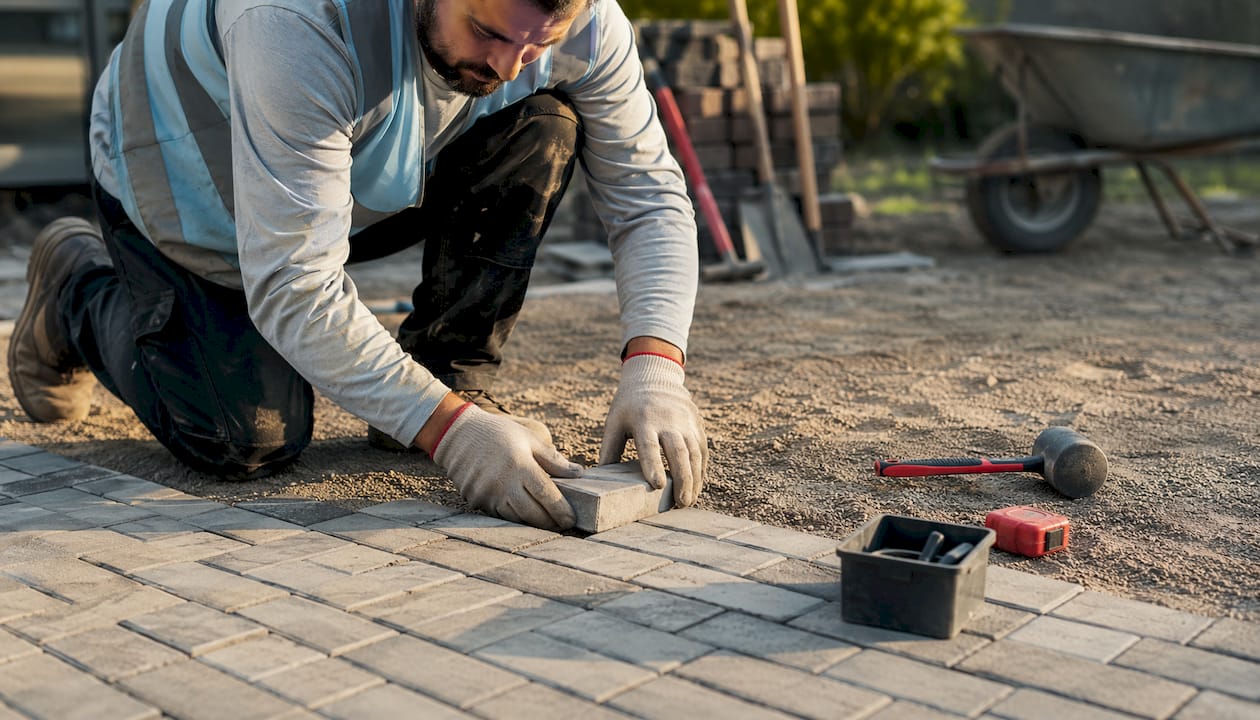
- Excavation depth and base thickness: Standard residential patios need a 4–6 inch compacted gravel base; heavier-use areas or poor-draining soils require 6–8 inches. More depth means more excavation, more gravel, and more compaction passes. This is the single biggest quality variable between a patio that lasts 25 years and one that settles in five.
- Demolition and disposal: Removing an existing concrete patio or deck adds $1–$3/sq ft before the new work starts. Disposal fees vary by region.
- Slopes and drainage: A sloped yard may require a retaining wall, engineered drainage, or both. Poor drainage design is the leading cause of paver failure, so don't let a contractor skip this conversation.
- Access restrictions: A backyard accessible only through a narrow gate forces wheelbarrow work instead of machine work. That adds labor hours fast.
- Tree roots: Root removal or rerouting can add hundreds to thousands depending on tree size and proximity.
- Utility conflicts: Underground irrigation lines, gas, or electrical that cross the patio footprint require marking, rerouting, or protection, all of which add cost.
- Permits: Most municipalities require a permit for patios above a certain size or when drainage is altered. Budget $100–$500 depending on your jurisdiction.
Pro Tip: Before you get bids, walk your yard and note any slopes, drainage issues, large trees near the patio area, and access points. Sharing this information upfront gets you more accurate quotes and avoids change orders mid-project. A-to-zconstruction's article on site prep mistakes shows exactly what gets missed when this step is skipped.
Where does the money actually go? A line-item breakdown
Understanding the cost breakdown helps you read contractor bids intelligently. Here's how a typical mid-range paver patio installation breaks down by line item:
| Line Item | Typical Unit Cost | Notes |
|---|---|---|
| Excavation | $1.50–$3.00/sq ft | Depth, soil type, and access affect this most |
| Gravel base (compacted) | $1.50–$3.00/sq ft | 4–6 inches standard; more for poor soils |
| Bedding sand | $0.50–$1.00/sq ft | Screeded level before paver placement |
| Paver material | $3–$15/sq ft | Varies widely by material tier |
| Paver laying (labor) | $5–$10/sq ft | Pattern complexity raises this |
| Edge restraint | $5–$15/linear ft | Plastic or aluminum; holds the field in place |
| Polymeric joint sand | $0.50–$1.00/sq ft | Locks joints and resists weeds |
| Compaction (plate compactor) | Included in labor | Final pass after laying |
| Optional sealing | $0.50–$1.50/sq ft | Extends color and reduces staining |
For a mid-range 350 sq ft project with standard concrete pavers, a realistic breakdown might look like: $525–$1,050 for excavation, $525–$1,050 for base gravel, $1,750–$3,500 for paver laying labor, $1,050–$5,250 for paver material, and $175–$700 for jointing and edge restraint. Total: roughly $4,000–$11,500 depending on material tier and site complexity.
Labor and base prep together represent the majority of what you're paying for on any well-built job. A bid that looks cheap almost always gets there by thinning the base or skipping the edge restraint. Both choices lead to the same outcome: shifting, settling, and weeds within a few years.
Should you DIY or hire a professional?
For a small, flat, simple patio, DIY is genuinely doable. For anything else, the math usually favors hiring a pro.
DIY makes sense when:
- The patio is under 150 sq ft and the ground is flat and well-draining.
- You can rent a plate compactor and have a full weekend (or two) available.
- You're comfortable with physical labor and precise leveling work.
DIY materials cost for a 12x12 patio with concrete pavers runs roughly $700–$1,200 for materials alone, compared to $1,700–$4,000 installed by a professional. That gap looks attractive until you factor in equipment rental ($150–$300/day for a plate compactor and possibly a mini-excavator), delivery fees, and the time investment.
The most common DIY mistakes:
- Skimping on base depth to save on gravel and excavation
- Using regular sand instead of polymeric joint sand (weeds move in fast)
- Poor compaction, which leads to settling and uneven surfaces within one or two freeze-thaw cycles
- Skipping edge restraint, which lets the field pavers migrate outward over time
A patio that settles unevenly is a tripping hazard and an expensive fix. Lifting, re-grading, and resetting pavers costs nearly as much as a fresh install. If you're in Utah and dealing with clay soils or a site with any slope at all, professional installation is the lower-risk path by a wide margin.
How long does a paver patio installation take?
Here's the typical on-site sequence and timeline:
- Site layout and marking (half day): Stake the perimeter, mark utilities, confirm drainage direction.
- Excavation (1–2 days for most residential jobs): Remove soil to the required depth; haul off excess.
- Base installation (1 day): Spread and compact gravel in lifts; check for level and drainage slope.
- Bedding sand and screeding (half day to 1 day): Lay and screed the sand layer to a precise plane.
- Paver laying (1–3 days depending on size and pattern): Set pavers by hand; cut edges as needed.
- Compaction and jointing (half day): Run plate compactor over the field; sweep in polymeric sand; compact again.
- Cleanup and optional sealing (half day to 1 day): Remove debris, apply sealer if specified, final inspection.
A small patio (under 200 sq ft) typically takes 2–4 days on site with a two-person crew. A 400 sq ft mid-range project runs 4–7 days. Large or complex jobs with retaining walls, outdoor kitchens, or extensive drainage can stretch to two or three weeks.
Weather matters. Rain delays compaction and jointing; freezing temperatures prevent proper base setting. Permit approval can add 1–3 weeks to the schedule before a shovel touches the ground.
How to get an accurate contractor estimate
Getting three comparable bids requires asking the same questions of every contractor. Here's the checklist:
Questions to ask every contractor:
- What is the base depth and compaction specification you'll use for this soil type?
- What jointing material do you use, and is polymeric sand included?
- What type of edge restraint, and is it included in the bid?
- What is your warranty on labor and base performance?
- Do you carry general liability insurance and a contractor's license? (Ask for both in writing.)
- What does the bid include for demolition and disposal of existing material?
- What is your mobilization fee, and is it itemized separately?
- What is the payment schedule, and what triggers each payment?
Red flags in bids:
- Vague base spec ("we'll put down some gravel") with no depth or compaction standard stated
- No edge restraint mentioned or listed
- A large deposit (over 30–40%) required before work begins
- No license or insurance documentation offered
- A total price with no line-item breakdown
What a solid bid should show: excavation unit price, base material and depth, bedding sand, paver material with unit cost, laying labor, edge restraint, jointing material, disposal, and a clear payment schedule tied to project milestones. Online tools like HomeCostCalc's paver estimator let you model line-item outputs before you meet with contractors, which makes it much easier to spot a bid that's missing something. For regional pricing context, this paver patio cost guide from an industry partner shows how line items compare in another U.S. market.
Why hire a licensed general contractor for your paver patio?
A licensed general contractor brings more than just labor. They carry liability insurance that protects you if something goes wrong, they pull permits where required, and they coordinate every phase without you managing multiple subcontractors.
A-to-zconstruction is a licensed general contractor based in Cedar City, Utah, with over 500 completed projects across residential and commercial hardscape. Their in-house crews handle every phase of a paver patio project, including:
- Site assessment and drainage planning before a bid is written
- Excavation and earthwork with proper depth specs for Utah's soil and climate conditions
- Base installation and compaction to the standard the project requires, not the minimum that saves time
- Paver laying, edge restraint, and polymeric jointing as standard, not optional add-ons
- Integrated project management from estimate to cleanup, with one point of contact throughout
Because A-to-zconstruction handles masonry, earthwork, and hardscape under one roof, projects that include retaining walls, outdoor kitchens, or fire pits don't require coordinating separate subcontractors. That cuts scheduling delays and eliminates the finger-pointing that happens when one trade's work affects another's. You can view their paver patio and walkway services or request a free estimate directly.
How much does paver patio cost vary by U.S. region?
Where you live can shift your installed price by 20–30% in either direction from the national average. Regional variation follows labor market costs, material availability, and local permitting requirements.
Northeast (New York, Massachusetts, Connecticut): $16–$35/sq ft installed. High labor costs and stricter permitting push prices well above the national midpoint.
Southeast (Georgia, Tennessee, the Carolinas): $10–$24/sq ft. Lower labor rates and milder freeze-thaw conditions (which reduce base depth requirements) keep costs down.
West Coast (California, Oregon, Washington): $18–$38/sq ft. Material costs are competitive, but labor rates in metro areas drive totals higher.
Mountain West (Utah, Colorado, Nevada): Prices generally track the national midpoint at $12–$25/sq ft, though remote areas add delivery costs for materials. Utah's clay-heavy soils in some regions require deeper base prep, which can push individual projects above the regional average.
Beyond geography, local factors like contractor density, seasonal demand, and material supply chain conditions all shift prices. Getting bids in late fall or winter often produces better pricing than peak spring and summer season, when crews are booked out weeks in advance.
What does paver patio maintenance actually cost?
Pavers are low-maintenance compared to wood decking, but they're not zero-maintenance. Here's what to budget annually and over the long term:
Annual maintenance (typical):
- Weed control in joints: minimal if polymeric sand was installed correctly; $0–$100 DIY or $150–$300 for a professional application
- Cleaning: a pressure wash once or twice a year keeps pavers looking sharp; $100–$300 professionally, or a few hours with a rented unit
- Spot repairs: individual pavers can be lifted and reset if they shift or crack, typically $50–$200 per repair area
Periodic maintenance (every 3–5 years):
- Re-sanding joints: $0.50–$1.00/sq ft professionally applied
- Sealing: $0.50–$1.50/sq ft; extends color and reduces staining, especially for lighter-colored concrete pavers
The real long-term advantage of pavers over poured concrete is repairability. A cracked concrete slab requires grinding, patching, or full replacement. A settled or cracked paver section can be lifted, the base re-graded, and the pavers reset, often for a fraction of the cost of concrete repair. A-to-zconstruction's spring hardscape maintenance guide covers the annual checklist in detail.
Over a 20–25 year lifespan, a well-built paver patio typically costs less to maintain than a poured concrete slab of the same size, particularly in climates with significant freeze-thaw cycling.
Key Takeaways
A professionally installed paver patio costs $12–$28 per square foot nationally, with labor and base prep making up the majority of that total, which means the quality of the base determines both the price and the longevity of the project.
| Point | Details |
|---|---|
| Installed cost range | $12–$28/sq ft nationally; a 20x20 patio (400 sq ft) with concrete pavers typically totals $6,400–$11,200 installed. |
| Labor dominates the budget | Labor and base prep account for roughly 60–70% of installed cost; this is where cheap bids cut corners. |
| Size affects $/sq ft | Small patios cost more per square foot due to fixed mobilization costs; larger jobs spread those costs out. |
| Get itemized bids | Ask every contractor for base depth spec, edge restraint type, jointing material, and a line-item breakdown. |
| A-to-zconstruction | Licensed Utah general contractor handling paver patios from excavation to sealing, with in-house crews and 500+ completed projects. |
The part most homeowners underestimate
The base is the patio. Everything visible, the pavers, the pattern, the color, sits on top of what the crew does underground. A patio with a shallow or poorly compacted base will shift, settle, and grow weeds within a few years regardless of how beautiful the surface looks on day one.
The most common failure pattern is a contractor who wins the bid by quoting a thin base and skipping edge restraint. The homeowner sees a lower number and signs. Two winters later, the corner pavers have migrated, a low spot holds water, and the whole section needs to be lifted and reset. That repair costs nearly as much as the original install.
Spend the money on base depth. Ask every contractor for their compaction specification in writing. If they can't give you one, that tells you everything you need to know about how they build.
A-to-zconstruction handles paver patios from excavation to final sealing
If you're in Utah and ready to move from budget research to an actual project, A-to-zconstruction builds paver patios across Cedar City, Salt Lake County, Cache County, and surrounding areas. Their in-house crews handle hardscape installation from initial site assessment through excavation, base prep, paver laying, and optional sealing, with no subcontractor handoffs and one point of contact throughout.
Because A-to-zconstruction also handles masonry, earthwork, and landscaping in-house, projects that include retaining walls, fire pits, or outdoor kitchens stay on a single schedule instead of waiting on multiple crews. Over 500 completed projects across Utah means the team has seen the soil conditions, drainage challenges, and site access issues that drive up costs, and they know how to price them accurately upfront. Request a free estimate and get a line-item bid you can actually compare.
Useful sources and cost calculators
Use these tools to model your own project before meeting with contractors:
- UseCalcPro Paver Patio Cost Guide (2026): Detailed per-sq-ft ranges by material tier, sample project totals, and labor breakdown.
- RemodeICalculators Patio Cost Comparison: Side-by-side cost comparison of pavers, concrete, flagstone, and gravel for a baseline patio size.
- HomeCostCalc Paver Patio Estimator: Free online calculator that models line-item outputs by paver tier and pattern complexity.
- ProjectCostPro Paver Calculator: Useful for understanding how pattern choice and size affect total cost.
- A-to-zconstruction Free Estimate: Request a local Utah estimate with a full line-item breakdown.
FAQ
How much does a 20x20 paver patio cost?
A 20x20 patio (400 sq ft) with mid-range concrete pavers typically costs $6,400–$11,200 installed, depending on material tier, site conditions, and regional labor rates.
Is a paver patio cheaper than concrete?
Pavers cost more upfront than broom-finish concrete, which runs roughly $1,900–$4,200 for a 320 sq ft baseline versus $3,800–$8,300 for concrete pavers. Over time, pavers often cost less because individual units can be lifted and reset rather than replacing whole slabs.
How much does a 12x12 paver patio cost?
A 12x12 patio (144 sq ft) with concrete pavers runs $1,700–$4,000 installed; natural stone for the same footprint typically costs $2,900–$7,200.
What is the paver patio cost per square foot for natural stone?
Natural stone pavers (flagstone, travertine, bluestone) run $20–$50 per square foot installed, with imported or large-format stone pushing toward the top of that range due to cutting labor and shipping costs.
Can A-to-zconstruction install a paver patio in Utah?
Yes. A-to-zconstruction is a licensed general contractor serving Cedar City, Salt Lake County, Cache County, and surrounding Utah areas, handling paver patio projects from excavation through final sealing with in-house crews.