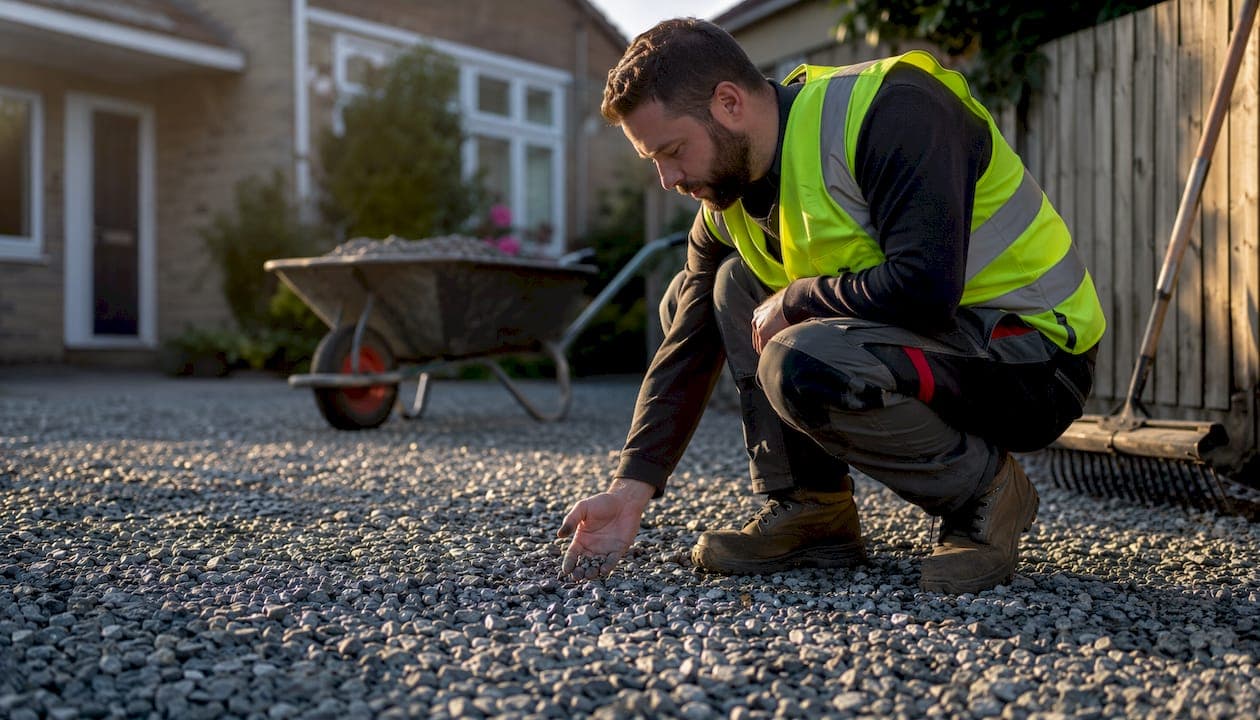
Angular gravel is mechanically crushed rock with sharp, irregular edges that interlock under compaction. The bottom line: choose angular crushed stone for any load-bearing surface (driveways, paver bases, structural fill, road base) and specify washed/clean angular stone for drainage applications like French drains. For decorative beds where foot traffic is light, rounded gravel works fine. For anything structural, crushed stone is the correct call. Common specs you'll encounter at the supplier yard: #57 (the workhorse), #3 (coarser), and crushed run (the compactable base blend). ASTM standards govern gradation for most of these, and A-to-zconstruction uses them as the baseline for every earthwork and hardscape project.
Table of Contents
- What angular gravel is and how it differs from rounded stone
- Common sizes and specs: what #57, #3, crushed run, and "clean" mean
- Where to use angular gravel: applications, sizes, and depths
- How angular gravel behaves under compaction and how to install it correctly
- Does gravel harden like concrete? Compaction vs. binding explained
- How to choose the right angular gravel for your project
- Contractor perspective: common mistakes and pro-level specs
- Key Takeaways
- The case for getting the spec right the first time
- A-to-zconstruction handles the full job, from base prep to final grade
- Useful sources
- FAQ
What angular gravel is and how it differs from rounded stone
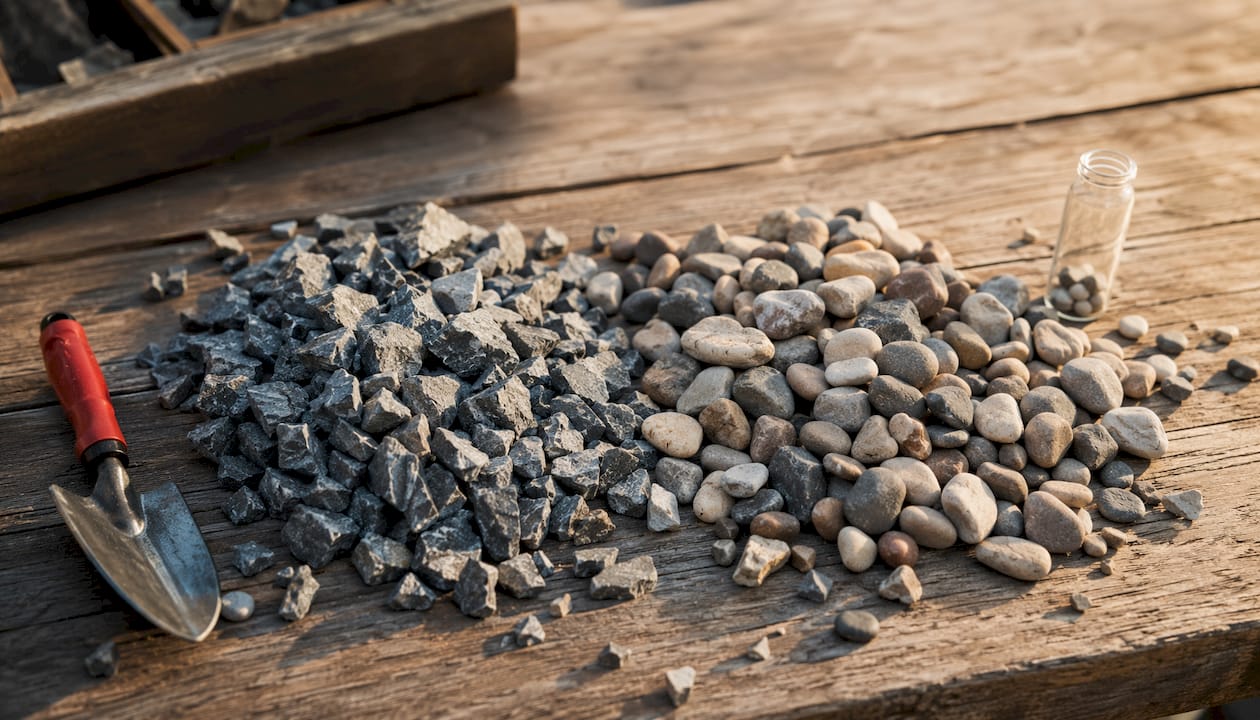
Quarried rock goes through a jaw crusher or cone crusher, then a series of screens that sort particles by size. The result is angular stone aggregate: particles with flat faces, sharp corners, and a rough surface texture. That roughness is the whole point. When you load a layer of angular stone and compact it, the particles wedge against each other and lock. Rounded river-run gravel, by contrast, behaves more like ball bearings under load. It shifts, migrates to the edges, and ruts.
The shape difference between angular and rounded particles is the primary factor determining whether a material locks together under traffic or migrates. That single physical trait explains why contractors reach for crushed stone on driveways and why decorative river rock stays in garden beds.
Physical properties of angular crushed stone:
- Sharp, irregular edges with no water-worn smoothing
- Flat or conchoidal fracture faces that create surface-to-surface contact
- Consistent gradation (controlled by crusher screen size)
- Higher friction angle than rounded equivalents, which increases shear strength
- Available in a wide range of sizes from crusher fines up to 3" cobble
Pro Tip: Think of angular stone as a self-locking puzzle. Rounded gravel is marbles in a box. One stays put; the other rolls.
A typical pavement assembly runs: native subgrade → geotextile fabric → compacted angular base (crushed run) → wearing course (#57 or similar). Each layer has a job, and the angular base layer is where structural performance is built.
Common sizes and specs: what #57, #3, crushed run, and "clean" mean
Ordering the wrong spec is one of the most expensive mistakes a homeowner can make. Suppliers use standardized size designations, and the difference between "crushed run" and "#57 washed" is not cosmetic.
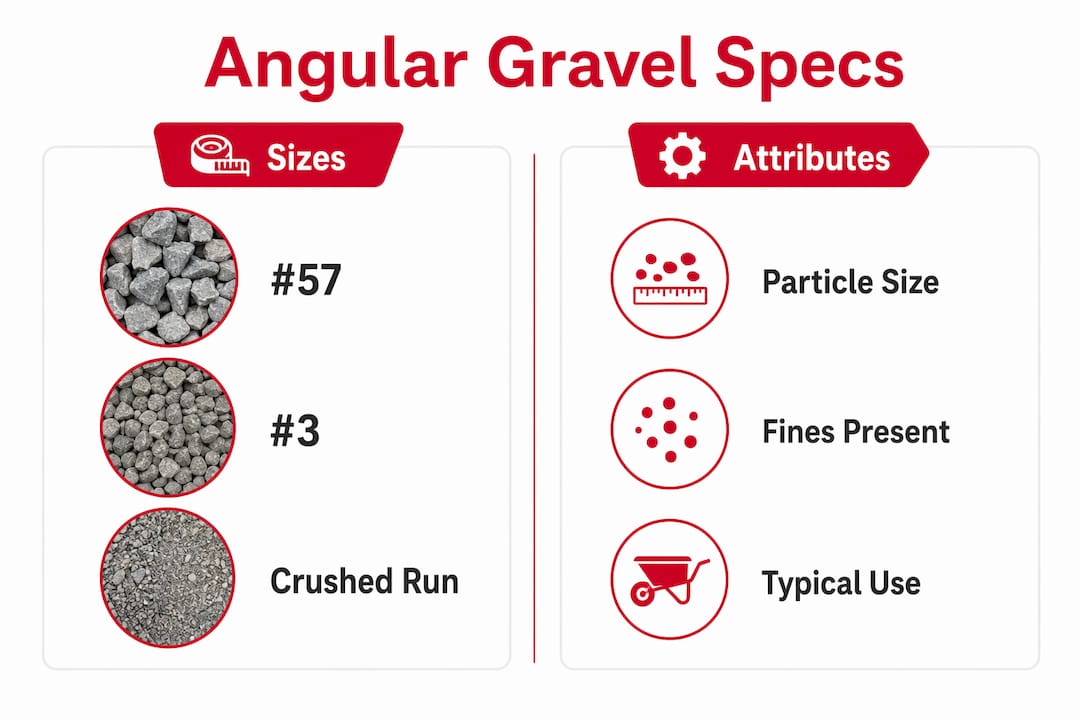
| Spec Name | Particle Size Range | Fines Present | Typical Use |
|---|---|---|---|
| #57 Gravel | 3/4" down to 1/4" | No (washed) | Driveways (wearing course), French drains, under slabs |
| #3 Gravel | 1" to 2" | No (washed) | Drainage backfill, pipe bedding, large French drains |
| Crushed Run (Minus) | Mixed, up to 3/4" | Yes | Driveway sub-base, road base, compactable fill |
| Pea Gravel | 1/4" to 3/8" | No | Decorative beds, playgrounds, loose pathways |
| Crusher Fines | Dust to 3/8" | Yes (mostly fines) | Compacted paths, leveling base |
Clean (washed) angular stone maximizes void space so water moves through freely. Crushed run includes fines, which fill those voids and allow the material to compact into a dense, semi-rigid layer. Neither is universally better. They do different jobs.
Key distinctions to know before you call a supplier:
- "Washed" or "clean" means fines have been screened and rinsed out
- "Minus" (as in "3/4 minus") means the material includes everything from that top size down to dust
- "Open-graded" is another term for clean/washed stone with good drainage void space
- ASTM C33 and ASTM D448 govern standard gradations for construction aggregates
Pro Tip: Always specify by ASTM designation or the supplier's exact product name. "Just some gravel" will get you whatever they have too much of.
Where to use angular gravel: applications, sizes, and depths
Crushed rock wins for load-bearing and compaction; rounded gravel wins for decorative and loose-fill uses. Here is how that plays out across common projects:
Primary applications:
- Driveways: Sub-base of crushed run, wearing course of #57 washed
- Paver bases: Crushed run compacted to a firm, level surface before sand setting bed
- Under concrete slabs: #57 or crushed run for drainage and frost protection
- Road base: Dense-graded crushed run, often 6" or more
- French drains: #57 or #3 clean washed stone around perforated pipe
- Retaining wall backfill: Clean #57 or #3 behind the wall for drainage relief
- Landscape beds: Decorative crushed stone (granite, limestone) in 2–3" layer
| Application | Recommended Spec | Layer Depth | Fines Required? |
|---|---|---|---|
| Driveway sub-base | Crushed run (3/4 minus) | 6–12" | Yes |
| Driveway wearing course | #57 washed | 2–3" | No |
| Paver base | Crushed run | 4–6" | Yes |
| French drain | #57 or #3 washed | Fill to pipe top | No |
| Foundation backfill | #57 or #3 washed | Per engineer spec | No |
| Under concrete slab | #57 washed | 4" | No |
One safety note worth stating plainly: angular stone is uncomfortable underfoot and can cut bare skin. For barefoot paths, pool surrounds, or pet runs, either use a rounded top layer (pea gravel) or install a paver surface over the compacted angular base. The base stays angular; the walking surface does not have to.
How angular gravel behaves under compaction and how to install it correctly
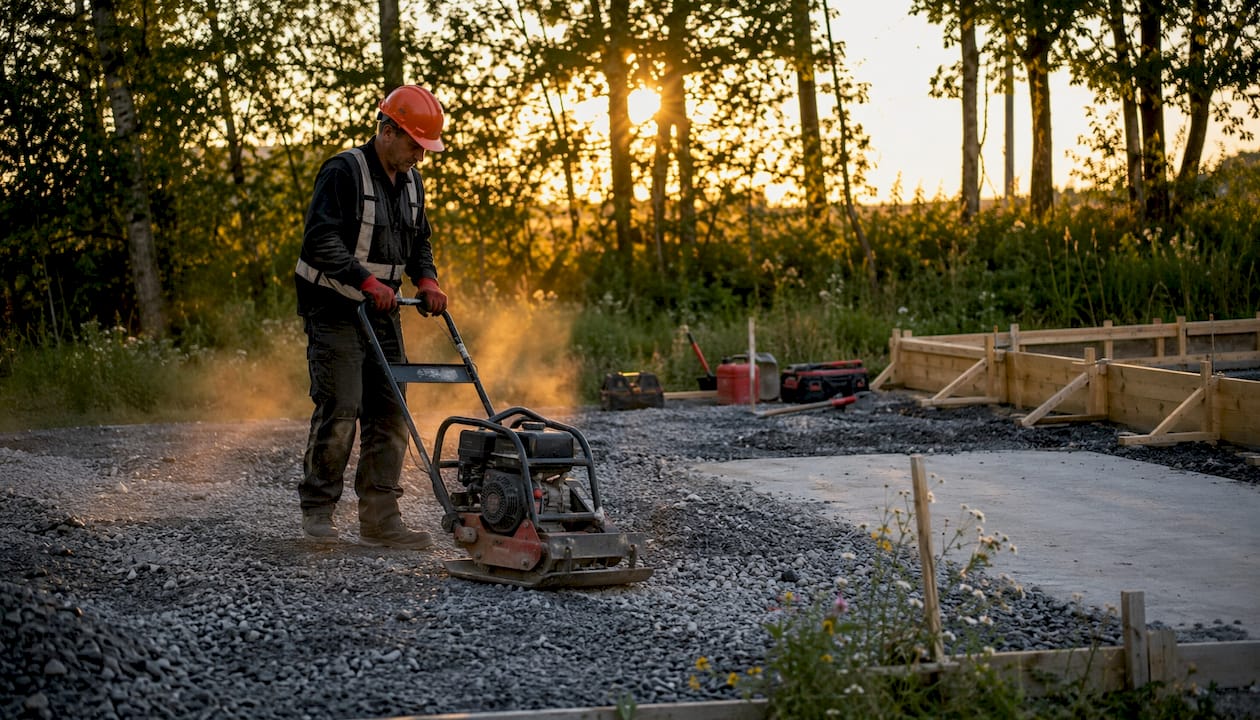
Angularity directly increases shear strength. When a plate compactor or vibratory roller passes over angular stone, the particles rotate into each other and lock. Rounded gravel compacts too, but the interlock is weaker and the surface can shear under lateral load. That is why a crushed-run driveway holds up to a loaded pickup truck while a pea gravel driveway ruts within a season.
Step-by-step installation sequence:
- Excavate to depth. Remove topsoil and soft material. Proof-roll the subgrade with a loaded truck or roller to identify soft spots before you add any stone.
- Install geotextile fabric. Lay non-woven geotextile over the subgrade when there is any risk of base material mixing with soft native soil. Skip it on solid, well-drained subgrades.
- Place base lifts. Spread crushed run in 2–4" lifts for a plate compactor, or up to 6–8" lifts for a vibratory drum roller. Never dump the full depth and compact once.
- Compact each lift. Target 95% of modified Proctor density. Make at least two passes in each direction. Check for deflection by walking the surface; it should feel firm with no bounce.
- Add wearing course. Spread #57 washed stone at 2–3" depth and compact lightly. This layer sheds water and resists clogging.
- Install edge restraint. Plastic or steel edging prevents lateral spread, especially on driveways without a concrete curb.
Pro Tip: The single most common installation failure is over-thick lifts. A 6" dump compacted once looks fine for a week, then ruts when the first heavy vehicle crosses it. Thin lifts, multiple passes.
For a plate compactor, 2–4" lifts are the practical limit. A vibratory roller can handle thicker lifts but is overkill for most residential jobs. Rent a plate compactor for driveways and paver bases; it is the right tool for the depth.
Does gravel harden like concrete? Compaction vs. binding explained
No gravel hardens chemically. Crushed run with fines compacts into a dense, semi-rigid layer that can feel almost solid, but it is mechanical interlock, not chemistry. Remove the load or introduce water, and the material can shift again. True hardening requires a binder: cement (concrete) or asphalt.
Clean washed angular stone vs. crushed run:
- Clean #57: High void space, excellent drainage, poor compaction (particles roll rather than lock with fines)
- Crushed run: Low void space, poor drainage, excellent compaction (fines fill gaps and create a dense matrix)
- Neither: Chemically bonds or hardens permanently without a binder
When you need a permanent, load-distributing surface, the answer is concrete or asphalt over a compacted angular base. The concrete driveway installation process always starts with a properly compacted angular base, typically 4–6" of crushed run, before the slab goes down.
Does gravel harden like concrete? No. Crushed-run gravel compacts into a firm, dense layer through mechanical interlock, but it does not chemically bond. For a permanent, rigid surface, a binder (cement or asphalt) is required.
How to choose the right angular gravel for your project
The decision comes down to four factors: load, drainage, appearance, and budget.
Decision checklist:
- Load-bearing surface? Use crushed run for the base, #57 washed for the top.
- Drainage priority? Use clean #57 or #3 washed. No fines.
- Walking surface? Consider a rounded or paver top layer over the angular base.
- Decorative only? Crushed granite or limestone in a 2–3" layer works well and holds on slopes better than rounded stone.
- Budget tight? Crushed run is typically the least expensive option per ton because it requires no washing step.
Ordering checklist for the supplier yard:
- Specify the exact product name: "#57 washed crushed limestone" or "3/4 minus crushed run"
- State washed vs. unwashed explicitly
- Order in tons (more accurate for weight-sensitive applications) or cubic yards (easier for volume estimates)
- Confirm delivery access: minimum truck clearance, gate width, turning radius
- Ask about recycled aggregate options if sustainability matters
On cost: utility-grade crushed stone typically runs $25–$50 per ton, while decorative crushed gravels run $50–$90 per ton. Delivery distance from the quarry is often the biggest cost variable. A quarry 5 miles away versus 50 miles away can double the delivered price per ton. Buying in bulk (10+ tons) usually brings per-ton cost down meaningfully.
On sustainability: recycled crushed concrete is a legitimate substitute for virgin crushed stone in base applications. It meets compaction requirements, costs less, and diverts material from landfills. Ask your supplier if recycled aggregate is available and specify the gradation you need.
Contractor perspective: common mistakes and pro-level specs
The most frequent homeowner mistake is choosing rounded gravel for a driveway because it looks cleaner or costs slightly less. Within a year, that surface ruts, migrates to the edges, and requires constant raking. The shape difference between crushed and rounded stone is not aesthetic; it is structural. Rounded stone simply cannot lock under traffic the way angular stone can.
The second most common mistake is insufficient depth. A 2" base will not support a vehicle. A residential driveway needs a minimum of 6" of compacted crushed run sub-base, and 8–12" is better in areas with freeze-thaw cycles or heavy truck traffic. Check your foundation and drainage work specs before ordering material.
Pro-level specs contractors use:
- Sub-base compaction: 95% modified Proctor density (verified with nuclear gauge or dynamic cone penetrometer)
- Lift thickness: 2–4" per pass for plate compactor; 4–6" for vibratory roller
- Edge restraint: required on all unconfined edges to prevent lateral spread
- Geotextile: non-woven, 4 oz minimum for residential base separation
Pro Tip: When calling a supplier, say "I need #57 washed crushed limestone for a driveway wearing course." That one sentence tells them the size, the washing spec, the rock type, and the application. Vague orders get substituted.
Specifying by material type, not by color or appearance, is how contractors avoid getting the wrong product. A supplier who hears "gray gravel" will send whatever gray stone they have. One who hears "3/4 minus crushed run, unwashed" knows exactly what to load.
Key Takeaways
Angular crushed stone is the correct base material for any load-bearing surface because its sharp edges interlock under compaction, delivering structural stability that rounded gravel cannot match.
| Point | Details |
|---|---|
| Angular vs. rounded | Angular stone interlocks under load; rounded gravel shifts and ruts — shape drives structural performance. |
| Spec selection | Use crushed run (with fines) for compactable bases; use #57 or #3 washed (no fines) for drainage applications. |
| Installation depth | Residential driveways need 6–12" of compacted crushed run sub-base plus 2–3" of #57 wearing course. |
| Cost range | Utility crushed stone runs $25–$50 per ton; decorative crushed gravel runs $50–$90 per ton before delivery. |
| A-to-zconstruction | Manages site prep through final compaction on driveways, paver bases, and drainage projects across Utah. |
The case for getting the spec right the first time
Most homeowners think about gravel as a commodity. Pick something that looks decent, spread it, done. The problem shows up 18 months later when the driveway has ruts, the French drain is clogged with fines, or the paver base has shifted enough to crack the surface.
The spec is not a bureaucratic detail. It is the difference between a surface that lasts a decade and one that needs repair in two years. Crushed run costs a few dollars more per ton than pea gravel. Washed #57 costs more than unwashed. Those differences are real, but they are small compared to the cost of pulling up a failed driveway and starting over.
What I see consistently on jobsites: homeowners who saved money on the wrong material end up spending more to fix it than they would have spent doing it right. The material cost is a fraction of the labor cost. Get the spec right, and the labor investment holds up. Cut corners on the aggregate, and you are paying for the labor twice.
Before requesting an estimate, know your square footage, your intended use (vehicle traffic, foot traffic, drainage), and whether you want a gravel surface or a gravel base under concrete or pavers. That information lets a contractor give you an accurate number on the first call.
A-to-zconstruction handles the full job, from base prep to final grade
If you're planning a driveway, paver patio, retaining wall, or drainage project in Utah, the material selection is only part of the equation. Site prep, excavation depth, compaction equipment, and sequencing all affect whether the finished surface holds up.

A-to-zconstruction manages earthwork and grading, base material selection, and compaction through final grade on a single contract. No subcontractor handoffs, no gaps between the excavation crew and the hardscape crew. The hardscape services cover paver patios, retaining walls, and driveways where a properly specified angular base is the foundation of everything above it.
To get an accurate estimate, have ready: site dimensions, intended use (vehicle load, foot traffic, drainage), preferred surface finish (gravel, pavers, or concrete), and any access constraints for delivery trucks. Request your estimate at a-to-zconstruction.com.
Useful sources
- Crushed Stone (Wikipedia) — Covers the geology, production process, and structural uses of crushed stone; good background on why angular aggregates became the standard for road and base construction.
- Angular vs. Rounded Gravel: Key Differences Explained (Western Materials) — Practical comparison of shape, interlock behavior, and application fit; useful for homeowners deciding between crushed and river-run stone.
- Crushed Stone vs. Gravel: What's the Difference? (The Stone Store) — Supplier-facing explanation of the structural difference; good reference for driveway and base material decisions.
- Crushed Stone and Gravel Guide (Cement Industrial) — Covers washed vs. unwashed specs, drainage vs. compaction trade-offs, and ordering guidance.
- Decorative Landscape Gravel (Landscaping Network) — Cost ranges and decorative application guidance for crushed and rounded stone options.
- Crushed Stone: The Unsung Mineral Hero (Geology.com) — Explains the geological distinction between crushed stone and gravel; clarifies why the two terms are often confused.
- Clean Angular Gravel #57 (Sensenig's Landscape Supply) — Product-level description of #57 washed angular stone, its gradation, and typical applications.
- Hardscape Contractor Utah (A-to-zconstruction) — A-to-zconstruction's hardscape service overview for readers planning paver, patio, or driveway projects requiring angular base preparation.
- Earthwork Services (A-to-zconstruction) — Overview of site prep, grading, and compaction services for residential and commercial projects in Utah.
FAQ
What is angular gravel?
Angular gravel is mechanically crushed rock with sharp, irregular edges that interlock under compaction. It differs from rounded (river-run) gravel, which is naturally smoothed by water and tends to shift under load.
What is the cheapest type of gravel?
Crushed run (also called 3/4 minus) is typically the least expensive option because it requires no washing step. Pea gravel is generally considered an affordable decorative option, but it is not suitable for structural base applications.
What are the three main types of gravel used in construction?
The three most common are crushed run (compactable base material with fines), #57 washed crushed stone (drainage and wearing course), and #3 washed stone (coarser drainage and backfill). Each serves a distinct structural or drainage role.
What type of gravel hardens like concrete?
No gravel hardens chemically on its own. Crushed run compacts into a dense, semi-rigid layer through mechanical interlock, but it will shift if the load or moisture conditions change. True hardening requires a binder: cement (concrete) or asphalt.
Can A-to-zconstruction handle both the base prep and the finished surface?
Yes. A-to-zconstruction manages the full sequence from excavation and base compaction through the finished hardscape surface, including driveways, paver patios, and retaining walls across Utah.