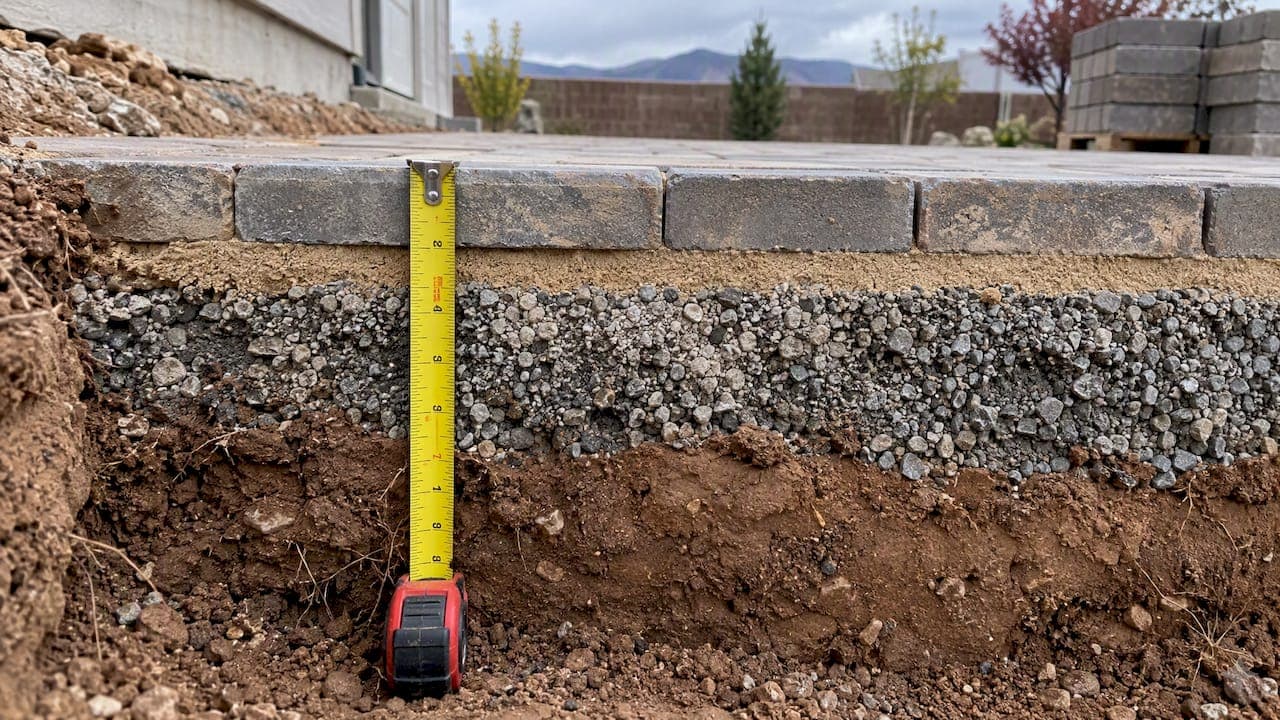
For a patio or walkway in good soil, plan on a compacted aggregate base of at least 4 inches, and 6 inches is the safer choice for most yards. Residential driveways need at least 6 inches, and weak soil, poor drainage or freezing winters call for more. The base, not the pavers, decides whether a surface stays flat for decades or sinks, rocks and heaves within a few seasons. Below you will find depths by project type, the conditions that add inches, a worked 12x12 example, and a straight answer on whether to seal pavers once they are down.
TL;DR
- Minimum compacted base: 4 inches for patios and walkways, 6 inches for residential driveways, 8 inches for parking lots and streets, all under ideal conditions.
- Weak soil, poor drainage or freezing temperatures mean a thicker base. The Concrete Masonry & Hardscapes Association (CMHA) suggests roughly 50% more for each poor condition.
- Compact in thin lifts of 2 to 4 inches, use dense-graded crushed stone, and finish with about 1 inch of bedding sand.
- Sealing is optional. It helps with stains and color but adds no structural strength.
Table of Contents
- Paver base depth by project type
- When to go deeper than the minimum
- What the base should be made of
- How deep to dig: the full excavation depth
- Compaction and drainage matter as much as depth
- Should you seal pavers?
- Perspective: what we see on Utah job sites
- Get the base right with A to Z Construction
- FAQ
- Sources
Paver base depth by project type
The numbers below come from industry technical guidance, and they are minimums for good conditions, not targets. The CMHA's application guide lists minimum aggregate base thicknesses of 4 to 6 inches for walks, 6 to 8 inches for driveways and 8 to 12 inches for streets, and notes that thicker bases may be needed depending on site conditions, freezing temperatures and traffic. A 2025 CMHA article puts the ideal-condition minimums at 4 inches for walkways and patios, 6 inches for residential driveways and 8 inches for parking lots or residential streets.
Manufacturers often recommend more. Unilock's 2024 guide lists typical gravel base thicknesses of 6 to 8 inches for patios and walkways, 6 to 12 inches for pool decks and 10 to 14 inches for driveways.
| Project | Association minimum (ideal soil) | Manufacturer guidance (Unilock) |
|---|---|---|
| Walkway or patio | 4 inches | 6 to 8 inches |
| Pool deck | not listed | 6 to 12 inches |
| Residential driveway | 6 inches | 10 to 14 inches |
| Parking lot or street | 8 inches | not listed |
How do you pick a number inside those ranges? Let the soil and the load decide. A small walkway on well-drained sandy ground can sit near the minimum. A patio that will carry a hot tub, an outdoor kitchen or a heavy grill island, or any surface a truck will cross, belongs at the thick end.
A claim you will hear from some installers is that 2 inches of recycled base is enough. It is well under every minimum above, and nothing in the association or manufacturer guidance supports it for a patio, let alone a driveway.
When to go deeper than the minimum
The minimums assume strong, well-drained soil and no freezing. Real yards rarely cooperate. The CMHA says that when a site lacks ideal conditions, such as weak soil, poor drainage or freezing temperatures, the base should be increased, by roughly 50% for each non-optimal condition.
Here is what that looks like in practice for a patio starting at a 4-inch minimum:
- One poor condition (say, clay soil): about 6 inches.
- Two poor conditions (clay soil and a freeze-thaw climate): about 8 inches.
- Three (add a low spot that holds water): 10 inches or more, and at that point drainage work matters as much as depth.
These are rules of thumb, not engineering, and a driveway or retaining structure deserves a professional's eye.
Soil type
Polycor's installation guide recommends a minimum compacted base of 4 inches for pedestrian areas over well-drained soils, 6 to 8 inches over clayey or silty soil and 4 to 6 inches over sandy or gravelly soil. The same guide says soil particle size and distribution affect paving performance and suggests soil testing, such as ASTM D422, to guide base design on demanding projects. For a typical patio you can learn a lot more cheaply: dig a test hole, look at what comes out, and check whether water drains from it within a day after rain.

Traffic
Foot traffic is the easy case. Once a vehicle drives on the surface, the base has to spread the load into the soil below. That is why driveway guidance runs from 6 inches up to 14 inches depending on the source. If you plan to park a truck or an RV on pavers, treat the driveway numbers as your floor and ask the installer to document the base thickness in the bid. We cover the full process in our driveway base preparation guide and the layers in our three-layer driveway gravel system.
Freezing temperatures
Frost is the reason the CMHA flags freezing climates for extra thickness. Water in the soil expands when it freezes and can lift the surface unevenly. A thicker, free-draining base gives that water somewhere to go and keeps the bedding layer from saturating.
What the base should be made of
Use crushed stone with angular, sharp edges, not round river rock or soft recycled fill. Polycor recommends a dense-graded crushed-stone base, such as 3/4-inch, 0 to 20 mm or No. 78 stone, chosen to avoid too many fines, which hold water, and too few, which let bedding sand migrate down into the base. Oregon State University Extension adds that crushed rock such as 3/4-minus gravel, with varied stone sizes and sharp edges, compacts easily.
So yes, 3/4-inch crushed gravel works as a paver base when it is the dense-graded, angular kind. Where your city, county or state has its own aggregate standard, follow it. The CMHA recommends ASTM D2940 when no local, state or provincial standard exists.
How deep to dig: the full excavation depth
People often ask how deep the hole is, which is a different number from base depth. Oregon State University Extension gives the formula: base depth of 4 to 6 inches, plus 1 inch of bedding sand, plus the thickness of the paver, with a thicker base for soft clay or vehicle traffic.
On the sand: about 1 inch is the target. TileBar's porcelain paver guide, for example, calls for a sand bedding course screeded to 1 inch. Two inches of sand is too much. Sand is not structural, it compresses unevenly, and a thick layer is where ruts and dips start. If the surface is low, fix it with base stone, never extra sand.
Worked example: a 12x12 patio
Assume a 6-inch compacted base, 1 inch of sand and a 2.5-inch paver. These are example numbers, so swap in your own.
- Excavation depth: 6 + 1 + 2.5 = 9.5 inches below finished grade.
- Base footprint: Polycor says the compacted base should extend beyond the finished edge by an extra width equal to the base thickness. Here that is 6 inches per side, so the base covers 13 x 13 feet, or 169 square feet.
- Base volume: 169 sq ft x 0.5 ft = 84.5 cubic feet, about 3.1 cubic yards compacted.
- Order extra: loose stone compacts down, so order more than the compacted figure, and ask your supplier how much.
The edges need to be held in place as well. Our guide to paver edge restraints covers the types and install steps.
Compaction and drainage matter as much as depth
A 6-inch base that was dumped in one pass is worse than a 4-inch base compacted correctly. Polycor names compacting everything at once as a common error and recommends thinner lifts of 2 to 4 inches. Another installer-focused guide says layers of 3 to 4 inches work for a deeper base, so a 6-inch base is built in at least two passes.
Subgrade matters too. The CMHA application guide says soil subgrade should be compacted to at least 98% Proctor density for pedestrian areas and residential driveways, and 98% modified Proctor under constant vehicle traffic. Compaction works best at the material's optimum moisture, and the CMHA says density should be verified with a nuclear density gauge or methods approved locally, which is more rigor than most patios get, but it explains why commercial work is so consistent. The CMHA also notes that subgrade and base preparation can take up to 70% of the total labor time. If a bid for your patio looks cheap, look at how the base is being handled. Our patio base compaction guide goes through the right way step by step.
Then there is water. The CMHA recommends a minimum 2% slope on the finished surface so water drains away from buildings, and Unilock says all installations must slope away from structures. Two percent is about a quarter inch per foot. Roof runoff is a common culprit, since a downspout that dumps beside the patio saturates the base from the edge. A good gutter drainage planning guide helps you decide where downspouts should discharge before the patio goes in. For more on checking soil, slope and outlet, see our paver patio drainage checklist.

Should you seal pavers?
Sealing is a choice, not a requirement. The CMHA says sealers add protection from stains, oils, dirt or water and can enhance color or add sheen, but they do not increase structural properties or loading capacity. Unilock likewise describes sealing as optional and primarily aesthetic for its concrete pavers. The base is what keeps the surface flat; the sealer only changes how the surface looks and cleans.
Pros of sealing
- Stain resistance. Oregon State University Extension says sealing can help prevent stains from oil, grease, grime, rust, moss, algae and tire marks and makes them easier to clean.
- Color. A transparent sealer can deepen color or give a wet look, according to Unilock's commercial maintenance brochure.
- Easier cleaning. Substances sit on the surface rather than soaking in, which suits outdoor kitchens and patios under trees.
Cons of sealing
- Recurring cost and work. The Unilock brochure says resealing is generally needed after two or three years, while its homeowner guidance suggests typically every three to five years. The CMHA says timing depends on use, climate and sealer quality.
- Haze. Applying too much or too often can leave a cloudy or milky finish, per the CMHA and Unilock.
- Slip risk. High-gloss products can be slippery. The CMHA says slip resistance should be maintained, which matters around pools and on slopes.
- Compatibility. Unilock warns that new sealer may not work over an old one, so keep a record of what was used.
When to seal
Do not rush a new patio. The CMHA says efflorescence, the white mineral bloom on concrete, may appear right after installation or within months and can peak in as little as 60 days. Clean it off first. Before sealing, remove stains, then dirt and efflorescence, and let the surface dry for at least 24 hours with no moisture. A newly cleaned pavement is a good moment to apply a sealer or joint-sand stabilizer.
One caution on cleaning: Oregon State University Extension warns that power washing can dislodge joint sand, in which case you need to refill joints and reseal. Sweep regularly and wash gently. For a seasonal routine, see our spring maintenance checklist for hardscape and concrete.
Our take: seal if you love the color, have a patio that sees food and grease, or are willing to repeat the job every few years. Skip it if you prefer a natural look and low upkeep.
Perspective: what we see on Utah job sites
We handle excavation, base, paving and finishing with our own crew, so we see what happens when the base gets shortchanged. It almost never fails in year one. The patio looks great, the owner is happy, and two winters later one corner has dropped and water pools by the house wall. By then nobody remembers that the base was thin or compacted in a single pass.
Three habits separate lasting patios from callbacks:
- Dig the full depth. If the plan calls for a 6-inch base, the excavation has to be deep enough to hold 6 compacted inches plus sand and paver. Shortcuts happen at the bottom of the hole, where nobody looks later.
- Treat the base as the product. Pavers are the part you see, but the base is where the money should go. We would rather add an inch of stone than save a few hundred dollars on a bid.
- Plan water first. Slope, downspouts and the soil's ability to drain decide how long the work lasts, however deep the base is.
If a contractor quotes you, ask for the base depth, the stone type, the lift thickness and the slope in writing. Those four answers tell you more than the price does.
— Jake
Get the base right with A to Z Construction
We are a licensed general contractor in Cedar City, Utah, and our in-house crew handles the excavation, base, paver install and finishing under one roof, so you deal with one point of contact instead of coordinating subcontractors. Our published range for paver patios and walkways is $8,000 to $25,000, and retaining walls run $6,000 to $40,000. Concrete driveways and approaches run $4,000 to $15,000 through our concrete services. Actual cost depends on size, soil and site, which is why we bid each job on its own. For context on budgets, our paver patio cost guide breaks down what drives the price.

If you are planning a patio, walkway or driveway and want the base specified correctly, contact us through our site for an estimate.
FAQ
How deep should a paver base be?
For patios and walkways, at least 4 inches of compacted aggregate in ideal conditions, and 6 inches is a common choice. Residential driveways need at least 6 inches. Add thickness for clay soil, poor drainage, freezing temperatures or heavy loads.
Is 2 inches of paver base enough?
No. It is half the CMHA's 4-inch minimum for walkways and patios and well short of the 6-inch driveway minimum. A thin base is likely to settle and shift, especially in wet or freezing conditions.
Is 2 inches of sand too much under pavers?
Yes. The bedding layer should be about 1 inch after screeding. Extra sand compresses unevenly and leads to dips, so correct low spots with base stone.
Can I use 3/4-inch gravel for paver base?
Yes, if it is crushed, angular, dense-graded stone, such as 3/4-inch crushed stone with fines. Round pea gravel and loose fill do not lock together and compact poorly. Check local standards first.
Do pavers have to be sealed?
No. Sealing does not change the pavers' strength or load capacity. It is a choice for color, stain resistance and easier cleaning, and it means reapplying every few years.
Sources
- Application Guide for Interlocking Concrete Pavements, CMHA
- Proper Concrete Paver Base and Depth, CMHA
- Construction of Interlocking Concrete Pavements, CMHA
- Building Your Interlocking Concrete Pavement to Last a Lifetime, CMHA
- Cleaning, Sealing and Joint Sand Stabilization, CMHA
- Pavers installation guide, Polycor
- Paver Installation basic tech guide, Unilock
- How To Seal Pavers, Unilock
- Paver Maintenance for Commercial Installations, Unilock
- 10-Step Guide to Installing Pavers, Oregon State University Extension
- Outdoor Porcelain Pavers installation guide, TileBar