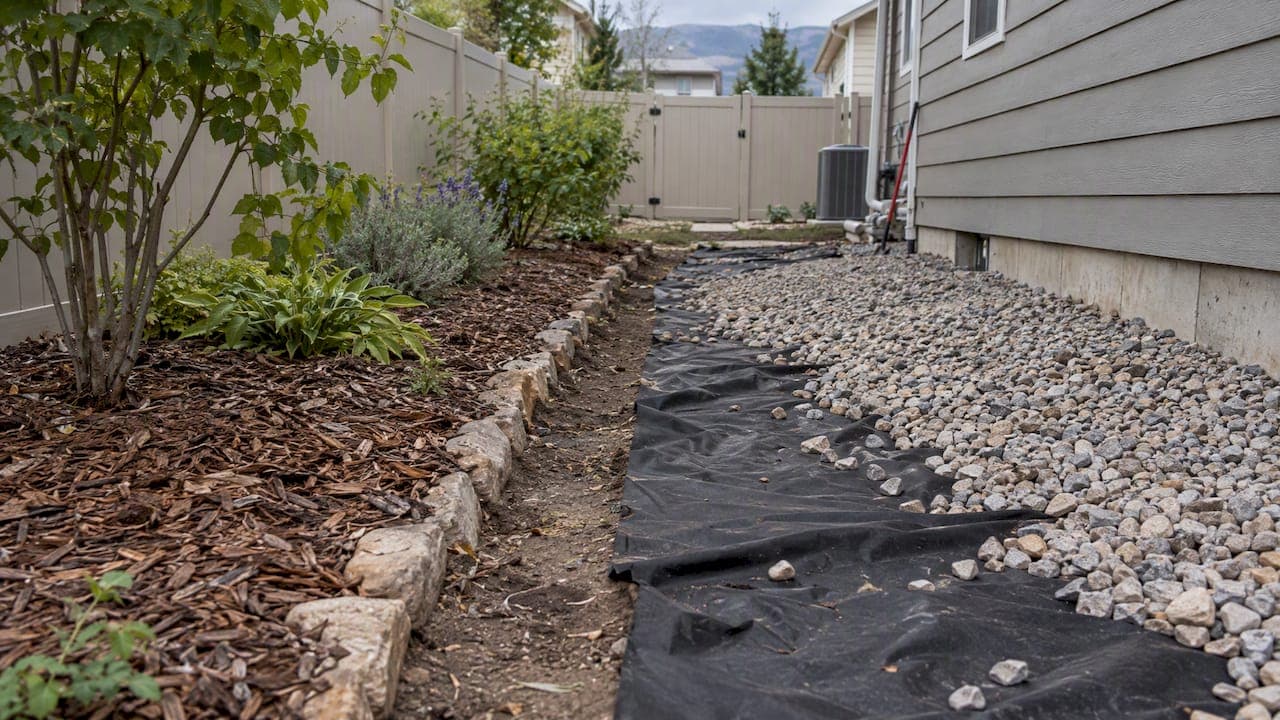
Landscape fabric works well for short-term weed control and under gravel, but it usually backfires in long-term planted beds because it clogs, starves the soil, and gets harder to manage. University extension guidance says its useful suppression often lasts only a couple of years. We see the same pattern on real jobs, so match the material to the bed.
TL;DR:
- Under gravel, choose woven fabric for strength; it separates stone from soil, while exposed fabric needs UV resistance and wears faster under foot traffic.
- In planted beds, clogged pores slow water and gas exchange, prevent organic matter from reaching soil, and let weeds root in mulch or through fabric.
- Washington State University cites research finding fabric reduced carbon dioxide movement about 1,000 times more than wood chip mulch; the figure summarizes one body of research.
- For long term planted beds, overlap plain cardboard by at least 8 inches, soak it thoroughly, and cover it with about 3 inches of mulch.
- If you expect frequent replanting, skip fabric because each new planting hole weakens the barrier and creates openings for weeds.
Table of Contents
- 1. What landscape fabric does well
- 2. What extension services warn about the downsides
- 3. Which type of fabric fits which job
- 4. How to install fabric and avoid future headaches
- 5. Alternatives that often beat fabric in planted beds
- 6. A quick rule for choosing
- 7. Why we still specify fabric under rock
- 8. Let us handle the planning and the install
- FAQ
- Sources
1. What landscape fabric does well
Fabric earns its place when the job is temporary or the bed is mostly stone. Washington State University Extension lists the main benefits, and they are real:
- Physical weed suppression without herbicide, because the fabric blocks the light weed seeds need to germinate at the soil surface.
- Reduced evaporation at first, so soil under the fabric can stay moister early on.
- Separation under gravel or stone, which keeps aggregate from mixing into the soil below and helps the rock layer stay clean and stable.
- A choice of strength: woven fabric generally offers more durability, while nonwoven has a felt-like texture and suits different uses.
Fabric is most useful in a few situations. A temporary bed you plan to rework is one. A gravel path or a rock bed where nothing will be planted is another. A new planting area where you want some weed control while young plants establish is a third. In each case, you are using the fabric for what it does best and accepting that it will not last forever.
2. What extension services warn about the downsides
The same extension sources that credit fabric's early performance are blunt about what happens later. Washington State University guidance summarizes the long-term problems:
- Pore clogging. Soil particles and decomposed mulch work into the weave, so the permeability that made fabric attractive declines over time.
- Restricted exchange. Once pores clog, water and gas movement between soil and air slows, and earthworms and microbes lose access to the surface organic matter they depend on.
- Weeds that move in anyway. Wind-blown seeds sprout in the mulch layer sitting on top of the fabric, and vigorous weeds can root through it, tangling with the material and becoming harder to pull.
- Plastic composition. Most landscape fabric is a polypropylene product, so it does not break down into the soil and has to be removed and disposed of when it fails.
Washington State University Extension cites research indicating that landscape fabric reduced carbon-dioxide movement between soil and atmosphere about 1,000 times more than wood-chip mulch. That is an extension summary of one body of research, not a spec for every product, but it shows how much a clogged barrier can choke soil exchange.
Organic mulch laid over fabric also cannot decompose into the native soil below, as UC Master Gardeners note. That buildup is part of what clogs the fabric in the first place.
3. Which type of fabric fits which job
Not every ground cover is the same product, and mixing them up causes trouble.
- Woven fabric is the stronger option. It suits gravel bases, paths, and spots with foot traffic where strength matters.
- Nonwoven fabric has a felt-like feel and is used differently. For a technical breakdown of how the two behave, this woven versus nonwoven geotextile primer goes deeper than most homeowners need but is a good reference.
- Black plastic sheeting is a different material altogether. It is impermeable, so water and air cannot pass, and extension guidance generally discourages it in planted beds. Choose by function: weed suppression, drainage, or soil separation.
Look for UV resistance if any fabric will be exposed, and expect a shorter life wherever you walk often or cut new planting holes. Sunlight, product quality, soil, mulch, and repeated cutting all change how long a fabric holds up, so there is no single service life to count on.
4. How to install fabric and avoid future headaches
If fabric is the right call, a careful install gets you the most from it.
- Prepare the site. Clear existing weeds, rake the surface flat, and remove sharp debris.
- Lay and overlap. Overlap seams by several inches so light cannot slip through gaps.
- Anchor it. Place staples along seams and edges so wind and foot traffic cannot shift it.
- Cut for plantings carefully. Make X-shaped cuts only where plants go, and plan the layout so you are not slicing it into Swiss cheese later.
- Cover with coarse material. Use a mulch or stone layer suited to the site.
Pro Tip: If you expect to swap plants often, skip fabric in that bed. Every new planting hole weakens the barrier and lets weeds in.
When you finish with it, pull degraded fabric out and dispose of it responsibly rather than burying it. Under hardscape or gravel, think about drainage first so water has somewhere to go.

5. Alternatives that often beat fabric in planted beds
For beds you want to keep healthy for years, organic methods usually win.
- Cardboard sheet mulching. Texas A&M AgriLife advises plain brown corrugated cardboard with tape and staples removed, overlapped at least 8 inches, soaked thoroughly, and covered with about 3 inches of mulch.
- Wood-chip mulch. It adds organic matter as it breaks down.
- Best uses. Cardboard and mulch shine when you are establishing a new bed, building soil, or planting perennials.
- A trade-off to know. Clemson's extension team notes that cardboard can slow water infiltration if it dries out, so drip irrigation beneath it works best.
Oregon State's sheet mulching guide frames the choice as trade-offs rather than a permanent weed-free surface.
6. A quick rule for choosing
Use fabric for short-term suppression, under gravel, or for temporary stabilization. Choose cardboard and coarse mulch for long-term planted beds. Match the decision to what the bed is for, how often you will replant, and whether you plan to improve the soil down the road.
7. Why we still specify fabric under rock
On real jobs, we reach for fabric mainly under rock and in projects meant to be temporary, and we design edges and layers so a bed can be maintained later. Anything involving drainage, grading, or a durable gravel base is worth planning properly from the start, because mistakes under stone are expensive to fix.
— Jake
8. Let us handle the planning and the install

If you would rather not guess, we plan and build these beds for you. Our work includes:
- Softscape installation and planting
- Excavation, grading, and drainage prep through our landscape earthwork services
- Gravel and hardscape installation
Request an estimate through our landscaping page, and we will talk through drainage and the right material for your yard.
FAQ
What's the best landscape fabric to use?
Woven fabric is generally the stronger, more durable choice, especially under gravel or on paths. Nonwoven has a felt-like texture and suits other uses. Pick by function, and expect any fabric's lifespan to vary with sun, traffic, and planting.
Does landscape fabric contain plastic?
Yes. North Dakota State guidance describes woven and nonwoven landscape fabrics as permeable polypropylene products. That means they do not decompose into soil and need to be removed at the end of their life.
Does landscape fabric let water through?
Permeable landscape fabric does, and that is how it differs from black plastic sheeting. The advantage declines over time as soil particles clog the pores, so water movement slows as the fabric ages.
What are the disadvantages of using weedmats?
The main problems are clogged pores, reduced soil exchange, harm to soil organisms, and weeds that root in the mulch above or grow through the fabric. Those downsides grow with time, which is why planted beds usually do better with organic mulch.
Sources
- The disadvantages of landscape fabric | Good Growing | Illinois Extension | Illinois
- Weed Barrier Fabric | Yakima County | Washington State University