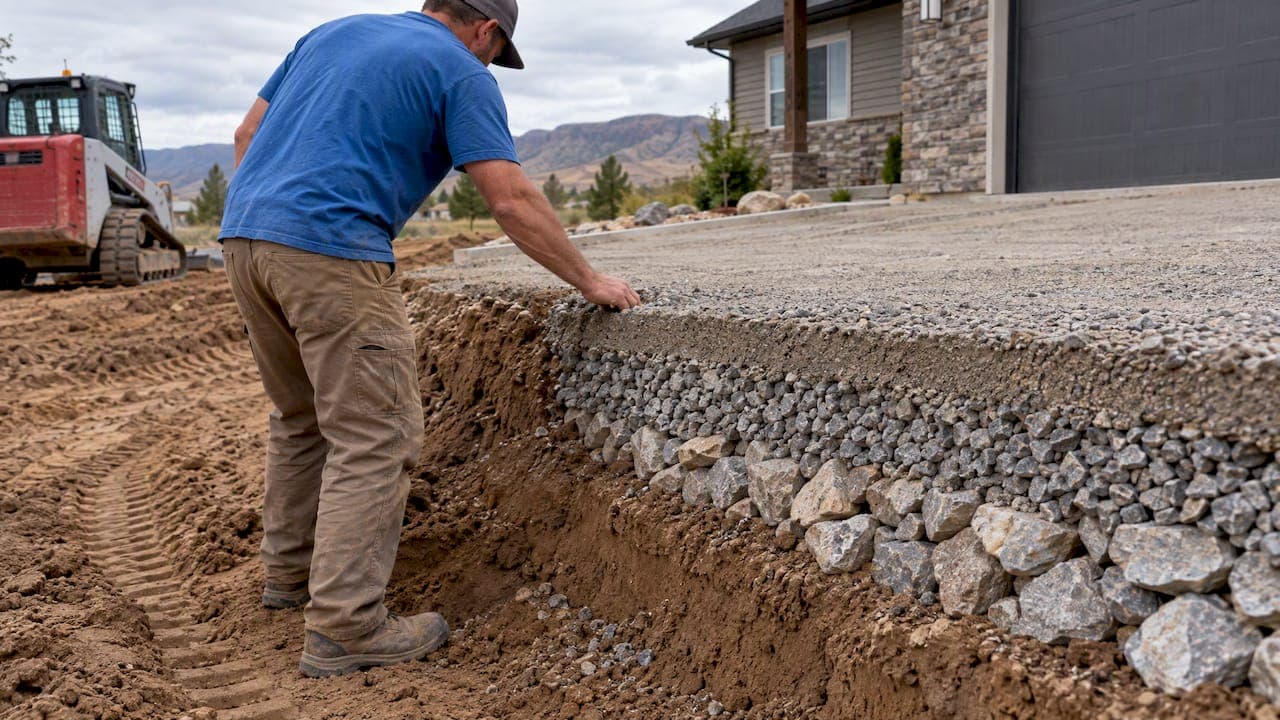
There is no single best driveway gravel. The right approach is a layered section that pairs different materials to different jobs: clean angular crushed stone for structural lift, #57 or #67 stone for the intermediate drainage layer and a compacted crusher run or dense-graded surface on top. Pea gravel and river rock look nice but shift and rut under tires, so they belong in landscaping, not in a driving surface. The rest of this guide covers sizes, costs, installation order, and upkeep so you can plan the whole system instead of guessing at one product.
TL;DR:
- Using angular crushed stone for the structural lift and #57 or #67 stone for drainage creates a more durable driveway system that resists shifting and rutting.
- Proper layering involves 4 to 6 inches of large structural stone, 3 to 4 inches of drainage gravel, and 1 to 2 inches of compacted surface material, adjusted based on site conditions.
- Geotextile fabric under the structural lift prevents erosion and pumping on wet or clay-heavy soils, extending the driveway's lifespan.
- Long-term performance depends more on correct installation, drainage, and base depth than on initial material cost or appearance alone.
- Major repairs often stem from neglecting drainage or skimping on base depth, emphasizing the importance of investing in proper site prep and layered construction.
Table of Contents
- Common driveway gravel types, sizes, and where each belongs
- How the layers of a gravel driveway actually work
- Matching gravel to your traffic, soil, and climate
- Cost, quantities, and how to order gravel
- Installation and maintenance that actually hold up
- When to call a contractor instead of DIYing it
- What years of driveway calls have taught us
- How we help with driveway and base work
- FAQ
- Sources
Common driveway gravel types, sizes, and where each belongs
Gravel comes in two basic shapes: crushed (angular) and natural (rounded). Angular stone has fractured faces that lock together under pressure, which is why it holds its shape under vehicle weight. Rounded stone rolls past itself instead of interlocking, so it migrates and ruts even when it looks solid on day one, according to UNH's gravel roads resources.
A few names come up in almost every driveway project:
- #3 or #5 stone: large, open-graded crushed rock (roughly 1.5 to 2 inches) used as a structural lift over soft ground.
- #57 or #67 stone: a mid-size crushed stone (around 3/4 inch) that drains well and sits between the structural lift and the surface.
- Crusher run, quarry process, or 2A modified: a blend of crushed stone, sand, and fines (dust to about 1.5 inches) that compacts tight and forms the driving surface.
- Pea gravel and river rock: small, rounded, decorative stones that look clean but are not structural; fine for walkways or borders, wrong for a driving lane.
- Crushed limestone, crushed granite, and decomposed granite: regional surface options that behave similarly to crusher run once compacted, with limestone tending to bind tighter due to its fines.
- Recycled asphalt: a budget surface option that compacts well and often costs less than quarried stone, though it can soften in extreme heat.
The UNH Technology Transfer Center lists typical per-ton pricing in this range: crusher run runs about $20 to $45 a ton, crushed stone about $30 to $55 a ton, and pea gravel about $30 to $55 a ton, though local quarry distance changes these numbers quickly.
The mistake we see most often is choosing a gravel based on how it looks in photos rather than what layer it's meant for. A driveway surfaced entirely in pea gravel, for instance, will always feel loose underfoot because nothing about that stone is designed to lock in place. Our angular gravel guide goes deeper into why fractured faces matter for anything you plan to drive on.
How the layers of a gravel driveway actually work
A durable gravel driveway is really three systems stacked on top of a prepared subgrade, not one material spread evenly across the ground. Each layer has a job, and using the wrong stone in the wrong spot is the single biggest reason driveways fail early.
Contractor guidance generally recommends this structure for a residential drive: 4 to 6 inches of #3 or #5 stone as a structural lift where the subgrade is soft, 3 to 4 inches of #57 or #67 stone as an intermediate drainage layer, and 1 to 2 inches of compacted crusher run or dense-graded aggregate (DGA) as the surface, according to this layer-by-layer contractor guide. On firm, well-drained subgrade, that bottom structural lift can sometimes be thinned or skipped, which is a judgment call best made after a site inspection rather than guessed from a chart.

Geotextile fabric belongs under the structural lift whenever the subgrade is wet, silty, or clay-heavy. A non-woven, needle-punched fabric keeps the soft soil from migrating up into the stone and causing pumping, a failure mode where mud works its way through the rock under repeated loading, per the same contractor guide. Heavier vehicles, weak native soils, or steep grades all call for a thicker structural lift and sometimes a wider base to resist lateral spread.
A practical build sequence looks like this:
- Clear and grade the subgrade, removing topsoil and organic material.
- Lay geotextile fabric if the soil is wet or fine-grained.
- Place and compact the structural lift in controlled layers.
- Add and compact the intermediate drainage stone.
- Finish with the compacted surface course, crowned for drainage.
Pro Tip: Compact each lift separately instead of dumping the full depth at once. A single thick lift rarely compacts evenly all the way through, which leaves a soft layer hiding under a hard-looking surface.
Our base prep guide walks through the inspection points worth checking before any stone gets delivered.
Matching gravel to your traffic, soil, and climate
The right material mix depends on what drives over it, what's underneath it, and what weather it has to survive, not just what's cheapest per ton.
- Vehicle load and frequency: a daily-driver sedan puts far less stress on a base than a truck, trailer, or RV parked repeatedly in one spot, which argues for a thicker structural lift under heavier vehicles.
- Soil type: clay-heavy or consistently wet subgrade needs geotextile and a more generous structural lift; sandy, well-drained soil can often get by with less.
- Climate: freeze-thaw cycles and heavy rain both punish poor drainage, so angular crushed stone and a properly crowned surface matter more in wet or cold regions than in dry, stable climates.
- Budget horizon: the cheapest gravel up front is often the most expensive over a decade once you count regrading, replenishing, and repair visits.
A layered system outperforms a single-material shortcut over time. Comparing gravel purely on upfront cost is risky because long-term durability depends on the full structural system, not the price tag on one load of stone, according to HelloGravel's driveway gravel guide.
If your site has large trees near the planned driveway path, root removal and grading often need to happen before any stone goes down; a land-clearing resource like this one covers what that prep typically involves.
Cost, quantities, and how to order gravel
Ordering by the bag is for garden beds. A driveway gets ordered by the cubic yard or ton, and the math is simple once you know the formula.
- Measure the driveway area in square feet (length times width).
- Multiply by the compacted depth in feet (for example, 4 inches equals 0.33 feet).
- Divide the result by 27 to convert cubic feet into cubic yards.
- Multiply cubic yards by roughly 1.4 to 1.5 to estimate tons, since crushed stone weighs about that much per cubic yard.
- Add 5 to 15 percent extra to cover compaction loss and spreading waste.
Say a driveway section is 50 feet long and 12 feet wide, with a 4-inch compacted layer: that's 600 square feet times 0.33 feet, or about 198 cubic feet, which converts to roughly 7.3 cubic yards and about 10 to 11 tons once you apply the weight factor and a modest overage.
Pricing per ton typically runs about $20 to $45 for crusher run, $30 to $55 for crushed stone, and $30 to $55 for pea gravel, per UNH's figures, though delivered pricing usually beats pickup once you factor in truck rental and your own time. Most suppliers set a minimum delivery load, so ask about that along with the gradation, percent fines, and quarry source before you order, since those details determine whether the load actually matches the layer you're buying it for.
Installation and maintenance that actually hold up
Drainage causes more gravel driveway failures than material choice does. A driveway without a crown or a way for water to leave the surface will eventually pond, soften the base, and start rutting no matter how good the stone is, according to UNH's gravel roads resources.
A few habits separate a driveway that lasts from one that doesn't:
- Crown the surface slightly so water sheds to the sides instead of sitting in the middle.
- Keep ditches or swales clear along the edges so shed water has somewhere to go.
- Compact in lifts at the right moisture content rather than relying on traffic to pack the stone down over time.
- Regrade periodically, pulling material back from the edges toward the center where traffic wears it thin.
- Add surface material when you start seeing bare spots or exposed base stone, rather than waiting for potholes.
- Edge the driveway with timber, steel, or paver borders to stop lateral stone loss onto the lawn.
Pro Tip: If you notice soft spots that stay wet days after a storm, that's usually a base or drainage problem, not a surface problem. Adding more gravel on top of a failed base just delays the next repair.
Washboarding, rutting, and a driveway that feels spongy underfoot are all signs the base has broken down and needs more than a top-up. Our spring maintenance checklist covers seasonal upkeep that catches these problems early.
When to call a contractor instead of DIYing it
Some tasks reward a weekend and a rented plate compactor. Others don't: subgrade remediation on wet or unstable soil, machine compaction of a structural lift, choosing and placing geotextile correctly, and any excavation that touches utility lines or permit boundaries are jobs for a licensed crew.
We keep every phase, from grading to final surface, under one roof, which means one point of contact instead of coordinating separate excavation and paving crews. Our base prep guide and gravel base for concrete guide are good starting points if you want to understand the work before you call anyone. Small resurfacing jobs on a firm, already-shaped base are reasonable DIY projects; structural rebuilds or soft, poorly drained soil are not.
What years of driveway calls have taught us
The same three mistakes show up again and again: picking one gravel for the whole job, ignoring drainage until water pools, and skimping on base depth to save money upfront. Spend on the base and the drainage first. That's the part nobody sees and the part that decides whether you're back out there regrading next spring.
— Jake
How we help with driveway and base work
If a gravel driveway is starting to feel like ongoing maintenance rather than a one-time project, we build concrete driveways and approaches that skip the regrading cycle entirely, along with the grading and earthwork that has to happen correctly before either material goes down.

Services relevant to a driveway project typically include:
- Excavation and grading to shape and compact the subgrade before any stone or concrete goes in.
- Concrete driveways and approaches, built on a properly prepared base rather than patched over a weak one.
- Landscape earthwork for sites that need drainage correction, slope adjustment, or soil removal.
- Drainage solutions worked into the grading plan so water has somewhere to go from day one.
A site visit from our crew includes a subgrade assessment, a look at existing drainage patterns, and a written scope so you know exactly what's being built and why before anything is ordered. If you're ready to talk through options, start with our concrete services page to request an estimate.
FAQ
What type of gravel is best for a driveway?
There's no single best type; a durable driveway uses different gravel for different layers. Angular crushed stone like #3 or #5 for the base, #57 or #67 for the intermediate layer, and crusher run for the compacted surface together outperform any single material used alone, per UNH's gravel resources.
What kind of gravel hardens like concrete?
Crusher run, quarry process, and similar dense-graded blends contain fines that bind together under compaction and moisture, forming a surface that resists shifting much like a hard crust. EPA and FHWA guidance notes that a well-graded mix with modest plasticity achieves this crusting effect, while clean open-graded stone used for base layers will not.
What is the cheapest gravel for a driveway?
Crusher run is typically the most affordable surface option, running about $20 to $45 per ton compared to crushed stone or pea gravel at roughly $30 to $55 per ton, according to UNH's figures. The cheapest material per ton isn't always the cheapest choice over time if it skips proper base layers underneath it.
Which is better for a driveway, crushed rock or gravel?
Crushed, angular rock is the better structural choice because its fractured faces interlock and compact tightly, while naturally rounded gravel tends to roll and shift under vehicle weight. Wisconsin's LTAP guide confirms that processed aggregates with fractured faces consistently outperform bank-run or rounded material in load-bearing applications.
Sources
- UNH Technology Transfer Center — Gravel roads resources
- Gravel Roads: Maintenance and Design Manual (EPA/FHWA)
- Best gravel for driveways: layer-by-layer guide (contractor resource)
- HelloGravel — Types of Gravel for Driveways (2025 guide)
- LTAP/Wisconsin — Gravel Roads Construction and Maintenance Guide