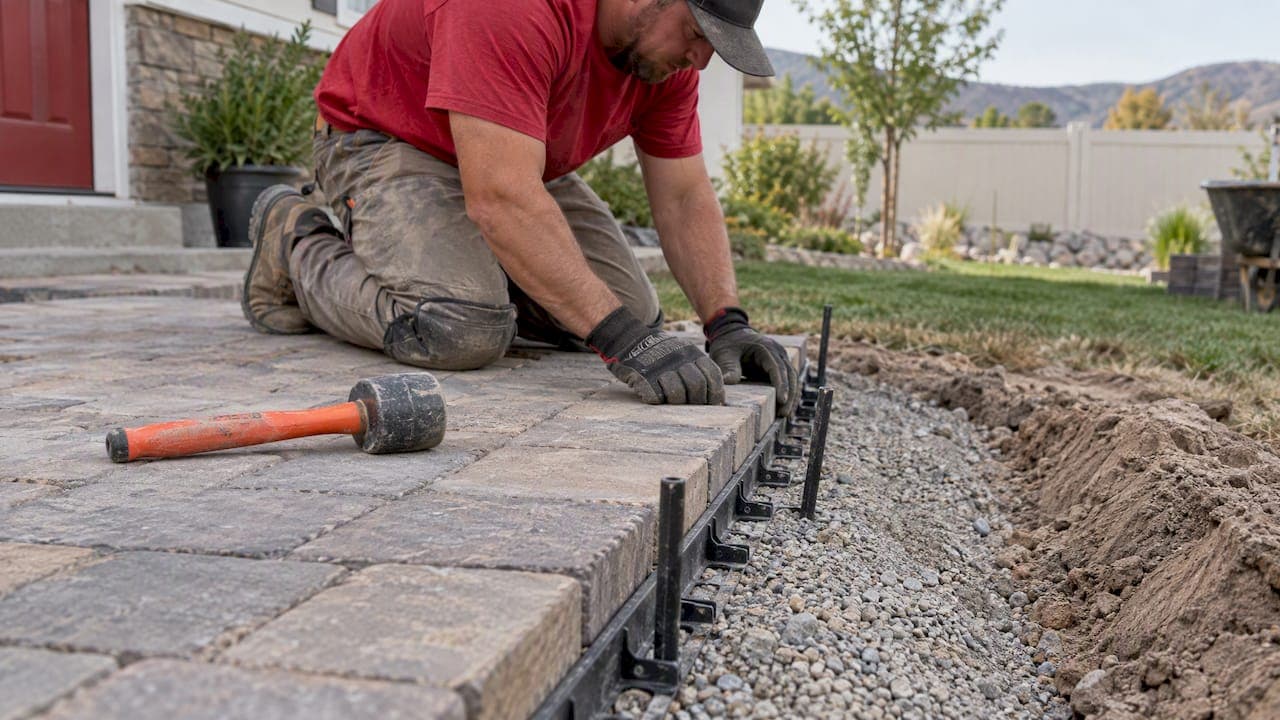
A paver edge restraint is the hidden border that stops your pavers from creeping outward. Yes, you need one on any interlocking paver surface. Plastic or aluminum edging is common for patios and walkways, while driveways call for heavier steel, aluminum or concrete. This guide covers the main types, how to match one to your project, how to install it, and which visible border ideas finish the look.
TL;DR
- Every interlocking paver surface needs an edge restraint. Without one, pavers spread, joints open and the surface loses its interlock.
- Plastic is fast and affordable for patios and walkways. For vehicles, step up to the thickest aluminum or steel, or a concrete edge.
- Set the restraint on the compacted base, never on the bedding sand, and spike it down at the right spacing.
- A restraint is hidden structure. Decorative borders, soldier courses and curbs are a separate design choice that sits on top of it.
- Freeze-thaw ground and vehicle loads are where cheap, under-spiked edging fails first.
Table of Contents
- What a paver edge restraint actually does
- Paver edge restraint options compared
- How to choose for a patio, walkway or driveway
- Paver border ideas that finish the edge
- How to install a paver edge restraint
- Freeze-thaw, soil movement and vehicles
- Our perspective: the edge is where cheap jobs show
- Getting it built right
- FAQ
- Sources
What a paver edge restraint actually does
Pavers hold together through friction. Sand fills the joints, and each unit locks against its neighbors. That interlock only works if the outer ring of pavers cannot move sideways. The edge restraint is that boundary.
The Concrete Masonry & Hardscapes Association describes edge restraints as structural containment that limits outward movement, keeping joint spacing and interlock intact. It treats them as an essential part of any interlocking concrete pavement. Oregon State University Extension makes the same point in its paver installation guide: without edging, pavers move and separate.
That is the answer to the common question of whether pavers really need one. They do. Loads from foot traffic, cars, mowers and freezing soil all push outward on the field of pavers. The restraint pushes back.
A good restraint has one more quality. CMHA notes that, whatever the material, it should present a smooth vertical face so the sides of the pavers sit in full contact with it. Gaps behind the pavers let them shift before the restraint ever engages.
Paver edge restraint options compared
There is no single best edging. The right one depends on the base, the load and how much of it shows. CMHA's guidance lists precast concrete, cut stone, plastic, aluminum, steel and poured-in-place concrete. Iowa State University Extension's older guide adds wood landscape timbers and heavy cut-stone blocks to the list of traditional choices.
| Type | Best for | Strengths | Limits |
|---|---|---|---|
| Plastic | Patios, walkways, curves | Quick to install, does not rust or rot, flexible for curves | Suited to light-duty use, and only if designed for pavers |
| Aluminum | Patios, walkways, some driveways | Works on flexible or rigid bases; thick profiles handle vehicles | Costs more than plastic |
| Steel | Driveways, heavy loads | Strong, thick profiles for vehicles | Rigid bases only |
| Precast concrete or cut stone | Visible edges, driveways | Solid and permanent, can double as a finished edge | Needs a proper footing and more labor |
| Poured or troweled concrete | Large areas, driveways | Stable and cost-effective on bigger jobs | Little give if the ground shifts, needs curing time |
The base and material notes in the table come from the CMHA tech note. The comparison of troweled concrete and manufactured systems draws on a hardscape manufacturer's education sheet. It calls troweled concrete traditional, stable and cost-effective, but with less movement flexibility. It adds that manufactured restraints are often nearly invisible and allow use right after installation, while concrete needs at least another day to cure.
If you pour a concrete edge, give it time before loading it. Our concrete curing timeline shows what to expect.
How to choose for a patio, walkway or driveway
Start with two questions: what is under the pavers, and what will roll or stand on them?
Base type
A flexible base is compacted aggregate. A rigid base is concrete. CMHA says plastic and aluminum edging can go on either, while steel should only be used on a rigid base. If you plan a compacted aggregate patio, the base itself matters as much as the edging. Our guide to patio base compaction walks through it.

Traffic load
For foot traffic, a well-spiked plastic restraint made for pavers is usually enough. For cars, CMHA recommends the thickest aluminum or steel edging, and says heavy-duty applications may need a greater restraining surface.
The Brick Industry Association gives a useful rule for clay pavers: where vehicle traffic comes within 3 feet of an edge, use a more robust restraint. Its examples are steel angles anchored to a concrete base, a precast or cut-stone curb on a concrete footing, or a poured concrete curb and gutter.

What a commercial spec looks like
Institutional projects show how seriously the heavy end is treated. The University of Maryland's 2026 paving specification calls for galvanized steel or aluminum angle edge restraints, 2 inches high with a 5-inch horizontal leg and 3/16-inch thickness, fastened at the top of the concrete base every 15 inches. It requires them wherever no concrete edge exists and wherever pavers meet grass or planting. A home driveway is a smaller job, but the logic carries over: more load, more steel.
Quick matching guide
- Patio or walkway on compacted base: plastic or aluminum edging, spiked.
- Curved patio or garden path: flexible plastic or aluminum made to bend.
- Driveway on compacted base: thick aluminum or steel, or a concrete edge on a footing.
- Driveway on a concrete slab: steel or aluminum angle fastened to the slab.
- Edge that will be seen: a precast curb, cut stone or concrete band.
Budget matters too. Edging is a small share of the total, so skimping there is false economy. Our paver patio cost guide shows where the money in a patio goes.
Paver border ideas that finish the edge
The restraint holds the pavers. The border is what people see. Treat them as two layers.
One manufacturer's design guide puts it well: decorative curbs, pavers, coping or wall caps create the finished appearance, while a spiked restraint supplies the underlying stability. Ideas worth considering:
- Inlay border. A band of pavers in a different color or texture frames the field. It looks custom and costs little more than field pavers.
- Double or triple soldier course. Contrasting rows add depth, define parking zones and protect driveway edges. They also act as a buffer against snowplows.
- Decorative edge pavers or curb stones. These give a raised, defined edge along beds and lawn.
- Freestanding wall edge. A low seat wall or garden wall can contain the patio and add seating.
- Concrete curbing. It is solid, but the same design guide advises against poured or troweled curbing in northern climates, moist areas or expanding clays, where movement can crack it.
Steps need a finished edge too. Retaining-wall blocks with caps, bullnose coping, matching pavers, paver step units or large natural stone slabs all work. Per the same guide, lightweight coping and pavers generally need mortar or adhesive, while heavy wall caps, step units and big stone slabs may stay put without it.
For garden beds beside a patio, see our take on lasting yard edging.
How to install a paver edge restraint
The steps below follow common manufacturer and specification guidance. Always follow the instructions for the product you buy.
- Finish and compact the base. The restraint rests on the compacted aggregate base, not on loose material.
- Set the line. Mark the perimeter with string. Edging should be installed plumb so pavers abut it properly, as the University of Maryland specification requires.
- Place the edging on the base, not the bedding sand. A landscape edging specification requires edge restraints directly on the prepared base, before the bedding layer and pavers. Another manufacturer's tips agree: they should not sit on the bedding layer.
- Spike it down. One installation guide calls for 10-inch steel spikes, one every 2 feet on walkways and patios, and one every foot on driveways and radii. A plastic edging data sheet allows 18 to 24 inches on patios and walkways and every foot for residential vehicles. When specs differ, use the tighter spacing.
- Handle curves and corners. Flexible edging bends for radii, with tighter spike spacing on the curve. Cut or notch the flange to turn a tight bend rather than forcing it.
- Lay the pavers, then backfill. The same data sheet says plastic edging must sit on the compacted base and be covered with backfill. With soil or sod over it, the restraint disappears for a clean edge.
For a driveway, the restraint should be fully installed at the start and end of every workday and before any vehicle crosses the finished pavement, per the Maryland specification. An open edge overnight is how a day's work spreads.
Before or after the joint sand?
The usual answer is before. Restraints should be in place before the final compaction of the pavers, according to installation guidance from a paver manufacturer, though some products can be installed before or after the units are laid. CMHA describes an exception: where site fixtures such as utility covers come later, you can lay and vibrate the pavers, fill the joints with sand, then saw-cut an opening and place the restraint. Treat that as a contractor's workaround, not the normal order.
Drainage is the other thing to settle before you set edging, since water pooling at the perimeter undermines it. Our paver patio drainage checklist covers soil, slope and outlet.
Freeze-thaw, soil movement and vehicles
Edges fail where the ground moves. CMHA says restraints are designed to stay stationary while taking impacts from vehicles and freeze-thaw cycles. That only holds if the product is right for the load and anchored properly.
Also weigh the material against the soil. One manufacturer sheet reports that a contractor prefers manufactured restraints in colder climates, because their flexibility allows more movement as the ground shifts than troweled concrete's limited range of motion. In a hard-freeze or expanding-clay area, ask your installer why they chose one over the other.
If you pour any concrete in a cold season, our cold weather concrete guide covers the rules. In spring, a quick look along the edges is part of our hardscape maintenance checklist.
Signs an edge restraint is failing
- Pavers at the perimeter are drifting outward or tilting.
- Joints along the border are widening while the center stays tight.
- Edging has heaved out of the ground or spikes are exposed.
- Sand washes out at one side after rain.
Catch it early. Re-spiking and resetting a few feet of edging is a small job, but a spread border means lifting and relaying pavers.
Our perspective: the edge is where cheap jobs show
We build paver patios, driveways and walls across Utah with our own crew, and the edge is the first place we look when we inspect someone else's work. You can't see most of a restraint when the job is done, which is exactly why it gets skimped.
Our view is simple. Match the restraint to the load, not to the bid. Spike it at the tighter spacing. Set it on the compacted base. Plan the visible border as a design decision, separate from the hidden structure. Because we manage every phase in-house, the crew that compacts the base also sets the edge and lays the pavers, so no one hands off a half-finished perimeter to a different team.
If an estimate says only "edging included," ask which material, what thickness and what spike spacing. A contractor who has done it right will answer in one breath.
— Jake
Getting it built right
If you want a patio, walkway or driveway where the edging is specified and installed properly, we handle it from estimate to final cleanup. See our paver patios and walkways work. Paver patios and walkways are published at $8,000 to $25,000, depending on size and design. For vehicle areas, our concrete driveways and approaches page shows what we pour. You can also contact us through our site for an estimate.
FAQ
What is the best edge restraint for pavers?
It depends on the load. For patios and walkways, plastic or aluminum edging made for pavers works well on a compacted base. For driveways, CMHA recommends the thickest aluminum or steel edging, or a concrete edge for heavy-duty use.
Do you need an edge restraint for pavers?
Yes. Interlocking pavers rely on the perimeter being held in place, and extension and industry sources agree that without it the pavers shift outward and separate. A wall, curb or slab that already contains the pavers can serve as the restraint.
How do you secure the edge of pavers?
Set the restraint on the compacted base and fasten it with long steel spikes. Guidance ranges from one spike every 2 feet on patios to one every foot on driveways and curves. Then backfill over it with soil so the pavers have firm support.
Do you install paver edge restraint before or after sanding?
Before, in nearly every case. Restraints go in before the final compaction and before the joints are swept with sand. The exception is a later site fixture, where the pavers are cut out and a restraint is added after the joints are filled.
Sources
- Edge Restraints for Interlocking Concrete Pavements, CMHA
- 10-Step Guide to Installing Pavers, Oregon State University Extension
- Installing Interlocking Concrete Pavers, Iowa State University Extension
- Edge restraint installation methods, manufacturer education sheet
- Section 321400 Unit Paving, University of Maryland
- Paving Systems Using Clay Pavers on a Bituminous Setting Bed, Brick Industry Association
- Paver border and edging options, manufacturer guide
- Paver border, banding and accent design ideas
- General paver installation guide
- Landscape edging specification, Section 32 94 13
- Edge restraint technical data sheet
- Installing paver edge restraints, manufacturer tips