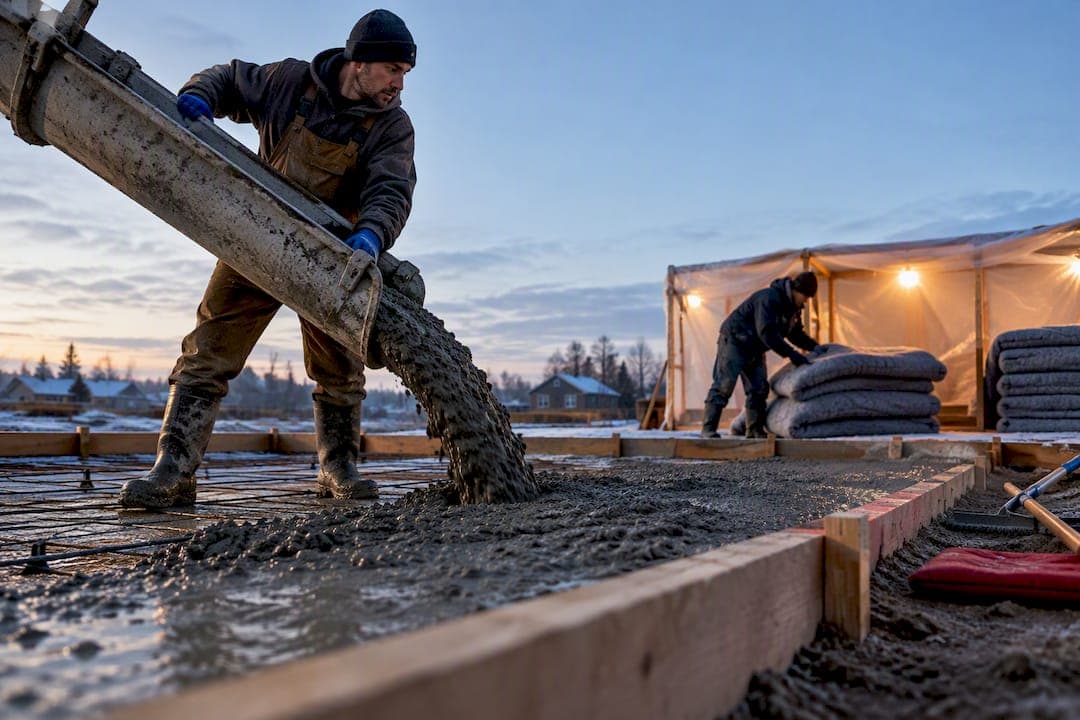
Yes, you can pour concrete in cold weather, but only if you stop it from freezing before it reaches roughly 500 psi. ACI 306 triggers cold-weather protocols once air temperature hits or is forecast to hit 40°F during the protection period. If you can't hold minimum placement temperatures and protect the slab afterward, the right call is to postpone the pour.
TL;DR:
- Pouring concrete in cold weather requires maintaining minimum temperatures based on section thickness, with protections lasting until strength is verified.
- Using heated water, accelerators, Type III cement, and proper air entrainment improves early strength and durability in freezing conditions.
- Avoid pouring on frozen ground, as it causes settling and cracking, and ensure subgrade temperatures are above freezing before placement.
- Applying insulating blankets within 20 minutes of finishing and using maturity testing or field cylinders helps determine when protection can end safely.
- Cold weather failures often result from late blanket application or pouring on frozen ground, emphasizing the importance of a comprehensive winter pour plan.
Table of Contents
- How Cold Weather Concrete Curing Actually Works
- Minimum Concrete Temperatures by Section Thickness
- Ordering the Right Mix for a Cold Weather Pour
- Never Pour Concrete on Frozen Ground
- Protecting and Curing Concrete Through a Cold Snap
- Deciding Whether to Pour or Wait
- Jake's Jobsite Checklist for Winter Pours
- Cold Weather Job Site Safety for Concrete Crews
- Will Cold Weather Concrete Last? Freeze-Thaw Durability Explained
- Jake's Take: Where Winter Pours Actually Go Wrong
- Get a Winter Pour Plan
- Where to Go Deeper on Cold Weather Concreting Standards
- Sources
- FAQ
How Cold Weather Concrete Curing Actually Works
Concrete gains strength through hydration, a chemical reaction between cement and water that slows dramatically as temperatures drop. Below 50°F, that reaction can take two to three times longer than it does on a mild spring day. This is the entire reason cold weather concreting exists as its own discipline. Freeze the mix before it reaches roughly 500 psi (3.5 MPa) and you don't just delay the job. You can permanently cut the design strength by up to about 50 percent, because ice crystals expand inside the paste and tear apart the microstructure before it has a chance to lock together.
Timelines shift fast with temperature:
- Near 50°F, a well-proportioned mix commonly reaches 500 psi within about two days.
- Below 40°F, that same mix can take several days longer, sometimes far longer, depending on section thickness and mix design.
- Thicker sections retain heat longer and cure faster than thin slabs or edges, which cool from all sides.
That last point catches a lot of DIYers off guard. A four-inch patio slab loses heat far faster than an eight-inch footing, so it needs more protection, not less.
Minimum Concrete Temperatures by Section Thickness
ACI 306 sets specific minimum as-placed concrete temperatures based on how thick the section is, because thinner concrete loses heat faster and has less mass to protect itself. These are not suggestions. They're the baseline for any pour once cold-weather conditions apply.
- Sections under 12 inches: minimum 55°F
- Sections 12 to 36 inches: minimum 50°F
- Sections 36 to 72 inches: minimum 45°F
- Sections over 72 inches: minimum 40°F
The minimum temperature for a concrete pour isn't a one-time checkpoint. You measure the concrete's temperature at the chute using ASTM C1064, record it, and then you have to maintain that temperature range throughout the entire protection period, not just at the moment of placement. A truck that arrives at 58°F but sits uncovered in 25°F air for six hours has already failed the standard, even though the delivery ticket looked fine.
Ordering the Right Mix for a Cold Weather Pour
The single biggest lever you have before the truck even arrives is mix water temperature. Ready-mix plants heat the water and sometimes the aggregate to hit a target discharge temperature, and that's a far more effective control than anything you can do on site after the fact. When you call in your order, specify the discharge temperature you need based on the ACI minimums above, not just "the winter mix."
Beyond heated water, a few adjustments make a real difference in cold temperature concrete mix design:
- Accelerators. Non-chloride accelerators speed early strength gain without risking corrosion in reinforced concrete. Calcium chloride is cheaper but should be avoided anywhere rebar or embedded metal is present.
- Type III cement. Ground finer than standard Type I/II cement, it hydrates faster and builds early strength sooner, which matters most when the forecast is tight.
- Air entrainment. Proper air content protects hardened concrete against freeze-thaw cycling for decades, not just during the initial cure.
- SCM adjustments. Fly ash and other supplementary cementitious materials slow early strength gain, so plants often reduce fly ash content in cold-weather mixes.
Pro Tip: Never let anyone add water on site to make the mix easier to place. Extra water dilutes strength and extends the time it takes to reach 500 psi, which is exactly the wrong direction when you're racing a freeze.
Never Pour Concrete on Frozen Ground
Frozen subgrade does two things wrong, and both of them are expensive. First, it acts as a heat sink, pulling warmth out of the fresh concrete from below at the worst possible time. Second, when that frozen ground eventually thaws, it settles, and a slab poured directly on top of it can crack, heave, or separate from footings months after everyone has forgotten about the cold snap that caused it.
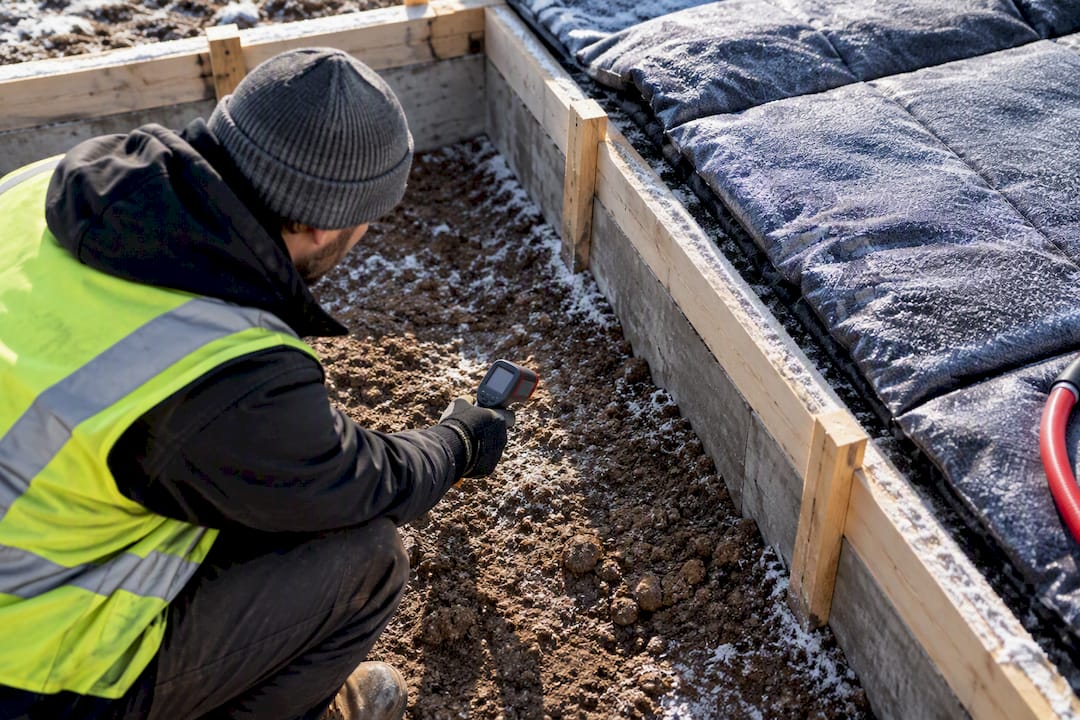
The fix is straightforward but takes planning. Ground heaters, insulated blankets laid over the excavation overnight, or hydronic heating loops can bring subgrade temperature above freezing before the truck shows up. If none of those are practical for the schedule or budget, reschedule the pour instead. Before placement, confirm subgrade temperature and moisture, and check that any embeds, anchor bolts, or contact surfaces are above freezing too. A frozen subgrade is one of the most common sources of hidden, delayed-onset concrete failure in residential work.
Protecting and Curing Concrete Through a Cold Snap
Getting concrete placed at the right temperature is only half the job; for best results, learn effective how to winterize your doors techniques to complement your cold-weather construction efforts. What happens in the next 48 to 72 hours determines whether it survives the winter. Here's the sequence that works:
- Apply insulating blankets fast. Get them on within about 20 minutes of finishing. Waiting even an hour lets heat escape that you can't get back, and that heat loss is often what pushes a slab toward freezing before it hits 500 psi.
- Choose the right protection level for the conditions. Blankets alone often handle moderate cold, roughly 25°F to 40°F. Below that, especially into the teens, a heated enclosure with indirect-fired, properly vented heaters becomes necessary rather than optional.
- Hold protection until strength is verified, not until you're tired of the tarps. The protection period isn't a fixed number of days. It ends when in-place strength is confirmed, ideally through maturity testing.
- Remove insulation gradually. Stripping blankets off all at once exposes warm concrete to sudden cold, and that thermal shock causes surface cracking even in concrete that's already strong enough structurally.
The most reliable way to know when protection can come off is maturity testing under ASTM C1074, which uses embedded sensors to track temperature history and convert it into a real strength estimate. Field-cured cylinders work too, though they're slower to give you an answer. Guessing based on the calendar is how contractors end up explaining cracked slabs to homeowners in the spring.
Deciding Whether to Pour or Wait
Not every cold-weather job is worth the extra cost and complexity. Before committing, run through this checklist:
- What's the forecast low for each day of the protection period, not just pour day?
- Do you have real access to heated mix water, insulating blankets, or an enclosure, or is that just a hope?
- Can the subgrade actually be thawed and kept above freezing, or is it already frozen solid?
- Is Type III cement or an accelerator available from your plant on short notice?
- Does the added cost of protection materials and heating change the project's budget meaningfully?
For most residential jobs, forecasts showing multiple consecutive days below 20°F, or no realistic way to thaw frozen subgrade, are strong signals to postpone rather than push through. A short delay costs far less than a slab you have to replace.
Jake's Jobsite Checklist for Winter Pours
On every winter job we run at A-to-zconstruction, the crew stages insulating blankets before the truck even arrives, because those first 20 minutes after finishing decide a lot. Chute temperature is recorded on every load and efforts are made to ensure it meets the ACI minimum for that section thickness.
Before we place anything, the checklist is short: subgrade thawed and checked, embeds above freezing, maturity sensor or field cylinders ready, blankets staged, heaters ventilated properly if an enclosure is in play.
Cold Weather Job Site Safety for Concrete Crews
Pouring concrete safely in freezing weather takes more than watching the mix temperature. Workers handling wet concrete in cold conditions face a specific combination of hazards that warm-weather crews rarely deal with.
Wet concrete against skin causes chemical burns, and cold weather makes it worse because workers wear gloves less consistently when they're trying to keep dexterity for finishing work. Waterproof, insulated gloves rated for wet work are non-negotiable, not optional gear.
Heated enclosures introduce carbon monoxide risk from indirect-fired heaters if ventilation isn't handled correctly. Every enclosure needs proper venting and, ideally, a carbon monoxide detector running the whole time crews are inside. This is one area where cutting corners has killed people on job sites, and it's entirely preventable with basic ventilation planning.
Icy surfaces around the pour site, especially where hoses, blankets, and heater cords cross walkways, create a serious slip and trip hazard. Keeping cords and hoses organized and salting approach paths before the crew arrives takes minutes and prevents the most common cold-weather jobsite injury.
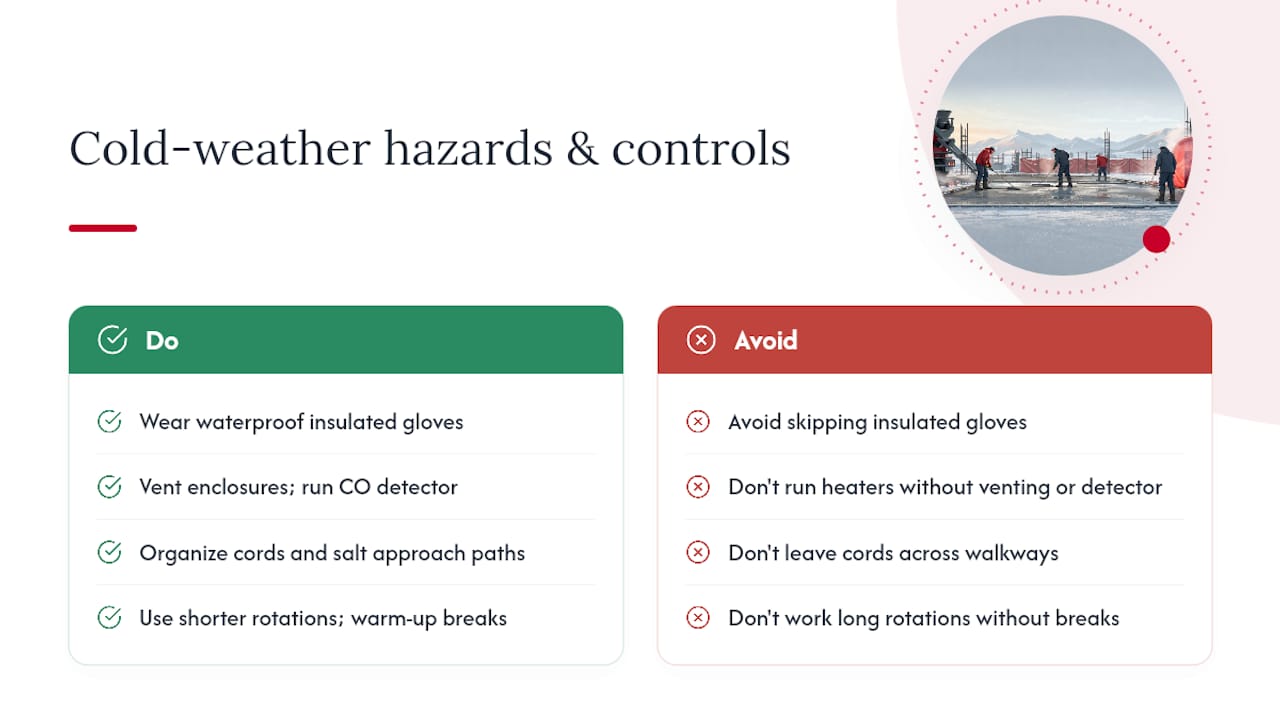
Cold also slows reaction time and grip strength, which matters when crews are handling vibrating screeds, power trowels, or heavy blanket rolls. Shorter work rotations with warm-up breaks keep crews sharp through a long pour day, and they're worth building into the schedule rather than treating as a luxury.
Will Cold Weather Concrete Last? Freeze-Thaw Durability Explained
A slab that survives its first winter without cracking isn't automatically in the clear for the next twenty years. Long-term durability in freeze-thaw climates depends on decisions made at the mix design stage, not just careful handling during the pour.
Air entrainment is the single biggest factor here. Properly entrained air creates microscopic voids that give water room to expand when it freezes inside the hardened concrete, instead of cracking the paste from the inside. A mix poured correctly in cold weather but missing adequate air entrainment can still deteriorate over repeated winters, showing surface scaling and spalling years down the road.
Curing quality during that first critical week also has lasting effects. Concrete that cures too fast, too slow, or through a harsh thermal shock when protection comes off ends up with a weaker, more porous surface layer, and that layer is exactly what takes the brunt of future freeze-thaw cycles and deicing salt exposure.
Control joints matter more in freeze-thaw climates too, since temperature swings stress the slab at predictable weak points, and a properly placed joint gives that stress somewhere controlled to go instead of an uncontrolled crack across the surface. Get the mix design, the cure, and the joint layout right during the cold-weather pour, and there's no reason a winter slab shouldn't outlast one poured in July.
Jake's Take: Where Winter Pours Actually Go Wrong
Most winter concrete failures I see trace back to two mistakes: blankets applied too late, or a crew that poured on ground they knew was still frozen and hoped it wouldn't matter. The damage isn't always visible right away. If your project involves a foundation, a driveway you'll rely on for decades, or any pour where hidden settlement could get expensive, that's when it's worth bringing in a licensed contractor who manages the whole process, mix to protection to strength verification, under one roof.
— Jake
Get a Winter Pour Plan
Cold weather doesn't have to mean canceled plans. Some contractors handle concrete driveways, slabs, and foundations year-round and coordinate mix ordering, subgrade prep, placement, and protection under one team to avoid delays.
That matters most in winter, when timing between the concrete truck, the blankets, and the weather window is everything. If you're weighing whether to push forward with a concrete driveway this season or wait for spring, a free estimate gives you a straight answer on cost and scheduling before you commit either way. Request a winter pour plan and find out what your project actually needs to succeed in the cold.
Where to Go Deeper on Cold Weather Concreting Standards
- ACI 306R-16 sets the placement temperature and protection-period rules referenced throughout this guide.
- The FHWA cold weather concreting specification covers admixture-based methods for placing concrete in subfreezing air.
- ASTM C1064 standardizes how fresh concrete temperature gets measured and recorded on site.
- Curing timelines and strength checks are covered in more detail in this guide to concrete curing time.
Sources
FAQ
What Type of Concrete Is Best for Cold Weather?
A mix using Type III cement, proper air entrainment, and a non-chloride accelerator handles cold weather best because it builds strength faster while still resisting future freeze-thaw cycling. Plants also heat the mix water to raise the delivery temperature, which does more for early strength than any additive alone.
At What Temperature Is Too Cold to Pour Concrete?
There's no single cutoff, but ACI 306 triggers cold-weather procedures once air temperature is at or expected to fall below 40°F during the protection period. Below roughly 20°F, most residential jobs need a heated enclosure, and if that's not feasible, postponing the pour is usually the smarter move.
Will Concrete Freeze at 32 Degrees?
Fresh concrete can freeze if it hasn't yet reached about 500 psi of strength, and freezing before that point can cut its final strength by up to half. Once it's past that threshold, it can tolerate freezing air far better, though protection is still smart practice.
Will Concrete Settle in Cold Weather?
Concrete itself doesn't settle from cold, but a slab poured over frozen subgrade will settle later once that ground thaws and loses volume. That's why never pouring on frozen ground is one of the firmest rules in cold-weather concreting, not a suggestion contractors can skip to save time.