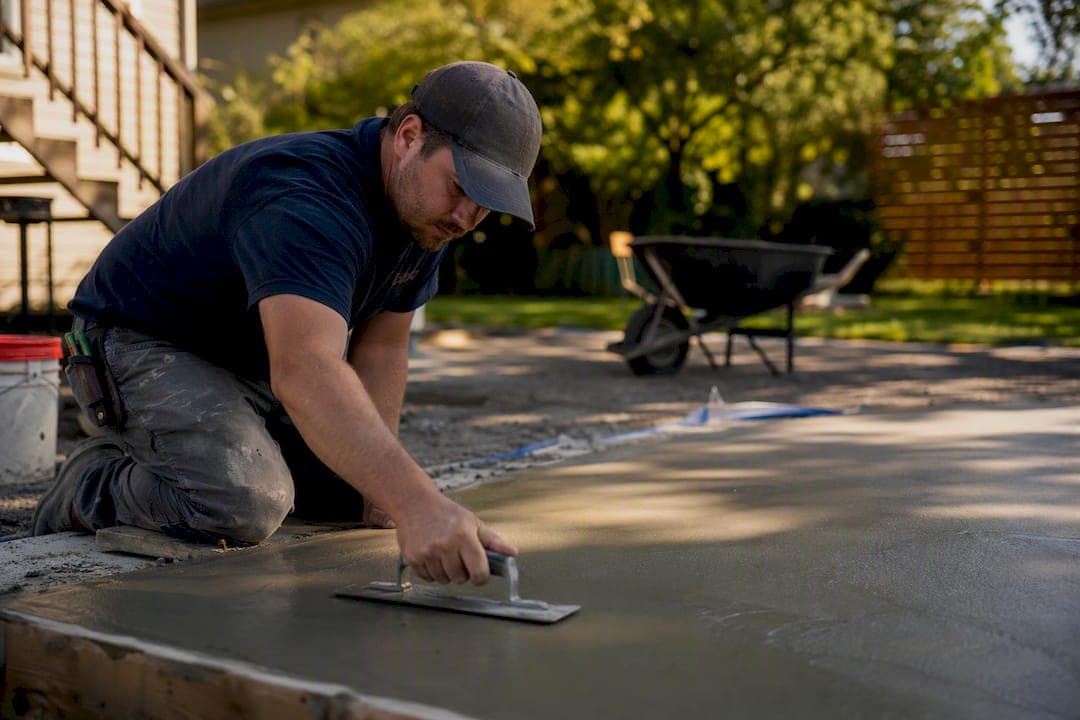
Concrete is generally walkable after 24 to 48 hours, can handle passenger vehicles at around the 7-day mark under normal conditions, and reaches its 28-day design strength benchmark on roughly day 28. Curing itself is not drying. It's the moisture and temperature control that keeps the cement's hydration reaction running, and that reaction is what actually builds strength.
A few cautions matter more than the calendar. Slab edges cure weaker and chip more easily than the interior, cold or hot weather can stretch these timelines significantly, and anything heavier than a car (think RVs, delivery trucks, or a loaded trailer) needs either a full cure or a slab designed for that load from the start.
- 24 to 48 hours: foot traffic, light tools, careful setup work
- ~7 days: passenger vehicles, assuming moderate weather and a standard mix
- 28 days: full design strength, the point most engineers treat as "cured"
Quick fact: Under ideal curing conditions, concrete reaches about 99% of its design strength by day 28, then keeps gaining strength slowly for years afterward.
Key Takeaways
Concrete curing time follows a predictable curve, walkable in 1 to 2 days, drivable around day 7, design-strength at day 28, but temperature, moisture, and mix design can shift every one of those numbers.
| Point | Details |
|---|---|
| Walk and drive timing | Foot traffic is generally safe after 24 to 48 hours; passenger vehicles after about 7 days in normal weather. |
| 28 days is a benchmark, not a finish line | Design strength is tested at 28 days, but concrete keeps gaining strength slowly for years. |
| Temperature controls the pace | Curing above 40°F needs a minimum week in many cases; freezing during early strength gain causes lasting damage. |
| Edges cure weaker | Slab perimeters and repeated parking spots crack and chip first, so treat them conservatively regardless of age. |
| Match the method to conditions | Wet curing, curing compounds, and insulating blankets each fit different weather and project types. |
Table of Contents
- Concrete Curing Time Milestones and What They Mean for You
- What Is Concrete Curing (And Why It's Not the Same as Drying)
- What Factors Speed Up or Slow Down Curing?
- Best Curing Methods for Concrete Slabs
- How Cold and Hot Weather Change the Cure Schedule
- How to Tell If Concrete Is Ready for Loads or Form Removal
- A to Z Construction's Field Approach to Faster, Safer Cures
- Standards and Tools Worth Bookmarking
- Why Job-Site Judgment Beats a Calendar
- Sources
- FAQ
Concrete Curing Time Milestones and What They Mean for You
Strength doesn't arrive all at once. It builds on a curve that's steep in the first week and flattens out as hydration slows.
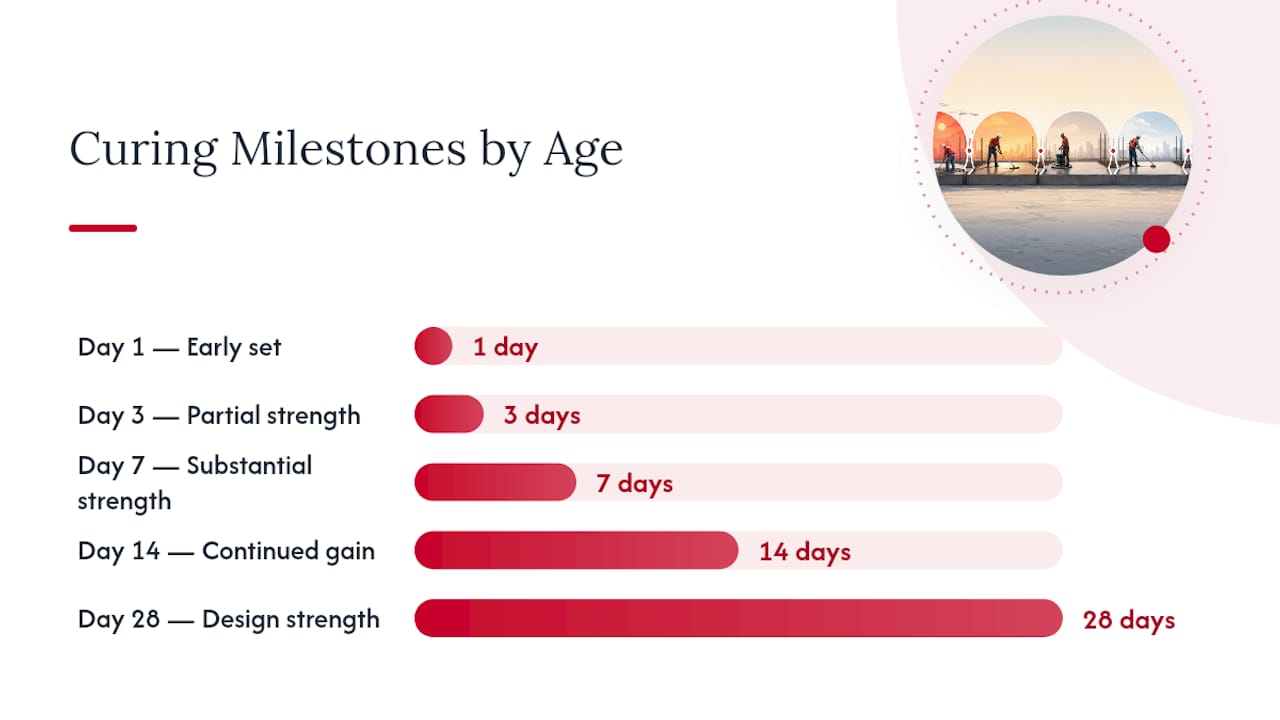
By day one, a slab has enough strength to hold its shape but not enough to trust with a footstool of extra load. By day three, most residential mixes have firmed up enough for careful foot traffic and light equipment staging. Day 7 is the commonly cited threshold for passenger vehicle access, and it's also roughly when many contractors consider moist-cured concrete significantly stronger than concrete left to cure uncured. Day 14 is a soft checkpoint for heavier residential use. Day 28 is the benchmark almost every engineer and inspector references for final design strength.
| Age | Typical Strength Reached | Common Activity Allowed |
|---|---|---|
| 1 day | Early set, minimal strength | Careful foot traffic only, no tools that concentrate weight |
| 3 days | Partial strength gain | Light foot traffic, setting up saw horses or materials nearby |
| 7 days | Substantial early strength | Passenger vehicles in normal weather |
| 14 days | Continued strength gain | Heavier residential use, limited equipment |
| 28 days | Design strength benchmark | Full use, including sustained vehicle and structural loads |
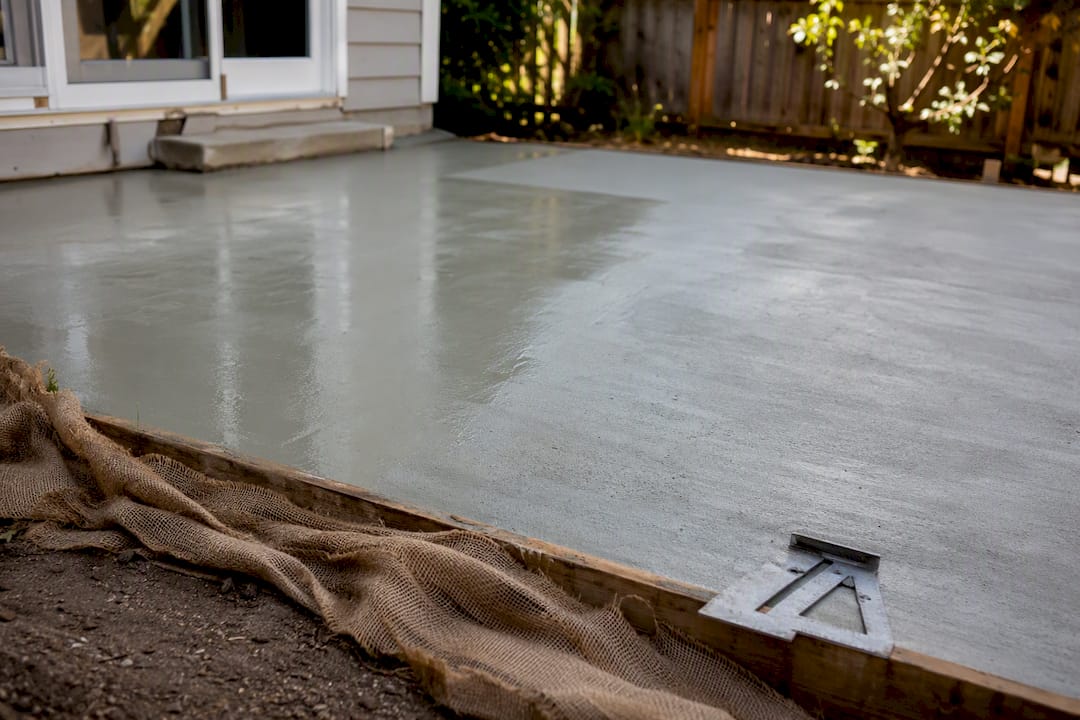
A sidewalk poured in June cures differently than a driveway poured in November, even with an identical mix. Thicker slabs, like a driveway designed for two vehicles parked side by side, hold heat and moisture longer than a thin garden walkway, which changes how fast that surface reaches usable strength. Treat edges and any spot that takes repeated heavy loads (like where a car always parks) with extra caution. Those areas are the first to crack or chip if you push the timeline.
What Is Concrete Curing (And Why It's Not the Same as Drying)
Curing is the process of holding moisture and temperature steady long enough for cement particles to fully hydrate. Drying is just water leaving the slab through evaporation, and it can actually work against you if it happens too fast, pulling moisture away before the chemical reaction finishes.
The water-to-cement ratio set at the batch plant determines how much strength that concrete can ever reach. Adding water at the job site to make a stiff mix easier to pour, a common shortcut, weakens the final slab because it dilutes that ratio below what the mix design intended.
The 28-day mark isn't some magic finish line. It's a testing convention, the age at which cylinder breaks are standardized so engineers can compare results across projects. Strength gain doesn't stop there. It just slows to a crawl, continuing for months or years depending on conditions.
- Curing = moisture + temperature control that sustains hydration
- Drying = surface water evaporating, which can stall hydration if it happens too early
- More water at the mixer or the job site weakens final strength, even though it makes the pour easier to handle
What Factors Speed Up or Slow Down Curing?
Temperature is the single biggest lever. Penn State's engineering guidance notes that curing periods above roughly 40°F should run a minimum of 7 days in many cases, and colder temperatures slow hydration dramatically. Below freezing during early strength gain, water in the mix can freeze and cause damage that never fully repairs itself.
Wind, direct sun, and low humidity pull surface moisture out fast, sometimes faster than hydration can use it. That's when evaporation retarders or a simple wet burlap cover earn their keep, especially on a hot, breezy afternoon pour.
Mix design and slab thickness matter too. A high-strength driveway mix reaches a given strength milestone faster than a standard mix poured at the same thickness, and a thick slab holds curing moisture longer than a thin one.
- Below 40°F: hydration slows sharply, freeze risk becomes real
- High wind or low humidity: surface dries faster than the interior, risking weak surface strength
- Thicker slabs: hold heat and moisture longer, often reaching milestones with more margin
- Edges and corners: always the first spot to weaken, crack, or spall
Pro Tip: Check the forecast for the 72 hours after your pour, not just pour day. A sunny, windy afternoon two days later can do more damage to a fresh slab than the weather on the day you actually placed the concrete.
Best Curing Methods for Concrete Slabs
Matching the method to the job and the weather makes the biggest difference in how a slab performs later.
- Wet curing (soaking with continuous misting, wet burlap, or ponding) delivers the most moisture and often the best strength results, but it needs monitoring so the surface never dries out between soakings.
- Membrane-forming curing compounds get sprayed on shortly after finishing and seal moisture in without ongoing maintenance, which makes them the practical choice for contractors managing several pours a week.
- Curing blankets and insulation trap heat generated by the concrete's own hydration, which is essential in cold weather when ambient temperature alone won't sustain the reaction.
- Accelerating admixtures speed early strength gain when a fast turnaround matters, but non-chloride accelerators are the safer choice near steel reinforcement, since chloride-based versions can corrode rebar over time.
Start whichever method you choose within the first hour or two after finishing, before the surface has a chance to dry out. Most methods should run at least 7 days, though blankets in cold weather often stay on longer, until temperatures reliably clear that 40°F threshold on their own.
Pro Tip: For a DIY patio pour, plain wet burlap kept damp for a week beats almost any store-bought curing spray for cost and effectiveness, as long as you're willing to check it twice a day.
How Cold and Hot Weather Change the Cure Schedule
Cold weather is the more dangerous extreme because the damage it causes doesn't reverse. ACI guidance calls for keeping concrete above defined temperature thresholds for an extended protection period, often using insulated blankets, temporary enclosures, or heated mixing water to keep hydration moving through cold nights.
Hot weather brings a different risk: the surface drying out before the interior has cured, which leaves a weak, dusty top layer prone to cracking. Scheduling pours for early morning, using evaporation retarders, and shading fresh concrete from direct sun all help. Rapid surface cooling after a hot day (a sudden thunderstorm, for instance) can also trigger thermal cracking if the slab's surface and core temperatures diverge too fast.
- Below 40°F: insulate or heat, and extend protection well past the usual 7 days
- Above 90°F with wind: shade the pour, retard evaporation, and consider a night or early-morning schedule
- Rapid temperature swings: protect against thermal shock, not just cold or heat alone
How to Tell If Concrete Is Ready for Loads or Form Removal
A few field checks tell you most of what you need to know before committing to a schedule.
- Surface check: the slab should resist a thumbnail scratch and show no visible tackiness by day 2 to 3 in normal weather.
- Sound check: tapping with a hammer should produce a solid, consistent tone across the slab rather than a hollow or dull thud in any one spot.
- Visual uniformity: color and texture should look even, without soft, discolored patches that suggest uneven curing.
- Form removal: vertical forms (walls, columns) typically come off sooner than horizontal forms supporting a slab or beam, since horizontal members carry load the moment support disappears.
For anything structural, like a foundation wall, a load-bearing slab, or a commercial pour, these visual checks aren't enough on their own. Cast test cylinders and use cylinder-break testing or maturity meters instead of guessing from calendar days, and lean on ASTM C1074's maturity method when a spec or inspector requires documented proof of strength.
A to Z Construction's Field Approach to Faster, Safer Cures
On a typical residential driveway pour, our crews sequence the schedule around the same milestones covered above, but we build in margin. Edge protection often means temporary wood forms left in place a day or two longer than the field, since that's where damage shows up first.
When a homeowner needs a faster turnaround, say, parking access before a week is up, we'll sometimes specify a higher-strength mix or add fiber reinforcement rather than rushing the standard schedule. Fiber-reinforced mixes resist surface cracking better during that vulnerable first week, which buys some flexibility without gambling on the slab's long-term integrity.
On site, that usually looks like:
- Temporary wheel strips or plywood tracks over fresh driveway sections
- Barrier tape and signage during the first 48 hours to stop foot traffic before it's safe
- A follow-up check around day 7 before we clear a driveway for regular vehicle use
Homeowners planning a new concrete driveway often ask how slab thickness changes this schedule, and it's one of the first things we walk through during estimating.
If your project involves a pour this season, A-to-zconstruction can walk you through a realistic curing schedule before the truck ever shows up, and our structural remodeling team handles the harder calls, like footings and foundation work, where getting the cure right isn't optional. For pool decks and surrounding hardscape, curing behaves a little differently than a standard slab, and Classic Marcite's guide to pool curing is worth a look if that's your project.
Standards and Tools Worth Bookmarking
- ACI 308, the industry's core curing standard
- Penn State's curing overview, a clear technical summary
- Concrete Network's curing guide, practical homeowner milestones
- HardHatCalc's curing calculator, for adjusting schedules to your local weather
Why Job-Site Judgment Beats a Calendar
The standards get you most of the way there, but 28 days as a hard rule is where a lot of DIY advice goes wrong. It's a lab convention, not a safety cutoff, and treating it as the only number that matters ignores how much temperature and moisture actually drive the outcome.
What gets underestimated is edge vulnerability. Homeowners fixate on "can I park on it yet" and skip past the fact that the same slab's perimeter is cracking under a garden hose left running too long. The center of a slab and its edges don't cure at the same rate, and most curing advice treats a driveway like one uniform surface when it isn't.
If there's one thing worth prioritizing over everything else in this article, it's moisture control in the first 72 hours. That window does more to determine long-term durability than any decision made afterward, including which curing compound you buy or how long you wait to drive on it. Get that part right, and the rest of the timeline mostly takes care of itself.
Sources
- Concrete Curing Time: How Long Does Concrete Take To Dry? - Concrete Network
- ACI 308: Guide to Curing Concrete (preview)
- Curing Concrete - Penn State Engineering
- Concrete Curing Time Calculator — Free Tool | HardHatCalc
FAQ
How long does concrete need to cure before you can walk on it?
Concrete is generally safe for foot traffic after 24 to 48 hours, though it's still gaining strength well beyond that point.
How long should you wait before driving on a new driveway?
Most passenger vehicles can use a new driveway after about 7 days under normal weather, but heavier vehicles like RVs or trucks should wait closer to 28 days.
What's the difference between concrete curing and drying?
Curing is maintaining moisture and temperature so the cement hydration reaction continues, while drying is simply water evaporating from the surface, and it can weaken the slab if it happens too early.
Does cold weather really slow down concrete curing that much?
Yes. Curing above roughly 40°F should run at least 7 days in many cases, and temperatures below freezing during early strength gain can cause permanent damage.
When is it safe to seal a new concrete slab?
Most sealers should wait until the concrete has cured for at least 28 days, since sealing too early can trap moisture that hasn't fully escaped yet.