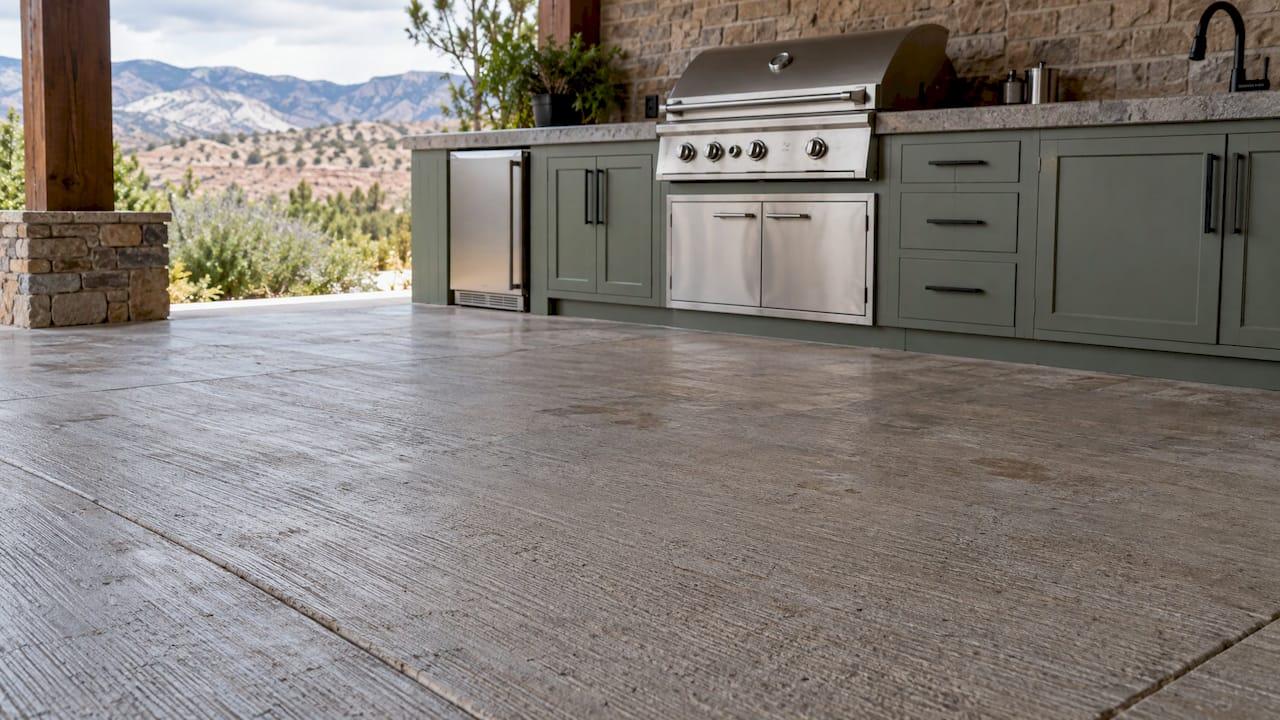
The best outdoor kitchen flooring is a firm, slip-resistant surface that drains away from the house and sits on a base built for the weight of your grill island. For most homeowners that means one of three things: poured or stamped concrete, pavers, or outdoor-rated porcelain tile. The material matters less than what is under it and how water leaves it. This guide shows how to compare the three, what each costs per square foot, and how to prepare and care for the floor so it still looks good in ten years.
TL;DR
- Concrete, pavers and outdoor-rated porcelain tile are the three main choices. Each works well when the base, slope and drainage are right.
- Choose texture before color. Grease, water and bare feet make slip resistance the first filter for any cooking area.
- Material price is only part of the bill. Base preparation, drainage, edges and the footing under the island often cost more than the surface itself.
- Where winters freeze, the base and the joints matter as much as the surface. Moisture that freezes under a floor can lift it.
- Plan the floor first, then the island, so the structure under the heavy equipment is designed once.
Table of Contents
- What to check before you pick a material
- Slip resistance comes first
- The three main materials compared
- What the floor really costs
- Base, slope and drainage
- Keeping the floor looking good
- Perspective
- Plan the floor and the kitchen together
- FAQ
- Sources
What to check before you pick a material
Four questions narrow the field faster than any showroom visit.
- What is already under the kitchen? A concrete patio, a paver patio, an open wood deck and bare ground each call for a different approach. A deck over living space, for example, has very different support and drainage needs from a slab on grade.
- Where will the water go? Rain, hose-downs and sink water all need a path away from the house and away from the cooking zone.
- How will you cook? A grill that spits grease, a pizza oven, a sink and a seating area all put different demands on the surface.
- What does your climate do to a floor? Hot sun, heavy rain and freeze-thaw cycles each stress a surface in their own way.
On that last point, we build in southern Utah, where a floor sees strong sun, big temperature swings and winter freezes. A surface that looks fine in a catalog photo has to survive all of that.
Slip resistance comes first
An outdoor kitchen floor gets wet, and cooking adds oils. That is why slip resistance is the first filter, ahead of color or pattern.
There is no single number that guarantees safety. The U.S. Access Board says accessible floor and ground surfaces must be stable, firm and slip resistant, and it notes that hardened materials such as concrete, asphalt, tile and wood are firm and stable enough, while most loose materials, including gravel, will not meet that bar unless treated. The same guidance does not set a minimum coefficient of friction, because no agreed method for rating slip resistance exists.
For tile, the industry measures wet traction as DCOF (dynamic coefficient of friction). One tile manufacturer explains that the ANSI A137.1 standard sets a DCOF of 0.42 or greater for tile recommended for level interior floors walked on when wet. The same document says ceramic and porcelain tile should not be used where water, oil or grease is consistently present, outdoor areas included, unless the product has a specific exception. It also states that no floor tile is slip proof, and that drainage, prompt cleanup, suitable footwear and good maintenance all reduce the risk.
For exterior wet areas and areas with grills or fryers, the ANSI A326.3 test method includes an informative note that a wet DCOF of at least 0.55 is generally accepted. Treat that as a useful target when you read a tile spec sheet, and ask your installer which product they recommend for an area with a grill.

The takeaway: pick a textured finish, confirm the manufacturer says it is rated for exterior wet use, and let the slope and drainage do the rest. If you are shopping for tile or slab finishes, look at how textured floor slab finishes are presented, because surface texture is what you are really buying.
The three main materials compared
| Material | Strengths | Watch for | Installed cost per sq ft |
|---|---|---|---|
| Poured or stamped concrete | Solid, continuous surface, handles heavy islands, many finishes | Needs sealing, can crack, smooth finishes are slick when wet | $3 to $8 (HomeAdvisor); $6 to $30+ (Fixr) |
| Pavers (brick, concrete, permeable) | Individual units are repairable, many colors and textures, forgiving of ground movement | Needs a well-compacted base, joint sand must be refilled | $8 to $25 for brick, $10 to $30 for permeable |
| Outdoor-rated porcelain tile | Low maintenance, refined look, low porosity | Needs a solid slab, grout is the weak point, must have exterior traction rating | Varies widely by tile and prep |
The concrete and paver ranges come from HomeAdvisor's 2026 outdoor kitchen cost data, which puts the full spread of outdoor kitchen flooring at $1 to $60 per square foot, including gravel at $1 to $4, natural stone at $3 to $35 and decking at $30 to $60. Fixr reports that concrete patio flooring runs $6 to $30+ per square foot installed, with brick pavers at $8 to $12. The wide ranges reflect finish, site access and prep work, so use them to compare materials, not to fix a budget.
Concrete
Concrete is the workhorse. It is a single continuous surface, so a heavy grill island, stone counters and appliances sit on it without shifting. It also takes many finishes: broom, stamped, exposed aggregate or colored.
For an outdoor kitchen, the finish matters. A trowel-smooth surface looks clean and turns slick when wet. A broom finish or exposed aggregate gives your feet something to grip. Seal it, and plan to reseal periodically, and clean grease spots promptly.
Concrete also needs the slope designed in. The pitch has to be built into the pour, not added afterward. Our guide to fixing pooling on a concrete patio covers simple tests for finding low spots and when a trench drain makes sense.
Pavers
Pavers are popular for good reason. They come in many shapes, sizes and textures, and if one stains or cracks you can lift and replace it. The surface is only as good as the base, though. Pavers sit on compacted aggregate and bedding sand, not on a rigid slab, so a weak base shows up as dips and rocking units.
A paver manufacturer's installation guide calls for base materials placed over undisturbed subsoil and compacted to 95% standard proctor density, and for sloping or draining the structure beneath. Read that as: the part nobody sees decides how the floor looks in five years. Our articles on paver base depth and a paver patio drainage checklist go through the details.
Under the island itself, pavers alone are not enough for the concentrated weight. A footing or slab beneath the kitchen run keeps heavy equipment from settling, and the pavers wrap around it.
Porcelain tile
Outdoor-rated porcelain has a low-porosity body, which helps in freeze-thaw climates and makes it easy to wipe clean. Its weakness is not the tile but what holds it down. A tile manufacturer's installation guidance says a solid concrete base is required for ground installations of outdoor floor tile, and recommends a waterproofing and crack-isolation membrane, exterior-grade thinset mortar and a grout sealer to protect against spills, stains, mold and mildew.
For porcelain landscape tile laid on a bed, the paver manufacturer's guide specifies joints of 1/8 to 3/16 inch. Smaller tiles bring more grout joints, which allow more drainage and make sloping easier, while large tiles look cleaner and need more careful traction selection.
Because tile is slick when wet unless textured, and because grease is part of cooking, choose a textured exterior-rated product and talk through the grill area with your installer.
Decks and composite surfaces
If the kitchen sits on a raised deck, the framing becomes the first thing to check. Decking surfaces cost more per square foot than concrete or pavers in HomeAdvisor's data ($30 to $60), and a deck above living space has its own support and drainage needs. Ask your builder to confirm that the structure can carry the island before you pick a surface board.
What the floor really costs
Per-square-foot figures only describe the surface. A realistic quote covers more. When you compare bids, make sure each one lists the same items:
- Demolition or repair of an existing slab
- Excavation, base and compaction
- The surface material itself
- Footings or a reinforced slab under the island
- Waterproofing, slope and drainage, including any trench drain
- Edges, steps and transitions
- Labor and utility runs for gas, water and power
A quote that looks cheap often leaves out drainage or the footing, which is where problems begin. Our outdoor kitchen cost breakdown includes a line-item checklist you can hold against any estimate.
For reference, our published project ranges are $8,000 to $25,000 for paver patios and walkways and $15,000 to $60,000 for outdoor kitchens. The final number depends on size, materials and site conditions, which we confirm in a written estimate.
Base, slope and drainage
Drainage is the most common reason an outdoor kitchen floor fails early. Standing water erodes a paver base, undermines a slab, grows mold and algae, and creates slip hazards. A few principles apply to every material:
- Slope away from the house and the island. Impervious surfaces such as slabs need to be sloped or designed with drainage, as the paver manufacturer's guide states. Build the pitch into the pour or the base from the start.
- Give water somewhere to go. Where a patio meets the house or a retaining wall, a channel drain can catch runoff before it reaches the foundation.
- Prep the substrate. Tile guidance stresses that surface preparation is the most important task, since a substrate that is not clean and dry compromises the finished floor.
- Respect frost. In freeze-thaw climates, water that enters tile, grout or the base and freezes expands and can crack or lift the floor. Ask your local building department how deep frost footings must go for the island.
- Support the heavy parts. Grill islands, stone counters and appliances need a stable foundation, not just a surface that can look good over loose fill.
Plan the floor before the island. Once the layout is fixed, the slope, footings and drain locations follow. Our guide to outdoor kitchen layouts you can tape out first shows how to mark the footprint on your patio before anything is poured.
Keeping the floor looking good
Maintenance depends on the material, but three habits cover most of it.
Clean the right way. Acidic cleaners, citrus degreasers, solvents and sealer strippers can change a floor's DCOF, according to the ANSI A326.3 guidance, and periodic deep cleaning helps maintain traction. Use mild cleaners, rinse thoroughly and deal with grease spills quickly.
Protect the weak points. For tile, that is the grout. Grout often deteriorates before the tile does, and cracked or eroded grout lets moisture in. Sealers on outdoor grout typically need reapplying every year or two depending on weather and traffic, and a chipped tile should be replaced quickly.

Do the seasonal check. Sweep and rinse pavers, refill joint sand and pull weeds. Look over concrete for new cracks and reseal on schedule. Our spring maintenance checklist for hardscape and concrete is a good template for that walk-around.
Perspective
We build outdoor kitchens start to finish with our own crew, so we see the floor as part of one system: the ground, the base, the slab or pavers, the slope, the drains and the island that sits on top.
Most of the flooring trouble we hear about started before any surface was chosen. The base was thin, the pitch ran toward the house, or the island was placed first and the floor was fitted around it. When one crew handles excavation, concrete, pavers and the kitchen itself, those decisions get made together, and there is one person to call.
Our approach for Utah is to pick the surface that fits the structure and the climate, then build the base and drainage to match. For many homeowners that is a textured concrete or a paver patio with a reinforced footing under the island. We would rather talk through your yard than push a single material.
Jake
Plan the floor and the kitchen together
If you are building an outdoor kitchen in Utah, we can design and build the floor, the structure under the island and the kitchen as one project, with a single point of contact from the first estimate to the final walkthrough. Explore our outdoor kitchen builds, or see the paver patio and hardscape work that often forms the kitchen floor.

Our outdoor kitchen cabinet guide on materials, design and care is a good next read once the floor is settled.
FAQ
What is the best flooring for an outdoor kitchen?
There is no single winner, but concrete, pavers and outdoor-rated porcelain tile are the usual choices. Concrete suits heavy islands, pavers are easy to repair, and porcelain is low maintenance. Whichever you choose, a textured finish, a solid base and a slope away from the house matter most.
Can I put tile on my existing patio?
Often yes, if the patio is a sound concrete slab. Tile guidance calls for a solid concrete base, a waterproofing and crack-isolation membrane and exterior-grade thinset. A cracked or poorly draining slab should be repaired or replaced first, so have a contractor look at it.
Is gravel a good outdoor kitchen floor?
Loose gravel is hard to keep stable under a grill, and the Access Board notes that most loose materials are not firm and stable enough for accessible routes. Heavy equipment and chairs also move around on it. A paved or slab surface around the cooking area is a more practical choice.
How much does outdoor kitchen flooring cost per square foot?
HomeAdvisor's 2026 data puts the range at $1 to $60 per square foot, with concrete at $3 to $8 and brick pavers at $8 to $25. Prep, drainage and footings add to the total, so compare itemized quotes rather than material prices alone.
Sources
- Access Board: Chapter 3, Floor and Ground Surfaces
- American Olean (Daltile): DCOF guidance
- SiteClara: Slip resistance testing, DCOF and ANSI A326.3
- HomeAdvisor: Outdoor kitchen cost
- Fixr: Patio floor ideas
- Unilock: Porcelain installation guide
- LATICRETE: Outdoor tile installation tips
- Tomellini: Floor slabs