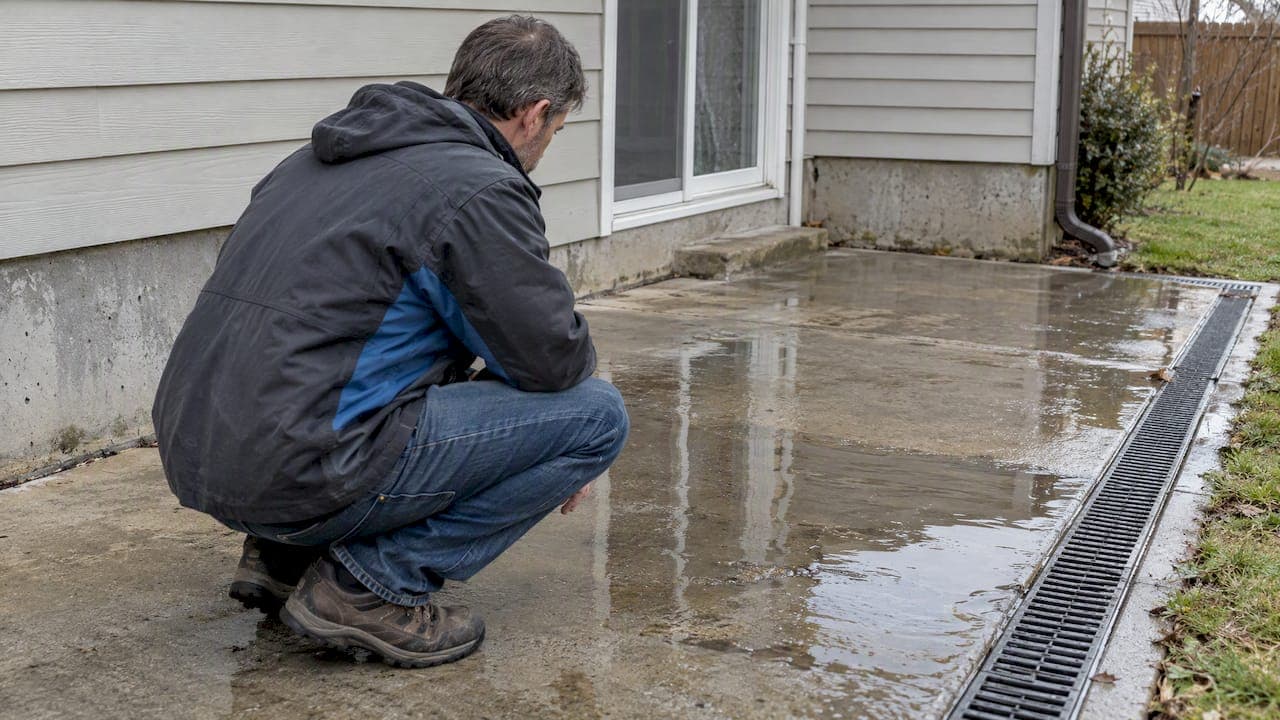
If your concrete patio holds water, the fastest fix is usually a trench or channel drain, or a targeted re-pitch of the problem area, not a full slab replacement. Start with a simple water test and mark the low spots. Building codes set clear slope targets for exterior slabs, and once water leaves the patio, a rain garden or similar feature can safely take the discharge.
TL;DR:
- Installing a trench or channel drain coupled with rerouted downspouts often resolves most pooling issues without needing full slab replacement.
- Proper slope standards include at least 1/4 inch per foot, with the first 10 feet from the foundation requiring a minimum 6-inch fall.
- French drains are suitable for sunken patios or groundwater problems, but they need a proper outlet and proper slope for effective drainage.
- Using overlays or slabjacking can fix mild slope problems or settle areas but are insufficient for large-scale slope or settlement issues.
- Always diagnose pooling causes first, begin with simple retrofits, and consult professionals for extensive regrading or foundation-related drainage fixes.
Table of Contents
- How to diagnose pooling and short-term fixes you can try
- Retrofit solutions: trench drains, French drains, cut channels, overlays, and slabjacking
- Base, slope, surface texture, and discharge: building for durable drainage
- Rain gardens, dry wells, and permeable paving for handling patio runoff
- Contractor checklist and when professional help is needed
- Author's short take: prioritize diagnostics and the least-invasive durable fix
- How A to Z Construction can help
- Sources
- FAQ
How to diagnose pooling and short-term fixes you can try
Before you fix anything, find out exactly where the water collects and why. Run a hose over the patio or wait for the next rain, then watch where puddles form and how long they sit.
- Set a straightedge, a four-foot level, or a string line across the suspect area to find the low spots and measure how far off level the surface is.
- Check nearby downspouts and gutters. A huge share of "patio drainage problems" are actually roof runoff dumping onto the slab.
- Look for clogged drains, grates packed with leaves, or a subbase that has settled and created a dip.
- Mark every low spot with chalk so you can compare your fixes against the original water test later.
Temporary fixes that buy you time include redirecting downspouts away from the patio, cutting a narrow sawcut channel across the low point, or patching a dip with quick-set concrete or asphalt patch. A shallow gravel-filled channel along the worst edge can also carry water off the slab without major demolition.
Pro Tip: Never cut or excavate within a foot or two of your foundation footing without knowing what's underneath. If a fix requires digging near the house, call a contractor instead of guessing.
Retrofit solutions: trench drains, French drains, cut channels, overlays, and slabjacking
Once you know where the water collects, match the fix to the cause instead of jumping straight to a rebuild.
- Trench or channel drains work well when runoff concentrates along one edge. You cut a slot, set a pre-formed channel with a grate, slope the channel itself toward an outlet, and tie it into a pipe that leads to daylight or a dry well.
- French drains (a gravel-filled trench with perforated pipe) suit sunken patios or spots with groundwater or poor infiltration below the surface. They need a real outlet, not a dead end, and the pipe itself should hold a slight downhill slope.
- Cut-in channels filled with decorative gravel or stone are the cheapest retrofit and work for light, occasional pooling rather than chronic standing water.
- Cement overlays or re-pitching can correct a mild slope problem without tearing out the slab, but overlays are limited by bond strength, minimum thickness, and whatever cracking already exists underneath.
- Slabjacking or polyjacking lifts a settled section back toward grade and can restore slope on a localized sink. Large-scale slope problems, though, usually need removal and replacement rather than lifting.
ConcreteNetwork's patio drainage guidance notes that for many existing patios, a small linear trench drain paired with rerouted downspouts gives the best outcome relative to cost, compared with tearing out and replacing the whole slab.
A small trench drain and redirected downspouts often solve pooling that looks, at first glance, like a full-replacement problem. That combination addresses both the surface water and the roof runoff feeding it, which is the pairing that causes most repeat complaints.

Base, slope, surface texture, and discharge: building for durable drainage
Whether you are retrofitting a fix or planning new work, the underlying construction details decide whether the repair lasts.
- Slope: the generally accepted minimum for exterior concrete is about 1/4 inch per foot, or 2%, sloped away from the house.
- Code reference: the IRC commonly requires a 6 inch fall within the first 10 feet from the foundation, with impervious surfaces within that 10 feet sloped at least 2% away from the building.
- Subbase: a compacted gravel layer of about 4 to 6 inches under the slab reduces the settling that creates new low spots months or years later. Our guide to patio base compaction covers why skipping this step is the most common cause of callbacks.
- Surface texture and joints: broom finishes and control joints should follow the direction of intended flow, and sawcuts or channel drains work best placed at the natural low point rather than fought against it.
The goal behind every one of these details is the same: get water to an approved discharge point, whether that is a street gutter, a storm drain, or a landscape feature built to accept it, without routing it back toward the foundation.
Rain gardens, dry wells, and permeable paving for handling patio runoff
Once water leaves the patio, where it goes next matters almost as much as the drain that got it there.
- Rain gardens sited downslope of the patio can absorb runoff, but EPA guidance recommends sizing them so standing water drains within roughly 6 to 12 hours, which means checking how fast your soil actually infiltrates before you dig one.
- Dry wells or infiltration pits work in free-draining soil but may be restricted by local code where groundwater sits high or where setbacks from the foundation apply.
- Permeable pavers and porous concrete let water pass through the surface itself, cutting runoff volume, though they need periodic vacuuming or pressure washing to keep sediment from clogging the voids.
- A channel drain can tie directly into a rain garden, dry well, or storm sewer, but only if the outlet is sized and sloped to actually carry the water it is supposed to collect.
A partner resource on designing a rainwater harvesting system walks through similar outlet and sizing logic if you want to put that runoff to use instead of just discharging it.
Contractor checklist and when professional help is needed
Small jobs, patching a low spot, redirecting a downspout, clearing a clogged grate, are reasonable DIY projects. Regrading a large area, cutting into the slab near the foundation, or installing an in-slab drain system is where a professional earns the fee.
- A contractor measures existing fall with a laser level, checks for buried utilities before trenching, and runs a simple percolation test if a rain garden or dry well is part of the plan.
- A real evaluation also covers permit requirements, since grading and drainage changes near a foundation can fall under local code.
- Expect a site visit, a written estimate with options rather than one fixed answer, and a clear next step if you decide to move forward.
Pro Tip: Ask any contractor you're considering how they plan to route the water once it leaves the drain. A fix that just moves the puddle ten feet isn't a fix.
Author's short take: prioritize diagnostics and the least-invasive durable fix
Run the water test first, clear the drains you already have, and try the simplest retrofit before anything structural. Stay conservative near the foundation, and bring in a professional site evaluation the moment discharge routing gets unclear.
— Jake
How A to Z Construction can help
If the diagnosis points to regrading, an in-slab drain, or a slab that has settled past the point a retrofit can fix, that's project work, not a weekend fix.

A qualified contractor can handle that range of work directly, without routing it through subcontractors:
- Grading and earthwork to correct slope across a full patio or yard, through our earthmoving and grading services.
- Concrete repair, replacement, and overlays for slabs that have settled or were never pitched correctly.
- Trench drain installation and hardscape or landscaping work to route runoff somewhere useful instead of back at the house.
Contact us for a site assessment and a written estimate with your options laid out. Start at our concrete services page or request a free concrete patio estimate to get a contractor out to look at the slope yourself.
Sources
- Semi-Arid Green Infrastructure Toolbox - Rain gardens — EPA
- IRC drainage and grade guidance — ICC excerpt
- Concrete Patio Drainage Solutions to Stop Pooling Water — ConcreteNetwork
- Concrete slope for exterior slabs — ConcreteNetwork
- Quikrete patio guidance: subbase and slope recommendations
FAQ
How do you drain water off a concrete patio?
Start by finding the low spots with a level or string line, then route surface water toward a trench drain, a sawcut channel, or a re-sloped section. ConcreteNetwork's drainage guidance notes that clearing existing clogged drains alone often restores function on older patios.
What is the best drainage option for a patio?
A linear trench or channel drain tied to a proper outlet is usually the best balance of cost and effectiveness for surface pooling. Sunken patios or groundwater issues call for a French drain instead, since it handles subsurface water rather than just surface flow.
Can I just use gravel for drainage?
A gravel-filled channel can carry light, occasional runoff off a patio edge and works as a low-cost retrofit. It won't solve chronic standing water caused by a genuine slope problem, which needs re-pitching, an overlay, or a proper drain.
How do I add drainage to an existing concrete slab?
The common approach is cutting a narrow channel at the low point and installing a pre-formed trench drain with a grate, sloped toward an outlet. For larger slope corrections, contractors use an overlay to re-pitch the surface or, where settlement caused the problem, slabjacking to lift the slab back toward grade.