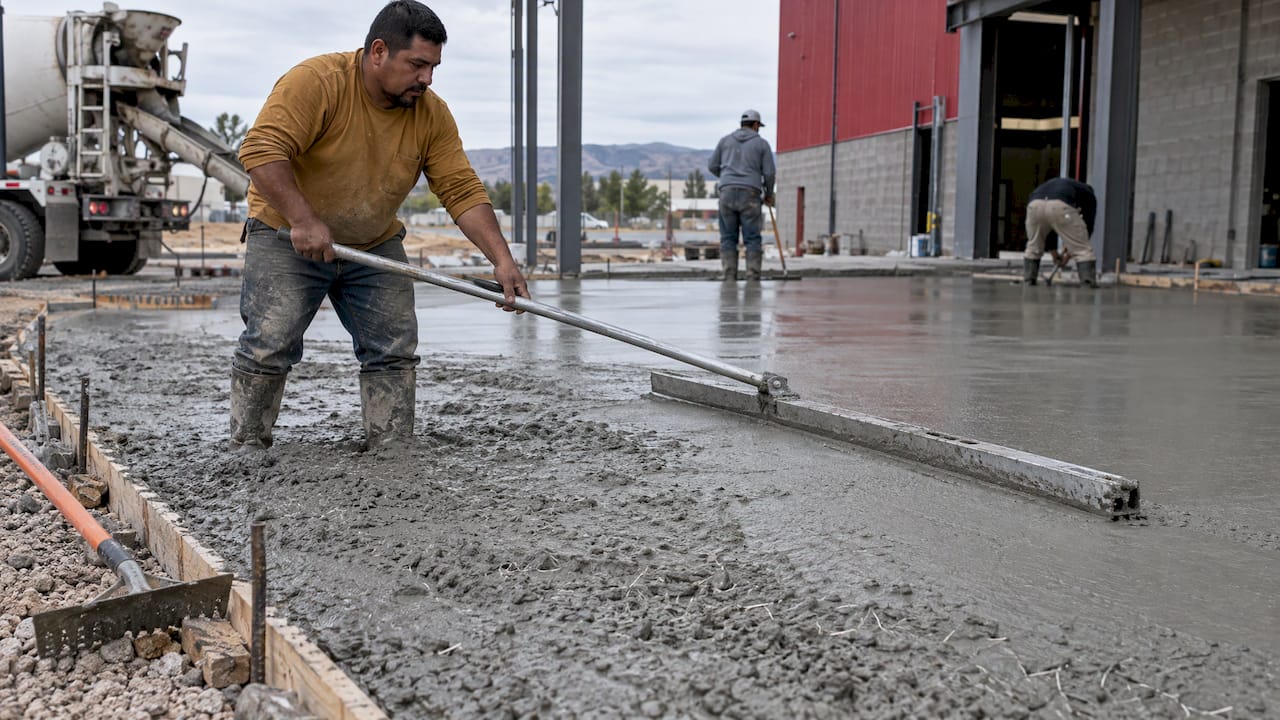
Fiber reinforced concrete (FRC) is concrete mixed with short, randomly dispersed fibers of steel, glass, synthetic polymer, or natural material. The fibers control cracking and add toughness after a crack forms. In slabs on ground and pavements they can serve as the only reinforcement. In beams, columns, and suspended slabs, they supplement engineered steel and do not replace it.
This guide covers what FRC is, how each fiber type behaves, how much fiber goes into a mix, where it is used, and how to decide whether a project needs it.
TL;DR
- FRC is a composite of cement, water, aggregate, and a dispersion of discontinuous fibers, used in place of or alongside traditional reinforcement.
- Fibers mainly improve crack control, toughness, and post-crack strength. They also reduce workability, so mixes often need water-reducing admixtures.
- Common uses are slabs on ground, pavements, shotcrete, precast units, mining, and tunneling.
- Fibers can be the sole reinforcement only where continuous steel is not essential to safety. Structural members still need bars designed by an engineer.
- For a home project, the right reinforcement depends on the soil, the load, and the slab. Ask your contractor to explain the plan before the pour.
Table of Contents
- What fiber reinforced concrete is
- How fibers change the way concrete behaves
- Types of fibers and what each does
- How much fiber goes into the mix
- Where fiber reinforced concrete is used
- Can fibers replace rebar?
- How to decide whether your project needs fibers
- Fiber mixes on a jobsite
- Work with a crew that handles the whole pour
- FAQ
- Sources
What fiber reinforced concrete is
The Fiber Reinforced Concrete Association describes FRC as a composite of hydraulic cement, water, fine and coarse aggregate, and a dispersion of discontinuous fibers. It adds that the fibers can be used in lieu of traditional reinforcement or in addition to it.
That answers the common question about the abbreviation. In civil engineering, FRC stands for fiber-reinforced concrete. You will also see it written "fibre reinforced concrete" in British and international sources. The material is the same.
Plain concrete is strong in compression and weak in tension. According to ACI's guide for design with FRC, concrete is brittle and weak in tension, and fibers can provide post-crack tensile and flexural capacity. Think of the fibers as thousands of tiny stitches across every potential crack plane. They do not stop a crack from starting. They hold it tight once it does.
How fibers change the way concrete behaves
The same ACI guide says fiber reinforcement improves toughness, energy absorption, and residual strength after cracking, and reduces crack widths. Residual strength is the load the concrete can still carry once it has cracked.
The effect depends on the fiber. According to ACI 544.3R, depending on material, length, diameter, deformation geometry, and addition rate, fibers can improve:
- plastic shrinkage cracking resistance (cracks that form in the first hours while the surface is still fresh)
- impact resistance
- toughness and ductility
- post-cracking (residual) strength
This is why "how strong is concrete with fiber?" has no single number as an answer. Fibers do not simply raise compressive strength. They change how the concrete fails, from sudden and brittle to gradual and ductile. How much of that you get depends on the fiber and the dose.
The workability trade-off
Fibers make a fresh mix stiffer. ACI 544.3R notes that adding fibers reduces workability, often calling for mid- or high-range water-reducing admixtures to keep placement properties right. The FRCA says the same about higher fiber dosages. A good mix design accounts for this up front, so the crew can place and finish the concrete properly. It is one reason fiber mixes are designed, not improvised on site.
Types of fibers and what each does
Per a 2021 academic review, fiber types fall into metallic, glass, polymer, and natural groups. The review also stresses that performance depends on fiber dimensions, elastic modulus, bonding capacity, and chemical compatibility with the mix.
| Fiber type | What it is known for | Typical use |
|---|---|---|
| Steel | High strength, post-crack load carrying; depends on geometry, bond, and aspect ratio | Industrial floors, pavements, shotcrete, tunnels |
| Glass (alkali-resistant) | High tensile strength and elastic modulus compared with most polymer fibers | Shrinkage control, thin precast panels |
| Synthetic (polypropylene and similar) | Toughness and impact resistance | Slabs, driveways, pavements, precast |
| Natural | Plant-based, still a developing category | Mostly specialty and research use |
Steel fibers
ACI 544.3R states that steel fibers must be made from high-strength steel to prevent tensile failure. Their behavior depends on their geometry (straight or deformed), bond characteristics, and aspect ratio, which is length divided by diameter. Hooked or deformed ends anchor better in the paste, which is why many structural-grade fibers are not straight wires.

Glass fibers
Glass offers strong reinforcing effects, but ordinary glass has poor alkali resistance, as a 2025 review of fiber-reinforced cementitious composites points out. Cement paste is highly alkaline, so concrete uses alkali-resistant (AR) glass. The 2021 review notes AR glass has relatively high tensile strength and elastic modulus compared with most polymer fibers.
Synthetic fibers
Polypropylene can improve toughness and impact resistance, according to the 2021 review. Synthetic fibers split into two families by size. Microsynthetic fibers are fine and mainly address early-age shrinkage cracking. Macrosynthetic fibers are thicker and are used for post-crack performance at higher doses.

How much fiber goes into the mix
Dosage is set by fiber type and by the job. ACI 544.3R gives these typical ranges:
| Fiber | Dose by volume | Dose per cubic yard |
|---|---|---|
| Microsynthetic | 0.05 to 0.2% | 0.75 to 3 lb |
| Macrosynthetic | 0.2 to 1% | 3 to 15 lb |
| Steel | 0.2 to 1% | 26 to 132 lb |
| AR glass (shrinkage control) | 0.01 to 0.03% | 0.5 to 1.5 lb |
| AR glass integral strands (macro) | Higher | 4 to 8 lb or more |
The spread is wide because the goal changes the dose. A light dose to limit early shrinkage cracks is a different design than a heavy dose meant to carry load after cracking. The producer and the project engineer set the number, based on the performance required and the fiber's data.
Where fiber reinforced concrete is used
The FRCA lists common applications as slabs on ground, pavements, shotcrete, precast units, mining, and tunneling. In each, the fibers do a job that would be slow or awkward with bars or mesh:
- Slabs on ground and pavements. Fibers are distributed through the whole depth, so there is no mesh to keep at the right height during the pour.
- Shotcrete, mining, and tunneling. Sprayed concrete on curved or irregular surfaces is hard to reinforce with bars.
- Precast units. Fibers can simplify factory production.
- Composite metal decks. The FRCA notes that using FRC in place of conventional reinforcement minimizes tripping hazards for crews walking on the deck.
At the high end, the Federal Highway Administration describes ultra-high performance concrete (UHPC) for bridge connections. UHPC connections normally use 2% steel fiber by volume. The common fiber is 0.008 inch in diameter and 0.5 inch long, and it bridges cracks. The FHWA says this can simplify bridge connections and reduce rebar development lengths. UHPC is a specialty material, but it shows how far fiber design can go.
Can fibers replace rebar?
Sometimes, and the answer depends on what the concrete is doing.
ACI's design guide says fibers may be the sole reinforcement where continuous reinforcement is not essential to safety and integrity. For structural members, it says reinforcing bars should conservatively support the total tensile loads.
The FRCA draws the same line in its comparison of fibers and conventional reinforcement. Structural steel designed under ACI 318 in girders, columns, and suspended decking generally cannot be reduced or replaced. Macrofibers can supplement the load-carrying capacity.
In practice:
- Fibers alone can be a fit for non-structural flatwork where the goal is crack control, such as many slabs on ground and pavements, when the design calls for it.
- Fibers plus bars is the usual answer where the concrete carries structural load.
- Bars or an engineered system is the answer for anything load-bearing, such as footings, walls, beams, and elevated slabs.
ACI Committee 544 also stresses that any structural contribution from fibers must be specifically assessed and justified for a load-bearing application. If you are weighing fibers against steel in a structural member, that assessment is an engineer's job. Understanding how structural members are modeled helps you follow the conversation, and a walkthrough of Revit structural framing explained shows how engineers lay out beams and loads before any concrete is ordered.
How to decide whether your project needs fibers
Use these questions when you plan a pour:
- What is the concrete for? A patio, walkway, or shed pad has different demands than a garage floor or a foundation.
- What loads will it carry? Vehicles, equipment, and structure above all change the answer.
- What is under it? Reinforcement cannot make up for poor support. Soil preparation and base come first, and our guide to concrete road base explains why. For foundations, see our soil checklist for house foundation types.
- How thick is the slab? Thickness and reinforcement work together. Our post on how thick a concrete driveway should be walks through the numbers.
- Where will the joints go? Reinforcement of any kind does not replace joint planning. See our control joints guide.
- How will it cure? Early-age care matters for every mix. Our curing time timeline covers it.
If you are comparing quotes, ask each bidder what reinforcement is in the plan (fiber, mesh, bars, or a combination), why, and what thickness and joint layout go with it. A clear answer is a good sign of a well-planned pour.
Fiber mixes on a jobsite
Fibers change how the crew works, so a few practical points apply:
- Placement. Because fibers reduce workability, mixes often include water-reducing admixtures. Do not let anyone add water at the truck to loosen a stiff load. Extra water weakens concrete.
- Finishing. Some fibers can show at the surface if finishing is not done carefully. A crew with experience in the specific product handles this routinely.
- Cleanup. Washout from any pour needs a plan. Read our concrete washout disposal checks before the trucks arrive.
- Demolition. Reinforced concrete of any kind has end-of-life options, covered in our guide to concrete disposal options and EPA rules.
Our perspective
Most of the questions we hear about reinforcement are really questions about the whole pour. Homeowners ask whether fibers are "better" than mesh or bars. The honest answer is that reinforcement is one decision in a chain: soil, base, thickness, mix, joints, finishing, and curing. Get the chain right and the slab performs. Get one link wrong and no additive saves it.
That is why we run every phase of a project with our own licensed crew and no subcontractors. The person who walks your site, prepares the ground, pours the concrete, and finishes it is part of one team, with one point of contact for you. When reinforcement is discussed, the people who will build the slab are in the conversation, along with the people who know Utah's climate and codes.
If your project involves anything structural, such as a foundation, a retaining wall, or a remodel that changes how a building carries load, we treat reinforcement as a design question, not a shortcut. Fibers have a real place in concrete, and so do bars. The right choice follows the load and the site.
Jake
Work with a crew that handles the whole pour
If you are planning concrete in Utah, A to Z Construction is a licensed general contractor based in Cedar City. We handle concrete driveways, slabs, foundations, and decorative flatwork with an in-house crew, from estimate to final completion. Published ranges on our site run $4,000 to $15,000 for concrete driveways and approaches. Final pricing comes from a fixed bid on your site.
For a driveway or patio, you can request a free estimate. If your project reaches into structural work, see our structural remodeling services. Planning a patio or retaining wall alongside the concrete? Our hardscape services put those under the same crew and the same contact.
FAQ
What does FRC stand for in civil engineering?
FRC stands for fiber-reinforced concrete. It is concrete containing dispersed, discontinuous fibers, used instead of or in addition to traditional reinforcement. The spelling "fibre" is common outside the US.
How strong is concrete with fiber?
Fibers mainly improve toughness, energy absorption, crack control, and residual strength after cracking, rather than simply raising compressive strength. The result depends on fiber type, length, geometry, and dose. A mix designer or engineer sets these for the application.
Can fiber reinforced concrete replace rebar?
In some applications, yes. Where continuous reinforcement is not essential to safety and integrity, fibers can be the sole reinforcement, according to ACI. In structural members such as girders and columns, bars should carry the tensile loads. Ask a licensed structural engineer when a member is load-bearing.
What fibers are used in concrete?
The main groups are steel, glass, synthetic polymer (such as polypropylene), and natural fibers. Steel and macrosynthetic fibers are used for post-crack performance. Microsynthetic and AR glass fibers are common for shrinkage crack control.
How much fiber is added to concrete?
ACI 544.3R gives typical microsynthetic doses of 0.75 to 3 lb per cubic yard and macrosynthetic doses of 3 to 15 lb. Steel runs 26 to 132 lb per cubic yard. The producer and engineer pick the dose for the job.
Sources
- FIP 1: Fiber-Reinforced Concrete, Fiber Reinforced Concrete Association
- FIP 9: Fibers vs. Conventional Reinforcement, Fiber Reinforced Concrete Association
- ACI 544.3R-08: Guide for Specifying, Proportioning, and Production of Fiber-Reinforced Concrete
- ACI 544.4R-18: Guide for Design with Fiber-Reinforced Concrete
- State-of-the-Art Review of Capabilities and Limitations of Fiber-Reinforced Concrete (2021)
- Fiber-reinforced cementitious composites: recent advances (2025)
- FHWA-HRT-19-011: Design and Construction of Field-Cast UHPC Connections