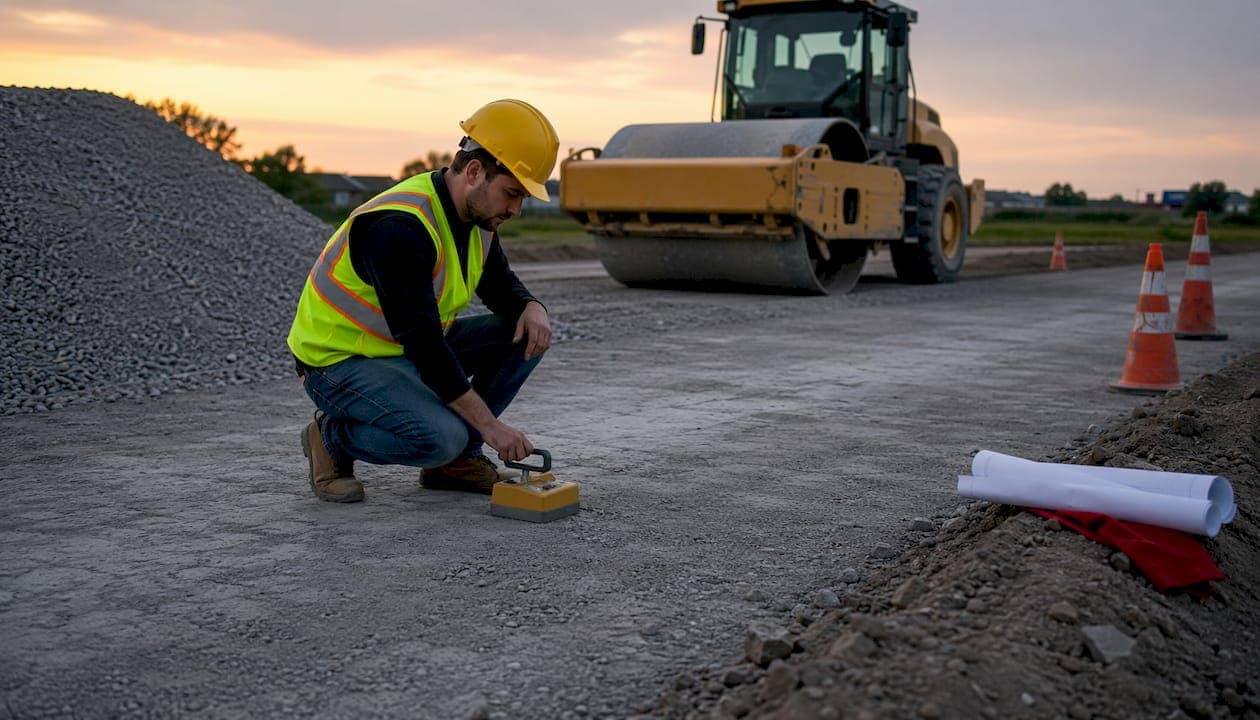
A concrete road base is an engineered, compacted aggregate layer placed directly beneath a concrete slab or pavement surface. Its job is to distribute load evenly across the subgrade, provide a stable working platform, and manage water movement so frost heave and erosion don't undermine the slab above.
Key facts to know before you spec or order:
- Composition: crushed rock, recycled concrete aggregate (RCA), or natural gravel, graded to include controlled fines but no clay or organic material
- Thickness: residential minimum is a typical minimum compacted thickness; commercial applications require thicker compacted layers appropriate to heavier loads
- Standards: ACI 302 guidelines call for granular base materials with controlled fines content, free of clay and organics
- Function: uniform support, drainage, and frost protection for the concrete above
- Agencies: the Federal Highway Administration (FHWA), Portland Cement Association (PCA), and American Concrete Institute (ACI) all publish guidance on base layer design
The distinction between a road base and a simple fill layer matters enormously. Fill compresses unevenly. A properly graded and compacted base does not, and that uniformity is what keeps concrete from cracking.
Table of Contents
- What makes a good concrete road base material?
- Where is concrete road base actually used?
- When concrete road base is the wrong choice
- How does concrete road base compare to other base materials?
- How to install concrete road base correctly
- What's the difference between a concrete base, lean concrete base, and subbase?
- A-to-zconstruction handles base prep and concrete work together
- Key Takeaways
- FAQ
What makes a good concrete road base material?
The physical properties of road base materials determine whether a slab lasts decades or starts cracking within a few seasons.
Gradation and particle size are the starting point. Granular base aggregates are typically dense-graded with moderate maximum particle sizes appropriate for base layers. Fines passing the No. 200 sieve are limited to amounts that preserve drainage and limit frost susceptibility. Angular, cubical particles interlock under load; rounded, smooth particles do not.
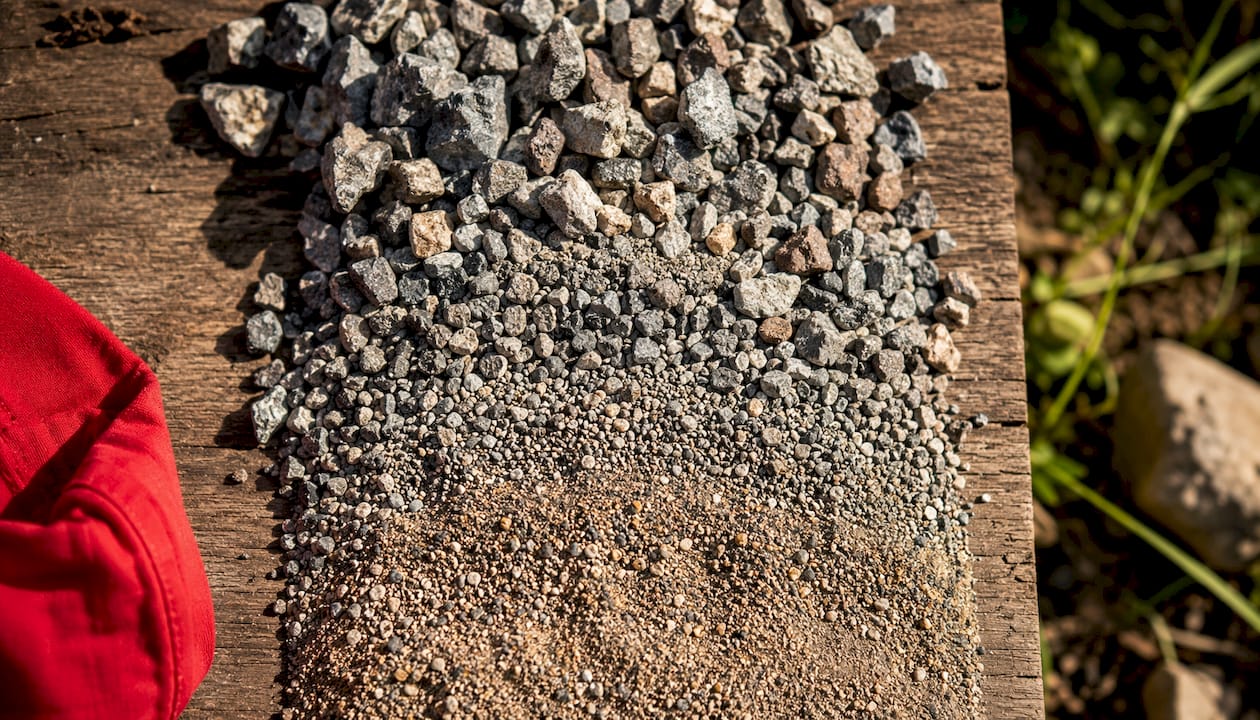
Compaction standards define the target density. Residential slabs require ≥95% Standard Proctor density (AASHTO T99); commercial and industrial applications require high compaction density. Nuclear density gauges and sand replacement tests verify field results.
California Bearing Ratio (CBR) measures resistance to deformation under load. A well-compacted crushed-stone base typically achieves CBR values well above the minimum thresholds needed for residential and light commercial slabs.
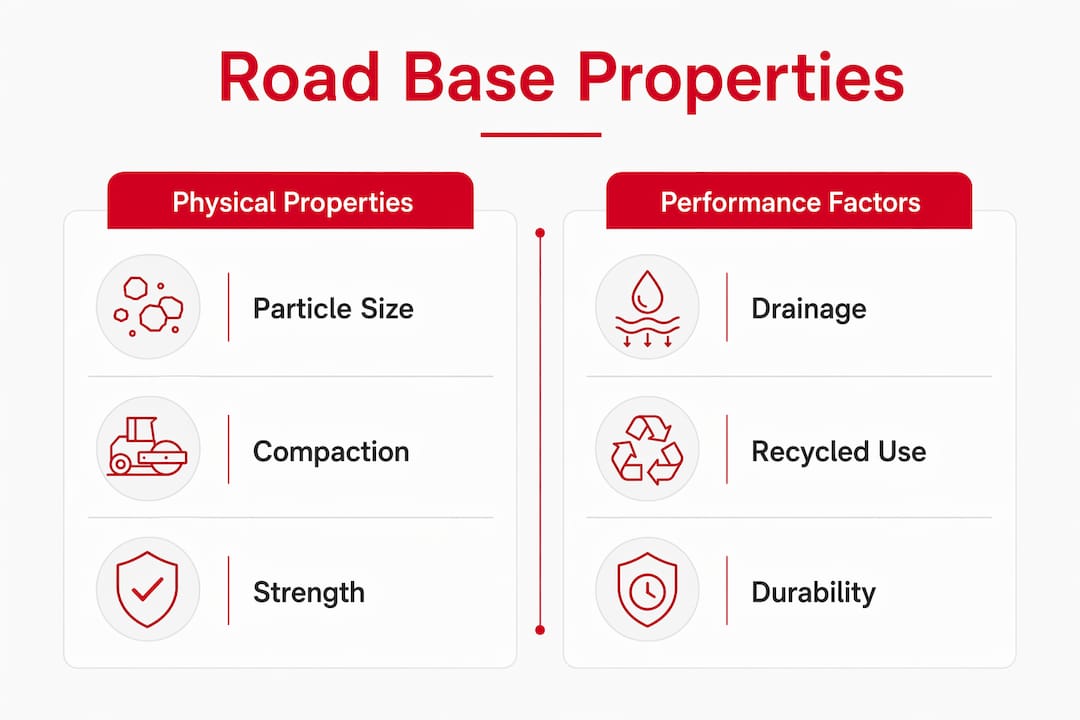
Drainage balance is where many specs go wrong. The PCA advises that overly permeable bases can compromise structural integrity, so dense-graded bases with moderate permeability are preferred over free-draining open-graded mixes for most applications.
Recycled crushed concrete (RCA) performs comparably to virgin aggregates when properly processed and free of contaminants. It carries real environmental advantages and is accepted under ACI 302 guidance.
| Property | Requirement |
|---|---|
| Max particle size | — |
| Fines content (No. 200 sieve) | Max 8% for base; — for subbase |
| Plasticity | Non-plastic fines only; no clay |
| Compaction (residential) | ≥95% Standard Proctor (AASHTO T99) |
| Compaction (commercial) | ≥98% Modified Proctor density |
| Organic content | None permitted |
Where is concrete road base actually used?
The range of applications is wider than most people expect.
- Road and highway pavements: the FHWA notes that base layers provide uniform support, prevent pumping, and serve as a stable working platform during construction
- Residential driveways and slabs: a compacted granular base under a concrete driveway prevents differential settlement and cracking from soil movement
- Parking lots: heavier vehicle loads demand consistent bearing capacity across the entire slab footprint
- Building floor slabs: industrial and warehouse floors use thick, well-compacted bases to handle forklift and rack loads without pumping
- Walkways and patios: even light-duty flatwork benefits from a graded base that sheds water away from the slab edge
- Landscaping foundations: retaining walls, paver patios, and outdoor structures all rely on a stable base layer to prevent settling
The load requirements differ significantly by application. A residential garage slab can work with 100mm of compacted base over a stable subgrade. A heavy industrial floor or a highway lane may need 200mm or more, sometimes with a stabilized subgrade underneath.
When concrete road base is the wrong choice
Not every site or application suits a standard granular base, and specifying one without accounting for site conditions leads to expensive failures.
- Expansive clay subgrades with CBR below 5% require thicker subbases of 250–400mm or soil stabilization before any base layer goes down; a standard base placed directly on weak clay will punch through under load
- Poor drainage environments: sites with high water tables or standing water need engineered drainage solutions or chemically stabilized bases, not just granular fill
- Continuously reinforced concrete pavement (CRCP): this pavement type has specific base requirements tied to its reinforcement design; a standard unbound granular base may not meet those specifications
- Frost-susceptible soils in cold climates: granular base alone may not provide sufficient frost protection depth; additional insulation layers or deeper excavation may be required
- Inadequate compaction before pour: placing concrete over a base that hasn't reached target density is one of the most common causes of slab failure; moisture exposure or rain between compaction and pour can undo the work entirely
The PCA's guidance is clear: uniform support matters more than raw strength. A base that's 90% compacted in most spots but soft in two corners will crack the slab at those corners regardless of how good the concrete mix is.
How does concrete road base compare to other base materials?
| Material | Composition | Best Applications | Strength & Drainage | Cost Considerations |
|---|---|---|---|---|
| Crushed stone base | Angular crushed rock, dense-graded | Roads, driveways, heavy slabs | High CBR; moderate drainage | Mid-range; widely available |
| Recycled crushed concrete (RCA) | Crushed demolished concrete | Driveways, parking lots, light roads | Comparable to virgin aggregate when clean | 20–30% less than virgin aggregate |
| Natural gravel | Rounded river gravel or pit-run | Light residential, drainage layers | Lower stability than crushed; good drainage | Lower cost; less stable |
| Lean concrete base (LCB) | Low-cement concrete mix | Under jointed highway pavements | High; rigid support | Higher than granular; longer install |
| Stabilized base | Granular + cement or lime | Weak subgrades, heavy industrial | Very high; low permeability | Highest cost; specialized equipment |
The practical takeaway: for most residential driveways and slabs in the US, crushed stone or RCA base delivers the right balance of performance and cost. Natural gravel works for light landscaping applications but lacks the angular interlock needed under loaded slabs. Lean concrete base is a highway-grade solution that rarely makes sense for residential work.
Proper subbase design for concrete foundations always starts with a soil assessment before choosing the base material.
How to install concrete road base correctly
Site preparation sets the ceiling on everything that follows.
- Excavate to design depth: remove topsoil, organic material, and any soft spots; the subgrade must be firm and graded to drain away from the structure
- Compact the subgrade first: a poorly compacted subgrade defeats even a perfect base layer
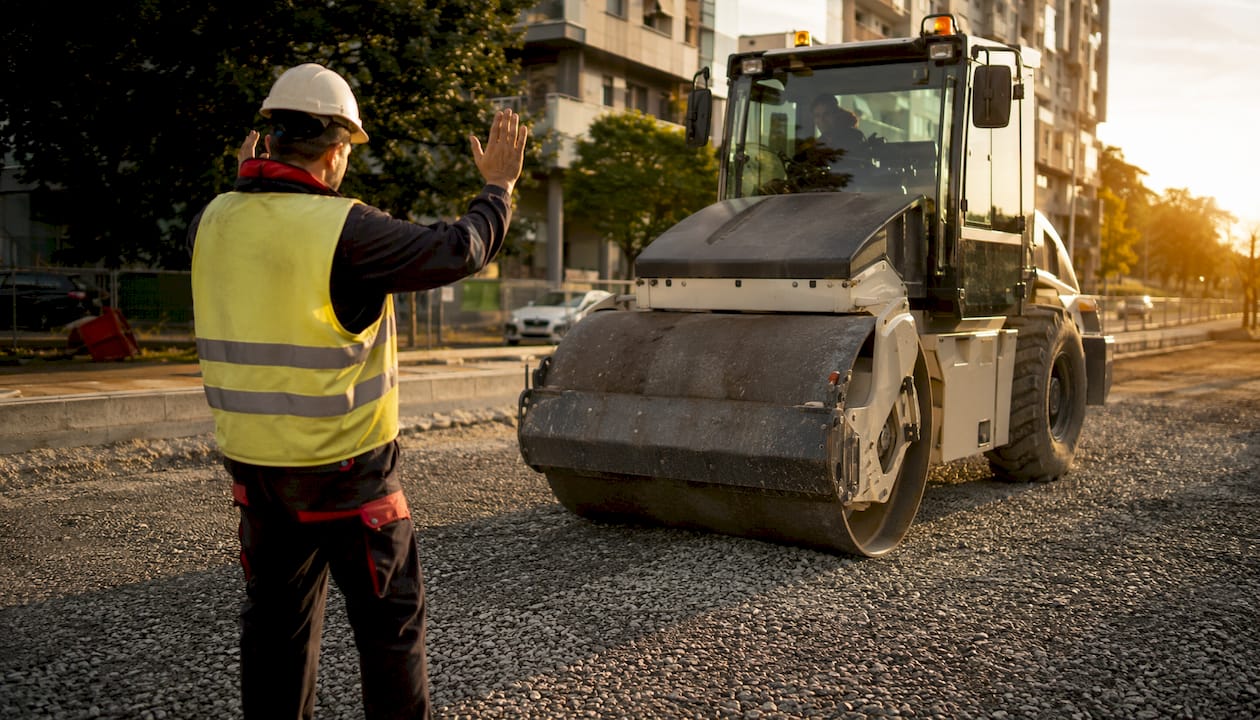
- Place base in lifts: granular base is spread in layers of 150–200mm and compacted individually; never dump the full depth and compact once
- Wet the material before compacting: moisture content near optimum (typically 4–8% for crushed stone) is required to reach target density
- Trim to grade: the finished base surface must meet tolerance requirements, typically ±10mm, so the concrete slab achieves uniform thickness
- Verify compaction: use a nuclear density gauge or a dynamic cone penetrometer for rapid, reliable bearing capacity assessment before the pour
- Protect before pouring: cover the compacted base if rain or freezing temperatures are forecast; re-compact if the surface is disturbed
Pro Tip: Run a loaded dump truck or roller across the finished base before the concrete crew arrives. Any soft spots will deflect visibly under the load. Mark them, dig them out, recompact with fresh material, and re-verify. Skipping this proof-roll is the single most common shortcut that leads to warranty callbacks.
Proper concrete driveway installation depends on this sequence being followed without shortcuts, especially the lift-by-lift compaction step.
What's the difference between a concrete base, lean concrete base, and subbase?
These three terms appear in the same spec sheets and often get used interchangeably. They are not the same thing.
Concrete base (CB) is an unreinforced structural concrete layer placed beneath a surface pavement. It provides rigid, high-strength support and is used under asphalt surfaces on high-traffic roads. The California DOT describes CB as the stiffer, more expensive option compared to lean concrete base.
Lean concrete base (LCB) uses a lower cement content than a standard concrete base, making it less rigid and cheaper while still providing effective load transfer beneath jointed concrete pavement slabs. A 28-day compressive strength around 15 MPa is typical. It's the standard choice under jointed highway slabs where a granular base alone won't provide sufficient support.
Subbase is the granular layer below the base, not a structural layer in the traditional sense. Its primary roles are drainage, frost heave resistance, and providing a uniform working surface for the base above. The FHWA and state DOT design manuals treat subbase as a support and drainage layer, not a load-bearing one.
The hierarchy from bottom to top: subgrade soil, then subbase (granular), then base (granular or concrete), then the concrete or asphalt surface. Each layer has a distinct job. Confusing LCB with a standard granular subbase, for example, leads to either over-engineering (and overspending) or under-building for the traffic loads involved. Guidance on preventing concrete cracking consistently points to correct layer specification as the first line of defense.
A-to-zconstruction handles base prep and concrete work together
Getting the base right and the concrete right requires the same crew working from the same plan. When earthwork, base preparation, and concrete placement are split across different subcontractors, tolerance errors compound and accountability disappears.
A-to-zconstruction is a licensed general contractor in Cedar City, Utah, with an in-house crew that handles excavation, subgrade compaction, base preparation, and concrete flatwork as a single coordinated scope. No handoffs between subs, no gaps in quality control between the base layer and the pour. Whether the project is a residential driveway, a commercial slab, or a hardscape installation in Utah, the base work and the concrete work are planned and executed together. Get a quote directly at A-to-zconstruction and have one crew own the result from excavation to finished surface.
Key Takeaways
A properly compacted, well-graded concrete road base is the single most important factor in preventing slab cracking, pumping, and premature pavement failure.
| Point | Details |
|---|---|
| Thickness by use | Residential base minimum is 100mm compacted; commercial typically requires 150–200mm or more. |
| Compaction targets | Residential slabs need ≥95% Standard Proctor density; commercial requires ≥98% Modified Proctor. |
| RCA is a viable option | Recycled crushed concrete performs comparably to virgin aggregate and costs 20–30% less for light-duty applications. |
| Uniform support over strength | The PCA identifies uneven support, not insufficient strength, as the primary cause of pavement distress. |
| A-to-zconstruction | Handles excavation, base prep, and concrete flatwork as one coordinated scope in Utah, eliminating subcontractor handoff errors. |
FAQ
What is a road base in concrete construction?
A road base is a compacted granular layer placed beneath a concrete slab or pavement to distribute load, provide drainage, and prevent frost heave. It is typically made from crushed stone, recycled concrete, or gravel graded to specific particle size and fines requirements.
Is road base a good material to use under concrete?
Yes, a properly graded and compacted road base is the standard foundation for concrete slabs. ACI 302 guidelines specify granular base materials with controlled fines and no clay or organics as the correct preparation before any concrete pour.
What's the difference between crushed concrete and road base?
Crushed concrete (RCA) is a specific material made from demolished concrete; road base is a performance specification that crushed concrete can meet when properly processed. RCA typically costs 20–30% less than virgin aggregate road base and performs comparably for driveways and parking lots.
Does road base need to be compacted before pouring concrete?
Compaction is not optional. Residential slabs require ≥95% Standard Proctor density and commercial slabs require ≥98% Modified Proctor density, verified with a nuclear density gauge or dynamic cone penetrometer before the concrete is placed.