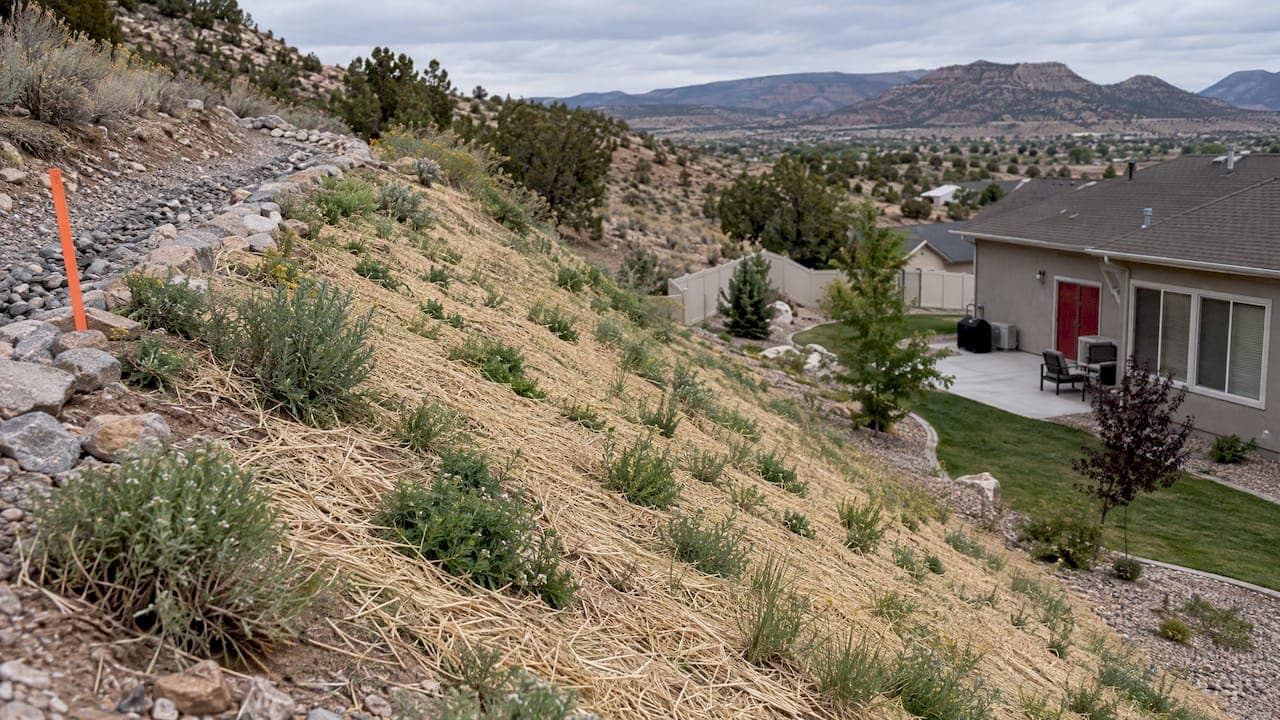
The fastest way to control erosion on a slope is to slow the water, spread it out and keep the soil covered. Most slopes need more than one fix. A gentle yard may only need ground cover and a redirected downspout. A steep or long hillside usually needs a combination of drainage, erosion-control blankets, deep-rooted plants and sometimes terraces or a retaining wall. This guide shows you how to read your slope, choose the right method for its grade and soil, and know when it is time to hire a licensed contractor.
TL;DR
- Find out where the water comes from first. Roof runoff, a neighbor's grade or a bare patch above the slope often does more damage than rain landing on the slope itself.
- Steeper than 3:1 or longer than 50 feet means more protection is needed, and no single fix is enough for a long, steep slope.
- Vegetation, mulch and erosion-control blankets suit moderate slopes. Terraces and retaining walls, with drainage behind them, suit steep ones.
- Never fill gullies with loose soil and walk away. Fix the water path that cut them.
- Large grade changes, walls and slopes above or near buildings call for a licensed professional and a permit check.
Table of Contents
- How to tell soil is leaving your slope
- Read the slope before you choose a fix
- Slope stabilization methods compared
- Landscaping a steep slope with plants that hold
- Drainage is the step most slope fixes skip
- Terraces and retaining walls for steep ground
- Controlling erosion while you build
- Perspective: why we handle slopes in-house
- When to call a professional
- FAQ
- Sources
How to tell soil is leaving your slope
Erosion rarely announces itself. It starts as a thin, even loss of topsoil and ends with a channel you can lose a boot in. Knowing the stage tells you how serious the fix needs to be.
Sheet erosion is the fairly uniform loss of soil across the whole surface. You see it as exposed roots, pebbles sitting on top of the ground, or a lighter, subsoil color where the dark topsoil used to be. Rills are small channels, usually less than 4 inches deep, and normal tillage can erase them. On a residential slope, that means raking and reseeding can still handle them if you also fix the cause.
Gullies are the point where you have to stop treating symptoms. When rills converge into larger channels that recur in the same place, the water has found a path and it will keep using it. Liquid water is the major agent of erosion: raindrops loosen the soil (splash), then moving water carries it off in sheets, rills and gullies.

A useful habit: walk the slope during or right after a hard rain. Note where water runs, where it pools, where it turns brown and where it speeds up. Those spots are your repair list.
One caution from the same federal guidance: regularly filling an ephemeral gully can make things worse over a wider area, because loose fill is easily carried off by the next runoff. Redirect the water, then repair the channel.
Read the slope before you choose a fix
The right method depends on four things: how steep the slope is, how long it is, what the soil is like, and how much sun and water it gets. Spend an afternoon on this and you will avoid paying twice.
Measure the grade
You can measure slope with a laser level, a clinometer or another simple method, as environmental guidance from a national laboratory describes. The string-and-stake method works fine at home: stretch a level string from a stake at the top of the slope to the ground at the bottom. To get percent slope, divide the height of the string at the stake by the string's length and multiply by 100.
Two thresholds are worth remembering. State erosion-prevention guidance says slopes steeper than 3:1 need more protection, and slopes longer than 50 feet carry greater risk. A 3:1 slope drops 1 foot for every 3 feet of horizontal run, about 33 percent.
Check soil, sun and water
Soil type matters. Loamy soils are more erodible than sandy or clayey soils, so a nice, workable garden loam can be the hardest to hold on a hill.
Sun matters too. South-facing slopes can dry faster and north-facing slopes stay cooler, which changes what will establish. A home-drainage manual recommends a site inventory that records slope aspect, sun and shade patterns, vegetation, high and low spots, and how water moves during rain. Sketch that on paper before you buy a single roll of anything.
Slope stabilization methods compared
The federal and state guidance we reviewed describes the same menu of options: vegetation, mulch, erosion-control blankets, terracing or retaining walls for steep ground, and drainage pipes behind walls. The table below matches each to the conditions where it earns its cost.
| Method | Best for | Limits |
|---|---|---|
| Native ground cover, shrubs and trees | Moderate to steep slopes with time to establish | Bare soil is exposed until roots take hold |
| Mulch (straw, bark, shredded material) | Temporary cover on bare soil, planting beds | Can wash off on steep or concentrated flow |
| Erosion-control blankets or turf-reinforcement mats | Steeper or highly erodible soil while plants establish | Need good soil contact and proper anchoring |
| Berm or diversion channel above the slope | Runoff arriving from higher ground | Must have a safe place for the water to go |
| Straw rolls or silt fence at the base | Catching sediment at the toe | Controls sediment, does not stop the erosion |
| Downspout extensions and drains | Roof and pavement runoff hitting bare soil | Only solves the water you can capture |
| Terraces | Long, steep slopes that need to be broken up | Earthwork, and sometimes engineering |
| Retaining walls with drainage | Steep grade changes, slopes beside structures | Highest cost, needs proper drainage behind it |
The guidance lists vegetation, erosion-control blankets, straw rolls or silt fence at slope bases and downspout extensions as practical ways to stop runoff, and the state manual adds that slope protection can include diverting upland runoff with a berm or channel, placing silt fence at the toe, and using blankets or turf-reinforcement mats where needed.
The same state guidance is blunt about one point: slope protection takes multiple actions, and no single approach is enough for a long, steep slope or highly erodible soil. Plan in layers: divert the water, cover the soil, then build roots.
Landscaping a steep slope with plants that hold
Plants are the cheapest long-term erosion control, and the only one that gets stronger with age. Roots bind soil, foliage breaks the force of raindrops and ground cover slows water as it moves.
What the guidance recommends
A state geology guide for homeowners advises you to plant native ground cover, and notes that the roots of trees and other plants strengthen the slope. Another source suggests vegetation for ground sloping more than 25 percent, and on slopes greater than 50 percent, plants that do not require mowing. Mowing a steep bank is also a safety problem, so a low, maintenance-light planting is the better choice anyway.
Do not pull out trees to open a view without thinking it through. The same state guide notes that after a tree is cut, its roots take 5 to 8 years to lose strength, so the slope can weaken well after the stump looks harmless.
Cover the soil while plants establish
Seeds and young plants need protection. Mulch such as straw, bark, shredded paper or leaves works, and wood scraps can hold soil around a new home until landscaping goes in. On steeper ground, pin down an erosion-control blanket over the seeded area instead of loose mulch.
Plant with the slope in mind
- Choose plants suited to your sun exposure and local climate. In Utah's dry conditions that usually means drought-adapted, xeriscape-style plantings with drip irrigation instead of overhead spray.
- Mix ground cover, shrubs and a few trees so you get shallow and deep roots.
- Water gently while plants establish. Too much irrigation on a slope is its own risk, as the next section explains.
- Skip lawn on very steep banks. Maintenance is hard and heavy watering saturates the soil.
If you want a finished look without a lot of upkeep, our landscaping team installs sod, xeriscaping, artificial turf and irrigation. Artificial turf is published at $8 to $20 per square foot, and it needs a properly graded, drained base to stay put on a slope.
Drainage is the step most slope fixes skip
Most erosion problems are water-management problems. A slope can be planted perfectly and still fail if a downspout dumps onto it.
Start above the slope. Capture roof water with gutters, and use downspout extensions that direct water past bare soil. Divert runoff from driveways and upslope yards with a shallow swale or berm that leads to a stable outlet. Our guide on fixing gutters and grade to stop standing water covers the first checks.
There is also a safety reason to be careful. A state landslide guide warns that adding water to a slope increases its weight and downward force, which puts surrounding homes at risk. Do not point drains, pool overflow or irrigation heads at a hillside.
Paved areas matter too. If a patio or driveway sheds water toward a slope, fix the pitch and outlet first. Our posts on concrete patio drainage and paver patio drainage walk through the soil, slope and outlet checks.
Finally, do not overlook small grade corrections. One yard-care guide suggests that a subtle slope of 1 inch per 10 feet is ideal for runoff on lawns and gentle yards, which is a reminder that you often want water to move slowly and steadily, not hit a steep bank at speed.

Terraces and retaining walls for steep ground
When a slope is too steep for plants and blankets alone, you shorten and flatten it. Terracing breaks one long slope into level steps, so water spreads and soaks in instead of gaining speed. Retaining walls do the same job in a smaller footprint and make flat, usable space.
Both appear in the list of methods for steep slopes, along with drainage pipes behind retaining walls. That last detail is the one homeowners miss. A wall holds back soil, but it also holds back water unless there is a way out. Gravel backfill, a perforated drain and a planned outlet are not optional. Read our explainer on retaining wall drainage before you accept any bid.
Here is what to weigh:
- Height and load. Taller walls, and walls that carry a driveway, structure or slope above, need engineering and a permit check.
- Wall type. Block walls and boulder walls suit different settings and budgets.
- Drainage. Ask exactly where the water leaves the wall.
- Access. Equipment access determines labor cost on a hillside.
Our published range for retaining walls is $6,000 to $40,000, depending on height, length, material and site conditions. You can read about our retaining wall work and, for the DIY-minded, a guide to building a retaining wall on a slope.
If the real problem is grade, not wall height, regrading may solve it. Our earthmoving and grading and landscape earthwork services reshape a yard so water drains away from the house and across stable ground. If you are hauling soil, this note on cut and fill volume conversions helps you estimate loads.
Fences on slopes bring their own issues: posts need deeper footings and rails need stepping. See our guide to fencing a sloped yard.
Controlling erosion while you build
Slopes erode fastest when they are freshly disturbed. If you are grading, excavating or building on a hillside, the plan for the soil should come before the equipment does.
The basics are consistent across official guidance. During construction, limit vegetation removal, use temporary covers such as straw mulch, and periodically check and maintain sediment controls. Phasing the work so only small areas are open at once, and relying on simple passive controls, is less costly and simpler to manage than structural sediment controls for large volumes of concentrated water. Planning engineering controls for site risks before work starts is how crews keep soil and sediment from leaving the site.
Timing matters. Maine's field guide, for example, calls for extra winter and snowmelt measures on unstabilized sites by November 1, and for erosion or discharges to be repaired immediately. Your local calendar differs, but the principle holds: do not leave bare slopes going into the wet or freezing season.
Concrete work on a slope adds a second runoff risk. Read about concrete washout disposal so slurry never reaches the soil you are trying to protect.
Perspective: why we handle slopes in-house
We see the same pattern on slope jobs again and again. A homeowner hires one company to regrade, another to plant and a third to build a wall. Each does its piece, and no one owns the water. The wall has no drainage outlet, the new sod sits under a downspout, and the regrade sends runoff to a neighbor's fence.
That is why we run every phase with our own licensed crew: earthwork, concrete, masonry, walls, fencing and landscaping. Without subcontractors, one person can look at the slope as a system. The grade, the drains, the wall and the plants get decided together, and you have a single point of contact when something needs adjusting after the first storm.
Our advice is to fix water before beauty. Divert it, spread it, slow it, then plant. We also build for Utah's climate and local codes, which is why we would rather talk you out of an oversized wall than sell you one the slope does not need. A sensible grade and the right roots solve more erosion problems than concrete does.
— Jake
When to call a professional
Some slopes are a weekend project. Others are not. The federal home-drainage guide tells readers to check applicable regulations and get technical help from a licensed engineer, landscape architect or certified erosion-control professional before putting practices in place.
Bring someone in when:
- The slope is steeper than 3:1 or longer than 50 feet and already shows rills or gullies.
- Water, cracks or sliding soil are near a house, a driveway or a septic area.
- You are planning a wall, terrace or large regrade, or need to move a lot of soil.
- You do not know where the runoff should go.
For anything that threatens a structure, an engineer's assessment comes first. Contractors build what the design calls for. Check city or county rules for grading and walls before you start.
If you are in Utah and want a hillside fixed without managing several trades, A to Z Construction handles grading, walls, concrete, fencing and landscaping under one roof, with fixed bids and a single contact from estimate to completion.
FAQ
What is the best way to stop erosion on a steep slope?
There is no single best way. For a long, steep slope, official guidance calls for multiple actions: divert upslope water, cover the soil with blankets or mats, establish deep-rooted plants and, on the steepest ground, add terraces or a drained retaining wall.
How do I stop soil runoff on a slope in my yard?
Start with the water source. Extend downspouts past bare soil, divert runoff with a berm or shallow channel, and cover bare ground with mulch or an erosion-control blanket. Then plant ground cover, shrubs or trees so roots hold the soil permanently.
What plants are best for slope erosion control?
Native ground cover, shrubs and trees suited to your sun exposure are the safest choice, since roots strengthen the slope. On slopes steeper than 50 percent, choose plants that do not need mowing.
Do I need a permit for slope stabilization?
Often you do, especially for retaining walls, large regrades or work near structures or property lines. Rules vary by city and county, so check with your local building or planning office. Official guidance also advises getting help from a licensed engineer or other qualified professional for bigger projects.
Can I just fill in a gully with dirt?
Not by itself. Loose fill washes out with the next storm and can spread the damage. Redirect the water that carved the channel first, then repair and stabilize the area with blankets and plants.
Sources
- SUBSECTION D-2 Water Erosion, USDA NRCS
- Erosion, National Geographic Education
- Erosion Control for Slopes, Stream Banks, and Dunes
- Maine Erosion and Sediment Control Practices Field Guide
- Kentucky Erosion Prevention and Sediment Control: Protect Slopes
- Water Recycling, Infiltration, and Conservation for the Home
- A Homeowners Guide to Landslides, Washington DNR
- Slow it. Spread it. Sink it! Home Drainage Guide, USDA NRCS
- Engineering Controls for Site Risks