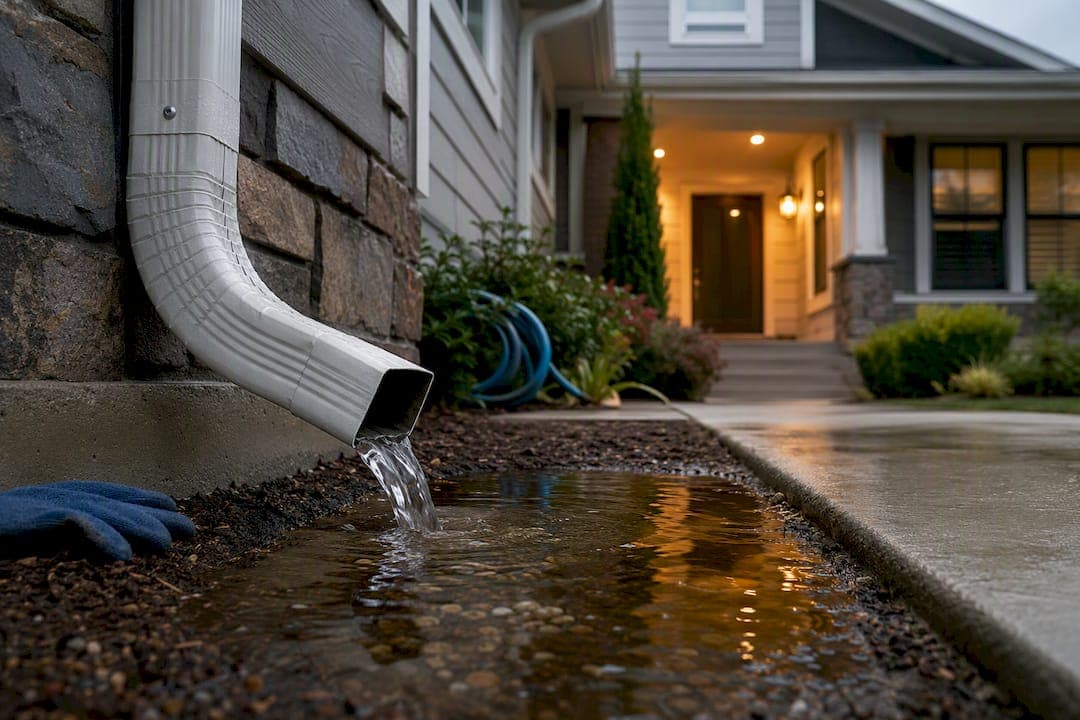
A puddle that vanishes within a day after a heavy storm is normal and not worth worrying about. Standing water that lingers longer than 24 to 72 hours, keeps returning, or collects near your foundation is a different matter and needs attention. Start by clearing gutters, confirming downspouts discharge away from the house, and keeping kids and pets away from any stagnant pool. If water still reaches the foundation or comes back after basic fixes, it's time to schedule an on-site assessment.
TL;DR:
- Most standing water in yards results from poor grading, compacted soil, blocked drainage systems, or concentrated runoff from roofs or neighboring lots.
- Simple fixes like gutter cleaning, extending downspouts, and regrading surfaces at least 0.5 inches per foot can resolve many surfacewater problems within a few days.
- When grading and surface solutions fail, subsurface options such as French drains, dry wells, or trenches require proper outlet access and proper soil conditions to work effectively.
- Rain gardens that drain within a day or two prevent mosquito breeding, especially when designed with proper soil infiltration tests and overflow routing.
- A professional assessment becomes necessary when water reaches the foundation, recurrent ponding persists despite basic repairs, or complex drainage infrastructure like pumps or retaining walls is needed.
Table of Contents
- Common causes of standing water in yards
- Quick checks and first fixes you can try this weekend
- Surface grading and swales: what they are and their limits
- Subsurface options: French drains, dry wells, and pumps
- Rain gardens and other landscaping fixes for mosquito risk
- Step-by-step troubleshooting to find the real source
- When to call a contractor for an on-site assessment
- Contractor perspective: budgeting and priorities
- A to Z Construction: services for lasting yard drainage
- Sources
- FAQ
Common causes of standing water in yards
Most soggy yards trace back to one of a handful of issues, and figuring out which one applies to your property is the first real step toward fixing it.
- Negative or flat grade: Low spots and yards that slope toward the house instead of away from it collect runoff instead of shedding it.
- Compacted or clay-rich soil: Dense soil slows infiltration, so water sits on the surface long after a storm passes.
- Blocked drainage components: Clogged gutters, downspouts, catch basins, or buried outlets stop water from moving where it's supposed to go.
- Concentrated runoff: Roof valleys, downspouts, or a neighboring lot can dump a large volume of water into one small area.
- Undersized or shifted pipes: Old or damaged drainage lines, or pipes with no working outlet, back up instead of draining.
Most yards have more than one of these working against them at once, which is why a single fix rarely solves everything on its own.
Quick checks and first fixes you can try this weekend
Before you rent equipment or call anyone, spend a weekend gathering information. Cheap fixes solve a surprising number of drainage complaints.
- Document the puddle. Photograph it during and after rain, and mark its edges with stakes or spray paint so you can see whether it's shrinking or spreading over a few days.
- Clear gutters and downspouts. Leaves and debris are one of the most common hidden causes of pooling near the house.
- Extend your downspouts. Add splash blocks or flexible extenders so water discharges several feet from the foundation instead of dumping straight down.
- Run a hose test. Trace where water travels across your yard and see whether a shallow surface channel would carry it toward a safe outlet.
Pro Tip: A temporary trench dug with a shovel can confirm whether a permanent swale would work, but treat it as a test, not a fix. Loose soil erodes fast and needs to be replaced with a properly graded, vegetated channel.
If the puddle disappears within a day once gutters are clear and downspouts are redirected, you've likely solved a surface problem without touching a shovel for anything bigger.
Surface grading and swales: what they are and their limits
Grading and swales solve most standing water problems that don't involve a hidden pipe issue, and they're almost always the first fix worth trying because they're cheaper than anything buried underground.
The Building America Solution Center recommends sloping permeable ground at least 0.5 inch per foot for 10 feet away from the foundation, or 2% away from the house on impervious surfaces close to the structure. A swale, which is a shallow, vegetated channel that carries surface water to a safe outlet, works best with a 3:1 width-to-height ratio and a longitudinal slope of 2% to 4%.
Before regrading, walk the property and consider a few things:
- Where does the water need to go, and is there a legal lower outlet available.
- Will raising or lowering grade near a property line send water onto a neighbor's land.
- Does the swale need turf, native grasses, or rock to resist erosion once it's carrying flow.
- Will the new grade need periodic touch-up as soil settles.
Correcting grade first matters because a buried drain installed over a yard that still slopes the wrong way tends to fail again once the pipe clogs or settles. Fix the slope, and many "drainage problems" simply stop being problems.
Subsurface options: French drains, dry wells, and pumps
When grading alone can't move enough water, or when the yard is flat and there's no room for a swale, subsurface drainage takes over. Each option fits a different situation.
- French drains use a perforated pipe wrapped in fabric and gravel to intercept water moving through the soil. They only work with a positive outlet, like a lower point on the property, a dry well, or a storm sewer connection. Without a real place for the water to go, a French drain just moves the puddle a few feet and calls it a day.
- Dry wells hold water underground until it slowly infiltrates the surrounding soil, so they only make sense in permeable ground or paired with an engineered underdrain. A percolation test before installation tells you whether the soil can actually absorb the volume you're sending it.
- Catch basins and trench drains collect surface water in tight spots like driveways and patios, then route it through a pipe to an outlet.
- Sump pumps handle water that's already inside a basement or crawlspace, not standing water out in the yard, and the discharge line needs to empty somewhere that won't just create a new puddle downstream.
Picking the wrong one of these usually means paying twice: once for the install, and again to fix the version that actually works.
Rain gardens and other landscaping fixes for mosquito risk
A rain garden is a shallow, planted depression built to catch and infiltrate runoff, and it can double as a landscaping feature instead of a bare drainage pipe. According to the EPA's green infrastructure guidance, rain gardens typically pond several inches deep and should drain within a few hours to a few days depending on the design and the soil underneath.

That drawdown speed matters for more than plant health. Mosquito eggs generally need 7 to 10 days of calm, standing water to develop, according to EPA research on stormwater structures, so a rain garden that drains within a day or two never becomes a breeding site.
A few design points keep a rain garden working instead of becoming another problem:
- Test soil infiltration before digging so you know whether natural drainage is fast enough.
- Add engineered soil media or an underdrain where native soil is slow to absorb water.
- Place overflow routes and underdrains so excess water heads away from the foundation and the neighbor's yard, not toward them.
- Clear inlets and remove sediment buildup each season so the garden keeps draining on schedule.
Step-by-step troubleshooting to find the real source
A methodical walk-through beats guessing, and it usually takes less than an hour.
- Photograph the puddle during and right after rain, then mark its boundaries and note how many hours it takes to disappear.
- Trace the water's path from the roofline through gutters and downspouts, across the lawn, and into the low spot where it collects.
- Check for clogs and buried outlets. Look at grates, catch basin lids, and any pipe ends near the property line for blockages.
- Measure the slope with a level or a laser line to confirm whether the yard is actually sloping toward the problem area.
- Decide on the fix. A flat or negative grade points to regrading or a swale, a wet spot fed by underground flow points to a French drain, and a yard with no workable outlet points to a professional assessment.
This sequence matters because it targets the cause instead of the symptom, which is the difference between a fix that lasts and one you'll be redoing next spring.
When to call a contractor for an on-site assessment
Some situations are worth handing to a professional rather than working through alone.
- Water reaches or pools against the foundation.
- Ponding returns repeatedly after basic fixes like gutter cleaning and downspout extensions.
- Erosion, runoff from a neighboring lot, or standing water after new hardscape work shows up.
- The fix likely needs excavation, a pump, or a retaining wall to manage a slope change.
A proper site visit should produce an elevation map of the yard's small watershed, notes on how the soil behaves during a soak test, a check of every inlet and outlet, and a costed recommendation for the outlet route. A to Z Construction handles earthwork and grading, French drains, retaining walls, dry wells, and irrigation rework as part of that kind of assessment.
Pro Tip: When you call around, ask for a contractor's license number, examples of similar drainage work, a written site plan, and references you can actually contact.
Contractor perspective: budgeting and priorities
Fix the source before the buried solution. Regrading and gutter work often cost a fraction of a French drain system and solve the same problem when the yard's slope is the real culprit. Costs vary by site access, soil type, and how far water has to travel to a real outlet, so treat any number you hear as a planning range, not a quote. Most drainage failures I see aren't design failures. They're a clogged outlet or backfill that settled a season after installation, which is why maintenance belongs in the plan from day one.
— Jake
A to Z Construction: services for lasting yard drainage
Grading and gutters fix a lot of yards, but flat lots, clay soil, or a yard with no natural outlet usually need buried drainage, and that's where a contractor with earthwork, hardscape, and landscaping crews under one roof saves you from coordinating four separate companies.

A to Z Construction handles earthwork and grading, French drains, retaining walls, dry wells, and irrigation changes as one project instead of several. An estimate typically starts with a site visit, elevation checks across the yard, and a recommended fix with a timeline attached, so the real scope is clear before committing. Request a free on-site drainage assessment through the hardscape and grading team to get a plan built around your actual yard, not a generic template.
Sources
Design guidance in this article draws on the Building America Solution Center, EPA rain garden guidance, and university extension resources on soil behavior.
- Final grade slopes away from foundation | Building America Solution Center
- Semi-Arid Green Infrastructure Toolbox - Rain gardens | EPA
FAQ
How can I fix standing water in my yard?
Start with the source: clear gutters, extend downspouts, and check whether the yard slopes away from the house at at least 0.5 inch per foot for 10 feet. If regrading a low spot doesn't solve it, a swale or a French drain with a confirmed outlet is the next step.
What are the causes of standing water in my yard?
The most common causes are flat or negative grading, compacted or clay-heavy soil, clogged gutters or drainage outlets, concentrated roof runoff, and pipes with no working outlet. Most properties have more than one of these working together.
How can I fix standing water in my yard with clay soil?
Clay slows infiltration, so surface fixes like grading and swales often need to be paired with a French drain or dry well rather than relying on the soil to absorb water on its own. A percolation test before installing a dry well confirms whether the clay can actually handle the volume.
How do I get rid of stagnant water?
Remove any standing water that isn't part of a designed drainage feature, since mosquito eggs generally need 7 to 10 days of calm water to develop. Fixing the drainage cause, whether that's a clogged downspout or a low spot with no outlet, stops the water from collecting in the first place.