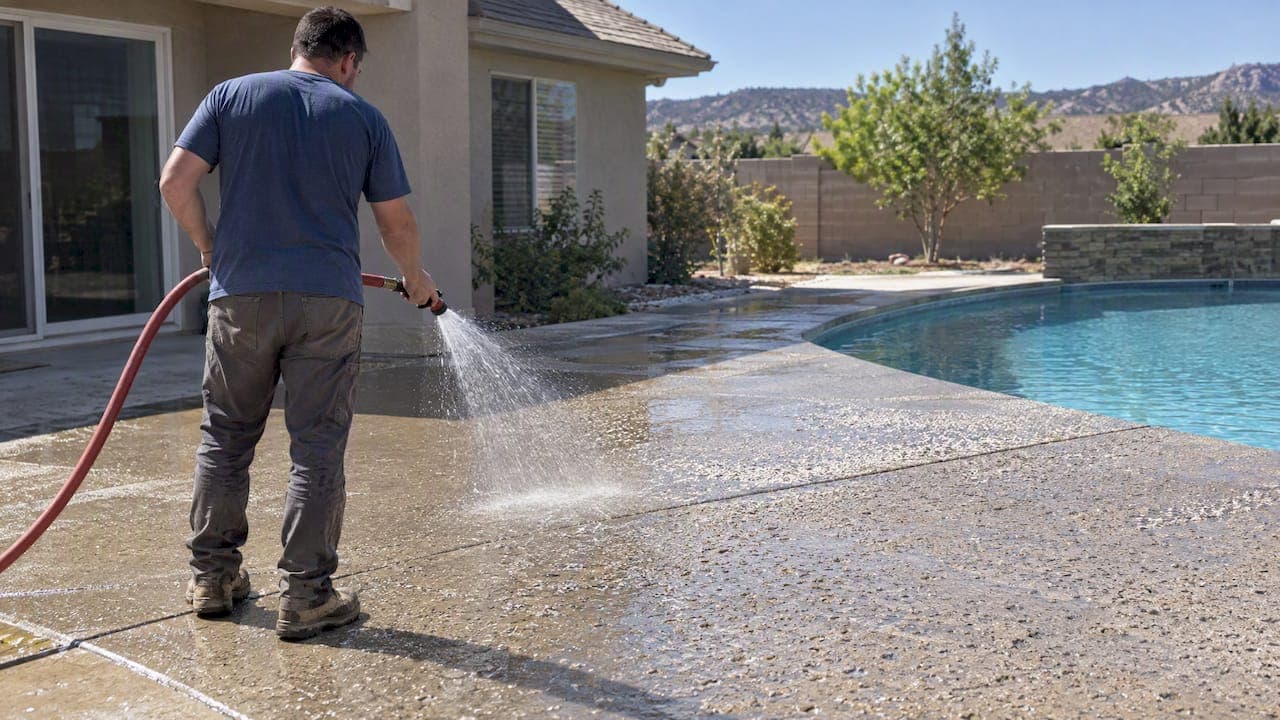
Salt finish concrete is a slab with a soft, speckled texture made by pressing coarse rock salt into the wet surface and washing it out after the concrete sets. It gives you good traction and a natural look for pool decks, patios and walkways. It also leaves thousands of tiny pits that hold water, so it needs the right mix, careful timing, and a sealer if your winters freeze. Below is how it is made, what it costs, where it works, and how permeable pavers compare when drainage is your real goal.
TL;DR
- A salt finish is made by broadcasting rock salt onto fresh concrete, pressing it in, and washing it out once the slab has set, leaving a textured, skid-resistant surface.
- Typical installed cost is about $8 to $12 per square foot, close to a broom finish and well under stamped concrete.
- The pits increase exposed surface area. In freeze-thaw climates, the slab needs proper air entrainment and a penetrating sealer, or it can spall.
- Results depend heavily on the finisher's timing and salt coverage. Mistakes cannot be fixed after the fact.
- If your real goal is stormwater drainage, permeable pavers are a different system with different upkeep, not a finish option.
Table of Contents
- What a salt finish actually is
- Pros and cons of salt finish concrete
- Does salt ruin concrete driveways?
- Is salt finish concrete more expensive?
- Where it works, and where to pick something else
- Protecting a salt finish: sealing and upkeep
- Our perspective: what we watch on a salt finish job
- Salt finish versus permeable pavers
- Can you DIY a salt finish?
- Questions to ask before you hire
- Planning a salt finish or another surface with us
- FAQ
- Sources
What a salt finish actually is
A salt finish is a decorative technique, not a different kind of concrete. The crew places and levels the slab as usual. Then they scatter coarse rock salt (halite) across the surface and press it in with a float or roller. After the concrete has set, usually around 24 hours later, the salt is rinsed away with water. What is left is a pattern of shallow, irregular dimples.
The salt works because it does not dissolve the moment it touches damp concrete. It holds its shape long enough to leave a void. The depth is modest. One long-running forum answer from a working finisher puts the texture at roughly a quarter to half inch from the surface, and in practice it varies with salt size and how hard it is pressed.
The look is softer than exposed aggregate and quieter than stamped concrete. Colored concrete shows it especially well, because the pits catch shadow and give a slightly weathered, stone-like appearance. That is why you see it so often around swimming pools, in courtyards and on residential patios.
How the process runs, step by step
- Placement and screeding. The slab is poured, leveled and floated. Bleed water must be gone before anything else happens.
- Waiting for the set point. The concrete has to be firm enough to hold an imprint but soft enough to take the crystals.
- Broadcasting the salt. The crew throws rock salt by hand, aiming for even coverage with no clumps and no bare patches.
- Embedding. A roller or float presses the crystals into the surface.
- Curing. The slab cures with the salt in place.
- Washing out. The next day, the salt is flushed off, and the surface is swept clean.
- Sealing. A sealer goes on once the slab is dry and cured enough to accept it.
The broad outline is the same across technical guides. The difference between a good slab and a poor one lies in steps 2 and 3.
Pros and cons of salt finish concrete
| Salt finish | What it means for you | |
|---|---|---|
| Traction | Good | Textured surface helps on wet pool decks and walkways |
| Look | Soft, natural, speckled | Works with plain or colored concrete |
| Cost | Moderate | Around $8 to $12 per sq ft installed, per Angi's finish comparison |
| Cold-climate durability | Needs care | Pits hold water and deicers |
| Cleaning | Needs sweeping | Debris collects in the dimples |
| Repairability | Poor | Errors usually mean tearing out and re-pouring |
The upsides
Slip resistance. Texture is the main practical benefit. A salt finish improves traction, which is why it is a regular choice for pool surrounds and high-traffic pedestrian areas.
A finished look without a premium price. Compared with stamped or heavily stained work, it adds visual interest at a modest cost. It also hides small surface blemishes and hairline scuffing better than a smooth trowel finish.
Cooler, less glaring surface. The matte texture reduces glare compared with a slick steel-troweled slab, which is nice around pools in bright sun.
The downsides
More surface area to protect. Salt itself does not harm hardened concrete. The issue is that the pits increase the surface area exposed to moisture and deicing chemicals. ACI's durability guidance notes that concrete lacking proper air entrainment, or exposed to freeze-thaw cycles, can spall as water collects in those pits and freezes.
It is a hard finish to get right. Hand-broadcast salt is random by nature. Bare spots and clumped areas are common, and once the surface is pressed, mistakes are essentially impossible to correct without a re-pour.
Tight timing. If the salt goes on too early, the crystals sink or vanish. If it goes on too late, they do not embed. The window can be short, and it shifts with temperature, wind, sun and mix design.
Debris collects. The dimples catch leaves, soil and grit. Plan on regular sweeping to keep it looking clean.
Does salt ruin concrete driveways?
There are two separate questions here, and they get mixed up.
First, does the finish damage concrete? No. The rock salt is washed out, and it is only a forming tool for the texture.
Second, do deicing salts damage concrete? They can, particularly on concrete that is young, poorly finished or not air-entrained. The Portland Cement Association publishes a guide on how different substances affect concrete and which protective treatments apply. A salt-finished slab in a cold region has more places for brine to sit, so the risk is higher than on a smooth or broomed surface. Our own article on what salt does to concrete goes deeper on that.
The durability recipe ACI Committee 201 and the PCA describe is a system: sound mix proportions, adequate air entrainment, and correct finishing. One finishing rule matters here. Finishing while bleed water is still present creates a weak, porous top layer, and pitting that layer with salt in a freeze-thaw environment invites early deterioration.

Is salt finish concrete more expensive?
A little, compared with the plainest options, and noticeably less than stamped. Angi lists salt finish at $8 to $12 per square foot in its national comparison, the same range as most textured finishes, while stamped concrete runs higher. Those are national averages for the total installed job, so local pricing, access, thickness, base prep, color and slab size will move your number.
Three things add cost that people forget:
- Sealer. In a cold climate, treat it as part of the price, not an extra.
- Base preparation and drainage. Good grading under the slab matters more than the surface finish.
- Color. Integral color or stain on a salt finish looks great, but it adds to the bill.
If your slab is a driveway, our published range for concrete driveways and approaches is $4,000 to $15,000, depending on size and scope. The finish is one factor among several in that total.
Where it works, and where to pick something else
Good fits
- Pool decks and surrounds in warm or mild climates
- Back patios and courtyards that see little deicer
- Garden walkways and covered porches
- Colored slabs where you want a quiet, natural texture
Think twice
- Driveways and front walks that get shoveled and salted every winter
- Shaded north-facing slabs where ice lingers
- Areas with poor drainage where water sits
- Any slab poured late in the season, when cold weather can interfere with the finish
Angi's guide makes the same climate point: salt finishes perform well in warm areas, while freeze damage is a concern in colder regions. In Utah, that means elevation matters. A pool deck in St. George faces a very different winter than a patio in Cedar City or Park City. We cover the trade-offs in choosing a concrete finish for Utah's climate.
If you want traction without the pits, a broom finish is the simpler, more forgiving option. It is the usual choice for driveways.
Protecting a salt finish: sealing and upkeep
Sealing is the single best thing you can do for a salted slab in a cold climate. ACI's durability guidance recommends a penetrating silane-siloxane system to protect against water, salts and stains. Penetrating sealers soak in rather than forming a film, so they keep the texture and reduce the traction loss a glossy topical coating can cause. ACI also publishes a guide to selecting protective treatments for concrete exposed to harmful substances. For help on product types, see our rundown of concrete sealer types and when to hire out.
A simple routine:
- Wait for the cure. Do not rush sealing or deicer exposure. Our concrete curing time timeline explains what to expect.
- Seal after the wash-out and once dry. Follow the product's instructions on moisture and temperature.
- Sweep regularly. Use a stiff broom to clear the dimples before debris packs in.
- Rinse, don't scrape. A hose and a soft or medium brush are enough for most dirt.
- Skip rock salt in winter. Use sand for traction, or ask your contractor which deicers are safer for your slab.
- Reseal on schedule. Follow the manufacturer's interval, and check how water behaves on the surface. If it soaks in instead of beading, it is time.
Avoid pressure washing at full power. It can erode the edges of the pits and roughen the surface unevenly.
Our perspective: what we watch on a salt finish job
We pour and finish a lot of flatwork, and salt finish is one of those jobs that looks easy until the day of the pour. Most of what decides the result happens before a single crystal goes down.
First, the mix. If the slab will see freeze-thaw, we want the concrete specified for it, with air entrainment, before we talk about texture. A beautiful finish on a mix that is wrong for the climate is a short-lived finish.
Second, patience. The temptation is to get on the slab as soon as it looks ready. We would rather wait for the bleed water to leave and the surface to reach the right firmness, because that single decision separates a crisp texture from a weak top layer.

Third, coverage. Hand-thrown salt is not uniform by itself. We watch the pattern as it goes down and fix bare spots right then, because there is no second chance.
Fourth, we run every phase with our own crew, from grading and forming through placing, finishing and sealing. That means the person who judged the set point is the same person who prepped the base and knows how it drains. There is no handoff between subcontractors to blur who is responsible. When a homeowner asks us whether salt finish is right for their yard, we sometimes say no. For a salted-in-winter driveway, we often point to a broom finish. For a pool deck, it is frequently the right call.
— Jake
Salt finish versus permeable pavers
People who search for salt finish often end up asking about permeable pavers too. They are not alternatives in the same sense: one is a surface texture on poured concrete, the other is a drainage system built from interlocking units on an engineered base. But if you are choosing a patio, walkway or drive surface, the comparison is fair.
What permeable pavers do
Permeable pavers reduce runoff by letting water filter through open joints into a washed-gravel reservoir below, where it slowly infiltrates the soil. The US EPA lists interlocking pavers among alternatives to traditional pavement that can help infiltrate rain and melting snow.
Benefits
- Less standing water and runoff
- A surface that handles rain without puddling
- Individual units can be lifted and replaced
- Can ease stormwater loads on a lot with drainage trouble
Maintenance
Permeable pavers only work if the joints stay open. Debris and sediment in the gaps block the flow, so the surface needs periodic cleaning. A porous-pavement sweeping guide recommends vacuum or regenerative-air sweepers rather than ordinary mechanical sweepers, which can push debris into the voids. Frequency rises with storms, foot traffic and nearby trees or exposed soil. Keep soil and mulch from washing onto the surface, and check any joint stone for refilling as it gets vacuumed out.
Are they worth it?
It depends on your lot. If you have a drainage problem, local stormwater rules, or a patio that floods, permeability can be worth the added base work and upkeep. If you simply want a good-looking, low-maintenance slab in a dry climate, a sealed concrete surface may do the job for less. Permeable systems depend on the base and soil beneath them, so a site assessment comes first.
| Salt finish concrete | Permeable pavers | |
|---|---|---|
| What it is | Texture on a poured slab | Interlocking units over a gravel reservoir |
| Main benefit | Traction and soft look | Water infiltration |
| Main risk | Freeze-thaw pitting if unprotected | Clogged joints if not cleaned |
| Upkeep | Sweep, seal | Vacuum sweep, refill joints |
| Fixing damage | Hard | Swap out units |
We build paver patios and walkways with a published range of $8,000 to $25,000. If drainage is part of your brief, tell us when we walk the site. The sub-base, slope and soil conditions drive the design, and you should settle them before choosing a surface. Our guide on stopping patio pooling shows simple tests you can run yourself first.
Can you DIY a salt finish?
You can, but it is a poor first project. The timing window is tight, the salt coverage is unforgiving, and you are working on a slab that is already hardening. A finished surface cannot be redone without demolition. If you do try it, practice on a small, low-stakes slab and have extra hands ready. For a pool deck, a visible patio or anything large, hire a crew that does it regularly. Cold or hot weather on pour day makes it riskier still: see our cold weather concrete checklist.
Questions to ask before you hire
- Is the mix air-entrained for our freeze-thaw conditions?
- How do you judge the set point before you broadcast salt?
- Can I see a salt finish you poured a few years ago?
- Which sealer do you use, and who applies it?
- How is the base graded and drained?
- Who is on site on pour day, and who is accountable for the finish?
Planning a salt finish or another surface with us
A to Z Construction is a licensed general contractor in Cedar City, Utah. We handle grading, forming, pouring, finishing and sealing with our own crew, so you deal with one point of contact from estimate to final walkthrough. Our concrete services cover driveways, slabs, foundations and flatwork, including pool decks and decorative concrete. Tell us how the surface will be used and how your winters behave, and we will recommend the finish that suits it, even when that is not the salt finish. You can start at a-to-zconstruction.com with a request for a fixed bid.
FAQ
Does salt ruin concrete driveways?
Rock salt used to make the finish does not, because it is washed out. Deicing salt can damage concrete that is young, poorly finished or lacking air entrainment. A salt-finished driveway has more pits for brine to sit in, so in cold regions a broom finish and a penetrating sealer are usually the safer pairing.
Is salt finish concrete more expensive?
It costs a bit more than a plain broom or trowel finish and less than stamped concrete. National figures put it around $8 to $12 per square foot installed. Your quote will depend on slab size, base work, color and sealing.
Is salt finish slippery when wet?
No, that is its main strength. The dimpled texture gives more grip than a smooth slab, which is why it is common around pools. Keep the pits clear of debris so the texture keeps working.
Are permeable pavers worth it?
They are worth it where water management is the problem: poor drainage, runoff limits or frequent puddling. They need periodic vacuum cleaning to keep the joints open, and the base has to be built correctly. Without a drainage need, a sealed concrete or standard paver surface may be simpler.
How long should I wait before using a salt finish slab?
The salt is washed out about a day after placement, but the slab keeps curing for weeks. Hold off on heavy loads and any deicers until your contractor says the concrete is ready. Our curing timeline gives typical stages.
Sources
- Rock Salt Concrete Finish, Concrete Network
- ACI 201.2R-08 Guide to Durable Concrete
- ACI 515.2-24 Selecting Protective Treatments for Concrete
- What is salt finish concrete? Mathews Readymix
- Salt Finish Concrete Surface guide, Build Construct
- 9 Types of Concrete Finish, Angi
- Permeable Pavers, University of Maryland Extension
- Soak Up the Rain: Permeable Pavement, US EPA
- How to Sweep Porous Pavement, Stewart-Amos