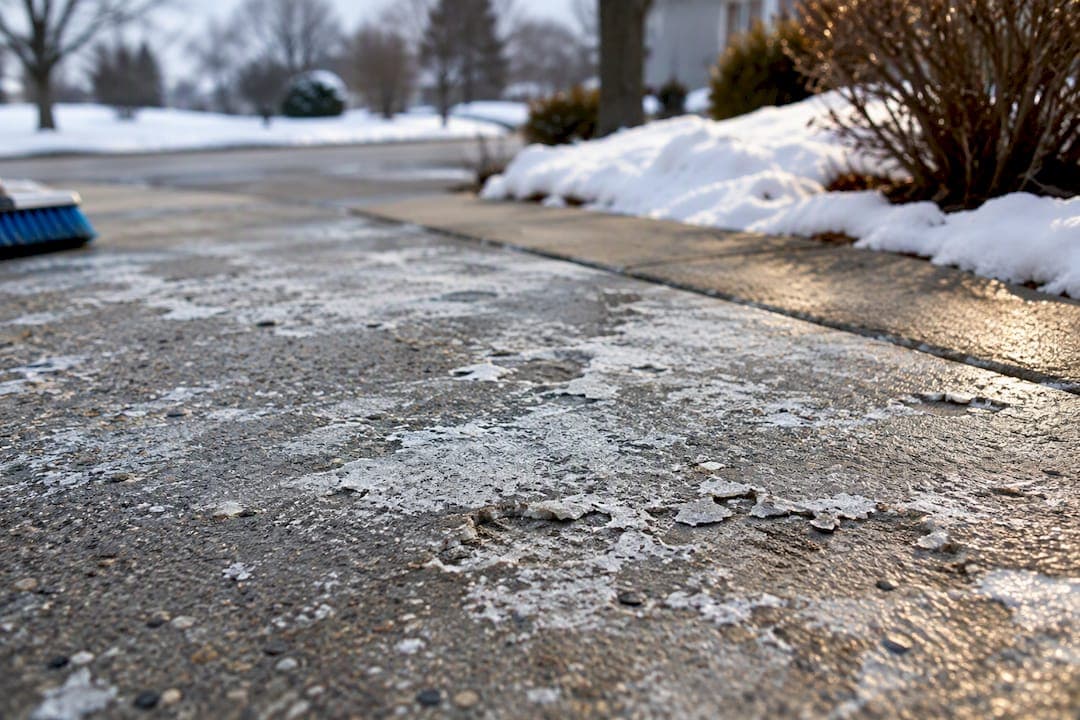
Salt and many common deicers can damage concrete, from light surface scaling to deep spalling and rebar corrosion. Minor surface damage is often repairable with patching or resurfacing, but deep spalling or exposed, rusted reinforcement usually needs a licensed contractor. If you spot fresh damage, stop pressure washing or hot water rinses immediately, gently rinse the area with cool water, and assess how deep the damage goes before deciding on next steps.
TL;DR:
- Salt damage is most severe at a concentration near 3% salt by weight, which can cause worse scaling with repeated light applications than one heavy dose.
- Proper concrete mix design, including low water-to-cement ratio and air entrainment, significantly reduces susceptibility to salt-induced physical and chemical damage.
- Using cool water and a soft brush is the safest way for homeowners to remove surface salt, avoiding high-pressure washers that can worsen deterioration.
- Repairs are only effective for surface scaling; deep spalling or exposed rebar require professional resurfacing or slab replacement for long-term durability.
- Regular inspections, sealing, and proper maintenance can prevent early damage, but significant cracking or rusted rebar mean a licensed contractor is needed.
Table of Contents
- How to recognize salt damage: visual signs and quick checks
- Why salt damages concrete: physical and chemical mechanisms explained simply
- How to remove salt safely: step-by-step homeowner methods and common mistakes to avoid
- Prevention: mix, finishing, curing, sealers, and smart deicer habits
- Repair options by severity: from patching to full replacement
- When to call a pro and a seasonal maintenance checklist
- A field perspective on catching salt damage early
- Get a professional concrete assessment from A to Z Construction
- Sources
- FAQ
How to recognize salt damage: visual signs and quick checks
Not all salt damage looks the same, and the type you see tells you how urgent the fix is. White, powdery deposits are usually efflorescence, a cosmetic mineral residue that rinses away and rarely signals structural trouble. Salt scaling looks like a peeling or flaking surface layer, often shallow, while spalling is deeper: chunks of concrete break away and can expose the aggregate underneath. Map cracking, a web of fine surface cracks, often points to internal stress building near the surface.
A few quick checks help you triage:
- Scrape test: run a flathead screwdriver across the surface; if it crumbles or flakes easily, the top layer has lost strength.
- Tap test: tap the slab with a hammer or metal rod; a hollow sound suggests delamination beneath the surface.
- Rinse test: hose down the area and watch how water pools or drains, which reveals low spots where salt tends to concentrate.
- Age and location check: inspect joints, edges, and any slab poured within the last year first, since these areas fail sooner.
Pro Tip: Check concrete within 12 months of a new pour more often during winter. New slabs haven't fully cured and are far more vulnerable to salt exposure than older concrete.
Why salt damages concrete: physical and chemical mechanisms explained simply
Salt damage isn't one process, it's two working together. Research on salt scaling identifies a "pessimum concentration" of about 3% salt by weight, the point at which surface scaling tends to be worst, meaning repeated light salt applications that hold this concentration near the surface can be more damaging over time than a single heavy dose that later washes away, according to a review of salt scaling mechanisms.
The second mechanism is chemical, and it doesn't need freezing temperatures to cause harm. Calcium chloride and magnesium chloride, both common in deicing products, can react with calcium hydroxide inside cured concrete to form calcium oxychloride, an expansive compound that cracks the paste from within, according to a technical brief on chemical deicers.
A pessimum concentration near 3% salt by weight often causes the worst surface scaling, according to research on salt scaling phenomenology, which is why moderate, repeated exposure can be riskier than one heavy application.
Poor finishing practices compound both mechanisms. Concrete that lacks proper air entrainment, has high permeability, or was overworked during finishing loses the microscopic air pockets that relieve internal pressure during freezing, leaving it far more exposed to both physical and chemical attack.

How to remove salt safely: step-by-step homeowner methods and common mistakes to avoid
Getting salt off your concrete without making things worse comes down to patience and the right tools.
- Let the surface thaw naturally before doing anything; working on frozen concrete traps salt deeper into the pores.
- Rinse with cool or lukewarm water at low pressure, never hot water on frozen concrete, since the temperature shock can crack the surface.
- Scrub with a stiff nylon or natural bristle brush, avoiding wire brushes that scratch and open the surface to more salt intrusion.
- For stubborn white residue, use a mild dish detergent or a manufacturer-recommended concrete salt remover, then rinse thoroughly.
- Direct runoff away from grass, garden beds, and storm drains where possible to limit environmental impact.
Avoid high-pressure washers on damaged or scaling concrete. The force can drive salt crystals deeper into existing cracks rather than flushing them out, worsening the very problem you're trying to fix.
Pro Tip: Skip the pressure washer on any concrete showing early scaling. A garden hose and a soft brush do less harm and still clear most surface salt.

Prevention: mix, finishing, curing, sealers, and smart deicer habits
Preventing salt damage starts before the concrete is even poured and continues every winter after. A properly designed mix with a low water-to-cement ratio (0.45 or lower), adequate air entrainment, and supplementary cementitious materials like fly ash or slag cement reduces both permeability and the calcium hydroxide available to react with chloride deicers, according to FHWA guidance on chemical deicers. Finishing matters just as much as the mix: overworking the surface during finishing can collapse the entrained air voids that protect against freeze-thaw damage, according to Portland Cement Association guidance.
New concrete needs time before it can handle deicing salts. The first winter after a pour is the highest-risk period, and letting a slab cure and air-dry fully before exposing it to deicers substantially lowers the odds of early scaling.
Penetrating sealers add another layer of defense. Silane and siloxane sealers, applied after the concrete has properly cured, reduce water and chloride penetration and measurably improve scaling resistance compared to unsealed surfaces, according to a study on penetrating sealant effectiveness. Reapplication is typically needed every three to five years depending on the product and traffic wear.
Day-to-day habits count too:
- Apply deicers sparingly and only where needed, rather than as a blanket precaution.
- Avoid letting deicer solution pool in joints or cracks, where it concentrates and lingers.
- Favor plain sodium chloride for routine use over repeated heavy use of calcium chloride or magnesium chloride near vulnerable slabs.
- Keep joints sealed and drainage clear so meltwater doesn't sit against the concrete.
| Prevention factor | What it does | When to address it |
|---|---|---|
| Low water-to-cement ratio (≤0.45) | Reduces permeability and salt penetration | At mix design, before pouring |
| Air entrainment | Absorbs freeze-thaw pressure inside pores | At mix design, before pouring |
| Curing time before deicer exposure | Lets concrete reach strength before stress | First winter after a new pour |
| Penetrating sealer (silane/siloxane) | Reduces water and chloride ingress | After curing, reapplied every 3 to 5 years |
| Joint and drainage maintenance | Prevents salt solution from pooling | Ongoing, checked each fall |
Repair options by severity: from patching to full replacement
The right fix depends entirely on how deep the damage runs. Surface-level scaling or minor flaking is usually a candidate for cosmetic patching or a thin resurfacing overlay, which can restore appearance but doesn't address any damage already inside the pore structure. These fixes typically last several years but are not a permanent solution if the underlying material has been compromised.
- Surface patching: fills shallow scaling and small chips; fast and affordable but purely cosmetic.
- Resurfacing overlays: a thin bonded layer that renews the surface after joint repair and thorough substrate cleaning; a reasonable option when damage is limited to the top quarter inch or so.
- Full slab replacement: necessary when spalling has exposed aggregate deeply, cracking suggests structural movement, or reinforcing steel is visibly rusted.
Surface repairs generally address appearance only. When internal pore damage or rebar corrosion is present, patch jobs tend to be temporary, and professional resurfacing or replacement is usually the more durable path.
Before hiring anyone, ask a few direct questions: What's the full scope of work, does the quote include joint repair and drainage correction, what's the finishing and curing plan for new concrete, and what warranty backs the work?
When to call a pro and a seasonal maintenance checklist
Certain signs mean it's time to bring in a licensed contractor rather than attempt a DIY fix: large-area spalling, exposed or rusted rebar, cracks that suggest the slab has shifted, or failed joints where water consistently pools.
A simple seasonal routine catches problems early:
- Inspect all concrete surfaces each spring for new scaling, cracks, or efflorescence.
- Rinse away winter salt residue as soon as temperatures allow.
- Reseal on the manufacturer's recommended cycle, generally every three to five years.
- Check joints and drainage paths for pooling or debris buildup.
- Photograph and note any changes year over year to track how fast damage progresses.
Some contractors apply this kind of routine across concrete projects, managing every phase in-house so inspection, repair, and resurfacing decisions come from one team rather than several subcontractors.
A field perspective on catching salt damage early
Concrete rarely fails all at once. The slabs I've seen hold up best are the ones where someone caught scaling or a hollow spot early and acted before winter came around again. DIY cleaning and light patching handle small problems, but once you see rebar or a crack that runs deep, call a licensed contractor before it spreads further.
— Jake
Get a professional concrete assessment from A to Z Construction
If your driveway or slab shows spalling, deep cracking, or exposed rebar, a patch kit won't fix what's happening underneath. A to Z Construction handles concrete repair, resurfacing, and full slab replacement with one in-house crew from inspection through final finish, so you're not coordinating separate subcontractors for demolition, pouring, and curing.
- Concrete repair, resurfacing, and replacement for driveways, slabs, and foundations.
- One team handling excavation, forming, pouring, and finishing without outside subcontractors.
- Local project experience across several Utah counties, including Salt Lake County and Cedar City.
Visit the concrete services page to request an inspection or get a quote on your repair.
Sources
- Chemical Deicers and Concrete Pavement: Impacts and Mitigation (FHWA)
- Effectiveness of early application of penetrating sealants (ACI summary)
- A review of salt scaling: I. Phenomenology (ScienceDirect)
FAQ
Can salt damaged concrete be repaired?
Yes, surface-level scaling and minor spalling can typically be patched or resurfaced. Deeper damage involving exposed aggregate, structural cracking, or rusted rebar generally requires professional resurfacing or full replacement rather than a cosmetic fix.
How long does it take for salt to damage concrete?
There's no fixed timeline since it depends on the concrete's mix, curing, and how often it's exposed to salt. New concrete is most vulnerable during its first winter before it has fully cured, and repeated exposure at a moderate salt concentration, around the 3% pessimum level, tends to cause the worst scaling over time.
What is the best concrete sealer to protect against salt damage?
Penetrating sealers made from silane or siloxane are widely used because they reduce water and chloride penetration without forming a surface film that wears off quickly. Studies on penetrating sealant timing show they work best when applied after the concrete has fully cured, and most need reapplication every three to five years.
What removes salt from concrete?
A cool water rinse combined with a stiff nylon brush removes most surface salt without harming the concrete. For stubborn residue, a mild detergent or a manufacturer-recommended concrete salt cleaner followed by a thorough rinse works well, while high-pressure washers and hot water on frozen surfaces should be avoided since they can drive salt deeper or crack the surface.