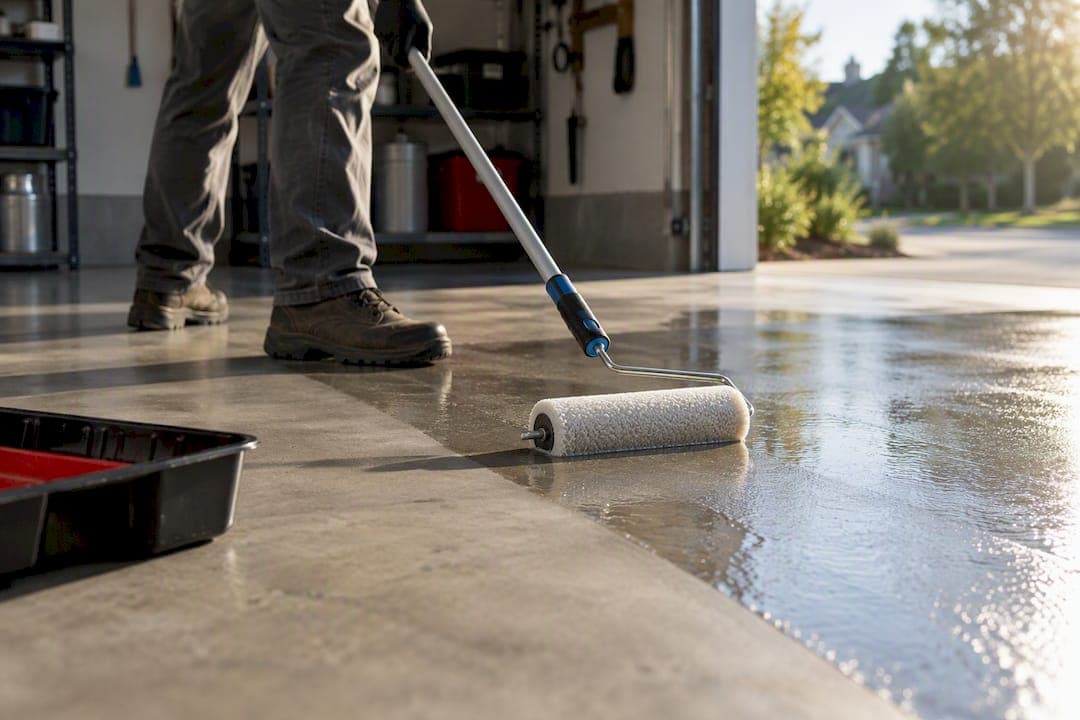
For most driveways and exterior slabs, a penetrating silane or siloxane sealer is the safer long-term bet because it resists freeze-thaw and deicing salt damage without peeling. For decorative patios, stamped concrete, or a wet-look finish, an acrylic film-forming sealer wins on looks but needs recoating far more often. Epoxy and polyurethane belong almost exclusively indoors, on garage floors and basements, where UV isn't a factor.
TL;DR:
- Penetrating sealers like silane or siloxane are ideal for driveways and exterior slabs in freeze-thaw regions because they prevent moisture and salt damage without trapping vapor.
- Acrylic film-formers are best suited for decorative patios and pool decks, offering glossy finishes but requiring reapplication every 1 to 3 years and risking slipperiness when wet.
- Epoxy and polyurethane coatings are mainly for indoor use, with epoxy suitable for garages and basements and polyurethane providing UV resistance and durability for high-traffic interior floors.
- Proper surface preparation is essential, as skipping cleaning or moisture testing leads to peeling, regardless of sealer type, emphasizing the need for professional evaluation in complex cases.
- Maintenance involves regular water-bead tests to check sealer effectiveness, with penetrating sealers lasting 5 to 10 years and film-formers needing more frequent re-coating depending on exposure and use.
Table of Contents
- Penetrating vs. Film-Forming Concrete Sealer Types: The Core Trade-Off
- Common Concrete Sealer Types Compared
- How to Choose a Sealer Based on Your Surface and Climate
- Why Surface Prep Decides Whether a Sealer Actually Works
- Maintenance, Recoat Schedules, and What Can Go Wrong
- Drying and Curing Times for Different Concrete Sealer Types
- A Contractor's View on Prep, Sealing, and Longevity
- How A-to-zconstruction Handles Sealer Selection and Application
- Sources
- FAQ
Penetrating vs. Film-Forming Concrete Sealer Types: The Core Trade-Off
Every concrete sealer on the market falls into one of two functional camps, and understanding which camp you're buying from matters more than any brand name on the bucket.
Penetrating sealers soak into the concrete's pores and react chemically with the material, or line the capillaries with a water-repellent barrier. They don't sit on top, so they don't change the surface's look or feel much, and they let water vapor keep moving through the slab. That breathability is the whole point: trapped moisture is what causes scaling, spalling, and freeze-thaw cracking in cold climates.
Film-forming sealers create a topical layer, like a thin coat of plastic, that sits on the surface and blocks intrusion from above. They deliver the wet-look shine homeowners want on patios and pool decks, but that same film can trap vapor if the slab isn't dry or properly prepped.
- Penetrating types typically last several years, offering a near-invisible finish and better vapor movement.
- Film-forming types typically last a few years for acrylics, longer for epoxy/polyurethane indoors, with visible gloss or matte sheen and are more prone to peeling if applied over a damp or dirty surface.
Common Concrete Sealer Types Compared
Here's how the major sealer families stack up once you get past the marketing language on the can.
1. Silane, Siloxane, and Siliconate Sealers
These penetrating chemistries are the workhorses for driveways, walkways, and any exterior slab that sees freeze-thaw cycles or road salt. Silanes have the smallest molecules and penetrate deepest into dense concrete; siloxanes work better on more porous surfaces. Contractor guidance from ConcreteNetwork consistently points to this family for long-life exterior protection in cold-weather regions, since it blocks moisture and salt intrusion without trapping vapor underneath. The trade-off: no color enhancement, no gloss, and a slightly duller wet-day appearance than an acrylic.
2. Acrylic Sealers (Water-Based and Solvent-Based)
Acrylics are the most common film-forming choice for decorative work, stamped patios, and pool decks. Solvent-based versions deepen color and add a richer wet-look shine; water-based versions are lower-odor, lower-VOC, and easier to reapply but produce a slightly flatter finish. Both need recoating every 1 to 3 years, and both will show tire marks or UV yellowing over time if the formula is low quality.
3. Epoxy Sealers
Epoxy is a heavy-duty film former built for interior floors, garages, and basements where chemical spills and abrasion are the real threat. It cures into a hard, glossy, chemical-resistant shell, but it breaks down under direct UV exposure, so outdoor use is a mistake unless the product is specifically UV-modified. It's also unforgiving of moisture in the slab; trapped vapor under epoxy causes bubbling and delamination.
4. Polyurethane and Polyaspartic Coatings
Polyurethane sealers, especially aliphatic formulas, resist UV far better than epoxy and hold up well against abrasion, making them a reasonable pick for garage floors that see foot traffic and vehicle tires. Polyaspartic coatings are a newer branch of the same family, and their standout feature is speed: some products from manufacturer lines like Prosoco cure fast enough to allow a floor back in service within a day, which matters for commercial garages or businesses that can't afford a multi-day shutdown.
5. Specialty Systems: Densifiers and Crystalline Treatments
Densifiers (often lithium silicate based) aren't sealers in the traditional sense. They react with free lime in the concrete to harden the surface from within, which is why they show up on polished concrete floors and warehouse slabs rather than driveways. They don't stop water the way a siloxane does, but they cut dusting and add wear resistance.
Pro Tip: Match the sealer to the failure mode you're actually worried about. Worried about salt and freeze-thaw cracking? Go penetrating. Worried about scuffed, dull-looking stamped concrete? Go film-forming acrylic and accept the recoat schedule.
| Sealer type | Best for | Avoid when |
|---|---|---|
| Silane/siloxane | Driveways, freeze-thaw climates | You want color enhancement |
| Acrylic | Stamped patios, pool decks | Surface stays wet or shaded most of the day |
| Epoxy | Garage floors, basements | Outdoor UV exposure |
| Polyurethane/polyaspartic | High-traffic interior floors, fast turnaround jobs | Budget is tight |
| Densifier | Polished/industrial floors | You need water repellency |
How to Choose a Sealer Based on Your Surface and Climate
Start with the surface, then layer in climate and use before you look at any product label.
- Driveway or exterior flatwork in a freeze-thaw region: penetrating silane or siloxane, full stop.
- Stamped or stained decorative concrete: acrylic film-forming, accepting the shorter recoat cycle for the color payoff.
- Pool deck: a slip-resistant acrylic or a specialty additive blended in, since gloss film-formers get dangerously slick when wet.
- Garage floor or interior slab with chemical exposure: epoxy or polyurethane, chosen by how fast you need the floor back in use.
- Countertops or polished decorative interior concrete: densifier plus a topical sealer for stain resistance.
Budget and maintenance tolerance decide the rest. Penetrating sealers cost less per application but ask nothing of you for years at a stretch. Film-forming sealers look better sooner and demand more attention. Before hiring anyone or buying a bucket, ask for the manufacturer's coverage rate per gallon, VOC content, expected slip resistance rating, and cure window. A vague answer to any of those questions is a warning sign. If your driveway has standing water after every rain, no sealer will fix that; you have a drainage or gravel base problem that needs solving first.
Why Surface Prep Decides Whether a Sealer Actually Works
Most sealer failures have nothing to do with the product and everything to do with what's underneath it. Oil stains, old sealer residue, and efflorescence (that white chalky bloom) all block adhesion, and no sealer chemistry overcomes a dirty surface.
The ACI 515.3R-20 guide is explicit that manufacturer-specified prep, meaning the right surface profile, moisture content, and cleanliness, isn't optional. Skip it and you risk peeling within months, plus a voided warranty.
- Pressure wash or scrub with detergent to remove surface contaminants.
- Test a small patch before committing the whole slab.
- Apply two thin coats rather than one heavy one; heavy coats trap solvent and blister.
- Respect wait times before foot or vehicle traffic resumes.
Pro Tip: If your slab needs shotblasting, diamond grinding, or a moisture test before sealing, that's the point to call a pro rather than a rental store.
Maintenance, Recoat Schedules, and What Can Go Wrong
Penetrating sealers generally hold up 5 to 10 years before reapplication; acrylic film-formers need attention every 1 to 3 years; epoxy and polyurethane systems run 3 to 7 years depending on traffic and exposure, according to guidance summarized by ConcreteNetwork.
A simple water-bead test tells you where you stand: pour a little water on the surface, and if it beads up, the sealer is still working. If it soaks in dark and flat, it's due for a recoat.
- Peeling usually means moisture was trapped or prep was skipped.
- Ambering shows up on some solvent-based acrylics and older epoxy formulas exposed to sun.
- A glossy film-former can turn a walkway or pool deck slippery when wet.
Drying and Curing Times for Different Concrete Sealer Types
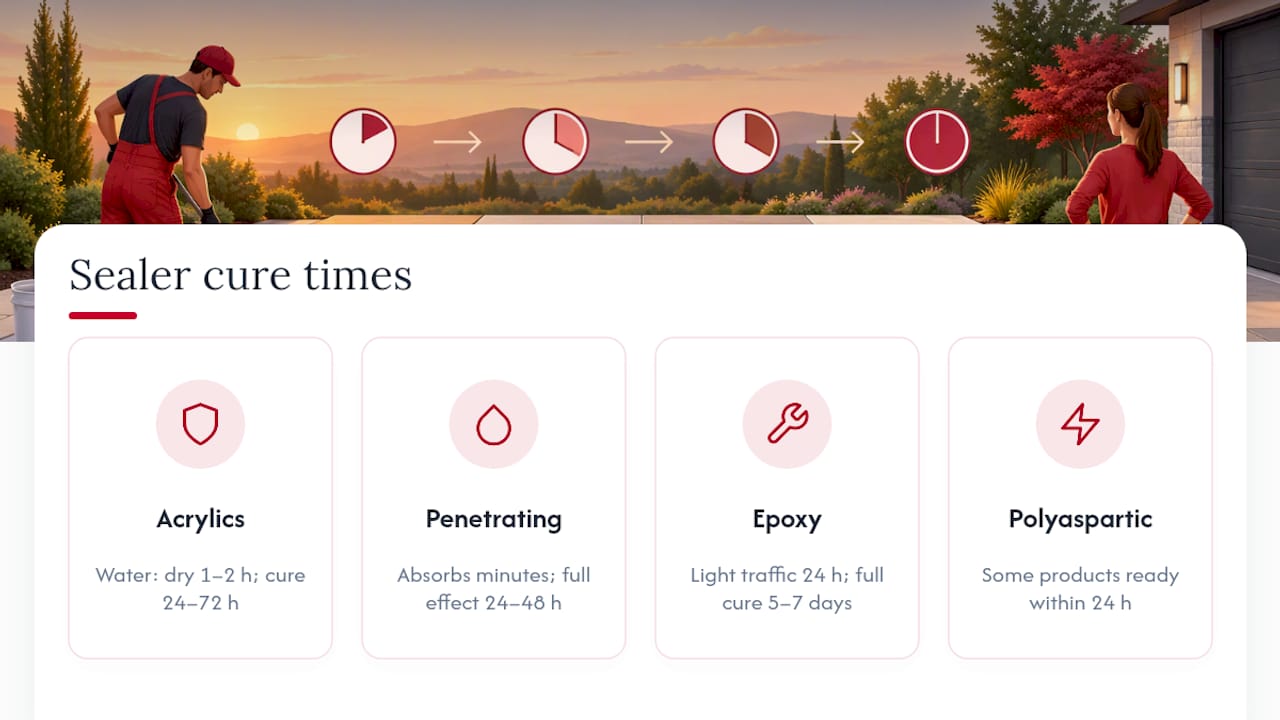
Drying and curing aren't the same thing, and mixing them up causes most DIY sealer disasters. Drying is when the surface feels dry to the touch and safe to walk on lightly. Curing is when the sealer reaches its full chemical hardness and protective strength, which takes considerably longer.
Water-based acrylics dry to the touch in about 1 to 2 hours and are usually ready for foot traffic the same day, but full cure takes closer to 24 to 72 hours. Solvent-based acrylics dry faster on the surface, often within an hour in warm weather, but off-gas more strongly and need good ventilation during that window. Penetrating silanes and siloxanes don't leave a film to dry at all; they absorb within minutes and typically reach full protective effect within 24 to 48 hours once the reaction with the concrete completes.
Epoxy is the slow one. Most two-part epoxy systems need 24 hours before light foot traffic and a full 5 to 7 days before heavy use or vehicle weight, because the chemical cure that gives epoxy its hardness happens gradually. Polyurethane sits in the middle, generally allowing traffic within 24 hours and full cure within 3 to 5 days. Polyaspartic coatings break that rule entirely. Because the resin chemistry reacts faster, some products let a garage floor back into service within 24 hours total, which is why they've become popular for commercial applications where downtime costs money.
Temperature and humidity shift every one of these windows. Cold, damp weather can double a cure time, and applying any sealer below the manufacturer's minimum surface temperature is a common reason for cloudy or blotchy results. Always check the specific product's datasheet rather than assuming a number from a different brand's can.
A Contractor's View on Prep, Sealing, and Longevity
Premature sealer failure almost always traces back to skipped prep or a moisture problem no one tested for. Experienced contractors who manage prep through sealing with one crew see better long-term results than jobs where sealing is added on by separate teams.
— Jake
How A-to-zconstruction Handles Sealer Selection and Application
Some contractors handle both the slab pouring or evaluation and the surface prep and sealing themselves, avoiding subcontractor handoffs and potential miscoordination.
That matters most on decorative work, where a bad prep job under an acrylic sealer shows up as ugly white haze within a season. A-to-zconstruction's concrete services cover new driveways, foundations, and decorative flatwork, with sealing handled as part of the same project rather than a separate contractor call. For patios and stamped surfaces where appearance drives the decision, the hardscape team coordinates paver and concrete finishing so the sealer choice matches the rest of the design. If you're not sure whether your slab needs moisture testing, grinding, or just a clean and reseal, request an inspection and a straight answer on what your surface actually needs before spending money on the wrong product.
FAQ
What Are the Different Types of Concrete Sealers?
The main categories are penetrating sealers (silane, siloxane, siliconate) and film-forming sealers (acrylic, epoxy, polyurethane, polyaspartic), plus specialty densifiers for polished floors. Penetrating types soak in and preserve breathability; film-forming types sit on top and add gloss or color depth.
Is It Better to Spray or Roll a Concrete Sealer?
Spraying gives more even coverage on textured or stamped surfaces and is standard for penetrating sealers on driveways. Rolling gives better control on smooth, flat surfaces like garage floors and is common for acrylics and epoxy, where an even film thickness matters more than speed.
What Is the Highest Rated Concrete Sealer?
There's no single sealer that ranks best across every surface, since penetrating and film-forming products solve different problems. For exterior driveways in freeze-thaw climates, penetrating silane/siloxane sealers are the most consistently recommended by contractor guidance, while acrylics lead for decorative appearance.
What Are the Downsides of Using a Concrete Sealer?
Sealers can peel or bubble if applied over a damp or dirty surface, and some solvent-based acrylics amber or yellow under UV exposure over time. A glossy film-forming sealer can also make a wet surface noticeably more slippery, which matters on pool decks and walkways.
How Often Should You Seal Pavers or a Driveway?
Penetrating sealers on driveways generally need reapplication every 5 to 10 years, while acrylic sealers on pavers or patios typically need a fresh coat every 1 to 3 years. A simple water-bead test tells you if it's time: if water soaks in instead of beading up, reseal.