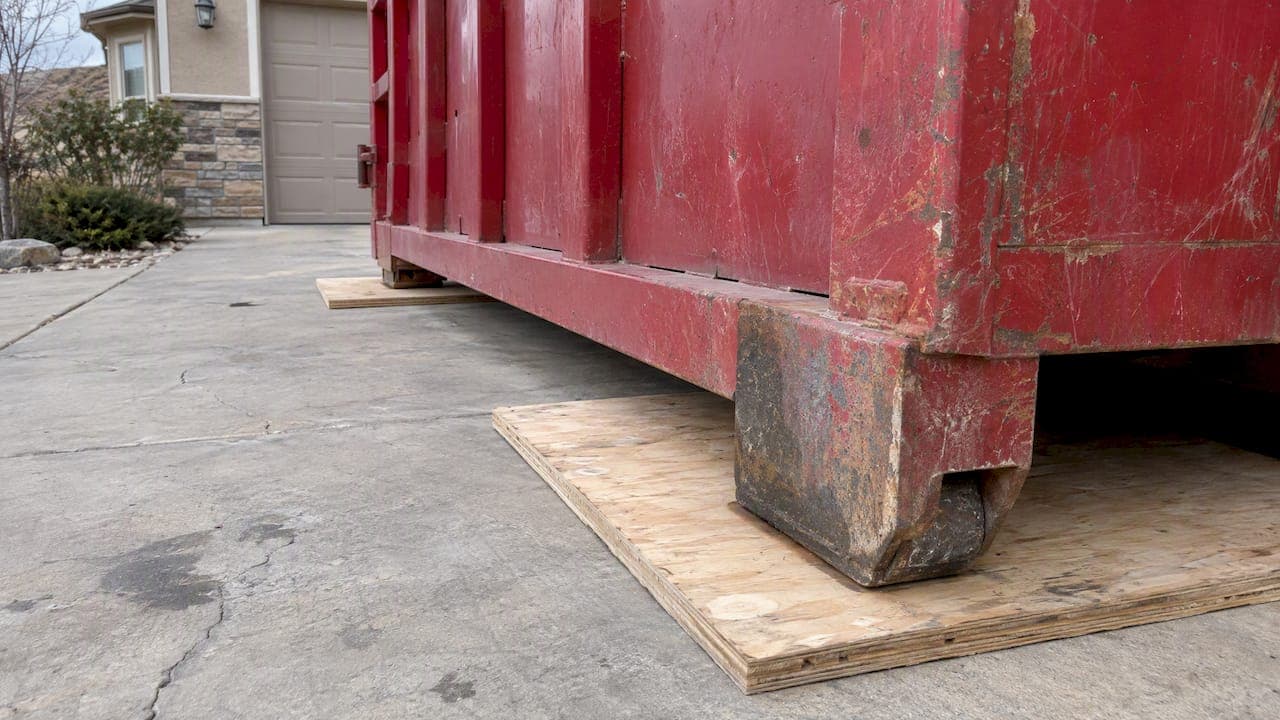
The most reliable way to protect a driveway from a dumpster is to spread the weight and keep steel off the surface. That means solid 3/4-inch exterior-grade plywood (or heavy boards) under every contact point, a flat and sound spot to set the bin, a load that stays level, and photos of the driveway before anything is delivered. Do those four things and most driveways come through a remodel cleanout without a mark.
This guide walks through each step, explains why asphalt and concrete fail differently, and covers the part most homeowners miss: the delivery truck is often harder on a driveway than the dumpster itself.
TL;DR
- Put 3/4-inch exterior-grade plywood or 2x8/2x10 boards under every point where the container and the truck touch the surface. Don't improvise with scrap.
- Set the bin on a flat, crack-free stretch, away from unsupported edges, slopes and the curb apron.
- Asphalt is the most vulnerable in summer heat. Ask for an early-morning delivery and never skip the boards.
- Never overload the bin or pile heavy debris in one corner. Uneven loads create the pressure points that punch through protection.
- Photograph the driveway before delivery and again before pickup, and read the damage clause in your rental agreement.
Table of Contents
- Why a dumpster can damage a driveway
- Put plywood under the dumpster
- Don't forget the delivery truck
- Choose the right spot on the driveway
- Match the protection to your driveway surface
- Summer heat and asphalt
- Load the bin so it doesn't punch through
- Document everything before delivery
- A step-by-step checklist
- What to do if damage happens
- Our perspective: protect it, or don't put weight on it
- Planning a bigger project?
- FAQ
- Sources
Why a dumpster can damage a driveway
A roll-off container is a steel box that gets heavier by the hour. A loaded one can weigh several tons, and all of that sits on a few narrow rails or small wheels at the bottom. Pressure, not total weight, is what breaks surfaces. A concrete slab can carry a lot when the load is spread across it. Concentrate the same load on two steel rails and you get cracking at the edges, spalling, and gouges.
Three things decide whether damage happens:
- The surface. Asphalt is flexible and softens in heat, so it takes ruts and imprints. Concrete is rigid and hard, so it fails by cracking, usually at joints, edges or thin spots. Pavers and gravel shift and settle.
- The condition underneath. A driveway with existing cracks, a thin pour or a weak base is a much worse candidate than a well-built one. What sits under the surface matters as much as the surface. If you're curious how a driveway should be built in the first place, our guide to driveway base preparation covers the base depth and checks a contractor should make.
- How the bin is loaded and placed. A level load near the center of the container behaves very differently from a corner stacked with concrete chunks.
None of this means a dumpster will ruin your driveway. On a sound surface, with protection and sensible loading, the risk is low. The point is that the protection costs very little compared with a repair.
Put plywood under the dumpster
The single most common protective step is a layer of wood between the container and the driveway. The wood acts as a wide, forgiving bridge that spreads the load.
What to use
- 3/4-inch exterior-grade plywood in full sheets is the standard choice. Thinner sheets can crack under a loaded container.
- 2x8 or 2x10 structural boards laid side by side also work, as long as they are sound and sit tight to each other.
- Heavy-duty commercial mats, if your hauler uses them, are another option.
Do not grab whatever scraps are lying around the garage. Thin, warped, split or uneven pieces can crack or shift under a load of several tons, which creates exactly the unstable point you were trying to avoid. If a board has a crack, a soft spot or water damage, leave it out.
Where it goes
Boards belong under every contact point. On most roll-offs that means the two long steel rails and any wheels at the rear end. Run the wood perpendicular to the rails so each rail bears on several boards, not on the edge of one. Extend the wood a little beyond where the rails will sit, because the container rarely lands in exactly the spot you pictured.
Who supplies it
Many haulers will lay boards for you if you ask when you book. Some include it by default, and some charge for it. Others expect you to provide it. Don't assume. Ask three questions when you reserve:
- Do you place protective boards under the container, and is it included?
- Will the truck's own outriggers or tires be on boards too?
- What does your agreement say about surface damage?
If you are renting from us, our dumpster rental is handled by the same in-house team that builds and remodels, so you have one point of contact to ask these questions.
Don't forget the delivery truck
Most people think about the dumpster and overlook the truck. A roll-off truck carrying a container can weigh more than the container sitting still, and its tires, and in some cases its stabilizers, press on the driveway during every drop and every pickup. The container also slides off the tilted bed and across the surface before it settles, which is when steel scrapes and gouges happen.
Things you can do:
- Ask the driver to place boards at the spot where the container will first touch down, not only where it will rest.
- Keep the truck's tires on the strongest part of the driveway, away from edges and the thin outer strip along a lawn.
- Be home for delivery if you can, or at least mark the spot clearly so the driver isn't guessing.
Also confirm there is enough room for the truck to work. Roll-off trucks need clear space in front of the drop point and generous overhead room, because the bed tilts up and the cable or hook mechanism swings. Low branches, power lines and service drops are common problems. Your hauler can tell you exact clearance numbers for its equipment, so ask before the day rather than on it.
Choose the right spot on the driveway
Placement is half the protection. Walk the driveway before you book and look for:
- Flat and level ground. A slope makes a container shift and concentrates weight on the low side.
- No cracks, patches or crumbling edges. Put the bin on the soundest section, not over a repaired seam.
- Distance from unsupported edges. The outside edge of a driveway often has little base underneath. A heavy rail near that edge can break it off.
- Away from the curb apron and sidewalk. These are thinner and often belong to the city, which can complicate things.
- Clear of sprinkler heads, drains, and buried lines. Irrigation boxes and pipes near the surface can crush.
- Near where you're working. A bin you can reach without long hauls is a bin you'll load more evenly.
If the driveway is too narrow, too steep or too cracked, the better answer may be another spot, such as the lawn on boards, or the street. Street placement usually needs local approval, and we explain how that works in our guide to street dumpster permits. Check with your city or HOA before you commit.
Match the protection to your driveway surface
| Surface | Main risk | What to do |
|---|---|---|
| Concrete | Cracking at edges and joints, surface scratches | Plywood or boards under all contact points, keep away from edges and existing cracks |
| Asphalt | Ruts and imprints, especially in heat | Plywood is non-negotiable; schedule early-morning delivery in summer |
| Pavers | Settling, shifted or broken units | Use wide boards, and consider placing the bin elsewhere if the base is soft |
| Gravel | Deep ruts, displaced stone | Boards to prevent sinking; pick the firmest, driest spot |
| Stamped or decorative concrete | Scratched or chipped finish and sealer | Boards plus a protective layer, and keep the load centered |
If your driveway is old, thin or already failing, think twice about parking several tons on it. A bin at the curb on the street, or on a lawn with heavy boards and a dry forecast, may cost you less than a repair.
Summer heat and asphalt
Asphalt is made with a petroleum binder, and that binder gets soft when the pavement is hot. On a hot afternoon, a steel rail resting on bare asphalt can leave a permanent dent. Dark pavement in full sun can run much hotter than the air.
In Utah, summers in places like Cedar City and St. George get hot enough that this is a real concern, so:
- Ask for delivery early in the morning, when the surface is coolest and firmest.
- Use boards every time, regardless of the forecast.
- If the bin will stay for weeks, consider shifting it to a shaded or concrete area. Dents form over time under steady load, not just on the first day.
- Avoid dragging or repositioning a loaded container.
Cold weather has its own issues. Frozen ground is hard, but thaw cycles can leave soft spots along the edges of a driveway, and wet ground under pavers or gravel gives way. Wherever you live, dry weather is your friend on delivery day.
Load the bin so it doesn't punch through
Protection under the container only works if the container stays within its limits. Overloading is one of the fastest routes to damage.
- Respect the weight limit. Your rental agreement states one, and exceeding it can mean extra fees and a hauler who refuses to lift the bin.
- Spread heavy debris evenly. Concrete, brick, tile, roofing and dirt are dense. Put them along the floor of the container, not in one corner.
- Keep the load below the rim. That's a safety rule and a pickup rule.
- Mix light and heavy. Lay heavy material first, then lighter bulky items on top.
A lopsided load concentrates weight on one rail, and that rail can break through even a protected spot. Heavy materials like concrete are the usual culprit. If you're hauling out a torn-up slab or a patio, you may want a smaller, dedicated container, or a dedicated plan for the debris. We cover your options in our guide to concrete disposal. To choose the right container in the first place, see dumpster sizes explained and our remodel sizing guide. Not sure what can go in? Check what items are prohibited before you start filling it.
Document everything before delivery
Protection lowers the risk. Documentation protects you if something still goes wrong.
Many rental agreements contain damage waiver language that limits the hauler's responsibility for surface damage. Read yours before you sign. If the language is unclear, ask for it in plain terms, and ask whether protective boards change who is responsible.
Then build your own record:
- Take dated photos of the whole driveway the day before or morning of delivery. Shoot wide, then close up on any existing cracks, stains and edges.
- Photograph the placement after the container is set, including the boards under the rails.
- Shoot again before pickup, and again after the container leaves.
- Keep your booking confirmation and any messages about protection and placement.
If you want a continuous record, a camera covering the driveway helps, and security camera systems designed for driveways are one way to get time-stamped footage of delivery and pickup. A phone camera is enough for most people, as long as the photos are dated.
Compare photos right after pickup. Damage reported the same day is far easier to resolve than a crack noticed a month later.
A step-by-step checklist
- Inspect the driveway for cracks, soft spots, sloped areas and weak edges.
- Choose the placement spot and confirm clearance for the truck and for overhead lines.
- Book the right size and ask your hauler about boards, truck contact points and damage terms.
- Photograph the driveway.
- Prepare boards (3/4-inch exterior-grade plywood or sound 2x8/2x10s) if you're supplying them, or confirm the driver will.
- Request early-morning delivery in hot weather.
- Be on site for drop-off if possible.
- Load evenly, heavy items first, staying under the weight limit.
- Inspect and photograph before pickup.
- Check the driveway after the bin leaves and report any problem immediately.
What to do if damage happens
Stay calm and move quickly.
- Take clear photos of the damage and compare them to your before shots.
- Contact the hauler the same day, in writing, with the photos attached.
- Refer to your agreement and your placement notes.
- Get a repair estimate. Minor surface scratches on concrete can often be cleaned or resealed. Cracked slabs may need sections cut out and replaced, and a dented asphalt area needs patching.
If the damage is more than cosmetic, a licensed contractor can tell you whether it is a repair or a replacement. We handle both concrete and asphalt-adjacent flatwork across Utah, which is useful when a driveway was already near the end of its life.
Our perspective: protect it, or don't put weight on it
We pour and replace driveways, and we also rent dumpsters, so we see both sides of this. Our view is simple: a driveway is a structure, and structures have limits.
A well-built concrete driveway with a proper base, placed on boards with a level load, is fine. The ones that suffer are the ones that were thin to begin with, have untreated cracks at the edges, or are being asked to carry a corner-loaded pile of broken concrete in July.

Because our crew handles estimating, earthwork, concrete and hauling in-house, we can look at your driveway before a project starts and tell you whether to set the bin there, on the lawn, or on the street. You get one point of contact for that answer rather than a handoff between a hauler and a contractor. If you're planning a remodel, a patio demo or a driveway replacement, think about the dumpster as part of the schedule, not an afterthought.
And if a driveway can't safely take the load, we'd rather tell you so and plan around it than watch you pay for a repair.
— Jake
Planning a bigger project?
If the dumpster is part of a remodel, a demolition or a driveway replacement, you can get the whole job handled by one licensed team. A to Z Construction provides concrete driveways and approaches with published pricing of 4000-15000 USD one-off, along with remodeling, earthwork, hardscape, fencing and landscaping, and dumpster rental for residential and construction projects. If your driveway is already cracked, our guide to concrete driveway installation explains what a replacement involves. To ask about a project or a bin, start at a-to-zconstruction.com.
For a sense of what a rental costs, see our dumpster rental cost guide.
FAQ
Will a dumpster damage my driveway?
It can, but it usually doesn't on a sound surface with protection. The risk rises with old or thin pavement, hot asphalt, uneven loading and no boards under the container. Plan for protection and you remove most of the risk.
How thick should the plywood under a dumpster be?
Use 3/4-inch exterior-grade plywood, or sound 2x8 or 2x10 boards, under every contact point. Thinner or damaged pieces can split or shift under a heavy load. Skip random scraps and use intact material.
Is plywood enough for an asphalt driveway in summer?
Plywood is the minimum, not a guarantee. Ask for early-morning delivery when the pavement is coolest, avoid moving the container once it is loaded, and consider a shaded or concrete spot if it will sit for weeks.
Who pays if the dumpster damages my driveway?
It depends on your rental agreement. Many agreements include damage waiver language that limits the hauler's liability, so read it first. Dated before-and-after photos and written communication with the hauler are your best support in a dispute.
Can I put a dumpster on the street instead?
Often, but many cities and HOAs require a permit and set rules on lighting, placement and duration. Check locally before you book. Our street dumpster permit guide explains the general process.