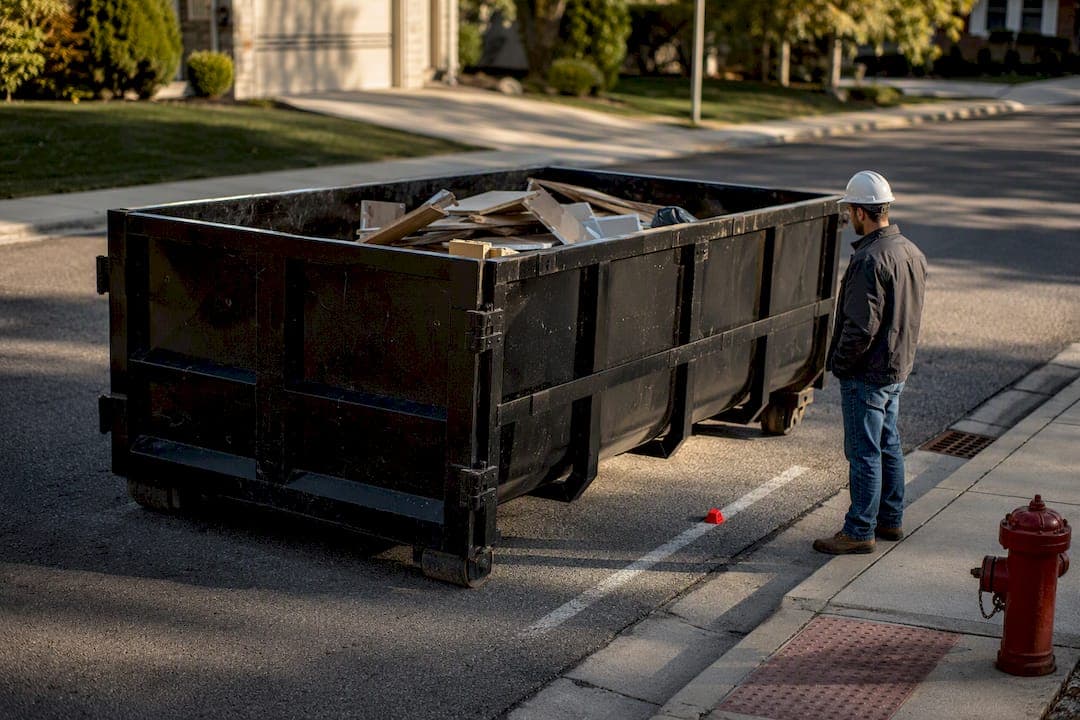
Most cities require a street or right-of-way permit before you can place a dumpster on a public street, sidewalk, alley, or planting strip, and that permit is usually held by a licensed contractor or a registered carting company rather than the homeowner. A handful of cities let homeowners apply for short, limited placements. If the container stays entirely on a driveway or private lot, a street permit is typically not needed at all.
TL;DR:
- Most cities require a permit held by a licensed contractor or registered hauler for street placements, with homeowners often limited to short-term, private property use.
- Applying involves a site plan, proof of insurance, and proper registration, with many cities demanding specific clearances from hydrants and intersections.
- Permit approval depends heavily on precise details like hydrant distances, exact meter numbers, and a complete application package with insurance documentation.
- Fees vary based on container size, placement location, and duration, with simple residential permits often approved quickly but construction permits taking several days.
- Ensuring a detailed, accurate site plan and confirming hauler registration beforehand can minimize delays and rejection risks.
Table of Contents
- Who needs a permit and who can apply
- Typical local rules and representative city examples
- Step-by-step: how to apply and what to prepare
- Site plan, placement rules, and safety requirements
- Fees, permit durations, and typical processing times
- Common reasons permits get denied or delayed
- Where to verify local rules and a printable checklist
- Author perspective: contractor lessons on permitting
- How A to Z Construction can help with permitting and dumpster rental
- Sources
- FAQ
Who needs a permit and who can apply
Cities restrict who can hold a street dumpster permit because they want a party they can hold accountable if the container blocks traffic, damages pavement, or overstays its welcome. In most jurisdictions, that means a licensed general contractor or a carting company registered with the city, not the property owner. New York City's rules, for instance, require permits to be obtained by a registered carting company or registered general contractor, and each permit generally covers one container for a set number of days, per NYC311's dumpster permit guidance.
- Licensed general contractors and registered haulers are the applicant types most cities accept.
- Some cities allow homeowners to apply directly for brief, limited events like a weekend cleanout.
- Commercial general liability insurance and hauler or DOT registration are standard prerequisites, since they give the city a way to enforce cleanup and cover damage.
- Ask your rental company whether it already holds an active city registration or permit account before you assume you need to file anything yourself.
Typical local rules and representative city examples
City rules share a basic skeleton: one container per permit, commercial-grade bins only in the public right-of-way, capped durations, and a requirement to post the permit or a label on the container. The differences show up in the details.
- New York City issues Construction Debris Container Permits for 20 to 40 yard bins tied to a Department of Buildings job, and separately allows homeowner bulk-item containers for up to five consecutive days when placed by a registered carting company, according to NYC311.
- Philadelphia requires pre-approval from the Department of Streets for a right-of-way dumpster license, with a separate Temporary Construction Dumpster Permit process and its own public-dumpster licensing track, as outlined by the City of Philadelphia.
- Minneapolis requires applicants to be licensed contractors and issues street use permits in 30, 60, and 90 day terms.
- Seattle distinguishes short residential curbside staging, which may not need a permit within specific timing rules, from construction containers, which require a Street Use permit and a right-of-way impact plan, per the city's director's rule guidance.
These are patterns, not a substitute for your city's own page: fees, container classes, and residential exceptions vary enough that you should confirm the exact rule before you schedule delivery.
Step-by-step: how to apply and what to prepare
Applying for a street dumpster permit is mostly a paperwork and logistics exercise. Work through it in order and you avoid the back-and-forth that stalls most applications.
- Identify the permitting office. Look for the department of transportation, public works, or a 311 portal, and confirm whether your applicant type (contractor, hauler, or homeowner) qualifies.
- Draft a scaled site plan. Show the dumpster footprint, nearby hydrants, ADA ramps, the curb line, catch basins, driveways, intersections, and any parking meters within the block.
- Gather your documents. You will typically need the application form, proof of insurance, contractor or hauler registration, a container ID, payment, and the exact dates and times requested.
- Arrange signage if required. Many cities want temporary no-parking meters or easels reserved in advance, sometimes 72 hours ahead of delivery.
- Submit and post. File through the city's online portal or in person, post the permit or label on the container as required, and time delivery to avoid restricted hours like street-cleaning windows.
If you plan to place the dumpster where materials like concrete or masonry debris will fill it fast, check our sizing guide for remodel dumpsters before you settle on a container class in the application.
Pro Tip: Call the permit office with your address before you file. A five-minute pre-check on hydrant distance or meter conflicts often saves a week of resubmission.
Site plan, placement rules, and safety requirements
Cities build their site plan requirements around three things: keeping intersections clear, protecting pedestrian access, and making sure the container is visible enough that no one hits it. Application supplements commonly ask that containers stay clear of intersections and fire hydrants by set distances, and that they never block a driveway, catch basin, or ADA ramp.
- Keep a clear, unobstructed path on the sidewalk for pedestrians and never block a curb ramp or crosswalk.
- Mark the container with reflective tape or corner markings, and add cones or barricades where visibility is limited.
- Post a label with the owner's or hauler's contact information, as several cities specifically require.
- Place plywood or runners under the container to protect the pavement, since you are typically liable for any surface damage.
Municipal application supplements often propose clearances such as staying outside 20 feet of an intersection or 15 feet of a hydrant, a detail worth confirming with New Orleans's application supplement as a representative example of what a scaled site drawing needs to show.
Fees, permit durations, and typical processing times
Fee structures generally combine a flat application charge with a placement or usage fee that scales with container class, location, and duration. Chicago's fee schedule, for example, lists separate rates for alley, curb, parkway, and sidewalk placements, with different charges inside the central business district than outside it, according to the CDOT permit fee schedule.
- Expect an application fee plus a per-day or per-space usage fee that varies by zone and container class.
- Homeowner cleanouts often run one to five days; construction permits commonly cover 30 to 90 days, sometimes renewable.
- Simple residential permits can be approved online almost immediately, while construction permits requiring a full site plan review can take several business days.
Common reasons permits get denied or delayed
Most rejections trace back to the same handful of problems: a vague or hand-drawn site plan, missing insurance paperwork, an applicant who doesn't qualify under the city's rules, or a container placed too close to a hydrant or ramp without anyone catching it before submission.
The fix is almost always the same: use the city's own site-plan template instead of a rough sketch, confirm your hauler's registration is current before you file, and put exact meter numbers and hydrant positions on the drawing rather than approximate ones. Scheduling delivery during low-traffic hours also avoids conflicts with street cleaning or peak parking demand. On our own jobs, we build the site plan and coordinate no-parking signage up front so the permit office sees a complete package the first time, which is the single biggest lever against a rejection.

Pro Tip: Attach your insurance certificate and hauler registration as files with the application instead of promising to email them later. Reviewers move completed packets faster.
Where to verify local rules and a printable checklist
Search "your city name plus dumpster permit," or go straight to the department of transportation, 311, public works, or traffic engineering page for your municipality. Bring or upload these items regardless of city:
- A scaled site plan showing the dumpster footprint and surrounding block features.
- Proof of insurance and your contractor or hauler registration.
- The container ID, requested dates and times, and payment for the application fee.
Double-check for seasonal restrictions too: snow-season parking bans, scheduled street-cleaning days, and special events can override a permit that would otherwise be routine.
Author perspective: contractor lessons on permitting
The permits that get approved fastest are the ones where the site plan does the talking: exact hydrant distances, meter numbers, and curb offsets, not vague sketches. A short call to the permit office before filing catches more problems than any amount of paperwork after the fact.
— Jake
How A to Z Construction can help with permitting and dumpster rental
Filing a street dumpster permit is one more task on a project that already has plenty of them. A to Z Construction handles the coordination directly: we prepare the site plan, confirm hauler registration, arrange no-parking signage, and lay down surface protection so the container doesn't leave a mark on the pavement.
- We coordinate dumpster rental and permit paperwork as part of larger construction and remodeling projects.
- We handle site plans and placement logistics for construction waste removal jobs.
- We serve dumpster rental clients directly in Washington County and the surrounding area.
To get a fast estimate, tell us your project type, container size, and rough dates. Reach out through our main site to get started.
Sources
- Dumpster Permit · NYC311
- Get a Dumpster License (Private or Right-of-Way) | Services
- Street Use Permits - City of Minneapolis
- Director's Rule / Seattle guidance (excerpt)
- CDOT 2022 Permit Fee Schedule (Chicago)
FAQ
How close can a dumpster be to a residence?
Placement distance from a residence depends on your local right-of-way rules rather than a single national standard, and most cities focus more on distance from hydrants, ramps, and intersections than from the house itself. Application supplements in some cities propose staying outside roughly 15 feet of a hydrant and 20 feet of an intersection, a pattern shown in New Orleans's application supplement.
Can you put a dumpster on the street in Chicago?
Yes, with a permit from the city's transportation department, and fees vary by container class and by placement in the central business district versus outside it. The exact rates and location categories are listed in the CDOT fee schedule.
Are dumpsters considered private property?
A dumpster itself is the property of the rental company or hauler, but where it sits determines whether it needs a permit. On a private driveway or yard, no street permit is typically required, while placement on a public street, sidewalk, or alley usually falls under municipal right-of-way rules.
How much does it cost to get a dumpster permit in New York City?
NYC311's guidance covers the permit process and duration rules for construction debris containers and homeowner bulk-item containers, but it does not publish a single flat fee figure. Check the NYC311 permit page directly or contact the Department of Transportation for the current fee tied to your permit type.