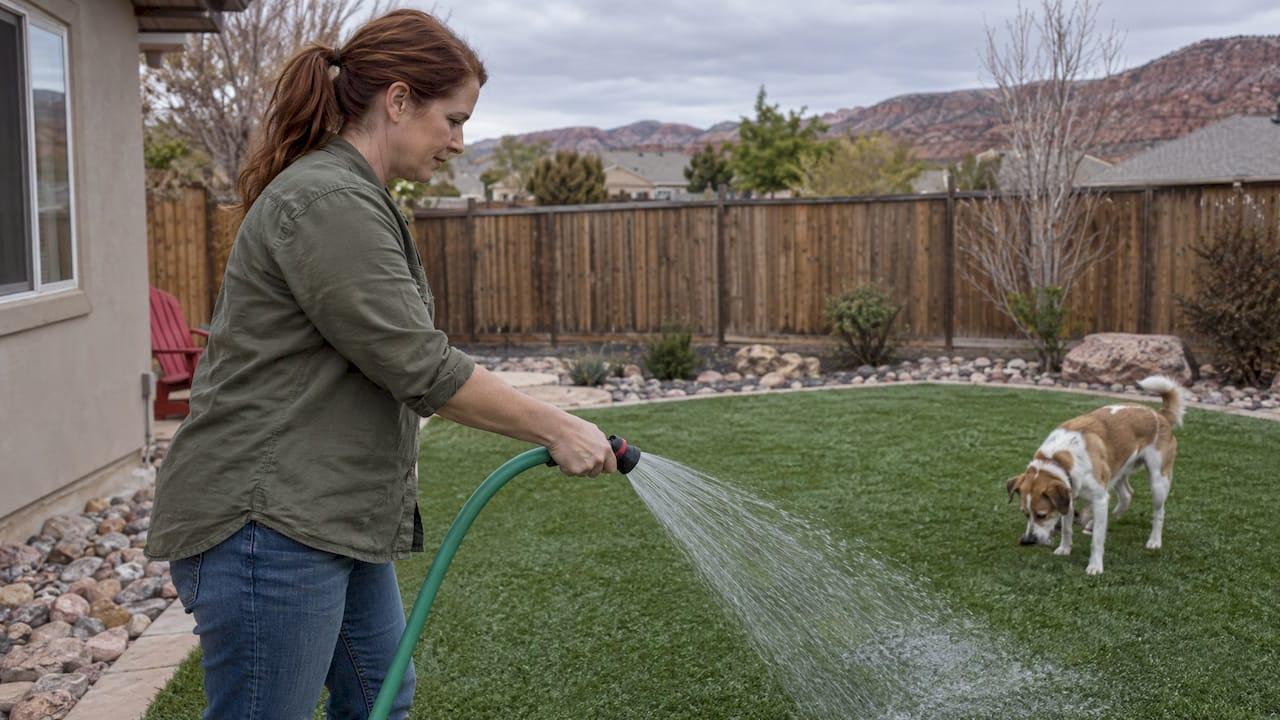
Pet odor on artificial grass comes from urine that stays in the turf system instead of draining away. Turf has no soil microbes to break urine down, so it builds up in the infill and backing, and a quick rinse only moves the problem around. You can deodorize turf with an enzyme-based cleaner, plenty of water and enough contact time. If the smell keeps coming back, the cause is usually underneath the blades: infill, drainage and base. Those are decided when the turf is installed, and we build that part of a yard ourselves from the first estimate to the last seam.
TL;DR
- Urine smells worse on turf because there are no soil microbes to break the waste down, so it accumulates instead of decomposing.
- To remove it: pick up solids, rinse, apply an enzyme-based outdoor odor eliminator, keep it damp for about 10 minutes, let it dry, and repeat if needed.
- Skip bleach, solvents, metal brushes and hard pressure washing. They damage turf and do not fix the cause.
- A smell that returns after every cleaning usually points to infill, drainage or the base, which is an installation question, not a cleaning one.
- If you are planning a new dog-friendly lawn in Utah, settle the infill and drainage plan before the turf goes down.
Table of Contents
- Why pet urine smells worse on artificial grass
- How to deodorize artificial turf step by step
- What to use, and what to avoid
- How often to clean pet areas
- When cleaning does not fix it
- Planning a new pet-friendly turf yard in Utah
- Our perspective on pet odor
- Get a pet-ready turf yard from one crew
- FAQ
- Sources
Why pet urine smells worse on artificial grass
On a natural lawn, soil bacteria and roots deal with a good share of what a dog leaves behind, and rain carries the rest down into the ground. Artificial grass is a different system. It is a layer of synthetic blades stitched into a backing, usually with infill between the blades, sitting on a compacted base. Nothing in that stack digests urine.
Urine contains urea and related compounds. When they sit in warm, damp conditions, bacteria convert them into ammonia, which is the sharp smell most owners notice first. Heat makes it more noticeable, which is why the problem peaks in summer. In a hot climate like southern Utah, a yard that is fine in April can be unpleasant by July.
Three things decide whether you notice it:
- Concentration. A dog that uses the same corner every day loads that patch with far more urine than rain or a hose can flush out.
- Where the liquid goes. If urine soaks into the infill and backing and drains slowly, it stays in contact with the material and keeps producing odor.
- What it can bind to. Some infill materials hold moisture. Others are designed to capture ammonia. We cover infill in more detail below and in our guide to turf infill types.
Understanding this saves you money. Spraying fragrance over a patch hides the smell for a day. Treating the compounds and moving the liquid out of the system is what makes it stay gone.
How to deodorize artificial turf step by step
This routine works on most turf lawns that dogs use. Always check the care instructions for your particular turf and the label on any cleaner you buy.
1. Remove solid waste first
Pick up solids as soon as you can. Do not hose feces into the turf: that spreads the contamination across a bigger area and into the infill. Bag the waste, then deal with whatever residue is left.
2. Keep pets off the area
Keep your dogs away while you clean and until the surface has dried. Cleaning products need time to work, and wet turf invites dogs back to the same spot.
3. Rinse the area
Start with a hose at low to moderate pressure. The goal is to flush fresh urine through the turf, not to blast the infill out of place. A pressure washer is the common mistake here. Home and garden experts advise against excessive pressure washing on artificial turf, along with bleach, solvents and metal brushes. High pressure can displace infill and leave you with thin, matted patches that drain worse than before.
4. Apply an enzyme-based odor eliminator
This is the step that matters most. An outdoor odor eliminator made with enzymes and naturally occurring bacterial microbes works on the source of the smell instead of masking it. Simple Green's guidance for artificial grass is to apply its Outdoor Odor Eliminator with a hose-end sprayer, keep the area damp for about 10 minutes, then let it dry. Repeat if the odor is still there.
Two habits make the difference:
- Saturate, don't mist. Urine soaks down through the blades into the infill and backing. A light spray on top treats only the blades. Wet the affected area enough that the product reaches the layers where the odor lives.
- Respect dwell time. Enzymes need time in contact with the residue. If the product dries in two minutes in July sun, you have not given it time to work. On hot days, treat in the early morning or evening, or re-wet the area to keep it damp for the full period.
5. Let it dry completely
Let the turf air-dry before dogs go back on it. Then do a smell test on a warm afternoon, not just right after cleaning. Odor from deep in the system often shows up only when the sun heats the surface.
6. Repeat on a cycle if needed
One treatment may be enough for a single accident. A spot your dog has used for months may need several rounds over a couple of weeks. If the smell returns every time it warms up, move on to the installation causes below.
What to use, and what to avoid
Owners ask the same questions again and again about household products, so here are direct answers.
| Product | Good for | Notes |
|---|---|---|
| Enzyme or bacterial odor eliminator made for outdoor or turf use | Urine odor, residue in infill | The best fit for pet odor. Follow the label for dilution and dwell time. |
| Diluted mild dish soap | Light stains and greasy spills | Fine for regular cleaning, but not a treatment for embedded urine odor. Rinse thoroughly. |
| Bleach, solvents, gasoline | Nothing on turf | Avoid. They can damage the turf and are not safe around pets. |
| Metal or wire brushes | Nothing on turf | Avoid. Use a stiff synthetic-bristle broom or brush. |
| Pressure washer | Nothing on turf | Avoid high pressure. A garden hose does the job. |
On the question of Dawn: a small amount of diluted dish soap is fine for a light stain, as long as you rinse it all out. It will not neutralize urine that has soaked into the infill. For that, use an enzyme product.
Whatever you choose, read the label for pet safety, keep dogs out until the area is dry, and never mix cleaning chemicals with each other.
How often to clean pet areas
There is no one schedule that fits every yard, because it depends on how many dogs you have, how big the yard is and how hot it gets. A sensible pattern:
- Daily: pick up solid waste.
- Regularly, and more in summer: rinse the spots your dog favors with a hose. Fresh urine is far easier to flush than urine that has baked in.
- As needed: treat the favorite spots with an enzyme cleaner when you notice any smell, and more often in the hottest months.
- Monthly: brush the turf. Home and garden experts suggest brushing about monthly and giving the turf a full rinse or clean about once a year. Brushing lifts matted blades so water and air can move through.
Our own turf care guide covers tools and routines in more detail: artificial turf maintenance.
When cleaning does not fix it
If you have cleaned correctly and the smell comes back within days, stop treating the surface and look at the system. These are the usual culprits.
Infill that holds moisture
Infill is the granular material between the blades. It keeps the blades upright and gives the turf weight. Different materials behave differently around urine. Plain sand mainly provides ballast and can hold moisture. Other infills are made to help with odor, and some are sold specifically for pet yards. If your yard has a dog and a plain sand infill, that may be the reason it smells. Our write-up of infill types and what each one costs explains the options so you can ask the right questions before a quote.

Slow drainage
Turf only drains as well as the base beneath it. If water pools or moves slowly, urine stays in contact with the backing and base long enough to keep producing ammonia. Low spots, a compacted or poorly graded base and turf laid over surfaces that do not drain are the typical causes. If your turf sits over a slab, see turf over concrete for the checks that matter.
Matted fibers in the high-traffic corner
Blades that lie flat in the dog's favorite path hold more liquid and dry slowly. Regular brushing helps, but a persistent mat in one place can signal that the infill has thinned there.
A zone that gets all the use
Dogs pick a spot and return to it. Some owners put a small dedicated potty area on a surface that rinses easily. Whatever you decide, plan the layout around where the dog actually goes, not where the yard looks best.
Planning a new pet-friendly turf yard in Utah
If you are replacing a patchy lawn or building a yard around a dog, the odor question should be answered at the design stage, not after the first hot summer. These are the decisions to settle before anyone cuts a single roll of turf:
- Base and grading. Water has to leave the area. That depends on excavation, compaction and slope, and those are earthwork decisions.
- Infill. Choose it for a yard with pets in mind, not just for the lowest price per bag.
- Turf type. Pet-focused products differ from decorative ones. Our guide to the best turf for dogs walks through what to look for.
- Edges and surrounding surfaces. Where the turf meets concrete, pavers or a patio, you want clean drainage and no trapped liquid.
- Water access. A hose bib or sprinkler line nearby makes the daily rinse something you will actually do. Our sprinkler water pressure guide helps if you are sizing a system.
On cost, our published range for artificial turf is $8 to $20 per square foot. See the 2026 installation cost guide for what moves a project within that range.
Our perspective on pet odor
We get the same call every summer: the turf looked great in spring and now the dog corner smells. People assume the turf is the problem. More often it is the layers under it.
Most of a turf yard is hidden. The base, the grading and the infill decide whether urine drains out or sits there. That is why we keep the whole job in one crew, from the estimate and the excavation to the turf and the finishing. When the person who plans the drainage is also the person who lays the turf, nothing gets lost between trades.
Our approach is built around one point of contact, no subcontractors and local knowledge of Utah's climate and codes. For a yard with dogs, that means we can look at the whole system together: where the dog goes, how water moves, what goes under the turf and what goes between the blades.
If you are planning a new yard, tell us about your dogs at the estimate. It changes how we think about the base and the layout.
Jake
Get a pet-ready turf yard from one crew
A to Z Construction is a licensed general contractor in Cedar City, Utah. Our in-house crew handles artificial turf from the first estimate through final completion, along with the earthwork, concrete, hardscape and irrigation around it, so you deal with one team instead of coordinating several. Artificial turf with us runs $8 to $20 per square foot.

If you are building or replacing a yard for a dog, start with our artificial turf installation page or request a free artificial turf estimate. You can also see everything we do outdoors on our landscaping services page.
FAQ
What kills strong dog urine smell on turf?
An enzyme-based outdoor odor eliminator is the right tool, because it breaks down the compounds behind the smell instead of covering it. Saturate the area so it reaches the infill, keep it damp for the dwell time on the label, then let it dry. For an old, strong smell, plan on repeating the treatment.
Can I use Dawn dish soap on artificial turf?
Yes, in a diluted form for light stains and greasy spills, as long as you rinse it out completely. It is not the right fix for urine that has soaked into the infill. Use an enzyme cleaner for odor.
Does artificial grass always smell with dogs?
No. With prompt cleanup, regular rinsing and a system that drains well, a turf yard can stay fresh. Smells that keep returning usually trace back to infill that holds moisture, slow drainage or a spot your dog uses constantly.
Can I use a pressure washer to deodorize turf?
It is better not to. Excessive pressure washing can damage turf and push infill out of place. A garden hose with an enzyme cleaner treats odor without the damage.
How do I keep my turf from smelling in summer?
Pick up solids daily, rinse favorite spots often, treat them with enzyme cleaner at the first hint of odor and brush regularly. In a new installation, the best prevention is a well-drained base and an infill chosen for pets.
Sources
- How to Clean Artificial Grass (Dog Urine) | Simple Green
- How to clean artificial turf this spring | Homes & Gardens