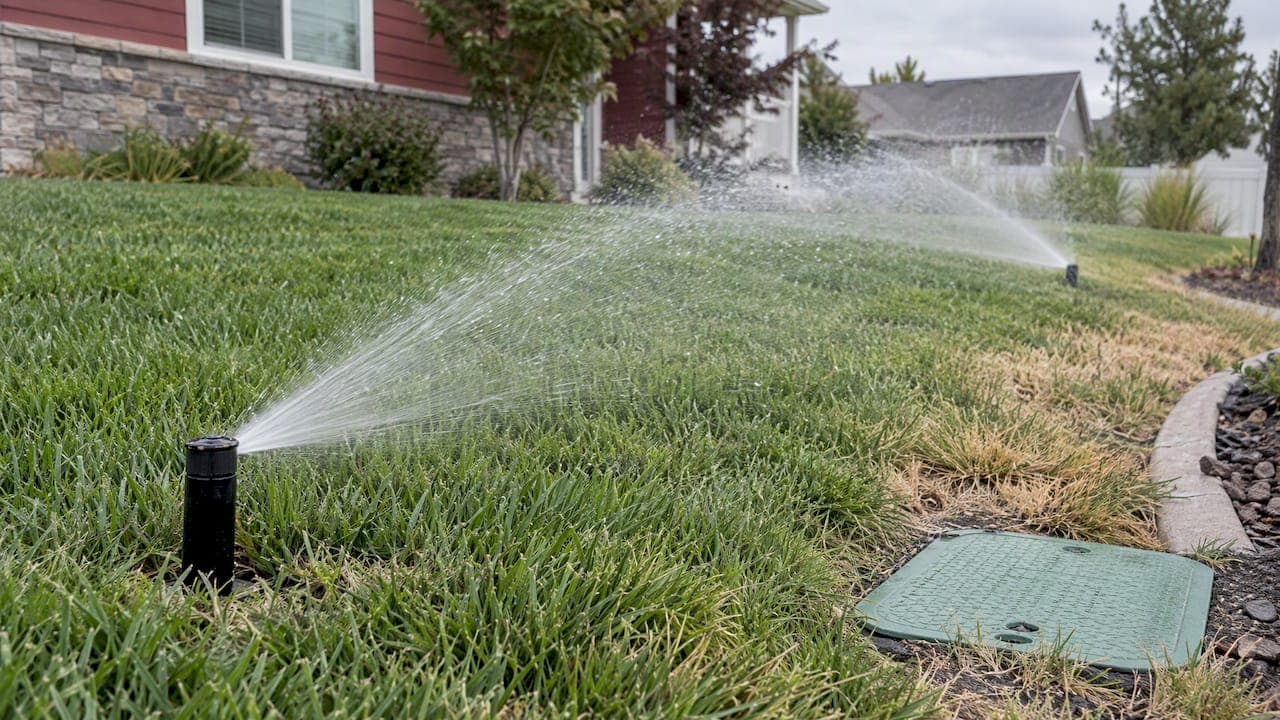
Most residential sprinkler systems work best at about 25 to 35 psi at the nozzle for spray heads and 40 to 55 psi for rotors. That is lower than the pressure at your hose bib, and it is not the same number you read at the street. If your yard has dry spots, misting heads or one weak zone, pressure is the first thing to measure, and often the cheapest thing to fix.
This guide shows you how to measure pressure correctly, what the numbers mean, and what to do when pressure is too low or too high. It also tells you when a repair stops being a weekend job and a licensed crew should take over.
TL;DR
- Measure static pressure first, with every water-using fixture in the house off. Use a simple gauge on a hose bib or the backflow assembly.
- Spray heads want roughly 25 to 35 psi at the nozzle, rotors 40 to 55 psi, and drip or micro-irrigation 15 to 30 psi. Expect about 15 psi of loss between the supply and the head.
- Low pressure is usually a restriction (a half-closed valve, a clogged filter, a leak), not a supply problem. Check these before buying a pump.
- High pressure shows up as fog or mist. A pressure regulator at the valve or head is the fix, and it saves water.
- Swapping in bigger nozzles to "get more water" usually makes coverage worse.
Table of Contents
- Why pressure matters more than most people think
- What psi should your sprinklers run at?
- How to measure sprinkler water pressure
- Signs your sprinkler pressure is too low
- Signs your sprinkler pressure is too high
- Pressure regulators for sprinklers: where to put them
- Increasing sprinkler pressure: a decision path
- Why pressure balance is good for the whole landscape
- Perspective: what we see in the field
- What a professional repair or install costs
- Protect your pressure through the winter
- Need a hand with your sprinkler system?
- FAQ
- Sources
Why pressure matters more than most people think
Every sprinkler nozzle is engineered for a pressure window. Inside that window it makes the droplet size and throw distance the manufacturer designed. Outside it, performance drops. According to Oklahoma State University Extension, running outside the optimal range causes poor distribution uniformity, dry spots, or water lost to misting and evaporation.
The goal is what irrigation designers call head-to-head coverage: the spray from one head reaches the next head. With low pressure it does not, and you get brown, stressed patches between heads. With high pressure the water atomizes, drifts and evaporates before it gets to the soil.
So pressure is not a "more is better" number. It has to match the nozzle.
Pressure and flow are different things
Pressure (psi) is the force in the pipe. Flow (gallons per minute, GPM) is the volume moving through it. A system can have decent pressure and weak flow, for example when a pipe is undersized or a valve is partly shut. It can also have plenty of flow and poor pressure at the far zones. Many "low pressure" complaints are really flow problems, which is why diagnosing before buying parts matters.

What psi should your sprinklers run at?
The table below pulls together the ranges from university extension research. Check the label on your own nozzles, because manufacturers publish their own ratings.
| Sprinkler type | Typical best range at the nozzle |
|---|---|
| Fixed spray nozzles | 25 to 35 psi |
| Rotor sprinklers | 40 to 55 psi |
| Micro-irrigation and drip | 15 to 30 psi |
The ranges come from the Oklahoma State fact sheet, which also notes that standard residential supply is often 40 to 60 psi. The Florida Water Star technical manual takes the same approach: sprinklers and emitters each have a pressure range where they work best.
The 15 psi rule of thumb
Even if your supply is strong, you will not get all of it at the head. Water loses pressure through the meter, the backflow preventer, the control valves and the pipe itself. A reasonable planning figure is about 15 psi of total loss, per the same Oklahoma State sheet. So a 60 psi supply leaves you closer to 45 psi at the nozzle once the system is running.
That is fine for rotors. It is too much for standard spray heads, which is why regulation matters so much on spray zones.
How to measure sprinkler water pressure
You need a pressure gauge with a hose-thread fitting. Hardware stores sell them for a few dollars. Then follow these steps.
- Turn everything off. Shut off faucets, the ice maker, the washing machine and the dishwasher. Flowing water inside the house gives a falsely low reading. Static pressure, measured with nothing running, is the baseline that professionals start with, as the water training course on irrigation pumps explains.
- Screw the gauge onto an outdoor hose bib. Open the valve fully and read the gauge. Do it at a few times of day, since municipal pressure can drift with demand.
- Note the number. Under 40 psi is low for most systems. Between 40 and 60 psi is the comfortable zone. Above 60 psi, regulation is worth considering.
- Measure with the zone running. If you can attach the gauge at the backflow assembly or a test port, compare the static number with the running number. The gap tells you how much you are losing to restrictions.
- Test your weakest zone. If just one zone is poor, the problem is in that zone, not at the supply.
Write down every reading. A technician will want them, and they let you confirm whether a fix worked.
Signs your sprinkler pressure is too low
- Spray patterns that fall short of the next head
- Rotors that barely turn or stall
- Pop-ups that rise slowly or not all the way
- Dry or yellow strips between heads
- One zone that looks fine while another is weak
Fix the restriction before you boost the pressure
This is where homeowners waste money. Before you consider any pump, check the cheap, common culprits:
- The isolation valve. The shutoff at the start of the irrigation line is often left partly closed after a repair or winterization. Open it all the way.
- The backflow preventer. Its shutoff valves need to be fully open. If the assembly is old or fouled, it can also choke flow.
- Clogged filters and heads. Sand and debris plug nozzle screens and zone valve filters. Pull them and rinse.
- Leaks. A broken lateral line or a cracked head lets water escape, so the remaining heads starve. Look for soggy ground or a zone that takes longer to start spraying.
- Too many heads per zone. If a zone was extended or heads were added, it may demand more flow than the supply can give. Splitting the zone is the correct fix.
These causes of artificial restriction are the first things to check in most troubleshooting guides, including the Ewing irrigation troubleshooting guidance that flags the same trap in the next section.
Do not just install bigger nozzles
It feels logical: bigger openings, more water. But if pressure is already short, a larger orifice uses even more of the limited flow, which shortens the throw and creates more dry spots. In a low-pressure zone, a smaller nozzle with a longer run time is often the better answer. Fix restrictions first, then match nozzles to the pressure you actually have.
When a booster pump makes sense
If the supply itself is weak, say a static reading well under 40 psi, and the system has no restrictions left to clear, a booster pump on the irrigation line can bring it up. Two points matter. A pump is sized by flow and head, not by psi alone. And it should be controlled so it only runs when irrigation circuits are running, typically with a pump start relay. A pump that is oversized or wired wrong will push pressure too high and stress the pipes.
Here is a note on electricity: pressure is not free. According to University of California Cooperative Extension research, going from 40 to 60 psi does not improve coverage uniformity in most residential systems but can raise flow by roughly 18% and increase pump electricity costs. Boost only as much as the design needs.
Signs your sprinkler pressure is too high
The classic sign is a fine fog around the head instead of distinct droplets. That mist evaporates fast and blows away in the wind. Other signs:
- Heads that spray a misty cloud, then dry out the grass at the edges
- Water hammer, the banging in pipes when a valve shuts
- Leaking fittings or blown-off nozzles and pop-up caps
- Puddles right at the head, with dry lawn farther out
High pressure is common. The EPA's WaterSense report on spray sprinkler bodies notes that many irrigation systems operate above the manufacturer's recommended pressure, and reports that Utah and Colorado studies found 63% of systems above the optimal 30 psi for spray heads. That is especially relevant if you live in Utah, where many municipal and secondary systems run strong.
The same report says that installing pressure regulation in systems running at or above 60 psi can save nearly 5,600 gallons of water per year for the average household. For reference, the EPA's WaterSense builder manual sets a maximum static service pressure of 60 psi for labeled new homes.
If you hear banging when zones switch, read our guide on irrigation water hammer and keeping pipe velocity under control. Pressure and velocity problems often show up together.
Pressure regulators for sprinklers: where to put them
A regulator holds downstream pressure at a set value no matter how the supply swings. You have three common options.
| Location | What it does | Best for |
|---|---|---|
| At the main line (after the meter or backflow) | Lowers pressure for the whole system | Systems with one pressure need and high supply |
| At each zone valve | Sets pressure per zone | Mixed zones, such as sprays and rotors together |
| In the spray head body | Regulates each head individually | Uneven elevation, long runs, heads that mist |
The EPA's research points toward regulation at the valve or head as the consistent professional solution, because high supply pressure at the source does not translate to good performance at the ground. Spray sprinkler bodies that carry the EPA WaterSense label include regulation inside the head.
A few practical notes:
- Regulators are rated for a specific outlet pressure. A 30 psi unit suits standard spray nozzles. Match it to what the nozzle needs, not to your supply.
- Elevation matters. On a slope, heads at the bottom see more pressure than heads at the top, so head-level regulation evens out the zone.
- Regulated heads need a minimum inlet pressure to hold their setting. If your inlet is already low, a regulator will not help and may reduce throw.
- Do not confuse this with a house pressure-reducing valve. If your whole house runs well above 80 psi, a PRV on the main line protects fixtures and pipes too, and some codes require it.
Increasing sprinkler pressure: a decision path
Use this order. It follows the cheapest-first logic that most irrigation pros use.
- Measure static pressure with nothing running.
- Open the isolation valve and backflow valves fully.
- Clean filters, screens and nozzles.
- Walk the zone looking for leaks or broken heads.
- Check whether the zone has too many heads for its flow, and split it if so.
- Match nozzles and heads to the pressure you have.
- Only then, if the supply is truly low, size a booster pump and a start relay.
If you get to step 7, call a pro. Pump sizing, pressure tanks and electrical work are not casual DIY jobs, and a wrong choice can burst a line.
Why pressure balance is good for the whole landscape
Uniform pressure means uniform watering, and that carries over to everything planted in your yard. Trees, for example, need a different approach than turf. If you are managing mature trees alongside a lawn, deep root watering for trees shows how delivering moisture straight to the root zone can complement the sprinkler zones. Pressure that is balanced across zones keeps those zones from over- or under-watering while you do it.
Perspective: what we see in the field
We build and repair irrigation as part of our landscaping work in Utah, and the pattern repeats. When a homeowner calls about weak sprinklers, they expect a pump. Most of the time, the real problem is smaller: a valve left partly closed, clogged filters, or a zone that grew heads over the years. We check those first because they are free to fix.

When pressure is too high, the fix is also cheap compared with the water it saves. Regulation at the valve or head gives each zone what its nozzles were designed for. We would rather size the system correctly at install than patch it later.
Because our crew handles excavation, trenching, hardscape and landscaping in-house, we can design irrigation around the rest of the project. Pipe runs go in before pavers and turf, not after, and no subcontractor has to guess at what the previous trade did. That coordination is also what keeps pressure losses predictable.
— Jake
What a professional repair or install costs
Costs depend on the size of the yard, the number of zones and the condition of the existing lines. Our published range for irrigation and sprinkler system work is $3,000 to $8,000. For a wider view of what homeowners pay and what drives price, see our guide to what U.S. homeowners actually pay for irrigation, and the breakdown of irrigation system types by budget.
A pressure fix on an existing system is typically a smaller job than a full install. We scope it by measuring first, then telling you what the readings say.
Protect your pressure through the winter
Pressure problems often appear in spring because of what happened in fall. Pipes that were not blown out can crack, and valves left in the wrong position cause low pressure all season. If you want to avoid a surprise, our guide to sprinkler winterization for homeowners walks through the steps.
Need a hand with your sprinkler system?
If you have measured your pressure and the numbers do not add up, or you would rather skip the diagnosis, we can do it for you. Our crew installs and repairs systems across Utah, and you can see the details on our irrigation and sprinkler systems page. To get a quote, use the free sprinkler and irrigation estimate. One contractor, one point of contact, from the first measurement to the final zone test.
FAQ
Is 90 psi too high for a sprinkler system?
Yes. Spray heads work best around 25 to 35 psi, and rotors around 40 to 55 psi, so 90 psi will produce heavy misting and strain fittings. A regulator at the main line, zone valve or head will bring it down. If your whole house runs that high, ask a licensed plumber about a pressure-reducing valve.
How do I increase sprinkler pressure?
Start by measuring static pressure, then make sure the isolation valve and backflow valves are fully open, clean filters and nozzles, and look for leaks. Those steps fix most low-pressure cases. If supply is truly low, a properly sized booster pump with a start relay is the next option.
Why does only one sprinkler zone have low pressure?
A single weak zone points to a local problem: a partly closed or clogged zone valve, a leak in that lateral, a blocked filter, or too many heads on the zone. The supply is fine, since the other zones work. Check that zone's valve first.
How much psi do I lose between the meter and the sprinkler head?
A planning figure is about 15 psi, caused by friction across the meter, backflow preventer, valves and pipe. A 60 psi supply therefore leaves about 45 psi at the head. Your real loss depends on pipe size, distance and flow.
Sources
- Managing Pressure in the Home Irrigation System, Oklahoma State University Extension
- Pressure regulation, Florida Water Star
- Irrigation Pumps and Alternate Water Sources
- How to Find and Fix Irrigation Water Pressure Problems, Ewing
- Crop Notes: pressure effects on sprinklers, University of California
- Relieve Pressure and Reduce Water Waste From Spray Sprinkler Bodies, EPA WaterSense
- WaterSense Resource Manual for Building WaterSense Labeled New Homes, EPA