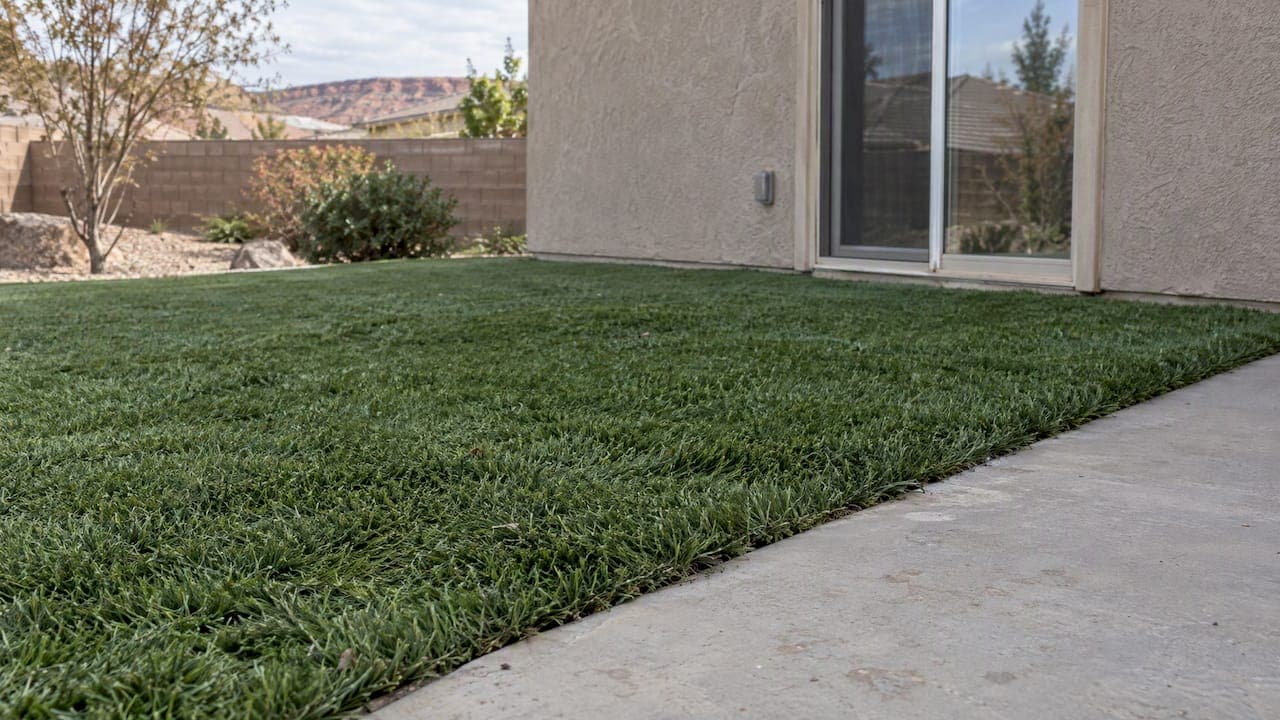
Yes, you can install artificial turf over concrete, but only when you plan for drainage, cushioning, and moisture before the first panel goes down. Concrete does not absorb water the way soil does, so skipping these steps leads to pooling, odor, and premature wear. The checklist below walks through what to check first and what the installation actually involves.
TL;DR:
- Run a hose test for at least five minutes, then recheck the slab after 20 minutes; redirect pooling toward an edge, drain, or weep gap.
- A slab with structural cracks, no drainage outlet, or a coating that blocks adhesive needs professional repair; minor wear and clear drainage suit DIY work.
- Choose permeable shock pads over a draining base to cushion impact and move water vertically; closed foam requires working slopes or edge drains.
- Clean and repair the slab, then test retained moisture with a meter or calcium chloride test; delay adhesive if readings are high.
- Use concrete adhesive on a clean, dry slab, follow product instructions for seam tape, and tug finished seams before adding infill.
Table of Contents
- Is Your Concrete a Good Candidate for Turf?
- Managing Drainage When Turf Covers a Nonporous Slab
- Cushioning Options: Shock Pads, Foam Underlays, and Drainage
- Preparing Your Concrete: Cleaning, Repairs, and Moisture Checks
- Installation Steps: Adhesives, Seams, Edges, and Transitions
- Routine Care and Troubleshooting Common Issues
- A to Z Construction: How a Licensed GC Scopes Turf-Over-Concrete Projects
- What Most Advice Gets Wrong About Turf on Concrete
- Hire a Pro: A to Z Construction's Turf-Over-Concrete Services
- FAQ
- Sources
- Technical Specs and Partner Resources
Is Your Concrete a Good Candidate for Turf?
Not every slab is ready for turf, and a quick walk-around tells you most of what you need to know. Start by looking for the basics, then decide if the project is something you can tackle yourself or if it needs a licensed contractor.
- Check whether the slab slopes toward an edge or drain, or whether water visibly pools after rain.
- Inspect for cracks wider than a hairline, spalled or flaking spots, and any lip that could trip someone.
- Find existing drains or weep holes and estimate whether they can handle the volume of water the turf will shed.
- Look for sealers, paint, or epoxy coatings that might block adhesive from bonding properly.
- Decide whether the repairs involved are small enough for a weekend project or whether cracking, settling, or drainage problems point to a contractor.
A slab with minor surface wear and a clear path for water is usually DIY-friendly. One with structural cracking, no drainage outlet, or a coating that needs stripping is better handed to a crew that can fix the concrete and install the turf in one scope.
Managing Drainage When Turf Covers a Nonporous Slab
Soil lets rainwater soak straight down. Concrete does not, so every drop that lands on turf over a slab has to travel somewhere else, either across the surface to an edge or straight down through a built-in drainage layer. Ignoring this is the single most common reason turf-over-concrete installs fail.
A few proven fixes handle most situations:
- Regrade the perception of slope by shimming the base or adjusting the underlay thickness so water runs toward an edge instead of pooling in the middle.
- Install trench drains, scuppers, or perimeter weep gaps where the slab has no natural low point.
- Tie into existing storm drains or downspouts if the slab already drains toward one.
- Add a permeable underlayer with vertical drainage channels so water moves down through the system rather than across it.
Before committing to any fix, run a simple hose test: soak the slab the way a heavy rain would and watch where water collects. Photograph any pooling so you have a record to share with a contractor if the fix turns out to be bigger than expected.
Pro Tip: Run the hose test for at least five minutes and check the slab again 20 minutes later; slow drains often look fine at first and only reveal pooling once water has had time to settle.

Cushioning Options: Shock Pads, Foam Underlays, and Drainage
Turf laid directly on bare concrete feels hard underfoot and transmits impact straight through to joints, which matters for kids' play areas, pet zones, and anywhere people walk barefoot. A cushioning layer softens that impact, but the type you choose has to match how the water needs to move.
- Permeable EPP shock pads, such as the ShockPad / Series XL spec, allow water to pass vertically through the pad itself rather than across the surface.
- Turf padding panels offer a lighter-duty cushioning option for patios and walkways where impact needs are lower.
- Closed-cell foam rolls add softness but do not drain, so they only work where water is already being managed by slope or edge drains.
ShockPad / Series XL is built from permeable expanded polypropylene and is engineered for full vertical drainage when installed over a vertically draining stone base, which means the pad itself becomes part of your drainage plan rather than an obstacle to it. For decorative patios, a thinner pad is usually enough. Play areas and pet runs call for a thicker, higher-impact-rated pad, and the manufacturer spec is worth checking against your turf backing before you buy adhesive, since some backings and glues are not rated for use with every pad type.
Preparing Your Concrete: Cleaning, Repairs, and Moisture Checks
Prep work determines whether your adhesive bonds and whether water actually goes where you planned. Rushing this stage is the fastest way to end up re-doing the job within a year.
- Pressure wash the slab to remove dirt, algae, and loose debris, then treat any rust or oil stains and degrease problem spots before moving on.
- Fill cracks, grind down high spots, and address any delamination or flaking concrete so the surface is flat and sound.
- Test for retained moisture using a calcium chloride test or a moisture meter, especially on older or below-grade slabs, and hold off on adhesives if readings come back high.
- Skip sealing the slab right before installation unless you plan to test adhesion on a small patch first, since some sealers and coatings interfere with how well adhesive bonds to concrete.
- Give any crack repairs or moisture treatments the full cure and dry time the product calls for before laying turf, which is usually longer than homeowners expect.
Rushing past moisture issues is one of the more common causes of adhesive failure down the line, so it is worth the extra day or two to get a clean reading before moving forward.
Installation Steps: Adhesives, Seams, Edges, and Transitions
Once the slab is clean, repaired, and dry, the actual turf install follows a fairly consistent sequence.
- Dry-fit the turf panels first, laying them loosely to check pattern direction and leaving small expansion gaps before cutting anything permanently.
- Choose a direct-bond adhesive formulated for concrete for full-panel bonding, or use seam tape with adhesive for joining two panels together, prepping each surface according to the product instructions.
- Terminate edges with a termination strip, mortar-set curbing, or mechanically fastened edge, depending on whether the edge borders a planting bed, a paver walkway, or open air.
- Cut seams straight, butt panels tightly with no gap, and apply tape and adhesive exactly per the manufacturer's instructions rather than eyeballing coverage.
- Build transitions flush with adjoining pavers where possible, or add a trim or angled edge where a height change is unavoidable, and pull on finished seams before infill to confirm they hold.
A seam that lifts under a firm tug now will lift under foot traffic later, so test before you consider the job finished.
Routine Care and Troubleshooting Common Issues
Turf over concrete needs less upkeep than a lawn, but it is not maintenance-free. A regular rhythm of cleaning and seasonal checks keeps small issues from becoming expensive ones.
- Sweep or hose down the surface regularly to clear debris, and rinse pet waste areas promptly to prevent odor buildup.
- Check seams and edges each season and after major storms, since freeze-thaw cycles and heavy rain are the most common causes of lift.
- Re-glue minor seam lift or edge delamination yourself with the same adhesive used during install, but call a contractor if lifting is widespread or the backing itself is failing.
- Watch for pooling after heavy rain and address localized spots with a small drain cut or an added weep gap rather than re-doing the whole drainage plan.
- In cold climates, give adhesive extra cure time in low temperatures, since cure rates slow down significantly below typical room temperature.
Pro Tip: Keep a small tube of matching seam adhesive on hand after installation; catching a lifted edge early takes ten minutes, while letting it spread can mean replacing an entire seam.
Pet owners dealing with regular waste cleanup may also find practical tips for handling dog waste on turf useful for keeping a yard odor-free between deeper cleanings.
A to Z Construction: How a Licensed GC Scopes Turf-Over-Concrete Projects
When scoping a turf-over-concrete project, the slab is inspected by checking slope, outlet capacity, crack severity, and moisture readings before quoting anything. When a slab needs crack repair, added drainage, and turf installed, these are bundled into one scope so the sequencing and cure times are handled correctly the first time, rather than passed between separate crews.
What Most Advice Gets Wrong About Turf on Concrete
Most guides to turf over concrete treat drainage as a footnote after the exciting parts: picking turf color, blade height, infill type. That ordering is backward. A slab with no plan for water will fail regardless of how good the turf itself is, while a mediocre turf choice on a well-drained, well-cushioned base will perform fine for years.

The conventional advice also underplays moisture testing. Homeowners want to skip straight to adhesive and seams, but a slab that reads high on a moisture meter will cause bond failure no matter how carefully the seams are taped. That single fifteen-minute test prevents more callbacks than any upgrade in turf quality.
If you take one thing from this, prioritize the hose test and the moisture check before you buy a single roll of turf. Everything else, cushioning thickness, adhesive brand, infill depth, is a tuning decision. Drainage and moisture are pass-or-fail.
— Jake
Hire a Pro: A to Z Construction's Turf-Over-Concrete Services
When a slab needs more than a weekend of DIY prep, we handle concrete repair, drainage solutions, artificial turf installation, and hardscape transitions under one roof.
- Using a single crew reduces gaps between the mason fixing cracks, the drainage install, and the turf installation.
- A single point of contact can keep scheduling and communication simple from estimate to final walkthrough.
- Managing the full sequence of repair, cure time, drainage, and turf under one scope avoids delays from juggling multiple subcontractors.
A first conversation typically starts with a site visit, followed by a written estimate and a realistic timeline based on what your slab actually needs. If you are ready to get a quote, visit our artificial turf and landscaping page to get started.
FAQ
What month should you lay turf?
Turf itself is not weather-dependent to install, but adhesive cure times are, so mild, dry weather in spring or fall tends to work best for concrete installs. Avoid days with rain forecast in the near future, since adhesive needs to set without moisture interference.
What is the best base to put under artificial grass?
Over concrete, a permeable shock pad designed for vertical drainage is generally the most reliable base, since it cushions impact while still letting water pass through to a draining layer below. The ShockPad / Series XL spec calls for installation over a vertically draining stone base to work as intended.
What should I put down before laying turf?
Before turf goes down, the slab needs to be clean, crack-free, and tested for retained moisture, with any necessary cushioning pad installed on top. Skipping the moisture check is one of the most common causes of adhesive failure later on.
How do you get artificial grass to stick to concrete?
Artificial grass bonds to concrete with an adhesive formulated specifically for that surface, applied to a clean, dry, properly prepped slab. Seams get extra attention with seam tape and adhesive applied per the manufacturer's instructions, and testing seam strength before infill helps catch weak spots early.
Technical Specs and Partner Resources
For readers and contractors who want to verify installation details, the ShockPad / Series XL product specification covers vertical drainage and base requirements. Our own guides on turf installation costs and patio drainage fixes go deeper on budgeting and diagnostics.