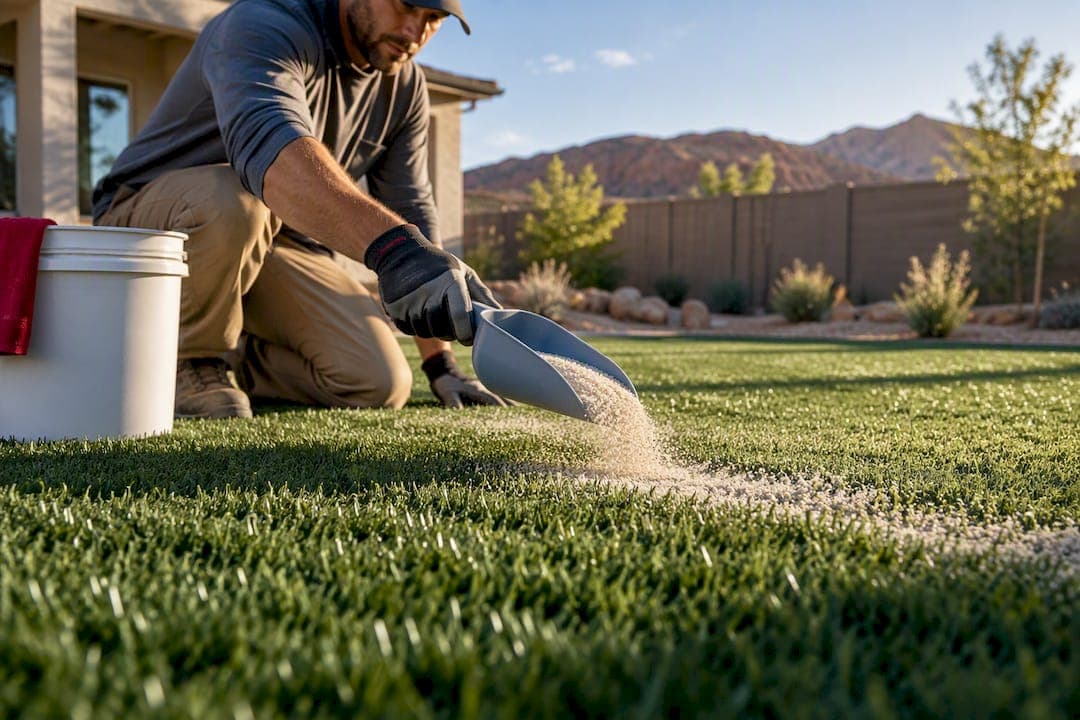
There is no single best turf infill. The right pick matches your main goal: budget lawns do fine with silica sand, pet yards need odor control from zeolite or coated sand, and sports fields need rubber or a rubber blend for shock absorption. Pile height and installation quality decide whether any of them perform as advertised.
TL;DR:
- Budget lawns benefit most from inexpensive silica sand, but unwashed or angular sand can cause turf damage and poor drainage.
- Pet yards require a layer of zeolite over heavier infill to effectively combat ammonia odors and bacterial growth.
- Higher pile height sports fields need deeper infill and often a shock pad, with rubber or rubber-blend infills providing essential shock absorption.
- Coated sands and cooling infills only work effectively when properly installed and maintained, with regular brushing and annual top-offs.
- Proper installation, including correct base grading, particle size, and infill seating, outweighs material choice in performance and longevity outcomes.
Table of Contents
- Why Turf Infill Types Matter More Than Most Homeowners Think
- The Main Turf Infill Types, Side by Side
- How to Choose the Right Infill for Your Project
- Installing and Maintaining Turf Infill the Right Way
- Pet Turf and Odor Control: Getting It Right the First Time
- Managing Surface Heat Without Overhauling the Whole Lawn
- What an Installer Actually Checks on Site
- What Actually Matters When You're Picking Turf Infill
- Get Infill and Installation Right the First Time
- Sources
- FAQ
Why Turf Infill Types Matter More Than Most Homeowners Think
Infill is not filler in the throwaway sense. It holds the blades upright, weighs down the backing so the turf doesn't shift underfoot, and manages drainage, heat, and odor all at once. Skip it or skimp on it, and even premium turf looks flat and feels stiff within a season.
Five jobs, one material.
- Blade support — keeps synthetic fibers standing so the lawn looks full instead of matted.
- Weight and stability — anchors the backing against wind uplift and foot traffic shifting.
- Drainage — lets water pass through instead of pooling on the surface.
- Cushioning — absorbs impact, which matters for kids, pets, and athletes alike.
- Heat and odor influence — some infills run hot in direct sun; others actively fight bacterial buildup.
Pile height changes the math on all five. A 1.25 inch residential lawn needs a different infill depth than a 2-inch sports turf, and an independent evaluation report found that surface hardness swings significantly depending on infill depth and whether a shock pad sits underneath. Skip the pad on a field application and no infill choice fully compensates.
The Main Turf Infill Types, Side by Side
Every infill on the market falls into one of a handful of categories, and each one trades off cost against comfort, cooling, or longevity.
Silica sand is the baseline. It's cheap, it drains well, and it adds the ballast weight turf needs to stay put. The catch: uncoated sand is abrasive against synthetic fibers over time, and it offers no odor or heat benefit. It's the right call for a decorative or low-traffic lawn where budget matters more than comfort underfoot.
Coated sand (Envirofill, Durafill) starts as silica sand but gets an acrylic coating that resists microbial growth and runs noticeably cooler than raw sand or rubber. Installers lean on it for family yards specifically because it balances softness, hygiene, and heat performance without rubber's drawbacks. Coated sand costs more upfront, but it lasts longer and needs less babying.
Crumb rubber, EPDM, and TPE deliver the best cushioning of any infill category, which is why athletic fields and playgrounds rely on rubber blends. Recycled SBR crumb rubber is the budget rubber option; virgin EPDM and TPE cost more but skip the tire-derived odor some homeowners notice in warm weather. All rubber infills retain heat aggressively in full sun, which is the tradeoff you're accepting for the shock absorption.
Zeolite (Zeofill) is a porous mineral that traps and neutralizes ammonia, and it's rarely used alone. Most installers layer it as a top dressing over a heavier base infill, which is the combination that actually solves pet odor problems rather than masking them temporarily.
Organic infills (cork, walnut shell) feel cooler underfoot and biodegrade naturally, appealing to buyers who want to avoid plastic-based infill entirely. They also break down faster than mineral infills, which means more frequent top-offs and a shorter runway before full replacement.
Hydrochill and other cooling-coated sands use an evaporative process: the coating holds water, and as it evaporates, surface temperature drops. It only works when the surface gets wet, so hot, dry climates without regular irrigation see less benefit.
Putting-green fine infills are a different animal entirely. Fine, uniformly sized sands control ball roll speed and stimp rating, and they're specified almost exclusively for golf and putting applications rather than general lawns.
One installer note worth remembering: mixing sand with crumb rubber often lowers surface hardness (Gmax) compared to either material used alone, according to the Penn State evaluation report. That's good for cushioning but it means the ratio and depth need to be dialed in, not guessed at, especially in wet conditions where hardness readings shift further.
How to Choose the Right Infill for Your Project
Work through these criteria in order, and the right infill usually becomes obvious by step three or four.
- Set your budget ceiling. Silica sand costs the least; coated sand and rubber blends run higher; organic infills sit in the middle but need more frequent replenishment.
- Identify your traffic level. Decorative lawns tolerate sand. Daily foot traffic, kids, or dogs push you toward coated sand or a rubber/sand mix.
- Account for pets specifically. Zeolite as a top layer over a heavier base infill is the standard fix for ammonia odor.
- Weigh heat sensitivity. South-facing yards in hot climates benefit from coated or cooling infills over raw rubber.
- Match to pile height. Higher pile turf (2 inches and up, typical on sports fields) needs deeper infill and usually a shock pad underneath.
- Factor in maintenance tolerance. Organic infills look great on paper but demand more upkeep than mineral options.
For quick reference: budget residential lawns do well with silica sand, family yards with pets do best on coated sand plus a zeolite top layer, and youth sports fields typically use a rubber or sand/rubber blend with a shock pad.
Pro Tip: Never let a contractor substitute "all-purpose" or beach sand for turf-specific silica sand. The particle shape is wrong, it's more abrasive against synthetic fibers, and it drains poorly compared to washed, rounded sand.
Watch for three red flags before signing off on any installation: unwashed or angular sand, lightweight infill used alone in a windy or exposed site (it migrates), and infill particle sizes that don't match the turf manufacturer's spec sheet.
Installing and Maintaining Turf Infill the Right Way
Installers commonly work from a rule of thumb of roughly 2 to 3 pounds of infill per square foot for every inch of pile height, though the exact depth still depends on the turf's own spec. A 1.75 inch residential pile typically lands in the 3.5 to 5 pound per square foot range once seated.
"Seated" is the operative word. Spreading bags of infill and lightly raking them leaves particles sitting on top of the fibers, where they cause matting and accelerated wear. Mechanical power brooming works the infill down into the thatch layer where it belongs, standing the blades upright in the process.

For combined goals, layer your infill: a heavier base like coated sand for weight and drainage, topped with a thinner zeolite layer for odor control.
A realistic maintenance schedule looks like this:
- Brush or broom monthly to redistribute infill and keep blades upright.
- Top off infill annually, or sooner if you notice thinning near high-traffic paths.
- Treat odor spots with an enzyme cleaner and extra zeolite rather than a full re-infill.
- Plan on a deeper infill refresh, not full replacement, every 3 to 5 years depending on traffic.
Our artificial turf maintenance guide covers the full brushing and rinsing schedule in more detail.
Pet Turf and Odor Control: Getting It Right the First Time
Ammonia from pet urine is the enemy here, and zeolite exists almost specifically to fight it. Its porous structure physically traps ammonia molecules, while antimicrobial coated sands like the ones referenced in pet turf infill guidance slow the bacterial growth that produces the smell in the first place.
Day-to-day, that means:
- Rinse high-use areas weekly, more often in hot weather.
- Spot-treat with an enzyme cleaner when odor lingers after rinsing.
- Add a fresh zeolite top layer annually in heavy-use pet yards.
Pro Tip: Specify odor-control infill during the original installation, not as a retrofit. Working new zeolite into an already-compacted, urine-saturated base is far less effective than layering it correctly the first time. Our guide to choosing turf for dogs covers pet-specific considerations beyond infill alone.
Managing Surface Heat Without Overhauling the Whole Lawn
Coated sands and Hydrochill-style products cool the surface through evaporation, but that mechanism only fires when the surface is wet. In practice, that means a quick sprinkle with a garden hose on hot afternoons, or a scheduled irrigation cycle if the turf sits somewhere kids or pets use it daily.
Organic infills like cork run cooler by nature without needing water, but they trade that benefit for shorter lifespan and more frequent top-offs. In climates with intense, sustained heat and no realistic irrigation access, shade structures or a lower-heat turf fiber selection may matter more than any infill swap.
What an Installer Actually Checks on Site
Field crews specify rounded, kiln-dried silica sand within a tight particle-size range because it resists compaction far better than generic sand. The most common DIY mistakes: wrong sand grade, underbrooming so infill sits on top of the blades instead of in the thatch, and ignoring drainage slope during grading. Pile height should always dictate the pounds-per-square-foot target, never a flat guess.
What Actually Matters When You're Picking Turf Infill
Most infill guides treat this like a spec sheet decision. It isn't. The research backs a simpler framework: name your top priority, then let that priority eliminate options.
Budget lawn with light foot traffic? Silica sand wins, full stop, and spending more on coated sand is money you probably won't recover in visible benefit. Family yard with a dog? Skip straight to coated sand with a zeolite top layer. Retrofitting odor control after the fact costs more and works worse than specifying it at install. Youth sports field or a backyard that takes real athletic use? Rubber blends are non-negotiable for shock absorption, but get the sand-to-rubber ratio right, because testing shows the wrong mix can swing surface hardness in ways that matter for player safety.
Where conventional advice falls short: most articles rank infills by price or by feel, ignoring that pile height and brooming technique change performance more than the infill brand ever will. A premium infill installed sloppy underperforms a basic infill seated correctly. Get the installation mechanics right first. Then upgrade the material.
— Jake
Get Infill and Installation Right the First Time
Picking the correct infill only pays off if the installation crew seats it correctly, and that's where a lot of turf jobs go sideways. Synthetic turf installers often offer full landscaping services and match infill type to your actual use case, whether that's a low-maintenance front lawn, a pet-friendly backyard, or a play area that needs real cushioning.
When a single crew handles grading, base prep, turf installation, and infill seating, it can help avoid the classic breakdown where one contractor sets the base wrong and another blames the turf for looking flat six months later. That coordination is the real value of hiring a licensed general contractor instead of piecing the job together yourself. If you're ready to move past the research phase, get a free estimate through the artificial turf and landscaping page and get infill specified correctly from day one.
Sources
- Evaluation of infill and synthetic turf systems (Penn State research report)
- Technical turf-systems guidance (STURF/MSU technical article)
- Types of infill for artificial grass | NexGen Lawns
- What are my artificial turf infill options? (The Motz Group)
FAQ
What is the best infill for turf?
There isn't one universal best option. Silica sand suits budget lawns, coated sand fits family yards, zeolite handles pet odor as a top layer, and rubber blends give the shock absorption sports fields need.
How much infill do I need for a 27 by 7 foot lawn?
Using the common guideline of 2 to 3 pounds per square foot for each inch of pile height, a 1.75 inch pile typically falls in the 3.5 to 5 pounds per square foot range once seated, though your turf manufacturer's spec should confirm the exact figure.
What is the difference between BioFill and Zeofill?
Zeofill is a zeolite mineral infill focused specifically on trapping ammonia and controlling pet odor. Organic alternatives like cork or walnut-based infills work differently, cooling the surface and biodegrading over time, but they don't target odor the way zeolite does.
Can I use all-purpose sand for turf infill?
No. All-purpose or beach sand has irregular, angular particles that increase abrasion against turf fibers and drain poorly compared to washed, rounded silica sand specified for turf use.
Does A-to-zconstruction install artificial turf with infill included?
Yes. A-to-zconstruction's artificial turf service runs $8 to $20 per square foot and includes selecting and installing infill matched to your specific use case.