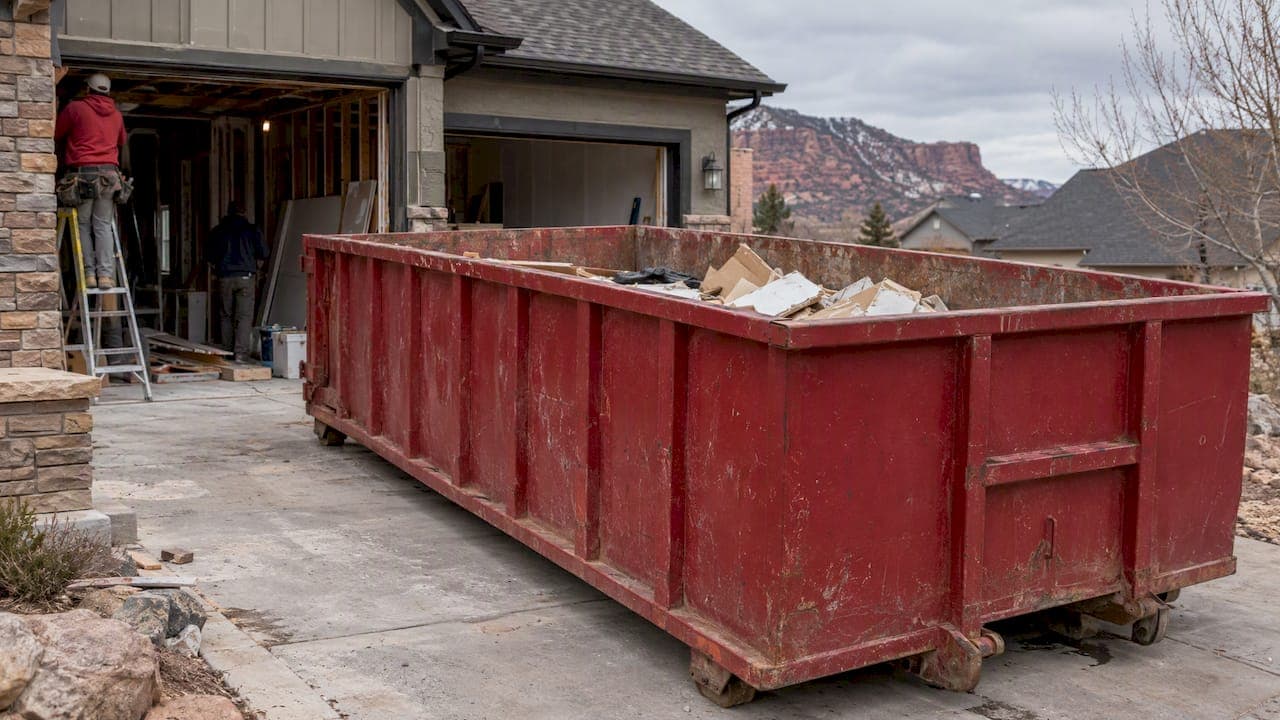
Most residential dumpster rentals in the U.S. include about 7 to 14 days, counted from the day the container is delivered. There is no nationwide maximum. The number that applies to you is the one written in your rental agreement, and it can be shorter or longer depending on the hauler, the size of the bin, your city and the kind of project. Below you will find typical timelines by job, what extra days cost, and how to keep a long project from outrunning a short rental.
TL;DR
- A standard rental window is commonly 7 to 14 days, and the clock normally starts at delivery, not when you start loading.
- Small jobs fit in 3 to 7 days. A kitchen remodel can need 10 to 14. Large builds may need 30 days or more with scheduled swaps.
- Extensions are usually billed per day or per week, so call before the scheduled pickup and confirm the rate.
- Your dumpster has three clocks: the hauler's, your project's and your city's or HOA's. The shortest one wins.
- Fill it right and early. A full bin can force a pickup even when your rental days are not used up.
Table of Contents
- What the standard rental period really is
- Three clocks decide how long you can keep it
- How many days your project needs
- What happens when you need more time
- Keep one bin, or swap on a schedule
- Why a bin can leave before your days run out
- Our perspective: plan the dumpster around the build, not the other way around
- Permits, HOAs and where the bin sits
- Ways to avoid paying for days you do not use
- What about buying a dumpster instead?
- When we handle the dumpster for you
- FAQ
- Sources
What the standard rental period really is
Search this question and nearly every result lands on the same range: roughly 5 to 14 days for most residential rentals. That range is a market habit, not a law. One hauler may include 7 days, another a longer window, and some price by the day, the week or the month.
Two details trip people up:
- Calendar days versus business days. Some agreements count only weekdays. A "10-business-day" rental is about two weeks on the calendar. Read which one your contract uses.
- The start date. The clock normally begins when the container is dropped off. If you order on Monday for a Thursday start, schedule delivery for Thursday, not Monday.
The fix for both is simple: ask for the delivery date, the included days and the pickup date in writing before you book.
Three clocks decide how long you can keep it
The rental agreement is only one of the limits. Most overruns happen because people plan around one clock and forget the others.
The hauler's clock
This is the included rental period in your agreement. It also covers terms that can end your rental early: weight limits, fill lines and prohibited materials. A bin that is full and overweight can be picked up before your last day.
The project's clock
Debris does not arrive evenly. Demolition produces most of the volume in the first days, then finish work adds small amounts. Weather, inspections, permit delays and a second trade arriving late all push the end date out. Add a buffer of a few days to whatever you think you need.
The city and HOA clock
A bin on your own driveway is usually your business, though an HOA can have rules about visible containers. A bin on the street is different, because the street is public right-of-way and many cities require a permit with its own time limit. We cover that in detail in our guide to street dumpster permits for homeowners and contractors. For Cedar City specifics, start with the city's ordinances page or call the city office at 10 N Main Street.
A project can need 30 days, a standard agreement might include 7 to 14, and a street permit might allow less. Check all three before you order.

How many days your project needs
These are planning ranges, drawn from Angi's rental-period guide. They are not guarantees, and your hauler's terms still control.
| Project | Typical time with a dumpster on site |
|---|---|
| Garage or basement cleanout | 3 to 7 days |
| Small landscaping job | 3 to 7 days |
| Bathroom remodel | 7 to 10 days |
| Kitchen renovation | 10 to 14 days |
| New construction or commercial renovation | 30 days or more, usually with swaps |
A few notes on reading the table.
Cleanouts are fast because you control the pace. Sort the week before, line up helpers for a weekend, and the bin can leave within days.
Bathrooms and kitchens run longer because demolition is only the first step. Cabinets, flooring, tile and drywall generate waste at different stages. If you are planning a kitchen, our kitchen remodel timeline shows how long each phase takes, and that tells you when the bin needs to be there.
Landscaping and hardscape jobs often produce a concentrated burst of waste at the start: old concrete, sod, soil, fence panels. A short rental usually covers it. If concrete is part of the debris, read our concrete disposal guide first, because heavy material changes which bin and which disposal route make sense.

What happens when you need more time
Extra days are normal, and they are rarely a crisis if you handle them early. The pattern across the industry is that extensions are charged per day or per week, and the rate is set by your agreement.
What to do:
- Call before the scheduled pickup. Do not let the pickup date pass and hope. Ask the hauler to extend the rental or move the pickup.
- Ask how the extension is billed. Daily, weekly or monthly rates can differ a lot. A week-long extension at a daily rate can cost more than the same time at a weekly rate.
- Ask whether you keep the same container. On busy weeks, some haulers may prefer to swap.
- Decide whether a swap is smarter. If the bin is full but the project is not finished, a swap takes the full container away and brings an empty one.
If you want to compare what different sizes and rental terms cost, our dumpster rental cost guide breaks it down.
Keep one bin, or swap on a schedule
On a long build, one container sitting for a month is rarely the best plan. It fills with early demolition debris, then sits half-used or overflows later. Matching the bin to the phase works better:
- Demolition phase: a bin for the heavy first days, picked up when full.
- Framing and rough-in: a second bin if scrap volume warrants it.
- Finish phase: a smaller one, or none at all.
Swaps also protect your schedule. An overflowing bin can be refused, and extra loads or fees follow. Scheduling swaps in advance, tied to the construction calendar, avoids that. Size matters as much as timing: our sizing guide for remodels and dumpster sizes explained help you choose one that does not fill on day two.
Why a bin can leave before your days run out
Rental days are a ceiling, not a promise that the bin stays. Three things end a rental early.
It is full. Once a container reaches its fill line, the hauler can pick it up. Loading past the top is a safety problem for the driver and the road.
It is overweight. Concrete, brick, roofing and soil are heavy. A small bin can hit its weight limit long before it looks full. Ask the weight limit and what happens if you exceed it.
Something prohibited went in. Haulers set their own lists, and the lists are strict. Items commonly restricted include hazardous chemicals, fuels, pesticides, batteries, tires, electronics, refrigerants, medical waste, ammunition and some paints. EPA's rules draw a line between household waste and regulated hazardous waste, but that exclusion does not mean every material is accepted in every rented container. The hauler and the local disposal facility decide. Use your area's household hazardous waste, electronics, tire and refrigerant programs for those items, as EPA's household hazardous waste compendium points out. Our list of items prohibited in dumpsters covers the usual suspects.
Our perspective: plan the dumpster around the build, not the other way around
We are a licensed general contractor in Cedar City, and we run projects from the first estimate to the final walk-through with our own crew. After more than 500 projects, the most common dumpster problem we see is not a hauler being strict. It is a homeowner who booked the bin before they had a schedule.
Here is how we think about it:
- Start from the demolition date. Debris is front-loaded. The bin should arrive the day demo starts, not a week earlier.
- Build in slack. Inspections, material delays and weather move dates. A project that is "two weeks" on paper deserves a rental plan that tolerates three.
- Put one person in charge of the whole sequence. When a single contractor handles demolition, concrete, framing and finish work, the bin schedule follows the work. When five separate trades do it, nobody owns the bin, and it sits there accruing days. That coordination is the reason we keep every phase under one roof.
- Ask before you load anything odd. A two-minute call beats a rejected pickup.
If your project is a remodel, the remodeling work we do includes planning for debris from the start, so the question of how many days never becomes a scramble.
— Jake
Permits, HOAs and where the bin sits
A rented dumpster is not private property just because it is on your land. It is the hauler's container, supplied under a rental agreement that controls pickup, access, weight and prohibited materials. What matters to you is the surface and the permission.
- Driveway: usually the easiest spot. Protect the surface, because a loaded bin is heavy. Plywood under the wheels or rails helps.
- Street: public right-of-way. Check the permit rules and time limit with your city before delivery.
- HOA neighborhoods: read the covenants, since some limit how long a container can be visible.
- Keep the truck's path clear. Overhead wires, parked cars and low branches can delay a pickup by a day.
Permits also matter for the project itself. Cedar City says a building permit is generally needed for structural, electrical, plumbing or mechanical changes, or for changes to walls or floors. A permit delay pushes work back, and the dumpster clock keeps running, so apply early.
Ways to avoid paying for days you do not use
- Schedule delivery for the first work day.
- Sort in advance. Separate items for donation, hazardous drop-off and recycling before the bin arrives.
- Load heavy items first and flat, then bulky lightweight pieces on top.
- Break down boxes, cabinets and lumber so air does not take up space.
- Book pickup as soon as you are done. Do not wait for the last included day if you finish early. Ask whether an early pickup changes the price.
- Consider the alternative for tiny jobs. If you only have a few cubic yards, see our comparison of a bagged-waste service versus a dumpster.
What about buying a dumpster instead?
Some readers asking how long they can keep one are really asking whether to own one. For a single project, it rarely makes sense. A new 30-yard roll-off is commonly advertised at about $5,000 to $7,500, and you would also need a truck to move it, storage space, insurance and a way to pay for disposal. Renting for a few days is the economical choice for a homeowner.
When we handle the dumpster for you
If your project is a remodel, a concrete tear-out or a yard overhaul, the dumpster is one of a dozen moving parts. We coordinate them with one point of contact and an in-house crew, so the bin arrives when the work starts and leaves when it ends. You can see our residential bins on our Utah residential dumpster rental page, or start with our main site for a project estimate. Ask us about the rental period for your job when you call, and we will tell you what fits your timeline.
FAQ
How long can you keep a dumpster at your house?
As long as your rental agreement allows, and your city or HOA permits. Most residential rentals include about 7 to 14 days, and longer terms are usually available for an extra daily or weekly charge. If the bin sits on the street, a permit time limit may be shorter than the rental.
Can I extend my dumpster rental?
Usually yes. Call the hauler before the scheduled pickup, not after it, and ask how extra days are billed. If the bin is already full, ask about a swap for an empty one instead.
What can you not throw away in a rented dumpster?
Common exclusions are hazardous chemicals, fuels, pesticides, batteries, tires, electronics, refrigerants, medical waste, ammunition and some paints. Get your hauler's prohibited-items list before you load, and ask about anything questionable.
Are dumpsters considered private property?
Not in the sense that matters to a homeowner. The container belongs to the hauler and is governed by the rental agreement, even when it sits on your private driveway. A street or sidewalk is public right-of-way, so placement there needs the city's permission.
When does the rental clock start?
Normally at delivery. That is why you should schedule the drop-off for the day work begins, not the day you place the order.
Sources
- How Long Can You Rent a Dumpster? | Angi
- Identification and Listing of Hazardous Waste, 40 CFR 261.4(b) reference | EPA
- Hazardous Waste Generator Regulations Compendium, Volume 4, Household Hazardous Waste | EPA
- Ordinances | Cedar City, UT
- Frequently Asked Questions, permits | Cedar City, UT