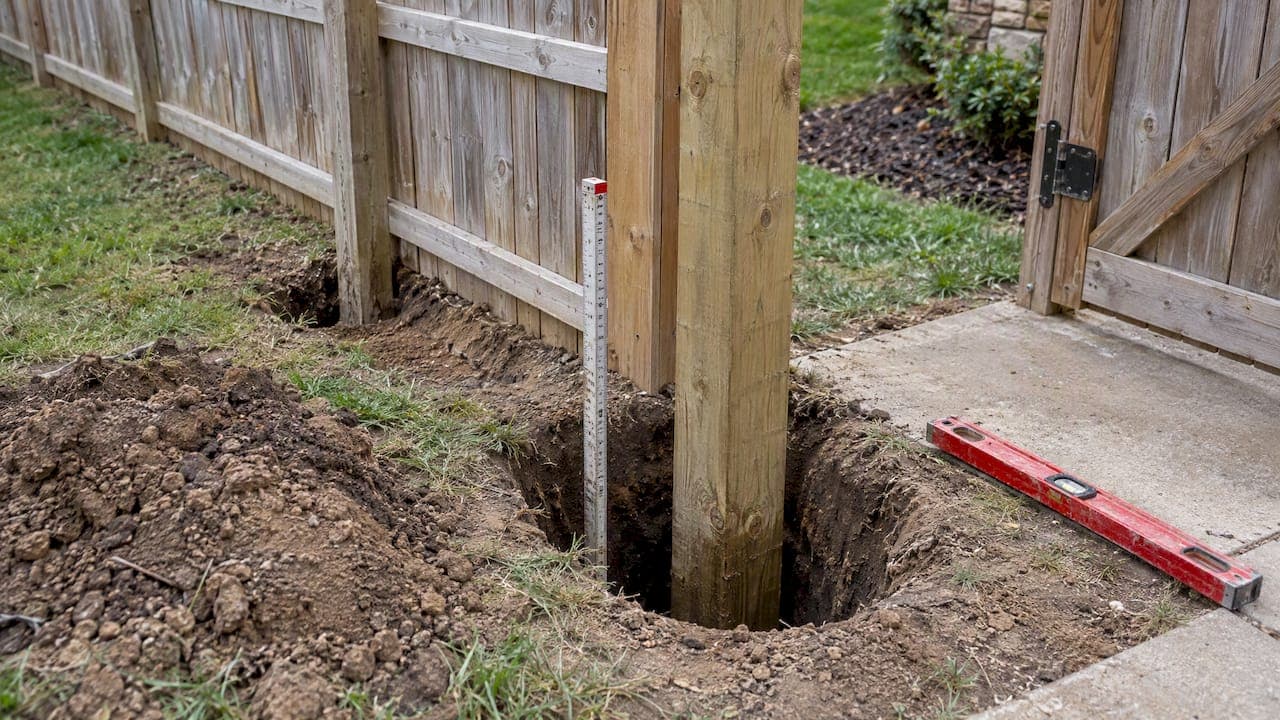
Set line posts about one-third of their total length into the ground, plus roughly 6 inches of gravel at the bottom, and go at least to your local frost line. For a 6-foot fence, that means a hole of about 36 inches. Gate, end and corner posts should go deeper than the posts between them. The rest of this guide covers how soil, wind and frost change that number, how much concrete each hole takes, and what to know about gate widths before you dig.
TL;DR
- The standard rule: bury one-third of the post's height, then add about 6 inches for a gravel base. A 6-foot fence lands near 36 inches.
- In cold climates, dig at least to the frost line. In much of Utah's Wasatch Front, that is 30 inches, and it varies by city and county.
- End, corner and gate posts should be set at least 6 inches deeper than line posts.
- Make the hole about three times the post width, and use roughly two 50 lb bags of fast-setting concrete for a 4-inch post in a 10-inch hole at 2 feet deep.
- A common pedestrian gate is around 36 inches wide. Driveway gates are much wider and need planning before the posts go in.
Table of Contents
- The basic rule for fence post depth
- How deep for a 6-foot fence
- Frost line: the number that overrides the rule
- Soil, wind and slope
- Gate, end and corner posts go deeper
- Hole width and gravel
- How much concrete for each fence post
- Gate width: plan it before you set the posts
- Should a privacy fence touch the ground?
- Build it right with a single crew
- FAQ
- Sources
The basic rule for fence post depth
The most repeated guideline in fence building is simple: the buried portion should be about one-third of the post's height. This Old House describes the general rule as digging about one-third of the post height plus 6 inches for gravel, which works out to about 2 feet for an average residential post of 6 to 8 feet, and at least down to the frost line in cold climates.
That last clause matters more than the fraction. A rule of thumb tells you the minimum for stability against wind and leaning. The frost line tells you the minimum for surviving winter. You need to satisfy both, so you always dig to whichever number is larger.

Here is how the math works in practice. Take the total post length you need, which is the fence height above ground plus the buried part. A post that must stand 6 feet tall above grade needs to be about 9 feet long if you bury 3 feet. People often buy a 6-foot post for a 6-foot fence and then wonder why the numbers don't work. Measure the above-ground height first, then add the depth.
How deep for a 6-foot fence

For a 6-foot privacy fence, plan on 36 inches. This Old House says a 6-foot-high fence typically needs posts set at least 36 inches deep in cold climates to prevent frost heave, and a 3½-foot fence should go at least 28 inches. Taller fences, high winds, sandy soil or frequent freeze-thaw cycles may call for deeper holes.
A quick reference built on those figures and the one-third rule:
| Fence height above ground | Typical buried depth | Notes |
|---|---|---|
| 3½ feet | At least 28 inches | Per the cold-climate guidance above |
| 4 feet | About 24 to 30 inches | One-third rule, then check frost line |
| 6 feet | About 36 inches | Includes the gravel base in cold climates |
| 8 feet | 36 inches or more | Wind load rises fast; many builders go deeper |
The 4-foot and 8-foot rows are our working application of the one-third rule, not figures from a code. Always confirm with your local building department, because some cities regulate fence height and footings, as we cover in our guide to privacy fence height, permits and footings.
Frost line: the number that overrides the rule
Water in soil expands when it freezes. A post that sits above the frost line can be lifted a little each winter, and it rarely settles back evenly. Over a few seasons, you get leaning panels, gaps under the boards and gates that no longer latch.
Building codes treat this seriously for structures. For non-engineered fill, the International Code Council's foundation provisions call for exterior footings to bear on undisturbed soil and extend below frost depth or be protected from frost. A fence isn't a house, but the same physics applies to a post in the ground.
For Utah, frost depth is set by each jurisdiction. Our breakdown of the frost line in Utah by city shows that the Wasatch Front uses a 30-inch rule. Southern Utah and higher-elevation areas can differ, so ask your city or county building office for the figure that applies to your address.
If you have had trouble with posts lifting before, read our three contractor-verified fixes for frost heave before you reset anything.
What if your frost line is deeper than one-third?
Go with the frost line. If your frost depth is 42 inches, a 42-inch hole is the minimum even for a 5-foot fence. The rule of one-third is a floor for stability, not a ceiling. Where it makes sense, add the gravel layer below that depth so the post bottom sits just beneath the frost line, not on it.
Soil, wind and slope
The same fence can need different holes on different lots.
Sandy soil. Loose soil grips less, so posts may need to go deeper. Roger Cook, the landscape contractor on This Old House, advises mixing gravel into the backfill in sandy soil for stability.
Clay soil. Clay drains poorly and holds water against the post. The same source advises packing only gravel around the post in poorly draining clay.
Rocky soil. Cobbles and caliche, common across southern Utah, can stop a post-hole digger well short of the target. Rocky ground may require alternative anchoring, according to the same guidance. Don't shorten the hole to avoid the work. A shallow post in hard ground is still a shallow post.
Wind. Solid privacy panels act like sails. If you add windscreens, inserts or signage, ASTM F1043 says to use stronger framework and fittings, reduce post spacing or add back-bracing to address wind load. Our guide on privacy fence styles and the wind tradeoff explains why full privacy needs more from the posts.
Slopes. Posts on a grade carry extra load and can creep downhill. We cover that in fencing a sloped yard with 2.5 to 3 foot footings.
Gate, end and corner posts go deeper
Line posts carry panels. Gate posts carry a swinging weight that pulls on them every time someone opens it. Corner and end posts take the tension of the whole run. Lowe's fence installation instructions say end, corner and gate posts should generally be set at least 6 inches deeper than line posts.
So on a 6-foot fence with 36-inch line posts, aim for 42 inches or more on the gate and corners. If your gate is heavy, such as solid wood, wide, or automated, a larger hole diameter helps too, and the post itself may need to be larger than the line posts.
Hole width and gravel
Depth gets all the attention, but diameter matters. The common guidance is a hole about three times the width of the post. QUIKRETE's post-setting guidance calls for making the hole three times the post width and adding about 6 inches of gravel, compacted and leveled. A 4x4 post (3½ inches actual) therefore wants a hole around 10 to 12 inches across.
The gravel layer isn't optional. It gives water somewhere to go instead of sitting around the bottom of the post. This Old House recommends a 6-inch base of gravel or crushed stone at the bottom of the hole before you install the post.
How much concrete for each fence post
People search "concrete for fence posts" more than almost anything else on this topic, because it's where budgets and weekends get wasted. Here are the facts from the manufacturer.
- For a 4-inch-diameter post, two 50 lb bags of fast-setting concrete are sufficient for a 10-inch-diameter hole at a 2-foot depth.
- A 60 lb bag of fast-setting concrete yields about 0.45 cubic feet of mixed concrete.
- For holes deeper than 2.5 feet, the same specification says to place the material in lifts of 2.5 feet or less so water can soak all the way through.
So a 36-inch hole with a 6-inch gravel base leaves about 30 inches for the post and concrete. Expect to need more than two bags for that depth, and count your bags from the volume of the hole, not from the 2-foot example. Divide the hole volume by the yield per bag, then buy a bag or two extra.
Setting the post step by step
- Mark post locations with string and stakes, using your planned spacing. Our fence post spacing guide covers how soil, slope and wind change it.
- Dig each hole to the full depth and about three times the post width.
- Add 6 inches of gravel and tamp it flat.
- Set the post, check plumb on two adjacent faces, and brace it.
- Pour concrete in lifts and keep checking plumb. Slope the top surface away from the post so water runs off.
- Let it cure per the bag instructions before hanging panels or gates.
For wood that goes in the ground, the U.S. Forest Service recommends posts with an in-depth preservative treatment, preferably pressure-treated for below-ground use, for maximum protection against decay and termites. Buy ground-contact rated lumber, not just "treated" lumber meant for above-ground use.
Gate width: plan it before you set the posts
Post depth and gate width are linked, because the gate posts are the deepest, most heavily loaded ones on the fence. Decide the opening first, then dig.
For a walk-through gate, a width of about 36 inches is the common choice, and many gates run from roughly 32 to 48 inches. If anyone needs wheelchair, wheelbarrow or mower access, go wider than the minimum. Measure the widest thing that will go through, then add a few inches of margin.
For vehicles, a single driveway gate is generally somewhere between 10 and 16 feet, and a double gate is wider again, often in the 16 to 24 foot range. These are common ranges rather than a code number. Your own vehicles, trailers, turning radius and the fire access rules in your city decide the real figure, so check with the local fire marshal or building department before you commit. A double gate splits that opening into two leaves, which keeps each leaf lighter and the swing shorter. That matters on a tight driveway.
Allow for latch hardware, hinge clearance and a gap at the bottom when you lay out the opening. If you plan to automate later, put in the conduit and a deeper, larger footing for the gate posts now. It's far cheaper than cutting concrete afterward.
Should a privacy fence touch the ground?
Generally no. Leaving a small gap under the boards keeps wood from wicking moisture and lets you trim along the base without damaging the fence. On a slope the gap varies from section to section, so panels are stepped or racked. Posts themselves, of course, go into the ground. It's the boards or panels that should hover just above it.
Perspective
After more than 500 projects, the posts are where we see fences succeed or fail. The panels and pickets get the compliments, but a fence that leans after two winters almost always started with a hole that was too shallow, too narrow or dug without a gravel base.
We build fences, concrete, grading and hardscape with our own licensed crew, so the person digging the post holes understands what the ground looks like on your lot. We aren't coordinating a fence sub, a concrete sub and an excavation sub who each assume the other handled drainage. One crew, one point of contact, and one accountable team from estimate to finish.
Utah's mix of frost, rocky soil and wind makes the "standard" number a starting point. We set depths for your soil and your local codes, then make the gate posts heavier than the line posts because that is where the load goes.
Jake
Build it right with a single crew
If you would rather not rent an auger, haul gravel and pour a dozen holes by hand, our team installs fences for homes and businesses across Utah. We offer vinyl at $25 to $45 per linear foot, wood at $20 to $40 per linear foot, and aluminum and iron at $30 to $60 per linear foot. Those are published ranges, and your final bid depends on the site, soil, slope and gates.
See the details on our fencing page, or look at vinyl fence installation in Utah if you want a low-maintenance privacy fence.

Because we handle concrete, earthwork and hardscape in-house, a fence tied into a patio, a retaining wall or a new driveway gets planned as one project. You can start from our main site and request an estimate.
FAQ
How deep should a fence post be for a 6-foot fence?
About 36 inches in cold climates, which includes the gravel base. That follows the one-third rule plus gravel, and it keeps the post at or below a typical frost line. If your local frost depth is deeper, dig to that depth instead, and add 6 inches or more for gate, end and corner posts.
Do all fence posts need concrete?
Not always, but concrete is the most common method for permanent wood and metal fences, especially at gates, corners and in loose or sandy soil. Compacted gravel can work for some line posts, and the setting product manufacturers describe methods that skip mixing. Gate and corner posts take the most stress, so those are where concrete earns its cost.
How wide should a driveway gate be?
Wide enough for your largest vehicle or trailer with clearance on both sides. A single driveway gate commonly runs 10 to 16 feet, and a double gate is wider. Confirm any emergency-access width requirements with your local building department or fire marshal before you set the posts.
How far apart should fence posts be?
Spacing depends on the panel type, wind exposure and slope. Closer posts, or back-bracing, are advised when you add windscreens or signage. Our fence post spacing guide walks through soil, slope and wind.
Sources
- How To Install a Fence Post, This Old House
- Fence Installation Instructions, Lowe's
- Foundations, International Code Council
- Structural Concrete 03310 specification, QUIKRETE
- Fast-setting concrete mix data sheet, QUIKRETE
- Setting Posts without Mixing, QUIKRETE
- Protecting wood fences for yard and garden, US Forest Service
- ASTM F1043 Standard Specification for Strength and Protective Coatings on Fence Framework