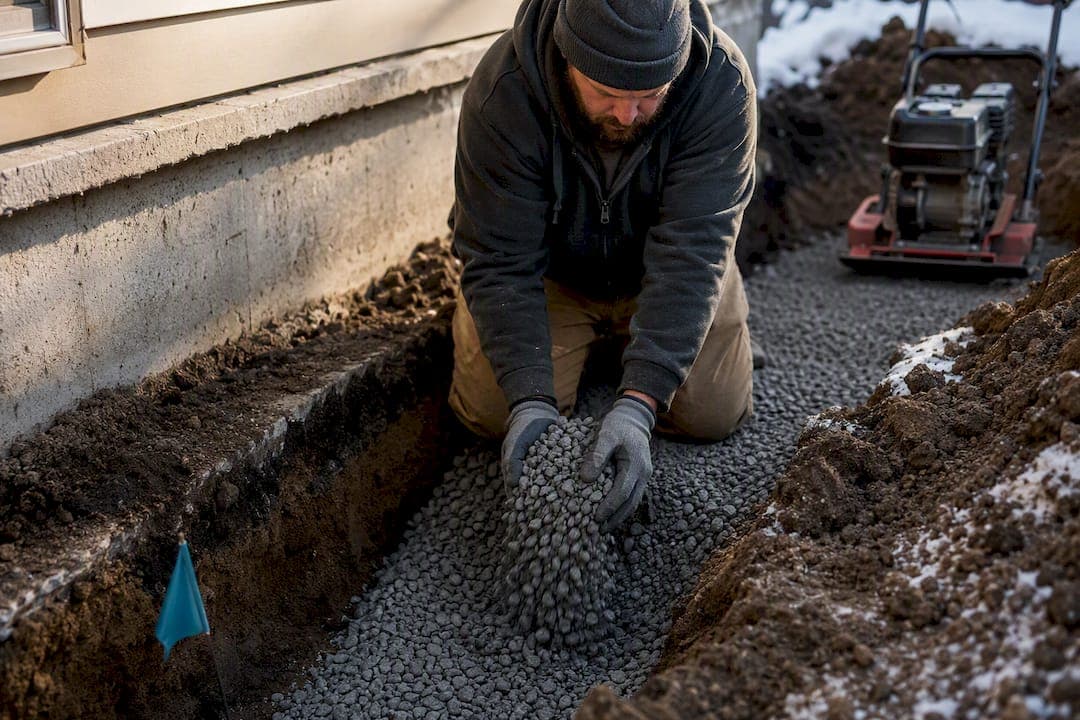
The single most reliable fix for frost heave is removing one of the three conditions that cause it, usually by swapping frost-susceptible soil for coarse granular fill or fixing drainage so water never reaches the freeze zone. Grading and gutter work solve minor cases; larger risk calls for subgrade replacement or a frost-protected shallow foundation. If cracks, tilted slabs, or sticking doors have already shown up, get a licensed contractor to evaluate the soil before you patch anything.
TL;DR:
- Replacing frost-susceptible soil with coarse gravel or sand is the most permanent fix but also the most costly, especially for full foundation or driveway projects.
- Drainage improvements are the least expensive and most effective preventative measure, as they limit water reaching the frost zone and can stop heave on their own.
- Soil testing to determine particle size is critical; soils with 10% or more particles passing a No. 200 sieve are classified as frost-susceptible and require targeted drainage or replacement.
- Insulation and frost-protected shallow foundations can reduce frost depth effects but depend on dry insulation layers and proper drainage to remain effective.
- Addressing the root causes early prevents recurring damage; patching and surface fixes are only temporary when soil and moisture conditions remain uncorrected.
Table of Contents
- What Causes Frost Heave (And Why Some Soil Types Are Worse)
- How to Tell If Your Property Is at Risk
- Proven Ways to Prevent Frost Heave
- Construction Details That Actually Matter
- If Frost Heave Already Damaged Your Property
- What Hiring a Contractor Actually Looks Like
- After the Work Is Done: A Seasonal Checklist
- The Fix Homeowners Overlook
- Get a Contractor Who Handles the Whole Job, Not Just One Piece
- Sources
- FAQ
What Causes Frost Heave (And Why Some Soil Types Are Worse)
Frost heave happens when water in the soil freezes into layers called ice lenses, and those lenses grow by pulling more water toward them through capillary action, the same wicking effect that draws water up a paper towel. As each lens thickens, it pushes the soil, and everything sitting on it, upward. The pressure can lift slabs, tilt fence posts, and crack foundation walls over a single hard winter.
Three conditions have to line up for this to happen: frost-susceptible soil, a source of moisture, and freezing temperatures reaching below the surface. Remove any one of them and heave stops.
Soil texture decides most of the risk. Silts and fine sands are the worst offenders because their pore spaces are small enough to pull water upward through capillary action but still large enough to let that water move freely. Clay holds water too but transmits it more slowly, so heave tends to develop over a longer timeline. Coarse sand and gravel barely wick water at all, which is why they almost never cause heave problems on their own.
- Ice lenses grow layer by layer as capillary action feeds them fresh water from below
- Silt and fine sand are the most frost-susceptible textures
- Clay heaves more slowly but can still cause significant movement over time
- Clean gravel and coarse sand resist heave because they do not support capillary flow
How to Tell If Your Property Is at Risk
Frost heave and normal settlement look similar at first glance, but they behave differently. Settlement is a slow, one-directional sinking that rarely reverses. Frost heave shows up seasonally: a slab that lifts in January and partially drops back by April is a strong tell, along with doors that stick only in winter or a driveway that develops a new hump near the same spot every year.
Pro Tip: Walk your property after the first spring thaw and look for standing water near the foundation. Pooling that lingers more than a day or two after rain is often the same moisture pathway feeding ice lenses in winter.
A few steps help you gauge exposure before calling anyone:
- Check for cracked or displaced concrete, fence posts leaning uphill of frost lines, or gaps opening between structures and the ground.
- Look for water pooling against the foundation after rain or snowmelt.
- If your soil looks silty or has visible fine sediment, request a particle-size analysis. Labs use the No. 200 sieve to measure this, and soils where 10% or more of particles pass that sieve are classified as frost-susceptible.
- Bring in a geotechnical consultant for structural cracking or repeated heave; call a contractor directly for drainage-only fixes.
Proven Ways to Prevent Frost Heave
The order you tackle these matters. Soil replacement solves the problem at its source, drainage prevents moisture from reaching susceptible soil in the first place, and insulation changes the freezing pattern entirely. Most properties need some combination, not just one.
Replacing frost-susceptible soil is the most direct fix. Contractors excavate the silt or fine sand under a foundation, walkway, or slab and backfill with clean, coarse gravel or sand. Gravel and coarse sand don't support capillary action, so no matter how cold it gets, there's no water migration to feed ice lenses. It's the most expensive of the three main approaches, but it's also the most permanent, which makes it the right call for new construction or a full driveway rebuild rather than a quick patch.
Drainage and grading cost far less and prevent a large share of residential frost heave cases. Extending downspouts, regrading soil to slope away from the foundation, and installing perimeter drains all reduce the water available near the freeze zone. Directing runoff away from foundations limits soil saturation in the freezing zone, which is often enough to stop heave on its own where soil replacement isn't practical or affordable.
Insulation and frost-protected shallow foundations (FPSF) work by keeping soil temperature above freezing rather than removing water. FPSF designs use horizontal insulation around the perimeter to raise soil temperature enough that foundations can be built shallower than the traditional frost line would otherwise require. This only works if the insulation stays dry, since saturated insulation loses much of its thermal value.
- Soil replacement: highest cost, most permanent, best for new construction or full rebuilds
- Drainage and grading: lowest cost, addresses moisture rather than soil type
- FPSF insulation: allows shallower foundations, requires a drainage layer to stay effective
- Geotextiles and capillary barrier layers: separate fine and coarse soil layers to keep replacement fill from contaminating over time
Two research directions worth watching: lab tests on organosilane water-repellent treatments cut frost heave and water intake by up to 88 to 90 percent compared to untreated soil, and separate testing on phase change material additives reduced frost penetration by roughly 50 percent and heave by about 85 percent. Both are lab results, not field-proven products your contractor can order off a shelf yet, but they point to where soil treatment technology is headed.
Pro Tip: If you're comparing quotes, ask whether the contractor is proposing soil replacement, drainage correction, or both. A quote that only mentions regrading won't solve a problem caused by fine, frost-susceptible soil under the slab.
Construction Details That Actually Matter
Specs on paper don't mean much if the crew doesn't hit them in the ground. A few numbers are worth asking your contractor to confirm directly.
- Backfill gravel should be compacted in lifts, typically 8 to 12 inches at a time, to reach the density needed to resist future settling or water infiltration.
- Foundation depth generally needs to be below your local frost line; however, using a frost-protected shallow foundation (FPSF) with appropriate insulation and drainage can allow shallower footing depths. Pavement and foundation guidance for seasonal frost stresses uniform subgrade preparation regardless of which approach you use.
- Horizontal insulation needs a drainage layer and gravel underlay beneath it. Skip this, and trapped moisture defeats the insulation's purpose within a season or two.
- Rebar reinforces slabs against cracking from load and shrinkage, but it does not stop frost heave. Reinforced slabs on frost-susceptible soil still lift; they just tend to lift and crack less unevenly than unreinforced ones.
If Frost Heave Already Damaged Your Property
Short-term fixes buy time but rarely solve the underlying issue. Regrading, adding surface drains, sealing cracks, or slab jacking (pumping material under a sunken slab to relevel it) all address symptoms. They're reasonable when the damage is minor and budget is tight, but expect to repeat them if the soil and moisture conditions underneath haven't changed.
Permanent repair means addressing the cause: full subgrade replacement with granular fill, underpinning or piling where excavation isn't practical, or retrofitting insulation and perimeter drains around an existing foundation. Where lab-tested treatments like organosilane sprays or phase change materials eventually reach field-ready products, they may offer a middle path between full excavation and surface patching, but they're not yet standard offerings from residential contractors.
- Short-term: regrading, drain improvements, slab jacking, crack sealing
- Permanent: subgrade replacement, underpinning, insulation retrofit, perimeter drains
- Replacement usually beats repeated patching once the same crack or lift recurs more than once
If you've slab-jacked or patched the same spot twice, that's the signal the underlying soil and moisture problem hasn't been touched.
What Hiring a Contractor Actually Looks Like
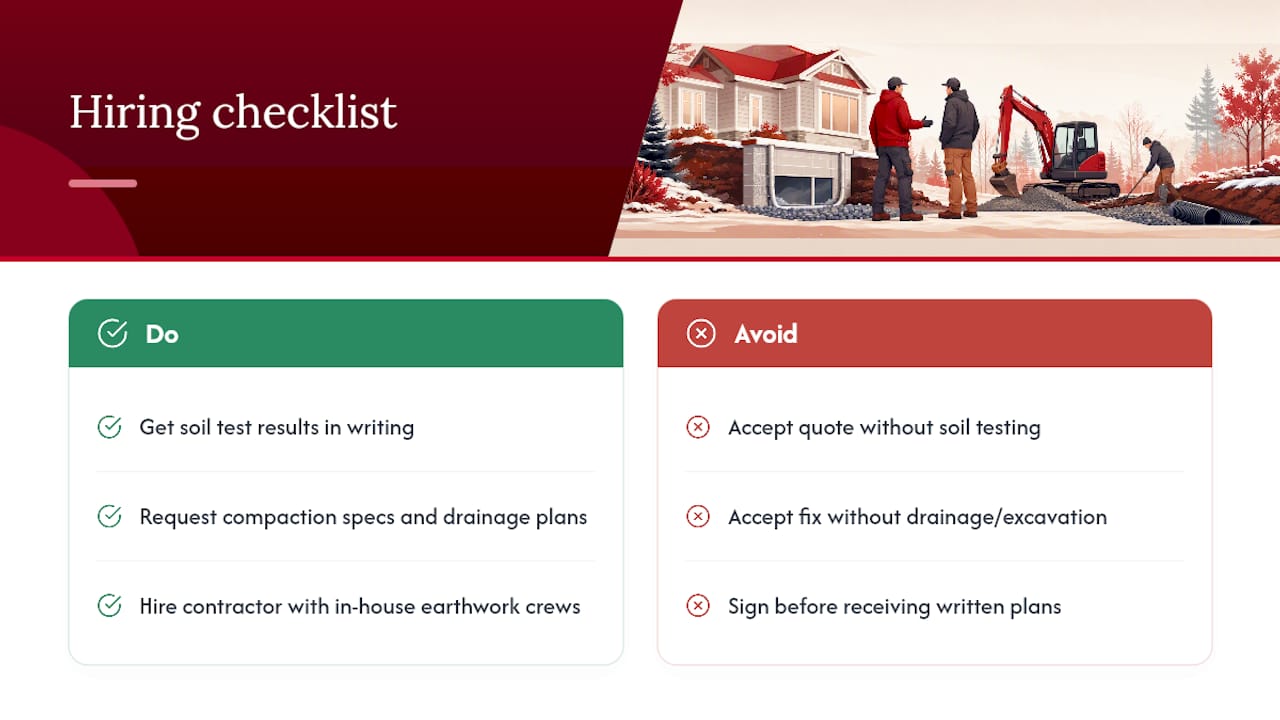
A full frost-heave prevention scope typically includes site evaluation, soil testing, excavation, drainage installation, granular backfill, and, where appropriate, insulation. Ask any contractor for soil test results, compaction specs, and drainage plans in writing before signing. A quote that skips soil testing entirely, or promises a permanent fix without touching drainage or excavation, is worth a second opinion. A-to-zconstruction's earthwork and foundation crews handle these scopes directly, from initial grading through backfill compaction, without handing pieces off to separate subcontractors.
After the Work Is Done: A Seasonal Checklist
Prevention work needs a yearly check, not a one-time install. Walk the property each spring and fall.
- Look for new cracks, slab offsets, or doors and window frames that no longer sit flush
- Clear gutters and downspouts before the first freeze
- Confirm soil still slopes away from the foundation; settling can reverse grading over a few years
- Test that perimeter drains and sump pumps are functioning, not just installed
- Call a contractor if pooling persists more than a day or two after rain, or if you spot movement in the same spot two seasons running
The Fix Homeowners Overlook
Most frost heave advice online jumps straight to insulation and FPSF designs because they sound like modern engineering. What gets skipped is that drainage, the cheapest and least glamorous fix, prevents a large share of residential cases before insulation ever becomes necessary. If your gutters dump water two feet from the foundation and your yard slopes toward the house instead of away from it, no amount of insulation upgrade fixes that.
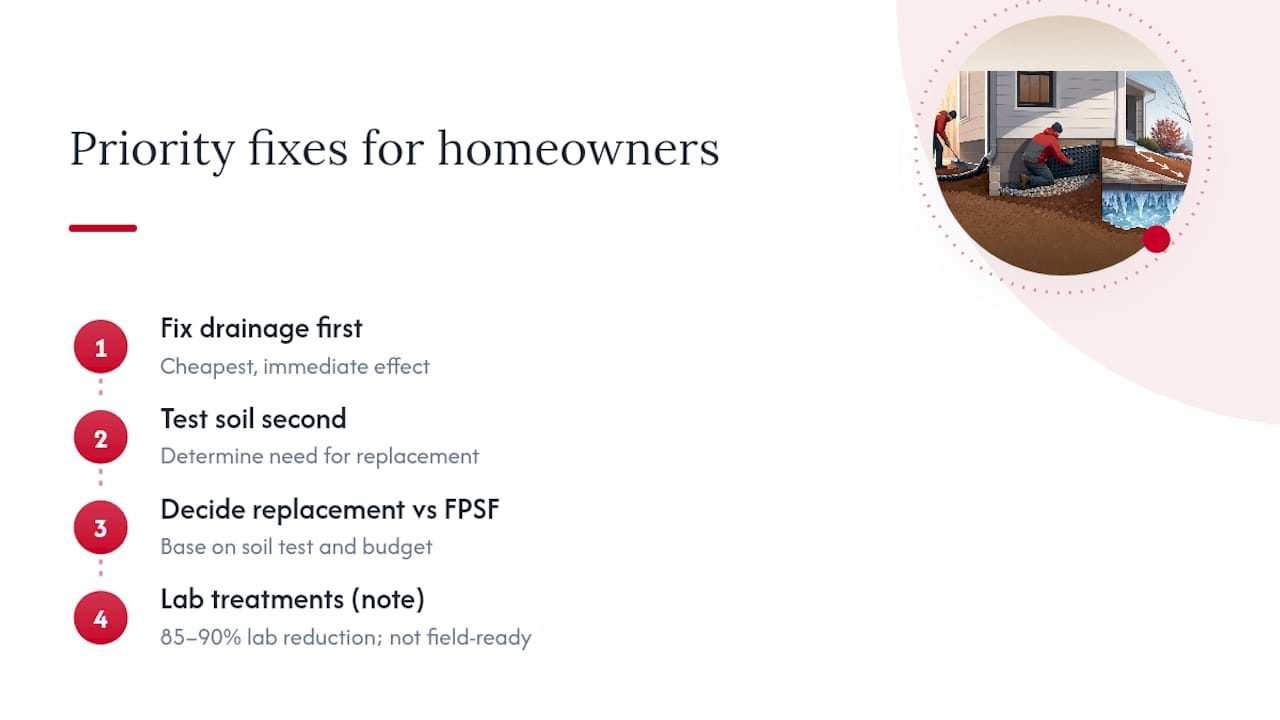
The research on organosilane treatments and phase change materials is genuinely exciting, with lab results showing frost heave cut by 85 to 90 percent in controlled tests. But homeowners reading those numbers should understand the gap between a lab specimen and a field-ready product a contractor can install this fall. That gap is real, and it's a few years wide at minimum.
My priority order for most homeowners: fix drainage first, because it's cheap and immediate. Test your soil second, because you can't make a good decision about replacement without knowing what you're dealing with. Only then weigh soil replacement against FPSF insulation, based on what the soil test and your budget actually support.
— Jake
Get a Contractor Who Handles the Whole Job, Not Just One Piece
A contractor who handles excavation, drainage, and concrete work under one contract can help avoid the need to piece together separate subcontractors for frost heave work. One licensed crew handles the soil testing conversation, excavation, granular backfill, and drainage correction under a single contract, which means fewer scheduling gaps and one point of contact if something needs adjusting mid-project.

That matters most for frost heave specifically, because the fix usually spans two or three trades: earthwork for excavation and grading, concrete for the slab or foundation work, and sometimes masonry or hardscape repair for anything cracked in the process. A-to-zconstruction's earthwork services cover grading, excavation, and compaction, while the structural remodeling team handles foundation-related repairs when heave has already caused damage. If you're seeing seasonal cracking, uneven slabs, or persistent pooling near your foundation, request an estimate and get a soil-informed plan before another winter passes.
Sources
For deeper technical background, the FHWA's soil classification guidance covers frost susceptibility testing, FPSF design references detail insulation placement, and the PLOS ONE study on composite insulation covers thickness thresholds in freeze simulations. Local building codes still govern final foundation depth requirements.
- FHWA: Frost Susceptibility and Soil Guidance
- FPSF design guidance (ASCE/IRC references)
- Experimental study on organosilane-based spray applications
- Mitigating Freeze–Thaw Damage in Soils via Phase Change Materials
FAQ
What soil is most susceptible to frost heave?
Silt and fine sand are the most frost-susceptible soil types because their pore structure pulls water upward through capillary action while still allowing that water to migrate freely toward the freezing front. 200 sieve](https://www.fhwa.dot.gov/engineering/geotech/pubs/05037/07c.cfm) are formally classified as frost-susceptible.
Will frost heave go away on its own?
No. Frost heave recurs every winter that the same three conditions, frost-susceptible soil, available moisture, and freezing temperatures, are present. Some visible lift may partially reverse each spring thaw, but the underlying cause remains until soil, drainage, or insulation is addressed.
Does gravel help with frost heave?
Yes. Clean, coarse gravel and sand don't support the capillary action that feeds ice lenses, which is why replacing frost-susceptible soil with gravel is one of the most reliable and widely used prevention methods.
How deep does frost need to penetrate for heave to occur?
Frost heave requires freezing temperatures to reach a layer of frost-susceptible soil with available moisture, and the depth that matters is your local frost line, which varies by region and climate. Foundations are typically built below that depth unless a frost-protected shallow foundation with insulation is used to allow a shallower design.