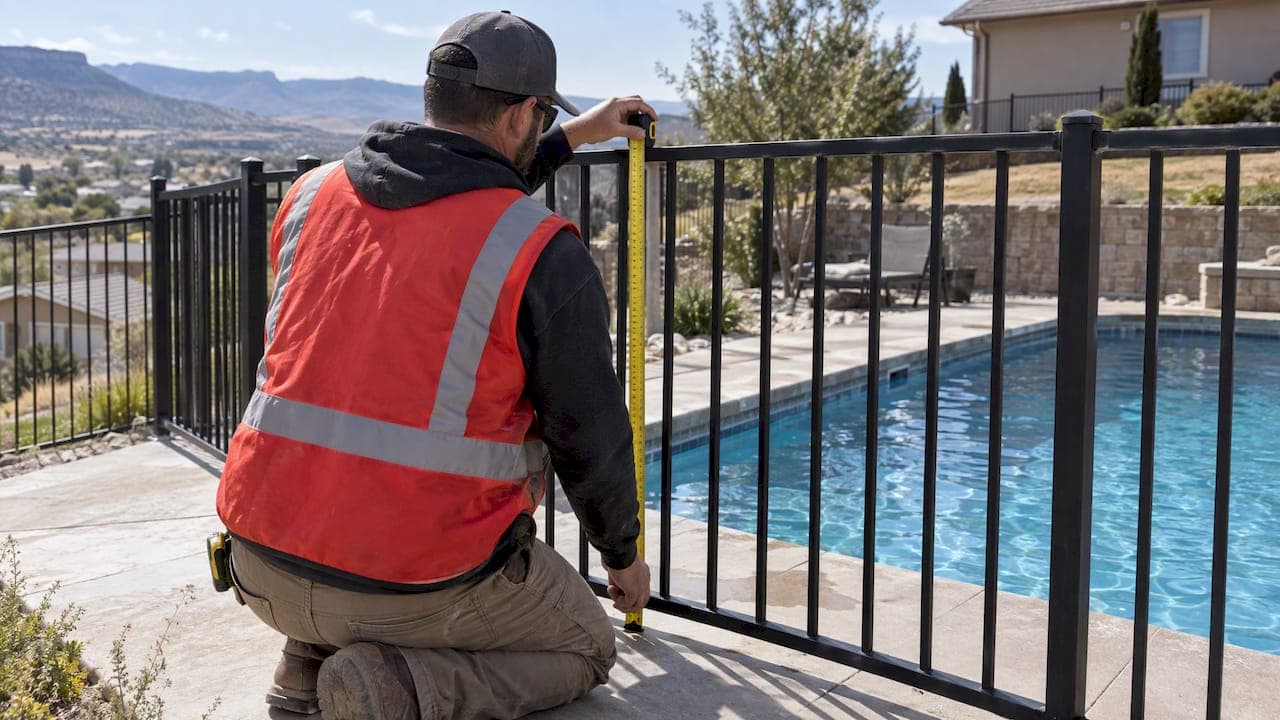
The baseline safety benchmark used in U.S. guidance is a 48-inch (4-foot) non-climbable barrier, with 5 feet recommended where feasible. Every gate must self-close, self-latch, and swing away from the water. These numbers come from federal guidance, not law: your enforceable requirement depends on the code your city or county has actually adopted, so verify it before you build or buy anything.
TL;DR:
- Fences must be at least 48 inches high on the interior side and measure from the lowest accessible grade to ensure compliance; gaps must be no larger than 1.75 inches for vertical pickets.
- Gates need to swing outward from the pool, close automatically, latch without requiring a second action, and have the latch placed at least 54 inches high and at least 3 inches back from the top if lower.
- Common pitfalls include low post depth on slopes, vegetation or landscaping acting as footholds, and gate hardware that does not function correctly or is not checked regularly.
- Building a compliant fence requires grade verification, careful hardware placement, and coordination with local permit and inspection requirements; contractors handle site-specific challenges proactively.
- Enforcement typically leads to fines, denial of permits, or inability to use the pool until violations are corrected, making early compliance critical to avoid costly retrofits.
- ✓Pool fencing installation
- ✓Concrete work
- ✓Earthwork and grading
- ✓Landscaping
Table of Contents
- Fence dimensions and construction requirements
- Gates, latches, and hardware rules
- When the house forms part of the barrier
- Above-ground and portable pools: ladder security matters most
- Permits, local codes, and how to confirm enforceable requirements
- Measuring and installation pitfalls: grade, slopes, and landscaping
- Maintenance, common failures, and how to verify ongoing compliance
- How a licensed contractor approaches a code-aware pool barrier
- Penalties and enforcement procedures for non-compliance
- Exceptions to fencing requirements for certain pool types or locations
- Why minimum compliance isn't the same as a safe pool
- Get your pool barrier built right the first time
- FAQ
- Sources
Fence dimensions and construction requirements
The CPSC's safety barrier guidelines call for a minimum height of 48 inches, measured on the interior side of the barrier, the side facing the pool. That detail matters more than most homeowners realize: if your yard slopes, the fence can measure a full 4 feet from the pool deck but drop below that threshold when measured from the outside grade. Always measure from the side a child would climb from, not the side that happens to be convenient.
Bottom clearance is just as strict. The same guidance limits the gap at the bottom of the barrier to no more than 4 inches above grade, tightening to 2 inches on soft surfaces like grass or soil, and just 1 inch for removable mesh fencing. Any opening in the fence, whether a gap between vertical pickets or a decorative cutout, has to be small enough that a 4-inch sphere cannot pass through it. For chain-link style or mesh fencing, mesh openings cannot exceed 1.75 inches.

A four-sided isolation fence separating the pool from the house and yard reduces a child's drowning risk by about 83% compared with a property-line fence that only encloses the yard, according to CDC-cited research. That single statistic is why isolation fencing, a barrier that surrounds the pool itself rather than the whole yard, is the design model safety guidance keeps pointing to.
A few more construction details separate a compliant fence from one that looks right but fails inspection:
- Horizontal rails and crossbars should sit on the pool side of the fence or be spaced far enough apart that they do not form a usable foothold or ladder.
- Vertical picket spacing should not exceed 1.75 inches when the openings would otherwise allow a child to squeeze through.
- Posts should be embedded deep enough to resist leaning or being pulled from the ground, especially in regions with frost heave or loose soil.
- Removable mesh fencing needs posts extending a minimum of 3 inches below grade with spacing no greater than 40 inches between posts, per CPSC's removable mesh specifications.
Material choice affects long-term compliance as much as initial installation. Vinyl and aluminum resist warping and rust, which keeps gaps from widening over time, while wood fences need periodic checks for rot or loosening pickets that can create unintended openings.
Gates, latches, and hardware rules
A self-closing gate shuts on its own, every time, using gravity or a spring mechanism, without anyone pushing it. Self-latching means the latch engages automatically the moment the gate closes, with no second step required. Both functions have to work reliably, not just on the day of installation.
For pedestrian gates, three rules apply together:
- The gate must swing outward, away from the pool, so a child pushing against it from the pool side cannot force it open.
- The release mechanism for the latch should sit at least 54 inches above the ground, well out of reach for most young children.
- If site constraints force the latch below 54 inches, the release must be set back at least 3 inches from the gate's top edge on the pool side, so a child reaching over the top cannot trigger it directly.
Acceptable latch types include key-locking hardware, keyed deadbolts, or spring-loaded self-latching mechanisms designed specifically for pool enclosures. Hinges and latches should be checked periodically since corrosion, sagging, or loose screws are the most common reasons a technically compliant gate stops functioning as one.
Pro Tip: Test every gate monthly by letting it swing shut from a few different angles. If it ever fails to latch on the first try, the hardware needs adjustment before the next use.

When a gate's placement or swing direction cannot physically meet these rules due to a tight side yard or an awkward property line, adding a door or gate alarm is a reasonable supplement, though it should never be treated as a substitute for fixing the hardware itself.
When the house forms part of the barrier
Many homes use an exterior wall as one side of the pool enclosure, with sliding doors or French doors leading directly to the pool area. In that setup, the door itself has to provide protection equivalent to a fence, and guidance recognizes three accepted ways to do that:
- A UL-compliant door alarm that sounds whenever the door leading to the pool area opens.
- A power safety cover meeting ASTM F1346-91 standards, which can fully cover the water when the pool is not in use.
- A self-closing, self-latching door with hardware mounted high enough to be out of a young child's reach.
For door alarms, placement is everything: the unit should be mounted high on the door frame, with any reset or bypass switch positioned where only an adult can reach it. For power safety covers, check the manufacturer's labeling for the ASTM rating and keep the cover's edges and mounting tracks clear of debris so it seals properly every time.
Local building departments sometimes require one specific option rather than allowing a free choice among the three, so confirm with your local authority having jurisdiction before you invest in equipment.
Above-ground and portable pools: ladder security matters most
An above-ground pool's own wall can often serve as the barrier, provided it meets the same 48-inch height rule and has no external ladder or step permanently attached. When a mounted barrier sits on top of the pool wall instead, it needs the same 4-inch bottom clearance rule that applies to ground-level fencing.
The access point that fails most often is the ladder. CPSC staff comments to ASTM flag above-ground ladders as a recurring vulnerability, which is part of why ASTM has been developing child-resistant ladder designs with dual-action locking mechanisms.
For portable or above-ground pools, a short checklist covers the essentials:
- Remove the ladder entirely or lock it in a raised position whenever the pool is not supervised.
- Add a lockable barrier or gate enclosure around the ladder base if it cannot be fully removed.
- Use removable mesh fencing or a mounted barrier that maintains the same clearance and height rules as a ground pool.
Permits, local codes, and how to confirm enforceable requirements
CPSC guidance is not law. It is the federal reference point that most state and local codes borrow from, but the actual enforceable rule in your area comes from whatever code your city or county has adopted, often a version of the International Residential Code Chapter 42, sometimes with local amendments that raise or adjust specific numbers.
Before installing or modifying a barrier, work through this sequence:
- Contact your local building or permitting department and ask which code edition and amendments apply to residential pool barriers.
- Ask whether a permit and inspection are required, and at what stage of construction the inspection happens.
- Ask whether existing pools installed before a certain date are grandfathered under older rules, since many jurisdictions treat new construction differently from existing barriers.
- Request a written permit checklist so you know exactly what the inspector will measure.
Bring a specific list of questions to that conversation: the adopted code edition and year, any local amendments to height or gate rules, whether self-closing doors are acceptable instead of a separate fence, and what documentation the inspector expects to see on-site. Getting these answers in writing before construction starts avoids the far more expensive problem of retrofitting a fence that already failed inspection.
Measuring and installation pitfalls: grade, slopes, and landscaping
Height has to be measured from the finished grade, meaning the ground level after all landscaping and grading work is complete, not from a temporary surface during construction. The rule that matters most in practice is to measure from the lowest accessible point around the entire perimeter, since a single low spot can drop a fence below the legal minimum even if most of the run measures correctly.
Retaining walls, raised planters, and even stacked landscaping stones next to a fence can function as a step stool, effectively erasing inches of height a child would otherwise have to climb; proper advice on this and more is available in the guide on tested path light spacing that includes outdoor lighting and spacing considerations. The same applies to sheds, decks, or play structures placed too close to the barrier line.
A short installer checklist helps catch these issues early:
- Confirm footing depth is adequate for your soil type and climate, especially on sloped lots where erosion can expose post bases over time.
- Keep post spacing consistent with manufacturer specifications for wind and soil load, detailed further in our guide to tested post spacing.
- Re-check bottom clearance a year after installation, since soil settling can open gaps that passed inspection on day one.
Pro Tip: On sloped yards, plan for post footings in the 2.5 to 3 foot range rather than a standard depth, since shallow footings are a common cause of early fence failure on grade changes, as outlined in our sloped-yard fencing guide.
Maintenance, common failures, and how to verify ongoing compliance
The most frequent reasons a compliant fence stops being effective are mundane: a gate that sags on its hinges until it no longer latches, a spring mechanism that weakens with age, erosion that opens a gap under the bottom rail, vegetation growing thick enough to act as a foothold, or torn mesh and broken slats that go unnoticed for months.
A simple seasonal routine catches most of these before they become a hazard:
- Test every gate's self-closing and self-latching action monthly during pool season.
- Walk the entire fence line after major storms to check for washed-out soil or shifted posts.
- Replace door alarm batteries at the start of each season and test the alarm sound.
- Trim back any landscaping that has grown within reach of the fence line.
When a fence shows structural movement, a gate hardware fails repeatedly, or you are preparing for a reinspection, it is worth calling in a contractor to re-measure and repair rather than patching hardware that keeps failing.
How a licensed contractor approaches a code-aware pool barrier
On real sites, the technical spec and the finished fence often diverge over small details: a slope that changes the effective height by a few inches, a retaining wall built too close to the fence line, or post footings that need to go deeper than a standard job because of soil conditions. A contractor-led approach addresses these before they become inspection failures.
A thorough scope typically includes:
- Grade verification at the lowest point around the entire pool perimeter, not just at the gate.
- Coordination between fence posts and any nearby retaining walls or hardscape to prevent future grade changes from reducing effective height.
- A written hardware spec sheet covering latch height, gate swing direction, and mesh or picket spacing before materials are ordered.
- Permit paperwork support so the homeowner is not navigating local code questions alone.
As a licensed general contractor, we handle these details as part of a single coordinated scope rather than splitting fence work, grading, and hardscape across separate subcontractors.
Penalties and enforcement procedures for non-compliance
Enforcement varies by jurisdiction, but the general pattern is consistent: a pool built or modified without the required barrier, or one that fails inspection, typically cannot receive final approval or a certificate of occupancy until the deficiency is fixed. Building departments commonly issue a correction notice with a deadline to bring the barrier into compliance, and in many areas a pool found in violation during a routine or complaint-driven inspection can be red-tagged, meaning it legally cannot be used until it passes a follow-up inspection.
Some jurisdictions layer on fines for each day a documented violation remains uncorrected, particularly when the pool was flagged during a property sale, a permit application for unrelated work, or a neighbor complaint. Insurance is another angle worth considering separately from code enforcement: a homeowner's policy may limit or deny liability coverage for a pool-related injury if the property lacked a required barrier at the time of the incident, though that determination sits with the insurer and policy language rather than the building department.
Because enforcement authority and penalty structures differ by city and county, the only reliable way to know what applies to your property is to ask your local building or code enforcement office directly rather than relying on a generic number found online.
Exceptions to fencing requirements for certain pool types or locations
Not every pool is treated the same way under typical adopted codes. Spas and hot tubs with a lockable, code-compliant safety cover are often exempt from full perimeter fencing requirements, since the cover itself serves as the barrier when properly secured after each use. Above-ground pools can also qualify for an exception when the pool wall itself meets the 48-inch height rule and the ladder or steps are removable, locked, or otherwise inaccessible when the pool is not in use.
Some jurisdictions also distinguish between pools serving a single-family home and those at multi-family or commercial properties, applying stricter or additional rules to the latter given higher foot traffic and less consistent supervision. A small number of local codes include exceptions for pools on large rural parcels with limited public access, though these are far from universal and should never be assumed without direct confirmation.
None of these exceptions override the layered-protection logic behind the guidance: a cover, a locked ladder, or a remote location reduces one avenue of access, but it does not replace the value of a physical barrier where one is feasible. Because exceptions are defined locally and vary widely in scope, the only dependable step is to ask your building department whether your specific pool type or property qualifies before assuming an exemption applies.
Why minimum compliance isn't the same as a safe pool
Meeting the 48-inch minimum and getting a passing inspection is the legal bar, not the safety ceiling. Layered protection, a solid non-climbable fence plus a self-latching gate plus a door alarm or cover plus active supervision, closes gaps that any single measure leaves open. Spending more upfront on sturdier hardware and non-climbable materials almost always costs less than retrofitting after a failed inspection or a near-miss. Hire a licensed professional for the code interpretation and permit work. It is one part of this process not worth guessing on.
— Jake
Get your pool barrier built right the first time
A code-aware pool fence takes more than picking a height off a guidance sheet. It takes grade verification, correct hardware placement, and a build that accounts for your specific property, which is exactly where our licensed crew comes in with design, permit coordination, installation, and inspection support handled under one roof.

A consult starts with a site visit and ends with a written scope, so you know the height, hardware, and layout before any post goes in the ground.
- We coordinate directly with your local building department on permits and inspection timing.
- We verify grade and slope on-site before quoting hardware and post spacing.
- We handle fence, gate, and any related hardscape work as one coordinated project.
Reach out through our fencing services page to schedule a site visit and get a written scope for your pool barrier.
FAQ
What is the minimum legal height for a pool fence?
Guidance from the CPSC sets 48 inches as the baseline barrier height, measured from the interior side facing the pool. Your actual legal requirement depends on the code your local jurisdiction has adopted, which can set a higher minimum.
Does a pool gate have to open outward?
Yes, pedestrian gates in a pool barrier should swing away from the pool rather than toward it, so pressure from the pool side cannot force it open. The release mechanism should also sit at least 54 inches above the ground under the same guidance.
Can my house wall count as part of the pool barrier?
Yes, when the door leading to the pool area has a UL-compliant alarm, a power safety cover meeting ASTM F1346-91, or self-closing and self-latching hardware placed out of a child's reach. Some local codes may specify which of these options is acceptable, so confirm with your building department.
How much does it cost to install a compliant pool fence?
Pricing depends heavily on material and linear footage. For context, our own vinyl, wood, and aluminum fencing runs from $20 to $60 per linear foot depending on material, with exact pricing set after a site visit.
Do above-ground pools need a separate fence?
Not always. The pool wall itself can serve as the barrier if it meets the 48-inch height rule and the ladder is removable, locked, or otherwise made inaccessible when the pool is unsupervised, per CPSC staff comments on above-ground ladder safety.
Sources
- Safety Barrier Guidelines for Residential Pools (CPSC)
- Drowning facts and risk-reduction analysis (CDC data repository)