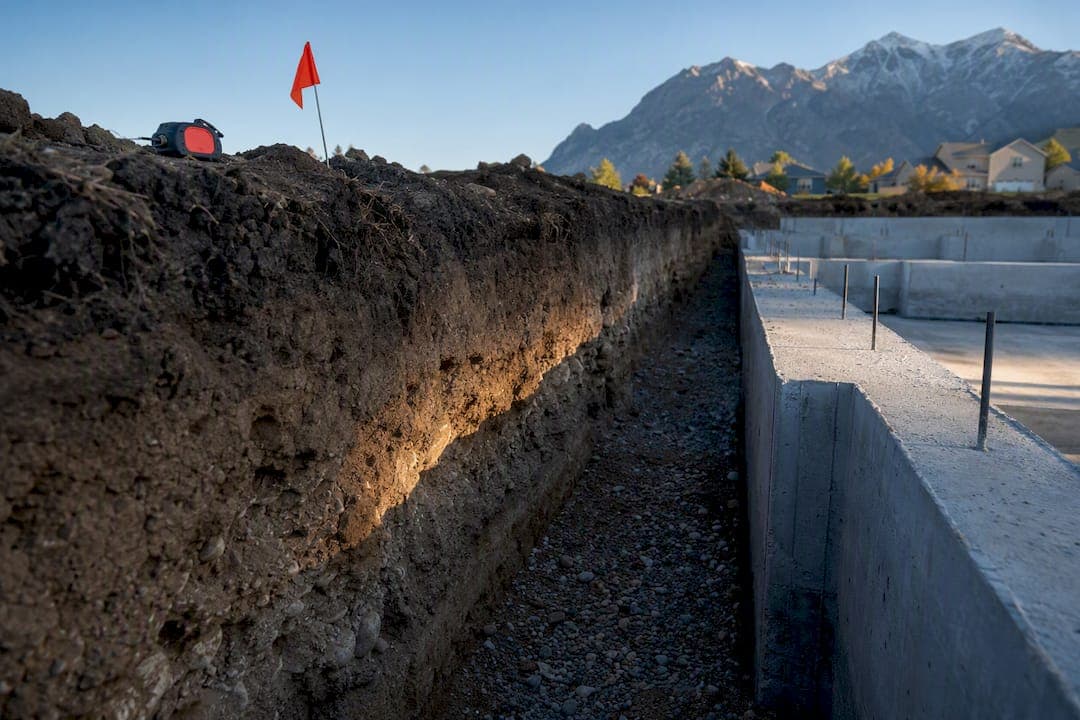
There's no single frost line depth for Utah. Cities set their own minimums, and most Wasatch Front municipalities, including Ogden, Provo, and North Salt Lake, require footings at least 30 inches below grade. Southern Utah runs shallower, mountain zones run deeper, and the only number that legally matters is the one in your local building department's design criteria. Pull that document before you dig.
TL;DR:
- Most Wasatch Front municipalities require footings to be at least 30 inches below grade, while southern Utah areas often need only 12 to 18 inches.
- Frost depths can exceed 36 inches in mountain zones, varying significantly based on elevation and local soil conditions.
- It is crucial to consult your city’s design criteria, not statewide averages, to determine the correct footing depth for your property.
- A geotechnical report is recommended for lots with unusual soil conditions, slopes, or high elevations to ensure proper frost protection.
- Building code in Utah mandates footings extend below the local frost line or use approved alternatives like frost-protected shallow foundations.
Table of Contents
- How Deep Is the Frost Line in Utah, by Region?
- How Frost Depth Shapes Your Foundation Design
- How do I find the frost line depth in my area?
- What Does Utah Building Code Say About Frost Protection?
- When Do You Need a Geotechnical Report?
- Practical Ways Utah Builders Protect Foundations From Frost
- A to Z Construction's Process for Frost-Compliant Foundations
- What Utah's Frost Line Rules Actually Get Wrong
- Get a Free Local Estimate for Your Frost-Compliant Foundation
- Sources
- FAQ
How Deep Is the Frost Line in Utah, by Region?
Ask ten Utah contractors "how deep is frost line Utah" and you'll get ten answers, because the honest answer depends entirely on where the ten of them are standing. The Wasatch Front, where most of the state's population lives, clusters around one number. Everywhere else varies enough that copying a neighbor's footing depth is a genuine gamble.
Here's the regional breakdown that shows up most often in municipal design documents and climate references:
- Wasatch Front cities (Ogden, Provo, North Salt Lake, and most of Salt Lake, Davis, Weber, and Utah counties): footings typically must reach 30 inches below grade, per the Ogden, Provo, and North Salt Lake design criteria documents.
- Southern Utah (the St. George area and lower Washington County): commonly runs 12 to 18 inches, based on regional frost-depth summaries from Hammerpedia's Utah frost line data.
- Mountain and high-plateau areas (parts of Summit, Wasatch, and Iron County's higher elevations): frost penetration frequently exceeds typical lower depths found elsewhere.
- Statewide climate maps from NOAA and similar sources give useful context for how cold a winter has been, but they carry no legal weight in a permit review.
That gap between 12 inches near St. George and 36-plus inches in the mountains is the whole reason a statewide number doesn't exist. Utah's elevation swings from around 2,200 feet at the Arizona border to over 11,000 feet in the Wasatch and Uinta ranges, and frost depth tracks elevation and winter soil temperature more closely than it tracks the state line. A footing depth that's overkill in St. George could crack under frost heave in Park City.
How Frost Depth Shapes Your Foundation Design
Frost heave happens when moisture in the soil beneath a footing freezes and expands. Shallow footings sit inside that active freeze zone, and the expanding soil pushes up unevenly under the structure. The result is cracked slabs, tilted footings, doors that stop closing right, and hairline fractures that widen every winter until they're a real repair.
Three general approaches handle this, and which one fits depends on your climate zone and budget:
- Standard deep footings. Dig below the locally adopted frost depth (30 inches on most of the Wasatch Front) so the footing base sits below the freeze line entirely.
- Frost-protected shallow foundations (FPSF). Use rigid insulation around the foundation perimeter to keep the ground underneath warm enough to stay above freezing, even with a shallower footing.
- Slab-on-grade with perimeter protection. Common for garages, patios, and some additions, but it demands careful insulation and drainage detailing to avoid the same heave problem at the edges.
Deeper frost lines change more than footing depth. They usually mean wider footings, added rebar, insulation requirements at the slab edge, and drainage work to keep water from pooling against the foundation and refreezing. Plan reviewers check the footing depth called out on your drawings against the municipal design criteria table before they'll approve a permit, so guessing at this number costs you a resubmission, not just a redo.
Pro Tip: Pull your city's design criteria before you finalize architectural drawings, not after. A footing depth that's wrong on paper is a five-minute fix. A footing depth that's wrong in the ground is a demolition.
How Do I Find the Frost Line Depth in My Area?
Nobody can give you a reliable frost line for plants in Utah, a shed footing, or a house foundation without knowing your city, because the number is set locally, not statewide. Here's how to get the real one for your parcel.
- Search your city or county's Design Criteria document. Most municipalities post this as a PDF on their building or engineering department page. Ogden's, Provo's, and North Salt Lake's are all public and list frost depth alongside snow load, wind speed, and seismic design category.
- Call the building department directly if you can't find it online. Have your parcel number or address ready. Smaller towns and unincorporated county areas sometimes handle this by phone rather than a published PDF.
- Cross-check with regional climate data for context, not compliance. The NWS frost depth map shows historical and recent frost penetration by region, which helps you sanity-check a number, but it doesn't override what your city requires.
- Write the adopted number on your permit set and hand it to your contractor. Don't rely on memory or a verbal quote from months earlier. Municipal design criteria get updated, and code cycles change footing requirements more often than most homeowners expect.
- Confirm the number again at the pre-construction or footing inspection. Inspectors measure against the adopted local standard, not against what a general contractor guide (including this one) says is typical.
Design criteria documents are the legally adopted, jurisdiction-specific standard your building department actually enforces. Statewide averages and climate maps are worth reading, but they've never controlled a single permit approval.
What Does Utah Building Code Say About Frost Protection?
Utah's building code doesn't leave frost protection to guesswork. Utah Building Code §1809.5 requires footings to extend below the frost line for the locality, or to use an approved alternative such as an ASCE 32 frost-protected shallow foundation design, or bearing directly on solid rock. The code sets the framework; it doesn't hand you a number.
That number comes from the municipality. Ogden and Provo both list 30 inches in their published design criteria, and North Salt Lake matches them.
The code gives cities the authority to set the exact frost depth for their jurisdiction. Ogden, Provo, and North Salt Lake have all landed on 30 inches, but §1809.5 explicitly allows a city to require more, or to approve alternatives like ASCE 32 assemblies where conditions justify it.
This is why "Utah's frost line" as a single figure is the wrong question. The code baseline applies everywhere in the state. The number that fills in the blank is whatever your specific city adopted, and a contractor who pulls permits regularly in your area will already know it cold.
When Do You Need a Geotechnical Report?
Municipal minimums assume typical soil conditions. Plenty of Utah lots don't have typical soil conditions, and that's where a geotechnical report earns its cost.
A geotech investigation typically gets ordered when:
- The lot has unusual or poorly documented soil, including expansive clay, fill material, or a history of settling nearby.
- The site sits on a steep slope or a lot with significant grade change.
- The property is at high elevation, where frost penetration can run well beyond a valley-floor minimum.
- The project calls for a foundation type, like a basement or a heavier structure, that pushes past what a standard footing table covers.
- The building official specifically requests one during plan review, which happens more often in newer subdivisions with variable fill.
A geotechnical report gives you soil classification, an assessment of frost susceptibility for your specific parcel, and a recommended footing depth or mitigation approach tailored to what's actually under your lot rather than a citywide average. When a geotech report calls for something deeper than the municipal minimum, that recommendation typically takes precedence, and it usually adds cost to excavation and concrete. Skipping the report to save a few hundred dollars up front is the single most common way homeowners end up with a foundation problem years later.
Practical Ways Utah Builders Protect Foundations From Frost
Once you know your adopted frost depth, the actual protection methods are straightforward, and most Utah contractors default to a handful of proven approaches.
- Dig to the adopted minimum, no shortcuts. If your city says 30 inches, that's the floor. Going a few inches deeper in a spot with poor drainage is cheap insurance.
- Consider an FPSF approach where it fits. Frost-protected shallow foundations use insulation instead of raw depth to keep soil temperature stable, and they can cut excavation cost in the right conditions, though they demand precise installation.
- Detail slab edges and perimeters correctly. Rigid insulation at the slab edge on garages, additions, and outbuildings stops the freeze line from creeping in sideways.
- Grade and drain the site so water moves away from the foundation, following best practices outlined in our lot clearing for construction guide. Standing water next to a footing is what turns an adequate frost depth into an inadequate one, because saturated soil freezes and expands more aggressively than dry soil.
- Match the fix to the problem for repairs. A minor frost-heave crack on an existing slab sometimes gets a targeted repair; a foundation with recurring structural movement usually needs a full footing rebuild to current code depth.
Pro Tip: Grading and drainage cost far less to get right during initial excavation than any frost-depth fix costs later. If water pools near your foundation every spring, that's the first thing to correct, before you worry about footing depth at all.
A to Z Construction's Process for Frost-Compliant Foundations
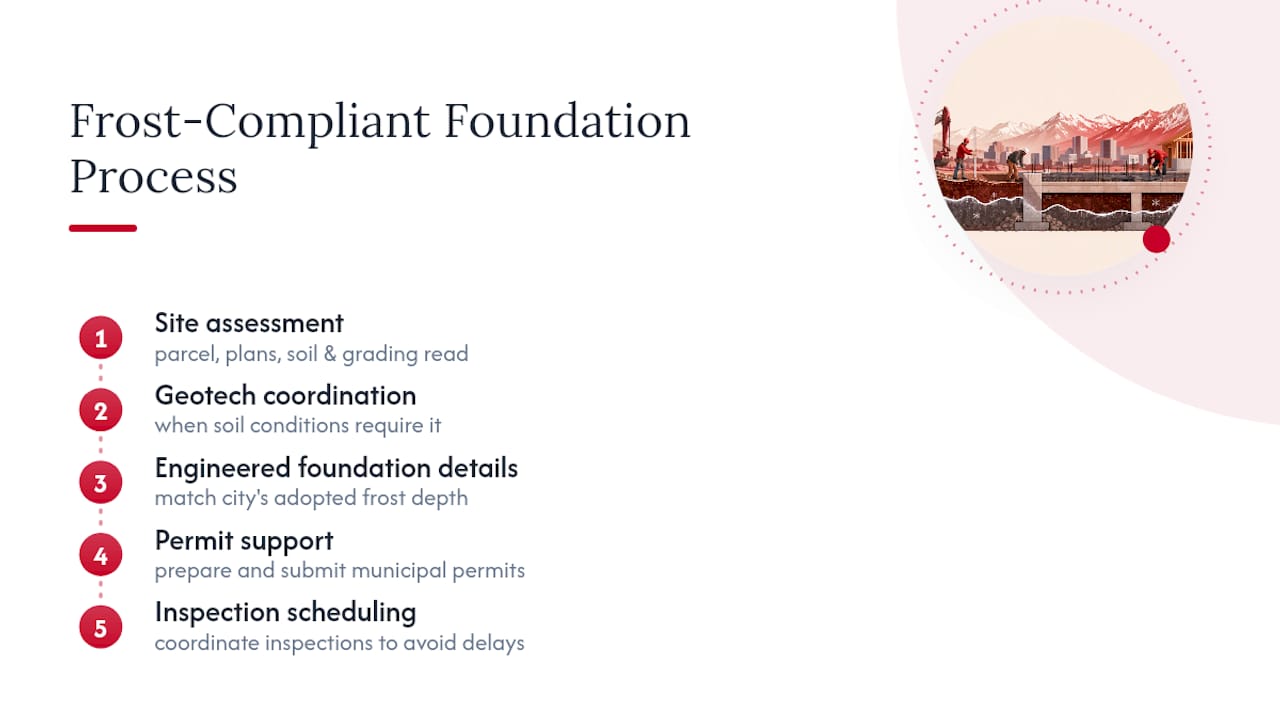
A to Z Construction handles frost compliance the way it should be handled: as part of one coordinated process, not a checklist item somebody remembers halfway through the project. A site assessment comes first, followed by geotech coordination when soil conditions call for it, then foundation details engineered to match your city's adopted frost depth, permit support, and inspection scheduling that keeps the project moving instead of stalling on paperwork.
As a licensed general contractor based in Cedar City with over 500 completed projects across concrete, hardscape, and remodeling work statewide, A to Z Construction has pulled permits under enough different municipal design criteria to know which cities need what. The first site visit covers your parcel details, any existing plans, and a read on soil and grading conditions, so you walk away knowing your real footing depth before excavation starts, not after.
What Utah's Frost Line Rules Actually Get Wrong
Most articles on this topic treat Utah's frost line like a trivia answer: one number, memorize it, done. That's backwards, and it's the part of the conventional advice that fails homeowners most often. The number that matters isn't a state average. It's whatever line item sits in your city's design criteria table, and that varies enough between St. George and Ogden that a "typical Utah frost depth" is close to meaningless for planning an actual excavation.
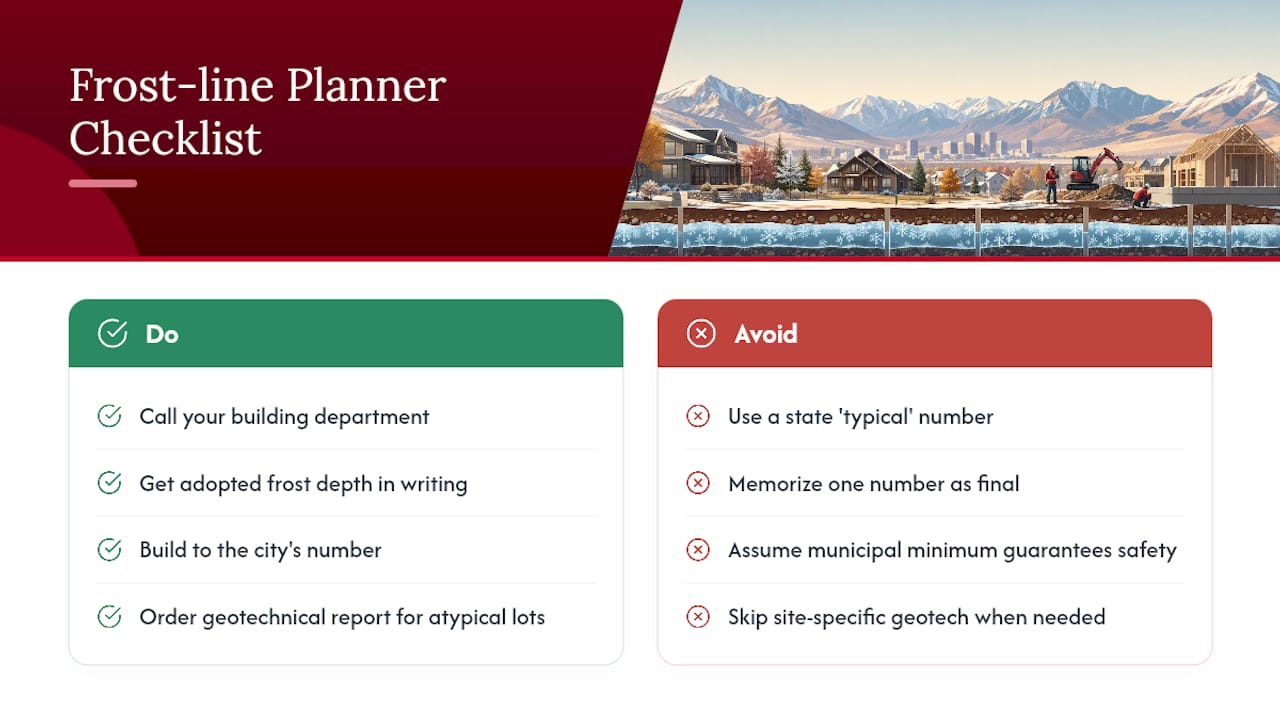
The bigger blind spot is elevation and microsite conditions inside a single city. Two lots ten minutes apart can carry different effective frost risk if one sits in a drainage low spot and the other doesn't. Municipal minimums are a floor, not a guarantee, which is exactly why geotechnical reports exist for lots that don't fit the standard soil assumption.
If you take one thing from this, prioritize the phone call to your building department over any guide, including this one. Get the adopted number in writing, then build to it.
— Jake
Get a Free Local Estimate for Your Frost-Compliant Foundation
Figuring out the right frost depth is only half the job. Getting a foundation built to that spec, permitted, and inspected without delays is where A-to-zconstruction earns its keep as your single point of contact instead of juggling separate excavators, concrete crews, and permit runners. A-to-zconstruction's free site assessment covers a review of your parcel and proposed plans, guidance on what your local design criteria require, and coordination with a geotechnical engineer when your soil calls for one.
Bring your parcel information and any existing site plans to the estimator visit, and you'll leave with a realistic footing depth, a materials plan, and a permit timeline instead of guesswork. Whether the project is a new foundation, a structural remodel, or a slab addition, A-to-zconstruction's in-house crew carries it from that first estimate through final inspection. Start with a structural remodeling consultation and get your frost-depth questions answered before you ever break ground.
Sources
- Design Criteria | Ogden, UT
- Design Criteria | Provo, UT
- Design Criteria | North Salt Lake, UT - Official Website
- 2021 Utah State Building Code - 1809.5 Frost protection.
- Frost depth map and data (NWS)
FAQ
How deep is the frost line in Utah?
It depends on your city. Most Wasatch Front municipalities, including Ogden, Provo, and North Salt Lake, require footings at least 30 inches below grade, while southern Utah areas near St. George typically run 12 to 18 inches, and mountain regions can exceed 36 inches.
What state has the deepest frost line?
Frost line depth generally increases with colder climates and higher elevation, so states in the northern U.S. and mountain regions, including parts of Minnesota, Alaska, and Montana, tend to require deeper footings. Utah's own range varies widely by elevation, from shallow requirements in the south to deep requirements in its higher mountain zones.
How far down do you have to dig to be below the frost line?
You need to dig to whatever depth your local municipal design criteria specify, since there's no single frost line for Utah. On the Wasatch Front, that's typically 30 inches; check your city's adopted requirement before excavating.
How do I find the frost line depth in my area?
Look up your city or county's Design Criteria document, usually posted on the building department's website, or call the department directly with your parcel information. NWS frost depth data can add regional context, but your municipality's adopted number is the one that governs your permit.