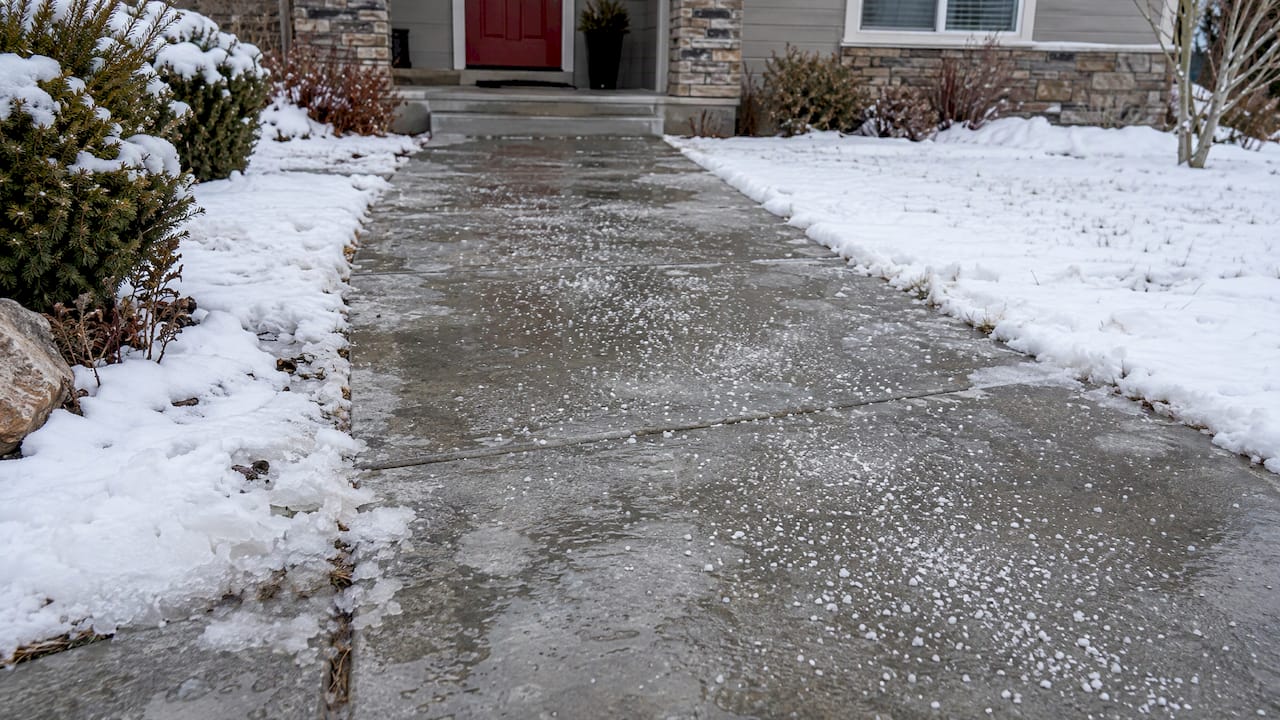
Deicing salt does not melt concrete, but it makes the freeze-thaw cycle harder on it. Used on a sound, sealed driveway after its first winter, and only to loosen ice for shoveling, common deicers are generally acceptable. Used on concrete poured within the last year, or in heavy doses, they are a leading cause of flaking, pitting and rough surfaces. Below: how the damage happens, which products are safer, when to skip them entirely, and how the way a slab is built decides how well it handles salt.
TL;DR
- Salt works by pulling more water into the concrete surface and increasing freeze-thaw stress, which is what flakes the top layer off.
- Do not use any deicer on concrete during its first winter. Use sand for traction instead.
- After the first winter, use salt or calcium chloride sparingly to loosen ice, not to melt every flake of it. Avoid products with magnesium, ammonium sulfate or ammonium nitrate.
- Sealing, good drainage and a properly built mix do more for salt resistance than anything you spread in January.
- Rinse and sweep salt residue in spring, and have flaking surfaces looked at before it spreads.
Table of Contents
- What deicing salt actually does to concrete
- Can you use salt on new concrete?
- Which ice melt is best for a concrete driveway?
- When to skip salt entirely
- Why some slabs handle salt and others do not
- Protecting a driveway from salt: a practical routine
- Salt on concrete in Utah's climate
- Why the contractor matters as much as the ice melt
- Planning a new or replacement driveway
- FAQ
- Sources
What deicing salt actually does to concrete
Concrete looks solid, but it is full of microscopic pores and channels. Water soaks into them. When that water freezes it expands, and the surface has nowhere to take the pressure. Over a few winters, small flakes of mortar pop off. That flaking is called scaling, and the University of Nebraska–Lincoln Extension describes it as the most common winter damage to concrete: water enters the capillary spaces, freezes, and thin layers of mortar come loose.
Salt does not cause this on its own. It amplifies it. The Federal Highway Administration's review of chemical deicers and concrete pavement says deicers worsen physical freeze-thaw damage in several ways: they keep the concrete more saturated, they cause thermal shock as ice melts and the surface cools suddenly, they create osmotic pressure in the pores, and salts can crystallize inside them.

That explains a pattern most homeowners notice. The damage is rarely a crack across the whole driveway. It starts as a rough, sandy-looking patch where water sits, near the garage apron, at the bottom of a slope, or along a path where the shovel never quite reaches.
The saturation point
Researchers at Iowa State University's transportation institute explain that concrete has a critical saturation point, roughly 85 to 87 percent of its void space filled with water. Past that, the pores can no longer absorb the expansion of freezing water, and the surface starts to fail. According to their deicing salts brief, drainage matters because it delays reaching that state. A slab that dries out between storms is far more forgiving than one that stays wet under a layer of slush.
Not all deicers are equal
The chemistry matters too. The FHWA report notes that calcium chloride can react with the cement paste and form a compound that expands and cracks concrete from within. A National Concrete Pavement Technology Center brief on concrete scaling adds that calcium chloride and magnesium chloride are the more aggressive of the common salts, and that how much paste is lost depends on both the salt and the concrete's makeup.
The practical takeaway is not that one bag is safe and another is a disaster. It is that the product, the amount and the age and quality of the concrete all work together.
Can you use salt on new concrete?
No. The most consistent advice from the concrete industry is to keep every deicer off a new slab for its first winter. The Ohio Concrete trade association's guidance on deicing agents says to avoid deicers during the first winter, especially for concrete placed after September 15 that was not air-dried and sealed. Immature concrete has not finished gaining strength, and it is more vulnerable to freeze-thaw scaling.
That guidance also gives a sealing timeline: new concrete should air-dry before it is sealed, and it recommends applying a conventional sealer about two months after a conventional curing compound.
The same guide suggests sand for traction in that first winter. Sand does not melt anything, but it gives tires and boots grip without pushing salty water into the surface.
A concrete project poured late in the season is the situation where this matters most. If your driveway or walkway went in during fall, expect to shovel and sand rather than salt until the following spring at least. Our guide to cold weather concrete covers what happens to a slab poured when temperatures are dropping.
What does "new" mean?
The first winter after placement is the rule most often given. A driveway poured in June has had a full summer to cure and dry. One poured in October has had only a few weeks. Both count as "first winter," but the October slab is far more at risk, which is why the September 15 cutoff appears in the guidance above.
Which ice melt is best for a concrete driveway?
The question usually comes down to rock salt (sodium chloride) versus calcium chloride, and the answer is less dramatic than many online posts suggest. According to the Ohio Concrete guidance, deicers containing salt or calcium chloride are generally acceptable on quality concrete after the first winter, as long as you use them to loosen ice and snow for removal. It recommends avoiding products containing magnesium, ammonium sulfate or ammonium nitrate.
Here is how the common options compare for a homeowner:
| Option | What to know for concrete |
|---|---|
| Sand | Safe for any slab, any age. Adds traction but melts nothing. The right choice in the first winter. |
| Rock salt (sodium chloride) | Generally acceptable on quality, mature concrete when used sparingly. Works slowly in very cold weather. |
| Calcium chloride | Generally acceptable on quality, mature concrete in moderation. Considered more aggressive on paste than sodium chloride. |
| Magnesium-based products | Avoid on concrete per industry guidance. |
| Ammonium sulfate or ammonium nitrate | Avoid. These are sometimes sold as fertilizer-based melters and attack the cement paste. |
If the product label lists several ingredients, read all of them. Blends are common, and the one that matters is often the second or third on the list.
How much is too much
The goal is not a bare, dry driveway. The Ohio Concrete guidance says to use deicers to loosen ice and packed snow so you can shovel or plow it, not to melt all of it. In practice that means:
- Shovel early, before snow gets packed down by tires.
- Apply a light, even layer only where you need it, such as the slope or the walking path.
- Wait for the ice to loosen, then scrape and shovel it off.
- Sweep up leftover granules instead of leaving them to dissolve into the slab.
A thick pile of salt does not work faster. It just puts more brine into the surface.
What about homemade ice melters?
Kitchen mixes of alcohol, dish soap or beet juice circulate widely online, but no standard or study in the sources we rely on establishes them as concrete-safe, and many still contain salt. The proven low-risk option is mechanical: shoveling early and using sand for traction. Save any brine or mixture for places other than a new or unsealed slab.
When to skip salt entirely
There are four situations where the safest answer is no salt at all:
- The first winter. As above, avoid every deicer.
- Slabs with existing scaling. Surfaces that already flake have lost their protective top layer, and salt speeds up the loss.
- Unsealed decorative concrete. Stamped, colored and exposed finishes show damage more obviously. Our stamped concrete maintenance guide explains how to care for them.
- Areas next to planting beds or lawn. Runoff carries salt into soil, which is a particular issue for the sod and xeriscape beds that often border driveways.
On a driveway that is cracked, heaving or has standing water, the water is the real culprit, and salt just makes it worse. If you see lifting or movement, read why driveways heave before assuming salt alone is responsible.
Why some slabs handle salt and others do not
Two driveways in the same neighborhood can take the same winter very differently. The difference is usually in how they were built, not in how they were salted.
The FHWA report lists the risk factors for deicer-related damage: locally saturated concrete, inadequate air voids, a water-to-cementitious-materials ratio above 0.40, aggressive deicer use and susceptible coarse aggregate. Most of these are decided on the day of the pour.
- Air voids. Air-entrained concrete contains microscopic bubbles that give freezing water somewhere to expand. It is the standard approach for exterior concrete that freezes.
- Water content. Extra water makes finishing easier and the concrete weaker and more porous. A lower ratio gives a denser surface.
- Cementitious mix. For hand-placed concrete exposed to freezing, the National Concrete Pavement Technology Center's brief reports industry guidelines that cap fly ash at 25 percent and slag cement at 50 percent.
- Finishing. Overworking the surface or adding water while troweling weakens the top layer, which is the part that scales.
- Drainage. A slab that sheds water dries faster. Water pooling on a flat patio is a common reason one area scales while the rest stays fine. See our piece on stopping patio pooling.
None of that shows up when you look at a finished driveway, which is why the contractor who pours it matters as much as the product you choose afterward.
Protecting a driveway from salt: a practical routine
Seal it, and keep it sealed
Sealers deter water from entering the surface pores, and the Ohio Concrete guidance says they can help prevent both freeze-thaw and salt damage. Reapply according to the sealer manufacturer's instructions. Sealer types behave differently, and the right pick depends on finish and exposure, which our concrete sealer guide walks through.
Rinse in spring
Once temperatures are above freezing and the last storm has passed, sweep off residue and hose the slab down. Rinsing keeps dissolved salt from sitting in the pores through the next freeze. Vinegar and water or a dedicated salt-neutralizing cleaner is often used on white salt stains, but avoid acid on colored or stamped concrete, where it can damage the finish.
Keep it clean year-round
Dirt, debris and lawn fertilizer left on a slab can chemically attack the surface and hold moisture against it. Sweep them off promptly, particularly where a driveway borders a lawn.
Catch salt before it comes inside
Salt tracked in on boots and tires spreads to garage floors and entry slabs. Boot trays and absorbent mats at entrances catch it before it reaches the concrete.
Watch for early warning signs
Rough, sandy patches, small pits or surface flakes are early scaling. Hairline cracks that hold water are the next place it will start. Addressing them while they are small is much cheaper than resurfacing or replacing a driveway. Sunken or settled sections are a separate issue, covered in our article on sunken sidewalk repair.

For a more detailed look at how salt concentration affects a slab, and what you can fix yourself, see our guide to stopping salt damage to concrete.
Salt on concrete in Utah's climate
Southern Utah's winters swing between freezing nights and sunny afternoons, so a driveway can freeze and thaw many times in a week. Each swing is a chance for water in the pores to expand and contract. That is the exact condition that deicers make worse. It is also why finish and mix design are not details for a Utah driveway. Our article on choosing a concrete finish for Utah's climate covers how finishes perform locally.
If you are planning a new driveway, schedule the pour with the first winter in mind. A slab placed in spring or early summer has months to cure, dry and be sealed before the first freeze. One placed in late fall has to get through a winter before it is ready for any salt at all.
Why the contractor matters as much as the ice melt
Most salt damage can be traced to the pour: too much water in the mix, no air entrainment, a surface finished too early, poor slope, or a sealer that was never applied. When one company handles excavation, base, forming, pouring and finishing, the details that decide salt resistance stay under one roof and one set of eyes. When those jobs are split among separate crews, no one is responsible for the result in March.
That is the difference between a driveway that lasts and one that scales after two winters, and it is why it is worth asking any contractor who pours your slab how they handle air entrainment, water content, slope and sealing.
Our view from the job site
We build concrete for Utah winters, and the freeze-thaw swings here are what we plan every driveway around. Most of the salt damage homeowners ask us about started before the first bag of ice melt was opened. It began with the base, the slope, the mix and the finishing.
That is why we run excavation, forming, concrete and finishing with our own licensed crew, with no subcontractors in between. One crew carries the project from the first estimate through completion, so the decisions that affect how a slab handles water and salt are made by the people who will stand behind it.
Our advice for any driveway: give it its first winter without deicers, keep it sealed, keep water moving off it, and use salt only to loosen ice once it has matured. A well-built slab makes all of that easy.
Jake
Planning a new or replacement driveway
If your driveway is scaling, cracked or poorly drained, a repair may only delay the problem. A to Z Construction is a licensed general contractor in Cedar City, Utah, and our concrete team pours driveways, approaches, slabs, foundations and decorative flatwork with an in-house crew. Concrete driveways and approaches are published at $4,000 to $15,000, and we work from fixed bids, so you know the number before the work begins.

You get a single point of contact from estimate to completion, and local knowledge of Utah's climate and codes. If you are weighing a replacement, or want a new slab placed in time to cure before winter, start at our concrete driveways and slabs page. If the project also involves paver walkways or a retaining wall to manage runoff, our hardscape services can be bid together with it.
FAQ
Is rock salt bad for concrete?
It can be, mostly through repeated freeze-thaw with salty water in the pores. On quality, mature concrete, salt-based deicers are generally acceptable when used lightly to loosen ice, according to the Ohio Concrete guidance. On new, unsealed or already scaling concrete, skip it.
Is calcium chloride better for concrete than rock salt?
Not for the concrete. Research from the National Concrete Pavement Technology Center lists calcium chloride and magnesium chloride among the more aggressive salts for concrete paste. Calcium chloride does work at lower temperatures, so use it lightly and only on mature concrete.
How long should I wait before using deicer on new concrete?
At least the entire first winter after the pour. Concrete placed after September 15 that was not air-dried and sealed is the most at risk. Use sand for traction instead.
Will rinsing the salt off prevent damage?
Rinsing and sweeping in spring removes residue that would otherwise stay in the pores through the next freeze, and it helps. It cannot undo scaling that has already started. Sealing the slab and keeping water draining off it are the longer-term protections.
How do I know if my driveway has salt damage?
Look for a rough, sandy or pitted surface, small flakes of surface mortar, and white residue after the slab dries. Patches near the lowest point of the driveway or where snow piles up are the usual starting places. If the damage is spreading, have a concrete contractor look at the slab.
Sources
- Chemical Deicers and Concrete Pavement: Impacts and Mitigation, Federal Highway Administration
- Winter Deicing Agents for the Homeowner, University of Nebraska–Lincoln Extension
- Revisiting Concrete Scaling, National Concrete Pavement Technology Center
- Use of Deicing Agents on your Concrete Surface, Ohio Concrete
- Deicing Salts and Concrete Pavements, Iowa State University