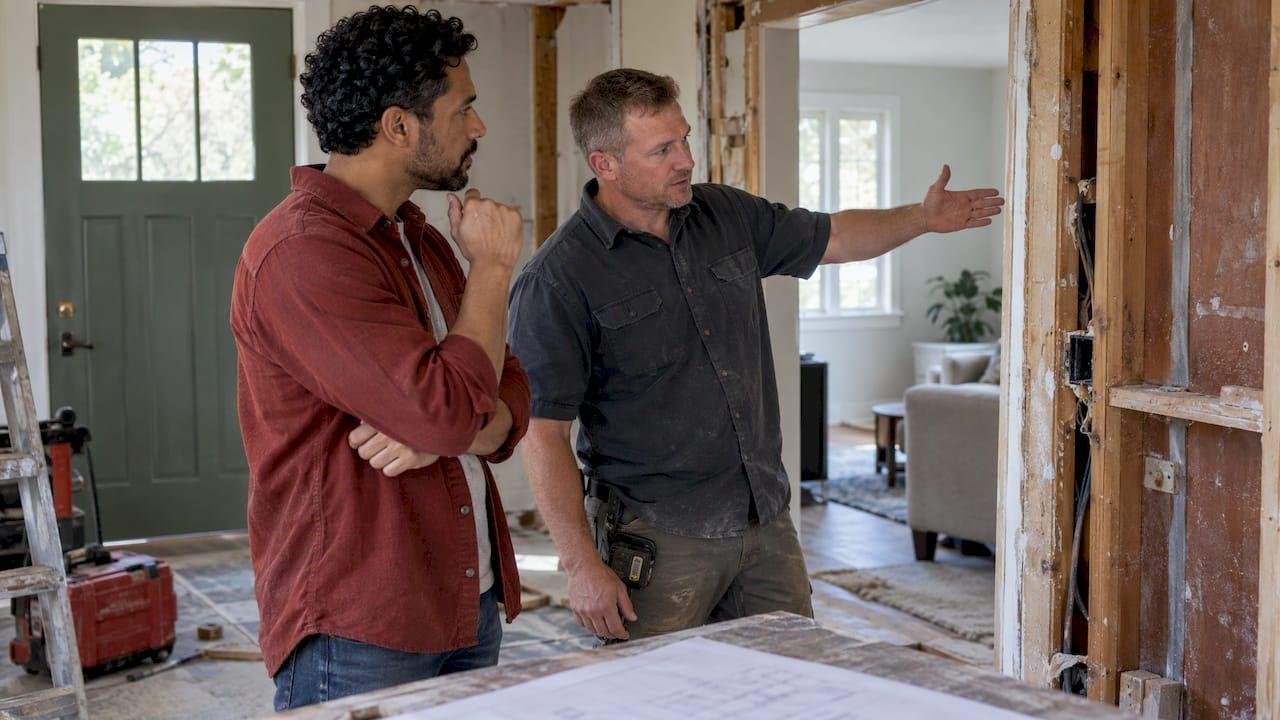
A preconstruction meeting is the sit-down between you and your contractor before any work starts, and the checklist that matters most is short: confirm the scope in writing, agree how and when you pay, set the rules for change orders, lock in who handles permits and inspections, and name one person who answers your questions. Do that, and most of the disputes that sink residential projects never start. Below is the full checklist, what to bring, what to ask, and how to record the decisions so they hold up later.
TL;DR
- Bring your signed contract, plans, selections and a written question list, and photograph every document you sign.
- Settle scope, allowances, the payment schedule and the change-order process in writing before the first day of work.
- Confirm who pulls permits, who schedules inspections, work hours, access, and end-of-day cleanup.
- Name one person with authority to answer questions, and agree how often you get updates.
- Finish with written minutes: each decision, one owner per action item, and a date.
Table of Contents
- What a preconstruction meeting is for
- What to bring
- The checklist, section by section
- Questions worth asking out loud
- Put it in writing: minutes and action items
- Our perspective
- Start your project with a clear plan
- FAQ
- Sources
What a preconstruction meeting is for
The meeting turns a signed contract into a working plan. The contract says what you bought. The meeting says who does what, in what order, on which days, and what happens when something changes.
Official guidance shows the same purpose from different angles. Philadelphia's Department of Licenses and Inspections asks contractors to submit a pre-construction meeting project-information form so the meeting identifies key project participants, establishes clear lines of responsibility and raises awareness of permit requirements. The building permit has to be issued before that meeting can even be scheduled. Your city may not run the process the same way, but the logic carries over: names, responsibilities, permits.
On a small job such as a driveway, a fence or a patio, the meeting may take thirty minutes at your kitchen table or on the site. On a remodel or a large hardscape project, plan for an hour or more. The length matters less than leaving with decisions on paper.
What to bring
You do not need a binder. You need the documents that define the deal:
- The signed contract and any proposal or bid it references. You will check the meeting's decisions against it.
- Plans, drawings or a site sketch. For outdoor work, mark where the work starts and stops, where the gates and utilities are, and where materials can be stored.
- Your selections. Colors, finishes, paver patterns, fence style, fixtures, each with the model or product name.
- A written list of questions. Notes made at the kitchen counter beat memory in the meeting.
- A phone or camera. Photograph every signed page and every marked-up plan before you leave.
- Your spouse or co-owner, if they will make decisions during the job. Two people hearing the same answer prevents "I thought we agreed" later.
The checklist, section by section
Work through these in order. Each item should end with an answer you could repeat to a neighbor, not a vague "we'll sort it out."
1. Scope, documents and site conditions
Start with what is being built and what is not. The National Association of Home Builders (NAHB) publishes a site-meeting checklist for builders in which the builder walks the homeowner through yes, no or not-applicable items. Those items include whether the lot was previously filled, whether property pins are located, whether the lot was surveyed by a licensed surveyor, easements and restrictive covenants, contract review, change orders, allowances, trash and cleanup, the zoning permit, flood zone, and the homeowner's own responsibilities. The list records homeowner signatures and dates.
For your meeting, turn that into plain questions:
- Does the written scope list every item you expect, such as demolition, hauling away debris, base material, sealing, finish and cleanup?
- Where are the property lines, and have they been marked? A fence or retaining wall built on the wrong side of a line is expensive to move.
- Are there easements, utilities, an HOA or covenants that limit what can be built or where?
- Is the ground ready? Fill, poor drainage or unstable soil change the base work for concrete, pavers and walls, so ask whether grading or excavation is in the scope.
- Which tasks are yours? The NAHB list includes a homeowner-responsibilities item. Clearing a space, moving vehicles and furniture, and securing pets are common examples.
2. Budget, allowances and payment schedule
Money is where small misunderstandings grow. Ask what is in the base price and what counts as an extra, and get the answer on paper.
Two state licensing boards give a clear picture of what careful homeowners confirm. Oregon's Construction Contractors Board building and remodeling checklist says to get a list of allowance items and budgeted amounts, with the understanding that the homeowner pays when an item exceeds its allowance. It also says to agree on a payment schedule in advance that coincides with completed work, with no full upfront payment.
California's contractor licensing board goes further on deposits. Its 2025 Construction Project Checklist tells homeowners to pay no more than 10% down or $1,000, whichever is less, with payments scheduled and documented by phase and no final payment until satisfied. That is a California rule. Your own state sets its own limits, so check with your state's contractor licensing board before you agree to a deposit.
At the meeting, confirm:
- The total price and whether it is a fixed bid.
- Every allowance (for example, a fixture, tile or lighting allowance) and the dollar amount behind it.
- The payment schedule, tied to finished work and not to calendar dates alone.
- What "done" means for the final payment: the punch list is complete and you have inspected the work. Our construction punch list guide shows how to build that list.
A worked example. Say you are building a paver patio. Our published price range for paver patios and walkways is $8,000 to $25,000, and the spread comes from size, materials and site conditions. At the meeting, ask the contractor to state which of those variables are already fixed in your bid: the square footage, the paver product, the base depth, the edge restraint, and whether grading or drainage work is included. Anything not fixed is a possible change order. Anything fixed should appear in the contract by name.
3. Change orders
Changes are normal. Surprises about price are the problem. Oregon's checklist asks for an agreement that change orders are signed by both contractor and homeowner, dated, and state the nature and cost of the change and who bears additional costs. Use that as your rule: no changed work starts before the paper is signed.
Ask at the meeting:
- What triggers a change order: a new request from you, a hidden condition found once work begins, a material that becomes unavailable?
- How quickly will you receive a written price after a change comes up?
- Does the change order show its effect on the schedule as well as the cost?
For a deeper look at the paperwork, see our U.S. field guide to construction change orders.
4. Schedule, access and daily routine
A schedule is only useful if it names the sequence and the dependencies. Ask for the start date, the order of work, and what could push it back: weather, inspections, material lead times, your own selections.
The California checklist also points to practical items worth settling: who oversees the work each day, the work days and hours, and end-of-day cleanup. Add the ones your property needs:
- Where crew vehicles park and where materials and equipment are staged.
- Which gate, door or driveway is used, and when you will be without access to your garage or yard.
- Where a dumpster sits and who orders it.
- How the crew protects landscaping, sprinklers and existing concrete.
- What time the crew arrives and leaves, and the plan for noisy work.
- What happens with pets, kids and deliveries on work days.
If you want a sample of how a full schedule is broken into phases, our construction project timeline guide walks through it.
5. Permits, inspections and site rules
Ask who pulls each permit, who pays the fee, and who schedules each inspection. California's checklist says the contractor should obtain the necessary building permits and arrange inspections, and that is a sound default to expect anywhere. Get the permit number and inspection sequence in writing. Our guide to getting Cedar City building permits faster covers the local process for Cedar City homeowners.
Cities often set site rules that you should hear about before the crew arrives. The City of Louisville, Colorado, publishes a pre-construction document that illustrates how detailed those rules can get. It calls for erosion controls on all sides, a contractor information sign and building permit displayed before work starts, approved staging plans, and engineered shoring for excavation steeper than 45 degrees from the property line. It also sets a noise limit of 65 dB at the property line for generators and warns that work outside the permit scope or on an unsafe site can draw a stop-work order. Your city's rules will differ, but the lesson applies everywhere: ask what your jurisdiction requires on site, and ask who is responsible for meeting it.
If your project involves digging, grading or utilities, also ask:
- Have underground utilities been located and marked before excavation?
- Is there an erosion or runoff plan for the site?
- Who handles concrete washout and debris? Our checklist on concrete washout disposal shows what a careful crew does before a pour.
6. Communication and authority
Many homeowner frustrations come down to "I couldn't reach anyone." Settle this at the meeting:
- Who is your single point of contact, and how do you reach them?
- How often will you get updates, and in what form (text, call, weekly walkthrough)?
- Who can approve a decision on the spot, and who has to check with someone else?
- What is the process if you spot a problem, and how fast does the contractor respond?
- Who handles quality checks, and how are defects corrected?
The more subcontractors involved, the more handoffs there are. Ask the contractor to tell you who will actually be on your property each week: their own crew or other companies.
For a longer playbook on running the job once it starts, see our project management guide for home renovation.
7. Cleanup, safety and closeout
Agree on what the site looks like at the end of each day and at the end of the job: debris removed, tools stored, hazards fenced or marked, and lawn and sprinklers repaired where the work touched them. Ask what the warranty covers, how long it lasts, and how to request a repair. Record the closeout steps now: final walkthrough, punch list, final inspection and final payment.
Questions worth asking out loud
If you only have time for ten, ask these:
- Which parts of my project are fixed price, and which could change?
- What allowances are in the contract, and how much is each?
- What is the payment schedule, and what work must be finished before each payment?
- What will trigger a change order, and how fast will I see the price?
- Who is pulling permits and booking inspections?
- What are the start date, the sequence and the expected finish?
- What could delay us, and how will you tell me?
- Who is on site each day, and who do I call?
- Where will materials, equipment and the dumpster go?
- What does "finished" mean, and how do we handle the punch list?
Put it in writing: minutes and action items
A meeting without minutes is a conversation. Minutes make it a record. Keep them simple:
- Date, location and who attended.
- The documents reviewed (contract version, plans, selections sheet).
- Each decision, stated as an outcome and not as a discussion.
- Each open item, with one owner and a specific date.
- The communication plan: who, how, how often.
- A note beside any verbal direction that says a change order will follow.
Ask the contractor to send the minutes within a day or two and reply with corrections right away. Silence can look like agreement. If you also manage your own paperwork on permits, payments and completion, a contractor project checklist covering permits and payments gives a useful parallel view of what the contractor's side tracks.
Finally, photograph everything signed and keep a folder, paper or digital, with the contract, change orders, permits, inspection results, payment receipts and minutes. You will want it at closeout, and again if you sell the home.
Our perspective
Most of the trouble we see on projects starts after the contract is signed, in the gap between what the homeowner pictured and what the crew was told. The preconstruction meeting is where you close that gap.
That is why we run each project as one team. We manage every phase internally, without subcontractors, so the person who walks your site at the meeting is accountable for the concrete, the grading, the hardscape and the cleanup. You get one point of contact, and decisions made at the table do not get lost between companies.
Our crew is licensed, we work from fixed bids, and we have completed more than 500 projects in Utah. We build for Utah's climate and codes, so conversations about base preparation, drainage, frost and permits happen at the start, not when a problem shows up.
Bring this checklist to your meeting. A contractor who welcomes every item on it is one you can trust with the job.
Jake
Start your project with a clear plan
A to Z Construction is a licensed general contractor in Cedar City, Utah. Our in-house crew handles concrete, remodeling, earthwork, masonry, fencing, landscaping and hardscape from the first estimate to final completion, and we also offer dumpster rental. Published price ranges include $4,000 to $15,000 for concrete driveways and approaches, $8,000 to $25,000 for paver patios and walkways, and $25 to $45 per linear foot for vinyl fencing. You can see the full hardscape services we build.
If you are planning a project, contact A to Z Construction and we will go through your scope, schedule and permits with you before work begins.
FAQ
What should I expect at a preconstruction meeting?
Expect to meet the person running your job, review the contract and plans, and agree on the schedule, payments, permits, site rules and how changes are handled. You should leave with named responsibilities and a written summary. Cities such as Philadelphia use the meeting to identify participants and lines of responsibility.
What is a preconstruction checklist?
It is a list of items to confirm before work begins: scope, documents, budget and allowances, payment schedule, change-order process, permits, inspections, schedule, access, communication and cleanup. Builders' associations like NAHB publish versions with yes, no or not-applicable items and signature lines.
What questions should I ask my builder at the meeting?
Ask what is included in the base price, what allowances apply, how payments are tied to finished work, what triggers a change order, who pulls permits, who is on site daily, and how you will get updates. The ten-question list above covers the essentials.
Do I need a preconstruction meeting for a small project?
Yes, a short version helps on a driveway, fence or patio. Thirty minutes to confirm the scope, price, start date, access, and who to call can prevent a surprise bill or a blocked garage. The larger or more complex the project, the more worth it the full checklist becomes.
How much can I pay up front?
It depends on your state. California's licensing board, for example, advises no more than 10% down or $1,000, whichever is less, and Oregon's board advises against full upfront payment. Check your state contractor licensing board for the limit that applies to you.
Sources
- Philadelphia Department of Licenses and Inspections: pre-construction meeting project information form
- NAHB: site meeting checklist, Basic Construction Management
- Oregon Construction Contractors Board: building and remodeling checklist
- California Contractors State License Board: 2025 Construction Project Checklist
- City of Louisville, Colorado: pre-construction document (2025)