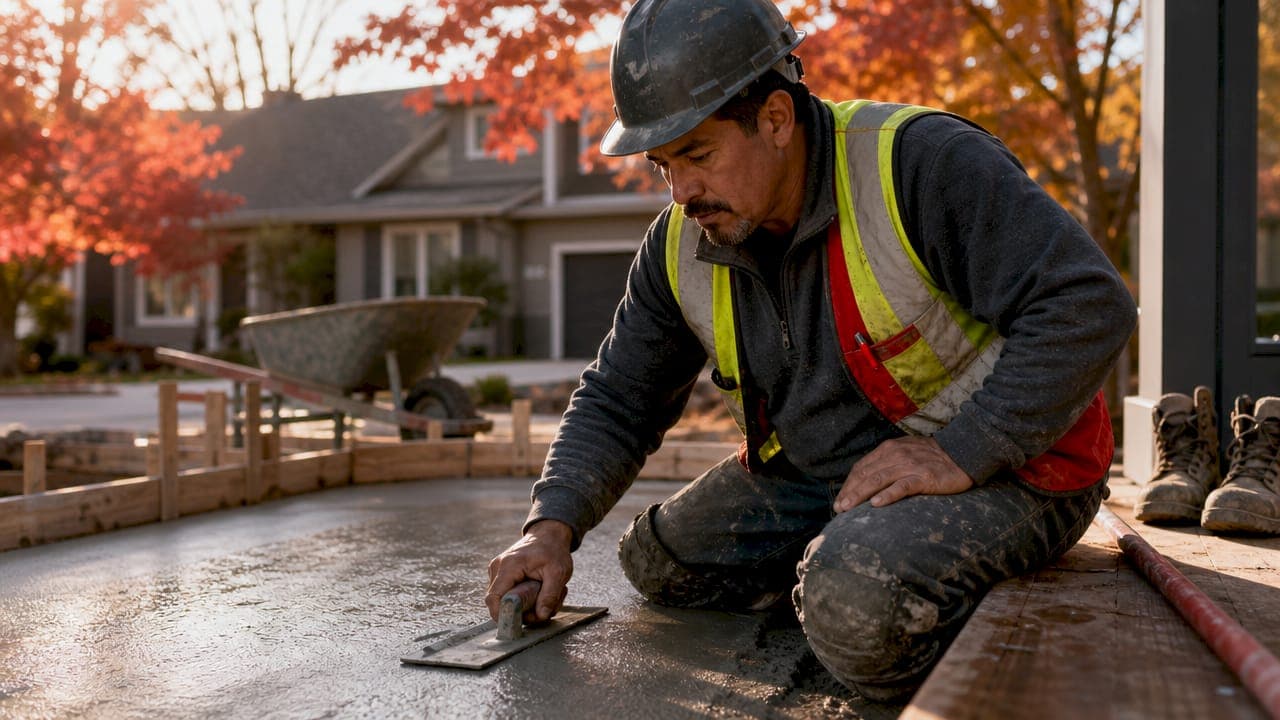
Concrete driveway installation cost is the amount you pay per square foot to pour and finish a new concrete driveway, and it typically falls between $6 and $18 per square foot for a standard broom finish. A 600-square-foot two-car driveway runs $4,665 to $10,800 in most markets. That range shifts based on size, surface finish, base preparation, reinforcement type, and whether you need to remove an existing slab. Knowing what drives each cost factor puts you in a much stronger position when you request quotes and compare bids.
How does concrete driveway installation cost change by size and finish?
Driveway size is the single biggest lever on your total bill. A single-car driveway costs $1,500 to $5,400, while large rural driveways with long runs from the road can exceed $20,000. The per-square-foot rate tends to drop slightly as the project grows, because labor and equipment setup costs spread across more area.
Cost by driveway size
| Driveway type | Approximate size | Estimated cost range |
|---|---|---|
| Single-car | 200–300 sq ft | $1,500–$5,400 |
| Two-car standard | 400–600 sq ft | $4,665–$10,800 |
| Large or rural | 800+ sq ft | $12,000–$20,000+ |
Surface finish is the second biggest variable. A standard broom finish is the baseline. It gives the slab texture for traction and costs the least. Decorative upgrades add real money.
- Stamped concrete: Mimics stone, brick, or wood patterns. Adds $6 to $15 per square foot on top of the base rate, pushing a 600-square-foot project well past $15,000.
- Stained concrete: Acid or water-based stains create color variation. Cost premium is similar to stamping and requires periodic resealing.
- Exposed aggregate: The top layer of cement paste is washed away to reveal the stone beneath. Durable and slip-resistant, with a moderate cost premium over broom finish.
Sealing is not optional for decorative finishes. Professional sealing every 2–3 years protects the color and surface texture. Budget $0.25 to $0.75 per square foot per sealing cycle, or roughly $150 to $450 for a standard two-car driveway.
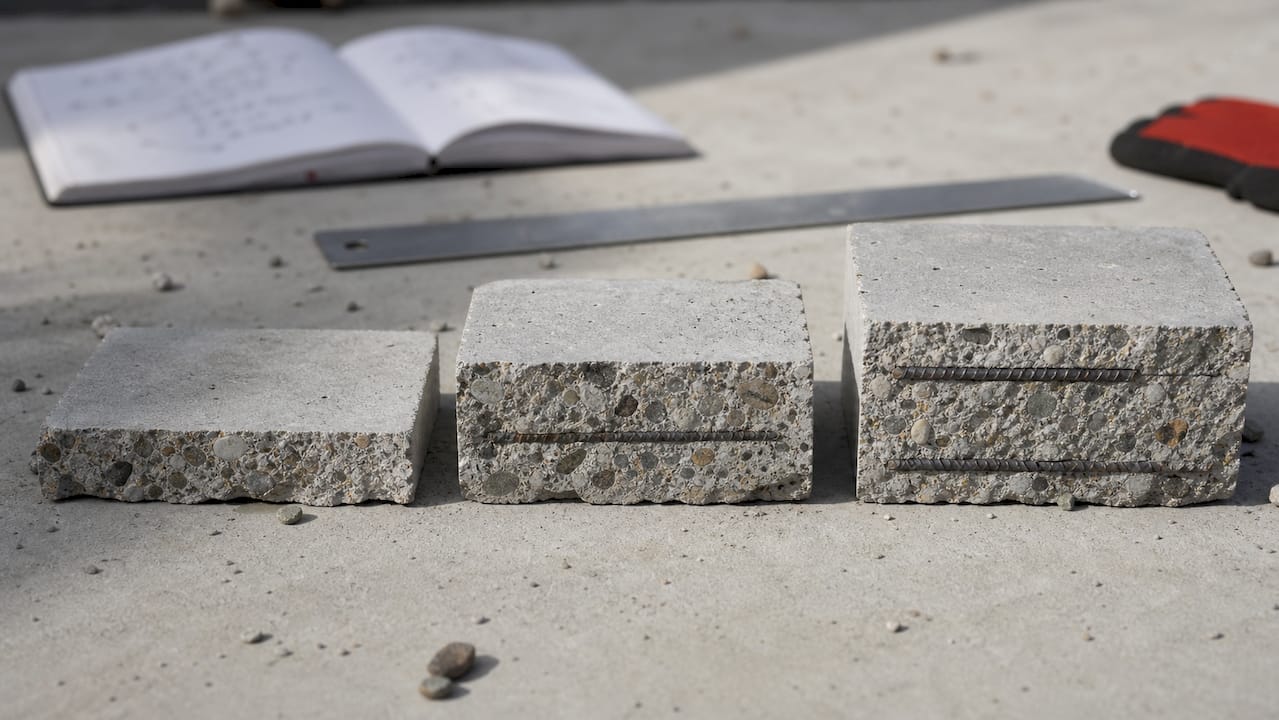
Slab thickness also affects price. A 4-inch slab handles passenger vehicles. A 5-inch or 6-inch slab handles trucks, RVs, or heavy equipment and adds material cost. Reinforcement choice ties directly to thickness and load requirements.
Pro Tip: If you want a decorative finish, get a separate line-item quote for the finish upgrade. Some contractors bundle it in a way that makes comparison shopping difficult. Seeing the base cost and the finish premium separately helps you decide if the upgrade fits your budget.
For a closer look at how different finishes perform in Utah's climate, the concrete finish guide from A-to-zconstruction covers freeze-thaw durability by finish type.
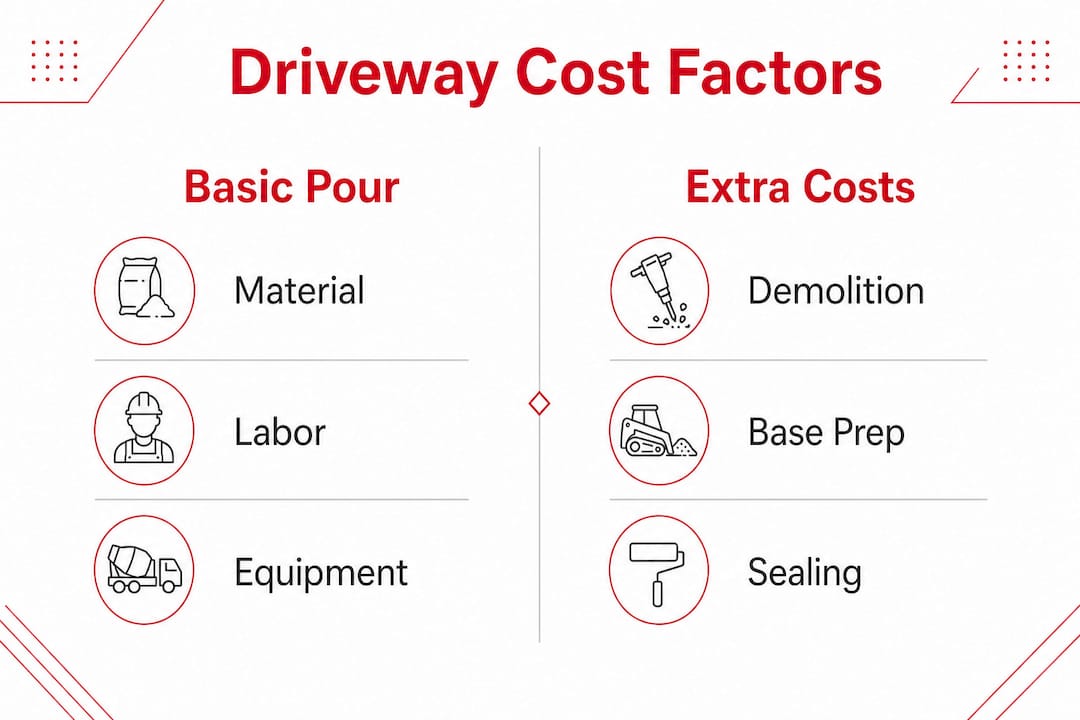
What extra costs should you expect beyond the basic pour?
The per-square-foot rate covers concrete material and labor for the pour. It rarely covers everything else the project needs. These additional line items catch many homeowners off guard.
Demolition and removal
If you have an existing driveway, removing it adds $1,000 to $3,000 to the project. The final number depends on slab thickness, material type, and how easily equipment can access the site. A thick reinforced slab on a narrow lot costs more to break up and haul away than a thin asphalt pad on an open property.
Base preparation
Proper base preparation is the most critical phase of any concrete driveway project. A compacted gravel base of 4–6 inches prevents premature cracking, especially in climates with freeze-thaw cycles. Base preparation costs $1.10 to $2.65 per square foot depending on depth and soil conditions. Skipping or skimping on this step is the leading cause of cracked driveways within the first few years.
Reinforcement options
The choice between fiber admixture, welded wire mesh, and rebar affects both cost and structural performance. Rebar is the recommended choice for driveways that carry vehicle loads. It costs more than wire mesh but provides significantly better crack resistance under repeated stress. Fiber admixture is the least expensive option and works for light-duty applications, but it does not replace rebar for standard driveways.
Hidden contractor fees
- Mobilization fees: Contractors often charge $300 to $500 for small projects under 400 square feet. This covers the cost of dispatching a ready-mix truck for a load that is smaller than a full truck.
- Short-load surcharges: Ready-mix suppliers charge extra when the ordered volume falls below their minimum delivery threshold. This is separate from the contractor's mobilization fee.
- Permit fees: Many municipalities require a permit for driveway work. Costs vary widely by jurisdiction.
- Drainage corrections: If your site has grading issues, correcting drainage before the pour adds labor and material cost.
Pro Tip: Ask every contractor to list mobilization, permit, and disposal fees as separate line items. A quote that bundles everything into one number is harder to compare and easier to pad.
Understanding long-term paving maintenance costs alongside installation costs gives you a clearer picture of total ownership expense over the driveway's life.
How does your location affect the cost of a concrete driveway?
Geography moves prices more than most homeowners expect. Labor and material costs run 25–40% higher in the Northeast and Pacific Coast compared to the national average. A project priced at $8,000 in a mid-sized Midwest city could cost $10,500 to $11,200 for the same scope in Boston or San Francisco.
Rural markets present a different challenge. Labor may be cheaper, but material delivery costs rise when the job site is far from a concrete plant. Long haul distances also increase the risk of concrete beginning to set before it reaches the site, which affects quality.
- Metro markets: Higher labor rates, more competition among contractors, easier material access.
- Suburban markets: Moderate pricing, good contractor availability, standard delivery logistics.
- Rural markets: Lower labor rates offset by higher delivery costs and fewer contractor options.
National averages from generic online calculators do not account for these differences. Homeowners should get at least three local quotes rather than relying on national figures. A quote from a contractor who knows your local soil conditions, permit requirements, and material suppliers will be far more accurate than any national estimate.
State and local permits add another layer of cost variability. Some jurisdictions charge flat fees under $100. Others charge based on project value and require inspections at multiple stages. Always ask your contractor whether permit fees are included in the quote or billed separately.
For homeowners in Utah, local labor and material pricing differs from national benchmarks. A-to-zconstruction's local concrete driveway services reflect regional conditions rather than national averages.
How do you budget accurately for a concrete driveway project?
Accurate budgeting starts with knowing your square footage. Measure the length and width of the planned driveway area and multiply them. Add 10% to account for waste, irregular shapes, and minor measurement errors. That number is your baseline for every quote you receive.
-
Specify the full scope in writing. Tell each contractor exactly what you need: base depth, slab thickness, finish type, reinforcement method, drainage work, and sealing. Quotes built on the same scope are the only ones you can compare fairly.
-
Ask what the quote excludes. Low bids often exclude base preparation, drainage, and curing, which are necessary for a durable result. A bid that looks $2,000 cheaper may simply be missing $2,500 worth of work.
-
Factor in the lifespan advantage. Concrete carries a 30–50 year lifespan with minimal upkeep. Asphalt needs seal-coating every 3–5 years and typically lasts 20–30 years. The higher upfront cost of concrete often costs less per year of service life.
-
Budget for maintenance from day one. Set aside funds for sealing every 2–3 years if you choose a decorative finish. Standard broom-finish concrete needs far less attention, but joint sealing every few years prevents water infiltration.
-
Get three quotes minimum. Pricing varies significantly between contractors even in the same market. Three quotes give you a realistic range and reveal any outliers worth questioning.
The spring maintenance checklist from A-to-zconstruction outlines what routine concrete care looks like after installation, which helps you plan ongoing costs accurately.
Key Takeaways
Concrete driveway installation cost ranges from $6 to $18 per square foot for a standard finish, with total project costs shaped most by size, finish type, base preparation, reinforcement, and your local market.
| Point | Details |
|---|---|
| Base cost per square foot | Standard broom finish runs $6–$18/sq ft; decorative finishes add $6–$15/sq ft on top. |
| Size drives total cost | Single-car driveways start at $1,500; two-car projects average $4,665–$10,800. |
| Base prep is non-negotiable | A 4–6 inch compacted gravel base prevents cracking and is worth every dollar. |
| Hidden fees add up fast | Mobilization, permits, demolition, and drainage can add $2,000–$5,000 to any quote. |
| Location shifts pricing significantly | Northeast and Pacific Coast markets run 25–40% above the national average. |
What I've learned after seeing hundreds of driveway bids
The most expensive mistake homeowners make is choosing a contractor based on the lowest number on a quote. I've seen it play out the same way every time. The low bidder skips the gravel base, uses wire mesh instead of rebar, and pours a 3.5-inch slab instead of 4 inches. The driveway looks fine for two winters. By year three, cracks appear at the joints. By year five, the slab is heaving.
The fix costs more than the savings from the cheap bid. That's the uncomfortable math nobody wants to hear when they're staring at a $3,000 gap between two quotes.
What I tell homeowners is this: the concrete itself is almost the same from one contractor to the next. The difference is in what happens before the pour. Subgrade compaction, drainage correction, expansion joint placement, and curing protocols are where quality contractors separate themselves. None of those steps are visible in the finished product, which is exactly why low-bid contractors skip them.
Ask every contractor one question: "What is your base preparation process?" A contractor who gives you a specific answer about compaction depth, gravel type, and moisture testing is worth paying more for. A contractor who says "we prep the site" and moves on is telling you everything you need to know.
Concrete's 30–50 year lifespan is only achievable with proper installation. A driveway that lasts 15 years because the base was wrong is not a bargain at any price.
— Jake
A-to-zconstruction can handle your concrete driveway project
A-to-zconstruction is a licensed general contractor based in Cedar City, Utah, with over 500 completed projects across residential and commercial properties. The team handles concrete driveways from site prep through final finish, with no subcontractor handoffs and no gaps in accountability.
Whether you need a standard broom-finish slab or a stamped concrete driveway with decorative upgrades, A-to-zconstruction manages every phase under one roof. That means faster scheduling, clearer communication, and a finished product that meets the full scope you agreed to. For homeowners and property managers ready to move forward, the free hardscape estimate page makes it easy to get a localized quote built around your actual site conditions.
FAQ
What is the average cost of a concrete driveway per square foot?
The national average for a standard broom-finished concrete driveway runs $6 to $18 per square foot. Decorative finishes like stamped or stained concrete push that rate higher.
How much does a two-car concrete driveway cost in total?
A standard 600-square-foot two-car driveway typically costs $4,665 to $10,800 installed. Demolition of an old driveway, decorative finishes, or difficult site conditions add to that total.
Does demolition of an old driveway add to the cost?
Yes. Removing an existing driveway adds $1,000 to $3,000 depending on slab thickness, material type, and site access.
Is concrete more expensive than asphalt for a driveway?
Concrete costs slightly more upfront at $6–$18 per square foot versus $5–$15 for asphalt, but its 30–50 year lifespan and lower maintenance needs make it less expensive over time.
What is a short-load fee and when does it apply?
A short-load fee is a surcharge contractors and ready-mix suppliers charge when a project requires less concrete than a full truck delivery. Projects under 400 square feet commonly trigger this fee, typically $300 to $500.