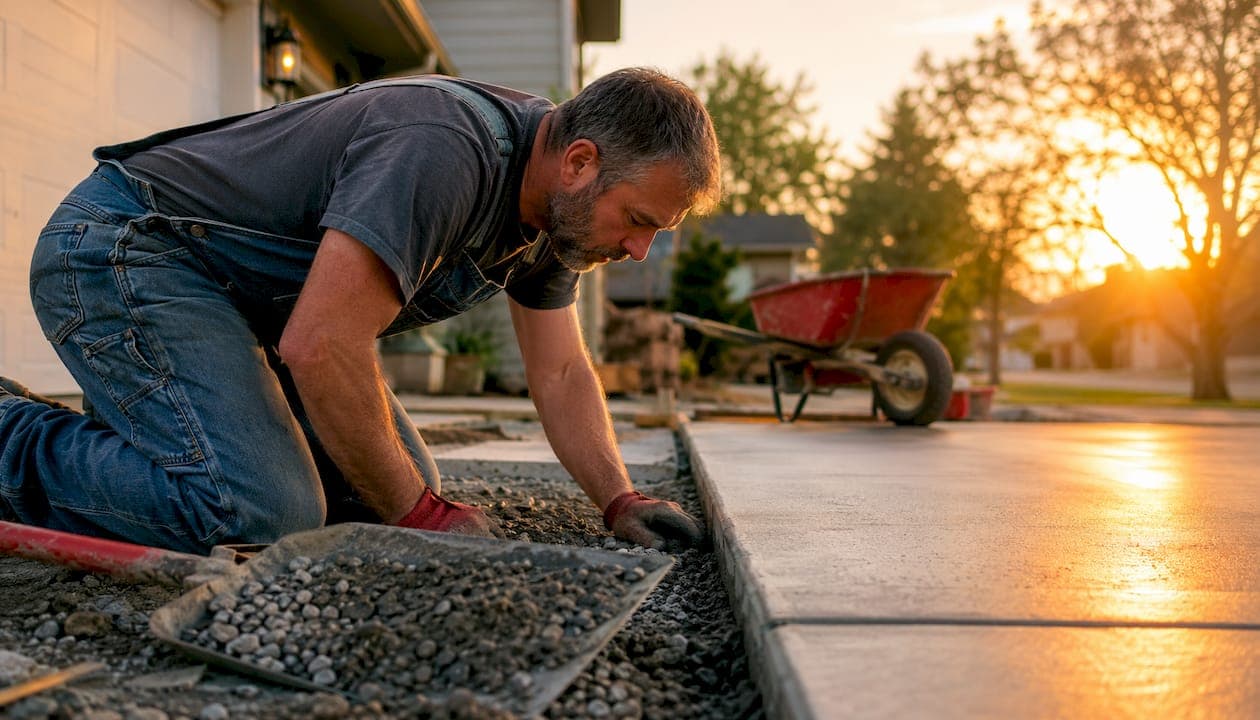
Is a 4-inch concrete driveway slab enough for your home?
Yes, a 4-inch concrete driveway is the standard minimum thickness for residential driveways handling passenger vehicles weighing up to 6,000 lbs on stable, well-compacted soil. The Michigan Concrete Association, the American Concrete Institute, and most local building codes all point to 4 inches as the baseline for typical household traffic.
That said, "minimum" and "optimal" are not the same thing. Here is a quick breakdown:
- Works well for: Passenger cars, sedans, light SUVs, and minivans on stable subgrade in mild climate conditions
- Borderline for: Mid-size SUVs (4,500–6,000 lbs) or driveways in moderate freeze-thaw zones
- Not enough for: Full-size pickup trucks over 6,000 lbs, RVs, delivery vehicles, or clay-heavy or frost-prone soils
- Pros: Lower upfront cost, meets code in most jurisdictions, adequate for decades with proper installation
- Cons: Less margin for error on subgrade quality, more vulnerable to freeze-thaw damage, shorter lifespan than a 5- or 6-inch slab
Standard concrete driveway thickness: what a 4-inch slab actually supports
A 4-inch residential slab is designed for passenger cars and light SUVs, assuming a minimum compressive strength of 3,500 PSI and a properly prepared subgrade. Most municipalities set 4 inches as the code floor, and for the majority of American homeowners, it holds up fine.
What makes or breaks a 4-inch pour is what sits beneath it:
- Subgrade compaction: Native soil must be compacted and free of organics before any base material goes down
- Gravel base: A 4–6 inch layer of compacted crushed stone or road base is the standard; this layer handles drainage and distributes load
- Concrete strength: standard residential concrete mixes provide appropriate strength for exterior flatwork
- Reinforcement: Wire mesh is standard for 4-inch residential slabs and helps hold any cracks together if they form
- Control joints: The Michigan Concrete Association specifies joints spaced according to recommended practice, typically about twice the slab thickness in feet
Well-compacted granular soils like gravel or sand provide strong support. Clay soils are a different story — they expand when wet and shrink when dry, creating the movement that cracks slabs from below.
When should you go thicker than 4 inches?
Certain conditions make a 5- or 6-inch slab the smarter call, even if 4 inches meets local code. Knowing these triggers before you pour saves you from a costly repair or replacement down the road.
- Heavy vehicles: Full-size pickup trucks, RVs (which can exceed 12,000 lbs), and delivery vehicles all exceed what a 4-inch slab handles comfortably
- Freeze-thaw climates: Water penetrates micro-cracks, freezes, expands roughly 9%, and fractures the slab from within; thinner slabs have less mass to absorb that stress
- Poor or expansive soils: Clay-heavy subgrades with low bearing capacity put constant upward pressure on the slab; a thicker section resists that movement better
- Steep grades: Braking and acceleration on an inclined driveway concentrate stress at specific points, accelerating wear on thinner slabs
- Long-term value: A 5-inch slab lasts 30–35 years versus 25–30 for a 4-inch slab; the jump from 4 to 5 inches adds a modest upfront cost for a 600 sq ft driveway but delivers a better cost-effectiveness when considering replacement costs over time
Going to 6 inches makes sense for regular RV storage, heavy truck access, or sites with genuinely poor soil conditions. For most homeowners, 5 inches is the sweet spot.
How reinforcement affects a 4-inch slab's durability
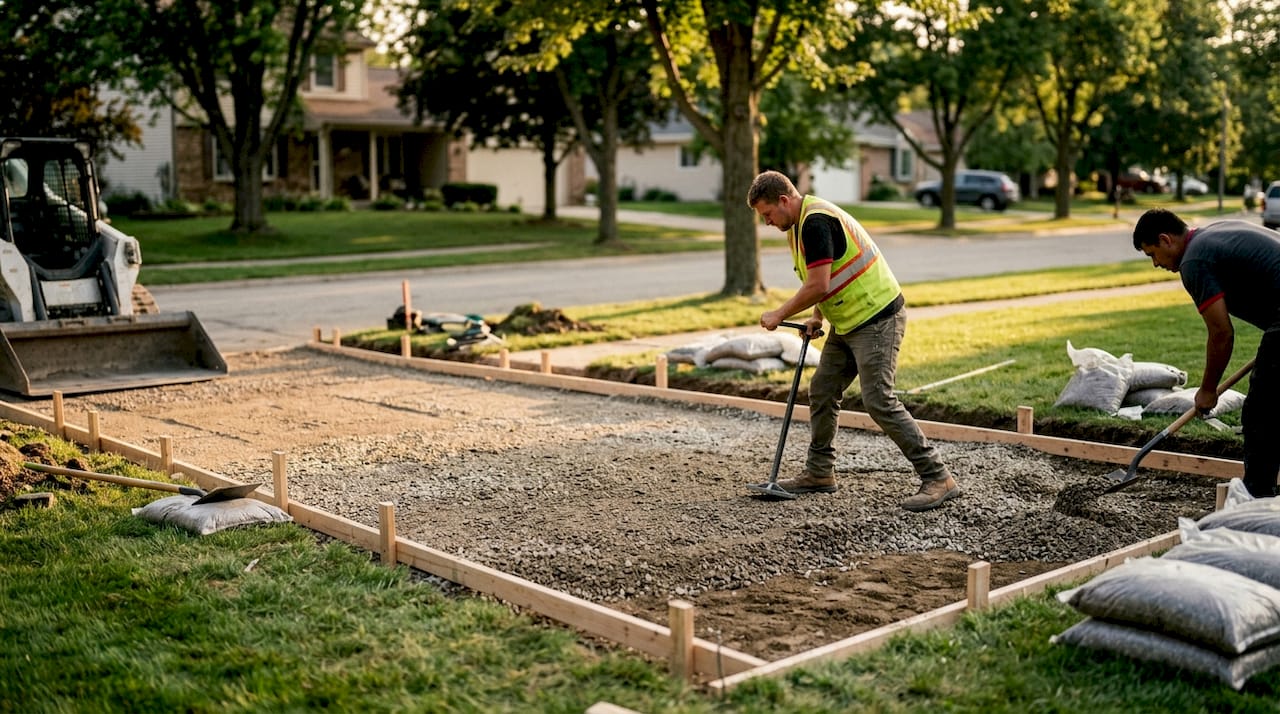
Reinforcement does not prevent cracks. What it does is keep cracks tight and controlled so the slab stays functional. For a 4-inch driveway, wire mesh is the standard choice; rebar is typically reserved for slabs 5 inches or thicker, or any application with heavy vehicle traffic.
A few details that matter more than most homeowners realize:
- Placement depth: Reinforcement positioned at mid-depth (roughly 2 inches from the bottom in a 4-inch slab) provides the best crack control
- Joint spacing: Control joints at 8–12 feet guide the slab to crack in straight, predictable lines as it shrinks during curing
- Joint depth: Cuts should reach one-quarter of the slab thickness, so 1 inch deep for a 4-inch pour
- No added water: Diluting concrete with extra water at the jobsite dramatically weakens compressive strength and accelerates scaling; insist your contractor orders the correct slump and does not let the truck driver add water on site
For sites with variable soil or moderate freeze-thaw exposure, fiber reinforcement mixed directly into the concrete reduces early plastic-shrinkage cracks and complements wire mesh well.
How local climate and soil conditions shape your thickness decision
Utah's climate varies sharply by region, and that variation matters for concrete driveway thickness. Cedar City sits at elevation with genuine freeze-thaw cycles; a 4-inch slab there needs more attention to air-entrainment and base preparation than the same slab would in a mild coastal climate.
Key environmental factors to weigh:
- Freeze-thaw cycles: Air-entrained concrete with 4–7% air content is essential in freeze-thaw zones; it creates microscopic bubbles that give expanding water somewhere to go without fracturing the paste
- Soil type: Sandy or gravelly soils drain well and provide stable support; clay soils shift seasonally and often warrant a thicker slab or a deeper gravel base
- Frost line depth: Northern states with deep frost lines may require thickened edges of 6–8 inches at the perimeter even when the field section stays at 4 inches
- Local codes: Some municipalities require 5 inches minimum for all driveways; always check with your local building department before finalizing plans
- Drainage: Poor site drainage keeps the subgrade saturated, which undermines even a well-poured slab over time
A soils engineer or experienced local contractor can confirm bearing capacity and frost-line depth for your specific site. That conversation costs nothing and can prevent a very expensive mistake.
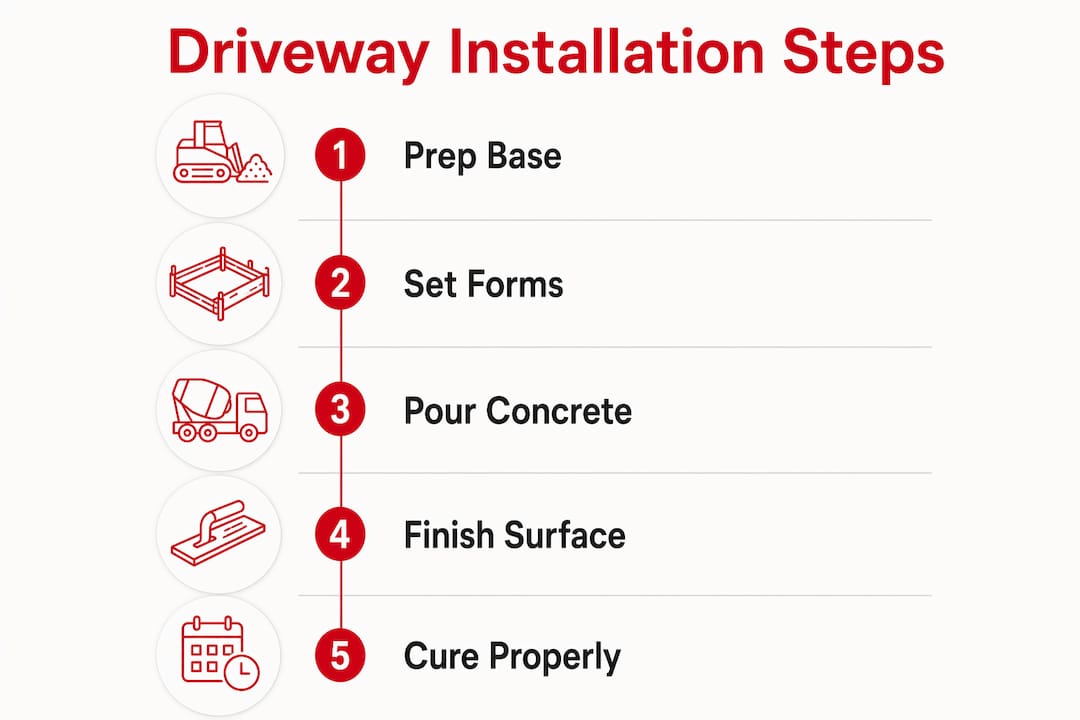
How to install a durable 4-inch concrete driveway
Getting a 4-inch slab to last 25–30 years comes down to execution, not just thickness. Every step below affects the final result.
- Excavate and grade: Remove all organic material; grade for a minimum 1/8-inch-per-foot slope away from structures for drainage
- Compact the subgrade: Native soil should be compacted to 95% density before base material goes down
- Place the gravel base: A 4–6 inch compacted gravel base is critical; on soft or clay soils, 6–8 inches is better
- Set forms and reinforcement: Position wire mesh at mid-depth; plan control joint locations before the pour so they align with garage door jambs and layout breaks
- Order the right mix: 4,000 PSI with air-entrainment for freeze-thaw climates; keep the water-cement ratio at or below 0.50
- Pour and finish: Avoid adding water to the mix at the site; use an evaporation retarder on hot or windy days to prevent surface drying before finishing
- Cure properly: Keep the slab moist or covered for at least 7 days; the Michigan Concrete Association notes the driveway can open to traffic after 7 days of curing, or sooner when testing confirms 3,000 PSI compressive strength
- Seal the surface: Apply a quality concrete sealer after full cure to reduce moisture penetration and extend surface life
Pro Tip: Pour the edges of your 4-inch slab 1–2 inches thicker than the field section. Thickened slab edges at 5–6 inches resist corner spalling and chipping, which is one of the most common failure points on residential driveways.
Cost and durability: what you actually get for your money
A 4-inch concrete driveway on a 600 sq ft footprint runs approximately $3,600–$6,000 installed, or roughly $6–$10 per square foot depending on your region, site conditions, and finish. That price assumes a standard mix, wire mesh reinforcement, and a compacted gravel base.
Stepping up to 5 inches adds roughly $900–$1,500 in additional cost and extends the expected lifespan from 25–30 years to 30–35 years. The cost-per-year math often favors the thicker slab, especially when a full replacement runs $5,000–$10,000. For detailed cost breakdowns by region and slab thickness, the 2026 cost guide from A-to-zconstruction covers the numbers in depth.
Meeting the 4-inch code minimum is not a guarantee of decades of durability. Codes set floors, not targets. The homeowners who get 30 years out of a 4-inch slab are the ones who also got the right base, the right mix, proper joints, and consistent sealing.
Common problems with 4-inch slabs and how to fix them
A 4-inch driveway that starts cracking or spalling within a few years almost always traces back to one of a handful of root causes.
Surface scaling and spalling usually means the concrete was finished while bleed water was still on the surface, or de-icing salts were applied during the first winter. Scaling is cosmetic at first but opens the surface to moisture infiltration. A penetrating sealer applied annually slows the progression; severe scaling requires resurfacing or replacement.
Cracking falls into two categories. Hairline cracks along control joints are normal and expected. Wide, random cracks that run across panels point to subgrade failure, inadequate joint spacing, or a mix that was too wet. Filling cracks early with a polyurethane or epoxy filler prevents water from getting in and widening them through freeze-thaw cycles.
Settlement and heaving happen when the subgrade shifts. Clay soils are the usual culprit. Mudjacking or polyurethane foam injection can lift and stabilize a settled slab without full replacement, but only if the concrete itself is still structurally sound. Proper site preparation before the pour is the only real prevention.
For homeowners considering slab removal and replacement, understanding what concrete slab removal involves helps set realistic expectations on scope and cost before getting bids.
If you are planning a concrete driveway in Utah and want it done right the first time, A-to-zconstruction handles every phase in-house, from excavation and subgrade prep through the final pour and finishing. No subcontractors, no gaps in accountability. Get a quote for your driveway project today.
Key Takeaways
A 4-inch concrete driveway meets residential code and lasts 25–30 years when paired with a compacted gravel base, proper reinforcement, and correct joint spacing.
| Point | Details |
|---|---|
| Standard thickness | 4 inches is the accepted minimum thickness for passenger vehicles on stable subgrade on stable subgrade. |
| Upgrade trigger | Heavier vehicles, freeze-thaw climates, or clay soils often require 5–6 inches for durability. |
| Cost difference | Going from 4 to 5 inches adds roughly $900–$1,500 on a 600 sq ft driveway. |
| Reinforcement rule | Wire mesh suits 4-inch slabs; rebar is recommended for slabs 5 inches or thicker. |
| Joint spacing | Control joints should be spaced no more than 8 feet apart on a 4-inch slab. |
FAQ
How strong is a 4-inch concrete slab?
A properly poured 4-inch slab with suitable mix and subgrade supports typical passenger vehicles on a well-compacted subgrade. Compressive strength depends heavily on mix quality, water-cement ratio, and curing conditions.
Does a 4-inch concrete driveway need rebar?
Wire mesh is the common reinforcement for 4-inch residential slabs(https://www.concretenetwork.com/concrete/concrete_driveways/thickness.html); rebar is typically reserved for slabs 5 inches or thicker or driveways handling heavy vehicle traffic. Reinforcement controls crack width but does not prevent cracking entirely.
How thick should a concrete driveway be?
The standard is 4 inches for passenger vehicles in mild climates with stable soil, and 5–6 inches in freeze-thaw regions or where soil bearing capacity is poor. Always confirm local code requirements with your building department before finalizing the design.
Is 4 inches of concrete enough for a vehicle lift?
No. A vehicle lift requires a concrete slab thicker than 4 inches, typically 6 inches or more with reinforcement, and many manufacturers specify even greater thickness depending on the lift's load rating. A standard 4-inch driveway slab is not rated for that point load.