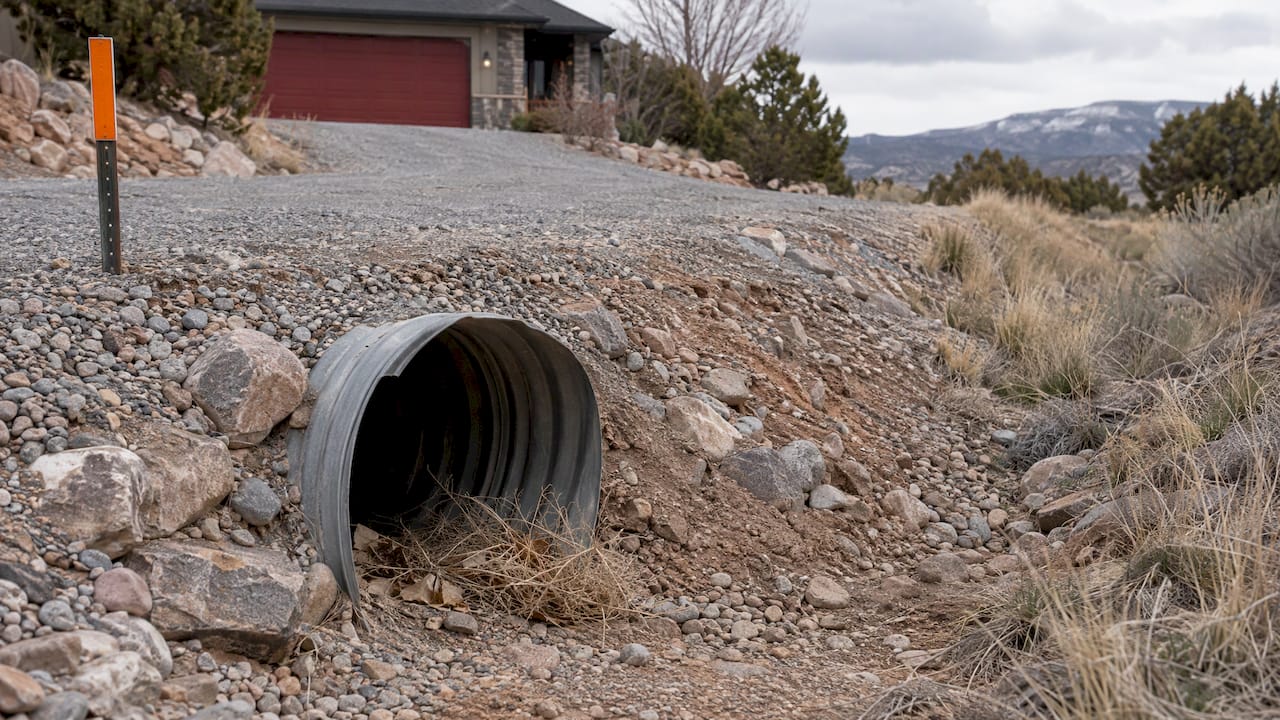
A driveway culvert needs a look at least twice a year, plus after every major storm. Clear both ends of leaves, sediment and trash, keep vegetation trimmed, protect the soil around the pipe from erosion, and repair damage early. In most places the pipe under your driveway is your responsibility, so a blocked culvert becomes your problem the first time heavy rain arrives. This guide gives you the schedule, the warning signs, the safe way to clear a pipe, and the point where cleaning stops being enough.
TL;DR
- Inspect your culvert in spring, in fall and after major rainstorms. Some local governments ask for quarterly checks, so confirm what your town recommends.
- Clear debris from both ends, working from the downstream side, and keep brush and grass trimmed back.
- Rust, cracks, a sagging driveway or sediment pouring out of the outlet mean cleaning alone will not fix it.
- Armor and plant the inlet and outlet to stop erosion, and ask your town or county about permits before altering or replacing the pipe.
- Replacement, regrading and anything that changes how water moves across your property is work for a licensed professional.
Table of Contents
- Who is responsible for a driveway culvert
- A seasonal inspection schedule
- Signs your culvert is blocked, damaged or failing
- How to clear a blocked culvert safely
- When cleaning is not enough
- Erosion control at the inlet, outlet and embankment
- Permits and local rules to check first
- Our perspective on culverts
- Planning a driveway or drainage project in Utah
- FAQ
- Sources
Who is responsible for a driveway culvert
If the culvert carries water under your private driveway, you almost always own the maintenance. The Marin County Flood Control District states that property owners must maintain drainage built for private property access, including driveway culverts and inlets, and that failing to clear debris could leave the owner liable for resulting damage. Other agencies say the same. The Town of Gilmanton, NH, notes that unmaintained culverts can lead to enforcement action and required repairs.
The reason is practical. When leaves or other waste block the pipe, water is redirected. The Marin district explains that this can cause serious flooding and localized erosion, and can damage pavement across or under the driveway. When it is working, a culvert protects your property from flooding, reduces erosion and supports the driveway and nearby roads.
The pipe may cross a ditch that belongs to a town, county or state, but the section under your driveway entrance is usually yours. If you are unsure, call your town public works office or county road department and ask who owns the pipe and the ditch.
A seasonal inspection schedule
The baseline from local governments is simple. Gilmanton recommends inspecting in spring, in fall and after major rainstorms, removing leaves, branches, sediment and trash from both ends, and trimming vegetation. Carrboro, NC, goes further: it asks homeowners to inspect and clean quarterly, check before big storms, and look again whenever there is standing water in the swale or the pipe is 20% or more full of sediment.
You can combine the regional schedules into one routine:
| Season | What to do |
|---|---|
| Spring | Inspect the inside of the pipe and both ends. Remove obvious blockages and clean out winter debris. |
| Summer | Remove blockages, clean and flush the full length of the pipe, and make repairs. Mow or trim grass and weeds near the entrances, cut branches upstream and plant the ends of ditches to prevent erosion. |
| Fall | Clear leaf and debris blockages. Mark the pipe ends or headwalls so snowplow operators can see them. |
| After big storms | Walk the culvert, confirm water is moving, and clear anything that washed in. |
That seasonal pattern follows the schedules published by the Upper Valley Lake Sunapee Regional Planning Commission and the Town of Lincoln, VT, which also adds repairing or installing headwalls and pipe ends in summer, plus establishing vegetation on bare slopes.
A routine only works if it is written down. Our commercial sewer maintenance checklist shows the same idea for another kind of buried pipe: set the dates, record what you found, and repeat. For a culvert, a note on your phone after each visit (date, how full the pipe was, what you removed) is enough to reveal trends over the years.
If your area gets a lot of snow, the fall step matters more than it looks. A pipe end that a plow cannot see is a pipe end that gets hit. Stakes or reflective markers cost very little compared with a crushed headwall.
In dry climates, the quiet months are the risky ones. Dust, tumbleweeds and sediment settle into the pipe through a long dry season, and the first heavy storm pushes all of it into the opening at once. A fall or early-summer check ahead of monsoon-type rain is cheap insurance.
Signs your culvert is blocked, damaged or failing
Most problems announce themselves before the driveway fails. Watch for:
- Standing water at the inlet after rain, or a ditch that stays wet long after a storm.
- Erosion around the pipe ends. The South Indian River Water Control District lists erosion, excessive rust, cracks and settled areas that leave a gap between driveway and culvert, and sinkholes or depressions in a dirt driveway above the pipe, as warning signs.
- Sediment buildup, especially after heavy rain.
- Sediment coming out of the outlet. St. Lucie County, FL, names this alongside depressions behind concrete miters, undermining of the driveway and rusted-away sections of pipe as key indicators of a failing culvert.
What you look for also depends on the material. Whatcom County, WA, advises checking concrete pipe for separations, cracks or collapsed tiles, metal pipe for pitting and rust (typically at the bottom), and plastic pipe for cracked or discolored sidewalls. With plastic, confirm the pipe is still mostly round and not oval.
The stakes are not only your own driveway. St. Lucie County explains that a failing culvert can slow or block stormwater and disrupt drainage for an entire neighborhood, and can lead to damage or collapse of part of the driveway above it.
How to clear a blocked culvert safely
Start at the entrance and work in. The UVLSRPC guide says to use a shovel around the culvert entrance first. If material remains, a pressure washer or sewage jet can push it out, and specialized tools can reach farther into the pipe.
A sensible sequence:
- Look first. Use a flashlight to see how much of the pipe is obstructed and what the blockage is made of.
- Clear both openings. Remove leaves, branches, sediment and trash by hand. Stafford County, VA, describes routine maintenance as mowing grass and removing trash, vegetation, debris or any obstruction that keeps water from flowing freely.
- Flush the pipe. Water from the upstream end helps carry loosened material out.
- Check the flow. Run water or wait for rain and confirm it passes through without backing up.
- Clean up the banks. Haul away what you removed so it does not wash back in.
Some safety sense applies. Never crawl into a culvert, and stay out of the ditch during or just after heavy rain, when flow can rise quickly. Wear gloves and boots, since stagnant ditches hold sharp debris. If the pipe crosses a stream or wetland, stop and read the permit section below before you dig or dredge.
When cleaning is not enough
A clear pipe can still be the wrong pipe. Whatcom County notes that culverts have a finite lifespan, and that replacement is warranted when the structure can no longer convey stormwater even after cleaning or presents a danger to the traveling public. Its common problem list also includes undersizing.
Here is a quick way to sort the situation:
| What you see | What it usually means |
|---|---|
| Pipe fills with debris each season but is otherwise sound | A maintenance problem. Tighten your schedule and clear upstream. |
| Pipe is more than about 30% full or erosion keeps recurring | Possibly undersized. The UVLSRPC guide suggests considering a larger size. |
| Rusted-through metal, cracked or separated concrete, flattened plastic | Structural damage. Cleaning will not restore the pipe. |
| Driveway sagging or sinking above the pipe | Soil may be washing out around the pipe. Get it assessed before driving on it heavily. |
Patching and repair
Small surface cracks in a concrete culvert end or headwall are sometimes repaired, but a crack in the pipe itself, a separated joint or a collapsed section is a structural question. Have a qualified excavation or drainage contractor look at it before you fill anything, because a patch over a void or a joint that is still moving will fail and can hide a washout underneath the driveway.

Size and depth matter on replacement too. The City of Scottsdale, AZ, requires a minimum 18-inch diameter pipe in city rights-of-way to avoid clogging, and says the bottom of the culvert should sit even with the bottom of the channel, not above or below, to prevent sediment buildup or ponding. Local rules vary, but the principle holds: a pipe set at the wrong elevation clogs no matter how often you clean it. Scottsdale also warns that homemade or improperly designed culverts can be disastrous for the homeowner, the neighbors and adjacent streets.

Erosion control at the inlet, outlet and embankment
Moving water carries soil. Without outlet protection, concentrated flow can cause scour holes, embankment erosion and pipe undermining, along with roadway shoulder deterioration and downstream sediment. How bad it gets depends on flow velocity, soil type and the slope of the embankment.
Practical measures homeowners and local codes point to:
- Deep-rooted vegetation downstream. The UVLSRPC guide recommends planting it to hold the soil where water exits.
- Rip-rap at the pipe ends. The City of Boiling Spring Lakes, NC, requires that open pipe inlets and outlets be stabilized with rip-rap to prevent bank erosion.
- Aprons, fabric and energy dissipation. On larger projects, culvert walls are often paired with riprap aprons, geotextile fabric or vegetative stabilization to slow water before it can scour.
- Stable, planted slopes. Bare banks near the ends are where erosion starts. Establish ground cover early in the growing season.
If erosion keeps returning at the same spot, the cause is usually volume or velocity, not bad luck. That is the point to look at upstream drainage, pipe size and the grade of your driveway. Our guide to fixing gutters and grade to stop standing water covers the yard-side half of that equation, and retaining wall drainage matters if the culvert sits below a wall or steep cut.
Your driveway surface plays a role too. Cracks and a poor gravel base send extra runoff toward the pipe and the ditch. See our notes on durable driveway crack repair and the three-layer driveway gravel system.
Permits and local rules to check first
Cleaning is generally fine without paperwork. Altering or replacing the pipe is where permits come in, and the rules are local. Examples from around the country show the range:
- New Hampshire: a driveway permit is required before installing or altering a driveway that connects to a town or state road. If it crosses a ditch or alters water flow, a culvert will likely be required, and the town or state decides its size, type and placement.
- Virginia (Stafford County): repairs or replacements can proceed without county approval if the pipe has the same diameter, general slope and length, and less than 2,500 square feet of land is disturbed. Culverts within VDOT right-of-way may need a Land Use Permit, and those crossing live streams or wetlands may need US Army Corps of Engineers permitting.
- Vermont (Lincoln): work on a driveway access requires a town permit, and the highway supervisor inspects before, during and after the work.
- Arizona (Scottsdale): grading or structural work within a drainage easement or right-of-way requires an Encroachment Permit and possibly other permits, and a watercourse may not be altered unless a professional engineer certifies it will not increase flood hazards.
- Florida (a drainage district): state law bars willfully obstructing public drainage, and one district may assess double the cost of culvert installation against owners who fail to pay for required replacements.
If you hire help, the paperwork is still yours. Carrboro, NC, says the homeowner must ensure the professional obtains the proper permits, which may include an encroachment agreement, 811 utility locates, zoning approval and, for waterway culverts, Army Corps permission. Whatcom County also notes that some ditches are classified as fish habitat and limit work to a window between July 15 and September 30.
The simple rule: before you dig, call your city or county public works or road department and ask who owns the ditch, what size and type of pipe is required, and whether a permit is needed. Then call 811 for utility locates.
Our perspective on culverts
We see the same pattern again and again: a driveway that looks fine on top and is quietly washing out underneath. The culvert is the part nobody thinks about until a storm proves it.
A culvert is part of the driveway system, not an accessory to it. Pipe size, the base under the concrete or gravel, the grade of the approach and the slope of the ditch all work together. When one is off, the others take the damage. That is why we prefer to run the whole job, from excavation and grading through the finished surface, with one in-house licensed crew and one point of contact. Nobody can point at a different subcontractor when water goes where it should not.
Our advice is simple. Inspect on a schedule, write down what you find, and bring in a professional early when you see settling, rust or repeated erosion. Fixing the drainage while the driveway is open costs far less than rebuilding a driveway after it collapses.
Jake
Planning a driveway or drainage project in Utah
If your inspection turns up settling, repeated erosion or a driveway approach that needs rebuilding, our team handles excavation and grading and concrete driveways and approaches as one coordinated project, with an in-house licensed crew. Start on our excavation and grading page, or see our concrete driveways and approaches. Concrete driveways and approaches are listed at $4,000 to $15,000 depending on the project.

For a broader view of how we build driveways that shed water properly, read our concrete driveway installation guide, or get in touch through a-to-zconstruction.com to talk through your site. For seasonal upkeep of the surfaces around your drainage, our spring maintenance checklist for hardscape and concrete is a good companion to this one.
FAQ
How often should I clean my driveway culvert?
At a minimum, inspect it in spring, in fall and after major rainstorms. Some local governments, such as Carrboro, NC, recommend quarterly cleaning and an extra check before big storms. If your culvert sits under trees or collects leaf litter, expect to clean more often.
How do I know if my culvert is too small?
Recurring erosion and a pipe that is regularly more than 30% full are the signs to watch for. The UVLSRPC guide suggests considering a larger size in that case. Because size, type and placement are often set by your town or state, ask your local public works office before choosing a replacement.
Do I need a permit to replace a driveway culvert?
Often yes, though it depends on where you live. Some places allow like-for-like replacement under a set amount of disturbed land, while others require a permit or inspection for any work. Culverts that cross streams or wetlands can also need federal approval, so check with your local public works department first.
Can I fix a collapsed or rusted culvert myself?
Cleaning is a homeowner job, but structural repair is not. Rusted-through metal, separated or collapsed concrete, and a sinking driveway point to a void or failed pipe that needs excavation and replacement. Hire a licensed contractor and make sure the required permits are in place.
Sources
- Marin County Flood Control District: Driveway culvert maintenance
- Town of Gilmanton, NH: Homeowner's Guide to Driveway Culvert Maintenance
- Carrboro, NC: Driveway Culvert Maintenance
- UVLSRPC: Driveway Culverts
- Town of Lincoln, VT: Driveway Culvert Maintenance
- South Indian River Water Control District: Driveway Culvert Maintenance
- St. Lucie County, FL: Culvert inspections
- Whatcom County, WA: Private Culvert Owner Resources
- Stafford County, VA: Residential Drainage Issues
- City of Scottsdale, AZ: Homeowner's Guide to Drainage
- City of Boiling Spring Lakes, NC: Driveway Connections to City Streets
- Hartman Products: Hydraulic and Erosion Control Considerations for Culvert Inlet and Outlet Protection