Drip and microirrigation are the most water-efficient irrigation system types, running roughly 90% efficiency compared with about 70% for sprinklers and 50% for surface methods like flood or furrow irrigation, according to WSU Extension. The right choice among surface, sprinkler, drip, and subirrigation systems depend on your soil, slope, water source, plant type, and budget, not just which method saves the most water on paper.
TL;DR:
- Drip irrigation delivers water directly to the root zone with roughly 90% efficiency, but requires careful filtration and suitable installation choices.
- Sprinkler systems cover large areas efficiently but lose more water to wind and evaporation, with many models still lacking smart controller integration.
- Surface irrigation methods have about 50% efficiency and depend heavily on soil type and slope, often resulting in higher water bills.
- Subsurface and subirrigation systems reduce evaporation and weed growth but are harder to monitor and typically more expensive.
- Proper yard grading and integrated planning are essential, as poor grading often causes residential irrigation failures regardless of the system type.
Table of Contents
- Drip and Microirrigation: The Water-Sipping Option
- Sprinkler System Types: From Pop-Up Heads to Center Pivots
- Surface Irrigation: Furrow, Flood, and Basin Methods
- Subsurface Irrigation and Subirrigation: Watering From Below
- Residential Setups That Actually Work
- Smart Controllers and Sensors: The Efficiency Multiplier
- Choosing the Right System for Your Site
- Maintenance: Keeping Any System Running
- What Installers Know That Manuals Don't Tell You
- Get Your Irrigation System Designed and Installed Right
- Sources
- FAQ
Drip and Microirrigation: The Water-Sipping Option
Drip irrigation delivers water directly to the root zone through emitters, either inline (built into the tubing at fixed intervals) or point-source (individual drippers placed at each plant). Pressure-compensating emitters keep flow consistent even on sloped ground, which matters if you're irrigating a terraced yard or a hillside orchard, according to USU Extension.

The catch is filtration. Emitter orifices are small enough that sediment, algae, or mineral scale clogs them fast, so every drip system needs a screen, sand media, or disk filter sized to its flow rate, and periodic flushing to clear debris before it builds up, per USDA/NRCS guidance. Water with iron, sand, or algae often needs pre-screening upstream of the main filter too.
Installation choices matter just as much as the emitters themselves:
- Subsurface drip resists UV degradation and reduces evaporation but makes leak detection harder.
- Aboveground tubing is easier to inspect and repair but vulnerable to rodent damage and UV breakdown over time.
- Root intrusion into buried lines is a real risk near mature trees and shrubs.
- Retrofitting an existing sprinkler zone into drip is common and often cheaper than a full redesign.
Pro Tip: Add air/vacuum release valves at high points in any subsurface drip line, and build in a way to isolate or flush sections. It turns a two-hour repair into a ten-minute one.
Sprinkler System Types: From Pop-Up Heads to Center Pivots
Sprinkler systems throw water through the air, which is exactly why they lose more of it to wind and evaporation than drip does. Residential setups typically use pop-up spray heads for small, oddly shaped beds and rotor or multi-stream rotating nozzles for larger turf areas, since rotors apply water more slowly and evenly over a wider radius.

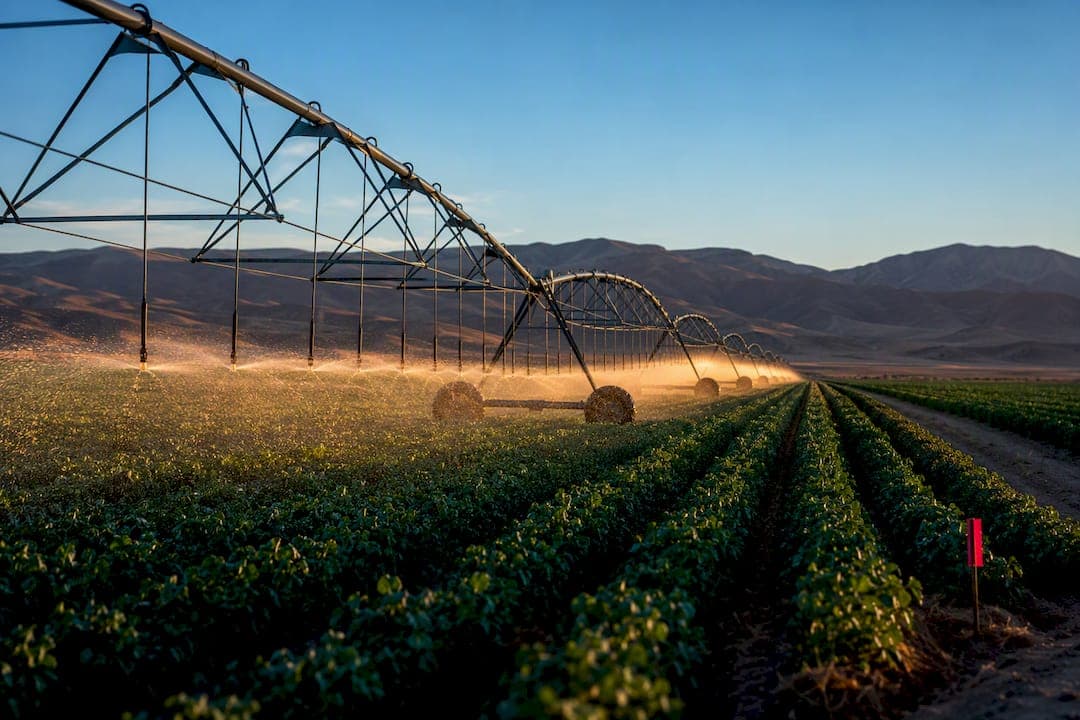
On a farm scale, center pivot systems (those long, wheeled arms you see tracing circles into cropland from an airplane window) cover large acreage with minimal labor, while traveling guns work well on irregular fields where a fixed pivot doesn't fit.
A few practical distinctions worth knowing:
- Pop-up spray heads suit small zones and ground cover under 15 feet in radius.
- Rotor nozzles cover 25 to 50 feet and apply water at a slower rate, reducing runoff on clay soils.
- Multi-stream rotating nozzles combine rotor-like precision with spray-head simplicity.
- Center pivots and traveling guns fit row crops and pasture where labor for manual irrigation isn't practical.
Fewer than 10% of the roughly 28 million in-ground sprinkler systems in the United States currently use smart controllers, and EPA estimates suggest widespread adoption could save hundreds of billions of gallons annually, per USU Extension research. Newer WaterSense-labeled sprinkler bodies and nozzles also cut waste simply through better spray uniformity and pressure regulation, independent of any smart controller.
Surface Irrigation: Furrow, Flood, and Basin Methods
Surface irrigation is the oldest of the irrigation system types, and it works exactly how it sounds: water flows across the field by gravity, no pipes or pressure required. Furrow irrigation channels water down shallow trenches between crop rows. Flood irrigation covers the entire field surface. Basin or terraced irrigation contains water within leveed sections, often used on sloped orchard or rice land.
Soil type controls how well any of these perform. Sandy soils drain too fast and waste water through deep percolation, while heavy clay can pond and drown roots if grading isn't precise.
- Efficiency runs around 50%, with the rest lost to runoff, evaporation, and uneven infiltration.
- Erosion and nutrient runoff are common on sloped or poorly graded fields.
- Row crops like alfalfa, cotton, and rice tolerate surface methods better than high-value produce.
- Hardware costs are low since there's no pump or pipe network, but water bills run higher over time.
Subsurface Irrigation and Subirrigation: Watering From Below
Subsurface drip buries emitter lines a few inches to a foot below grade, delivering water straight to the root zone with almost no surface evaporation. Subirrigation works differently: it raises the water table itself, often through a network of buried pipes or tiles, so roots draw moisture upward rather than water being pushed down to them.
Both methods protect the system from foot traffic, mowing equipment, and UV exposure, but they share one downside: you can't see a leak or a clog forming, so monitoring depends on soil moisture readings or watching plant stress patterns.
- Subsurface drip suits row crops, vineyards, and high-value specialty agriculture.
- Subirrigation is common in golf course turf and nurseries with engineered drainage or tiling systems.
- Both reduce weed germination since the surface stays dry.
- Repair requires locating buried lines, which usually means professional equipment.
Residential Setups That Actually Work
Most home landscapes don't need agricultural-grade equipment. They need the right combination of soaker hoses, pop-up sprinklers, and micro-sprays matched to what's actually growing in each zone.
- Group plants by water need first. Turf, shrubs, and perennial beds each drink differently, so university extension guidance recommends separate valves for turf and non-turf zones, called hydrozones, to prevent overwatering one while starving the other.
- Retrofit before you replace. Pop-up-to-drip adapter kits convert existing sprinkler canisters into drip supply points, cutting wasted spray in garden beds without repiping the whole yard, according to USU's backyard drip guide.
- Go hybrid when zones differ. A lawn on rotors and a perennial border on drip, run off the same controller, is often the most practical setup for a typical quarter-acre lot.
Smart Controllers and Sensors: The Efficiency Multiplier
A weather-based irrigation controller (WBIC) adjusts run times using local evapotranspiration data pulled from weather stations or online forecasts. A soil moisture sensor (SMS) instead reads actual moisture at the root zone and skips a cycle entirely when the ground is still wet. Both approaches beat a fixed clock timer, which waters on schedule whether the lawn needs it or not.
EPA WaterSense certifies both controller types for performance, and installing one can save a typical home thousands of gallons a year by eliminating unnecessary cycles.
A Utah State University field study found smart controllers cut water use by 30% to 63% compared with standard clock-based timers, with some modern systems saving up to roughly 15,000 gallons annually depending on lot size and climate, per USU Extension. Several state and utility rebate programs now subsidize the upgrade.
- Place soil moisture sensors at average root depth for the dominant plant type in that zone, not at the surface.
- Recalibrate WBICs seasonally since evapotranspiration rates shift dramatically between July and October.
- Don't rely on a single sensor for a yard with mixed sun and shade exposure.
Choosing the Right System for Your Site
Before picking among irrigation system types, walk the property with three questions in mind: how fast does water soak into this soil, how much slope am I working with, and what's my actual water source and pressure?
- Sandy soil drains fast and often needs shorter, more frequent drip cycles rather than long sprinkler runs.
- Heavy clay soil resists sprinkler application rates above 0.3 inches per hour, causing runoff before absorption.
- Steep slopes favor drip with pressure-compensating emitters over surface methods, which erode on grade.
- Municipal water pressure supports most residential drip and sprinkler setups; well water may need a booster pump.
- Mixed plantings (turf plus shrubs plus beds) almost always need more than one irrigation method on separate zones.
Selection ultimately comes down to matching method to crop, soil, slope, water supply, and economics together, not any single factor in isolation, according to USDA/NRCS. A tool like Veete lets you sketch a layout and get live pricing before committing to a design, which helps when comparing drip versus sprinkler costs for the same yard.
Misjudging infiltration rate on a mixed lot is the single most common cause of dead patches and soggy corners.*
Maintenance: Keeping Any System Running
- Flush lines and check filters monthly during the growing season to catch clogging before it starves emitters downstream.
- Inspect emitters and sprinkler heads each spring for cracked nozzles, tilted heads, or drip lines chewed by rodents.
- Winterize before the first freeze by blowing out lines with compressed air in colder climates to prevent burst pipes.
- Troubleshoot in order: check system pressure first, then flush the mains, then inspect individual emitters or heads. Most "dead zone" problems trace back to one of those three.
- Call a professional for chronic clogging. Persistent algae or mineral buildup usually means backflushing or chemical treatment beyond a basic filter cleaning.
What Installers Know That Manuals Don't Tell You
The efficiency numbers get all the attention, but they assume a system was designed correctly in the first place. A 90%-efficient drip layout with the wrong emitter spacing for the soil type performs worse than a well-designed sprinkler zone. That's the part most buying guides skip.
Grading and irrigation are inseparable decisions, not sequential ones. If the yard hasn't been graded to shed water away from the foundation and toward planting beds, even the best-chosen irrigation method fights the site instead of working with it. Coordinating earthwork, hardscape, and irrigation timelines under one crew avoids the common scenario where a patio gets poured before anyone maps out where the sprinkler heads need to sit.
The honest take: most residential failures aren't a bad choice between drip and sprinkler. They're a good choice installed on bad grading.
— Jake
Get Your Irrigation System Designed and Installed Right
Irrigation and sprinkler system design and installation done alongside grading, hardscape, and landscaping work helps ensure a system performs well once installed. Coordinated scheduling prevents gaps between yard grading and irrigation line installation, avoiding finger-pointing if a zone drains poorly.
Irrigation and sprinkler system installations typically run $3,000 to $8,000 depending on yard size, zone count, and controller type. If you're weighing drip against sprinkler for a Utah property, or planning a full landscape refresh that includes xeriscaping alongside irrigation, request a free estimate and get a system designed around your actual soil and slope instead of a generic layout.
Sources
- Drip irrigation for agricultural producers (WSU Extension)
- EPA WaterSense: soil moisture-based irrigation controllers
- Reducing residential landscape water use in Utah: technologies and strategies (USU)
- Selecting an irrigation system (USDA/NRCS)
- The do-it-yourself guide to backyard drip irrigation (USU extension)
FAQ
What Are the Four Main Types of Irrigation Systems?
The four main irrigation system types are surface (furrow, flood, and basin), sprinkler (pop-up, rotor, center pivot, and traveling gun), drip or microirrigation (surface and subsurface), and subirrigation, which raises the water table to reach roots directly, according to USDA. Each fits different soil, slope, and crop conditions.
What Are the Three Main Types of Irrigation?
Many agricultural references group irrigation into three primary categories: surface, sprinkler, and micro/drip, treating subirrigation as a specialized fourth method used mainly in specialty crops and turf, per USDA. The distinction usually depends on whether a source separates root-zone subirrigation from surface-applied methods.
What Is the Best Type of Irrigation System?
Drip irrigation is generally the most water-efficient option, running about 90% efficiency compared with roughly 70% for sprinklers and 50% for surface methods, according to WSU Extension. The "best" system still depends on your soil, slope, water source, and plant type, since drip requires more filtration and design care than a basic sprinkler zone.
What Are the Four Traditional Methods of Irrigation?
The traditional, pre-modern methods are furrow, flood, basin (or terraced), and manual or bucket irrigation, all relying on gravity rather than pumps or pressurized lines. These surface methods still see use today on row crops and orchards where hardware costs need to stay low.
How Much Does a Residential Irrigation System Cost?
A professionally installed residential irrigation and sprinkler system typically costs $3,000 to $8,000, depending on yard size, zone count, and whether the design includes drip, sprinkler, or a hybrid layout. DIY retrofit kits for small beds cost considerably less but don't cover full-yard zoning or controller integration.