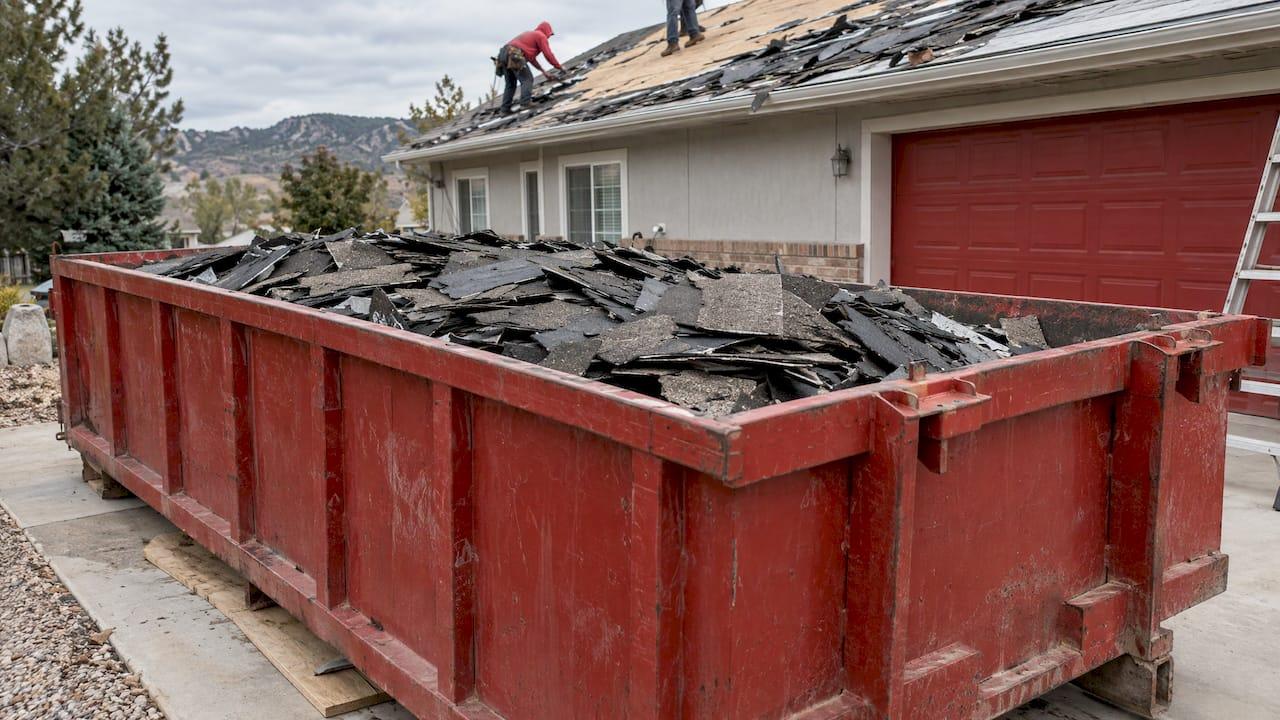
For most single-layer home tear-offs, a 10- to 20-yard roll-off dumpster is the right choice, and weight, not space, is what decides the size. Asphalt shingles are dense. A bin that looks half empty can already be at its tonnage limit. Below you will find the size chart by roof area, the loading rules that keep a bin legal to haul, and a straight comparison with a dump trailer.
TL;DR
- Size by roof squares (1 square = 100 sq ft of roof) and number of layers. A second layer roughly doubles the weight.
- One manufacturer's chart puts a 15-square 3-tab roof in a 10-yard bin and a 25-square laminate roof in a 20-yard bin. Roofs of 35 squares or more may need two bins.
- Load shingles flat, spread them evenly and keep them below the top edge. Overweight or overfilled bins can't be hauled.
- A dump trailer or pickup rarely carries a full tear-off in one trip. A roll-off bin at the eave is usually the faster, simpler option.
- Check the weight allowance and the placement rules in your city before the bin is delivered.
Table of Contents
- Why weight decides the size
- Count your roof squares first
- Dumpster size by roof area
- What can go in the bin with the shingles
- How to load a shingle dumpster
- Dumpster or dump trailer: which one fits a tear-off
- What disposal costs
- Questions to settle before the bin arrives
- Our perspective on shingle dumpsters
- Dumpster rental from A to Z Construction
- FAQ
- Sources
Why weight decides the size
Most people shop for a dumpster by cubic yards. That works for furniture and drywall. It doesn't work for shingles.
The EPA's standard conversion table lists loose asphalt shingles at 418.5 pounds per cubic yard. A 10-yard container filled level with loose shingles would therefore come in well above 4,000 pounds. Dumpster companies also publish a tonnage allowance with every size. IKO notes that in most of North America, state or provincial rules require weight limits on containers so they are safe on the road, so you generally can't fill one to the brim with asphalt shingles.
So you are picking two numbers: the volume the debris takes up and the weight the bin is allowed to carry. The heavier of the two sets your size.
Count your roof squares first
Roofers measure in squares. One square covers 100 square feet of roof surface, so a roof with 2,000 square feet of surface is 20 squares. Measure the roof surface, not the footprint of the house. Pitch, dormers and additions add area. If you want a walk-through of the method, see this guide to measuring your roof size before you order. Your roofing contractor's estimate will also list the number of squares, so ask for it.
Then note three things:
- Shingle type. 3-tab shingles are lighter than laminate (architectural) shingles, and premium shingles are heavier still.
- Layers. Many older roofs carry two layers. Every layer you strip goes in the bin.
- Extras. Underlayment, flashing, ridge caps, vents and any rotten decking add weight and volume.
Dumpster size by roof area
IKO's 2023 sizing chart is the clearest published example that ties roof area, shingle type and bin size together. Here is how its figures read for single-layer tear-offs:
| Roof size | Shingle type | Estimated weight | Dumpster size |
|---|---|---|---|
| 15 squares (1,500 sq ft) | 3-tab | 3,000 lbs | 10-yard |
| 15 squares (1,500 sq ft) | Laminate | 3,600 lbs | 15-yard |
| 25 squares (2,500 sq ft) | 3-tab | 5,000 lbs | 20-yard |
| 25 squares (2,500 sq ft) | Laminate | 6,000 lbs | 20-yard |
| 25 squares (2,500 sq ft) | Premium | 7,500 lbs | 25-yard |
| 35+ squares (3,500+ sq ft) | Laminate or premium | Over 8,000 lbs | Multiple dumpsters |
Source for every row: IKO's dumpster size chart for roofing. Its weight allowances for each bin were 4,000 lbs for a 10- or 15-yard, 6,000 lbs for a 20-yard and 8,000 lbs for a 25-yard.
Treat this as a planning range. Weights per square vary by brand and product, and your hauler's own tonnage allowance is what counts at the scale.
What a second layer does
A second layer doubles the weight of the shingles. A roof that fits a 15-yard bin with one layer can need a 30-yard bin, or a second haul, with two layers. If you don't know how many layers are on the roof, ask your roofer to check at the eave or a vent before you book.

Rule-of-thumb sizing
These are quick checks for a typical house with a single layer:
- Small roof, under about 15 squares: a 10-yard bin if the shingles are 3-tab, a 15-yard if they are laminate.
- Average two-story or ranch roof, 20 to 25 squares: a 20-yard bin.
- Large or complex roof, 30 squares and up, or two layers: plan a larger container or a scheduled swap-out so a full bin is hauled away and an empty one is set.
If you are between two sizes, go up. The price gap between neighboring sizes is usually smaller than the cost of an extra haul. Our guide to how dumpster sizes compare shows the dimensions, and our sizing guide for remodel projects covers jobs where shingles are only part of the debris.
What can go in the bin with the shingles
A tear-off makes more than shingles. Roofing felt, underlayment, flashing, ridge caps, roof vents and old plywood decking normally ride in the same bin. Ask your hauler to confirm the list, because accepted materials differ by provider and disposal site.
Things to keep out:
- Liquid or hot-tar roofing products and solvents. These are hazardous and need separate disposal.
- Shingles that contain asbestos. Older homes can have asbestos-containing roofing materials, and that material needs special handling and an approved facility. If your home is old, ask a qualified testing professional before the work starts, and tell your roofer and hauler.
- Paint, batteries, chemicals and other items on the prohibited list. Our page on what items are prohibited in dumpsters lists the usual ones.
Some disposal facilities ban asbestos shingles outright. The town of Middleborough, Massachusetts, for example, accepts clean shingles as construction and demolition debris but bans asbestos shingles entirely. Your local rules will differ, so ask your city or county solid waste office.
How to load a shingle dumpster
Good loading gets more roofing into the bin and keeps the hauler's truck legal on the road.
- Place the bin close to the eave. The closer it sits to the work, the more your crew can drop straight in, and the less debris lands on the lawn. Mark where the truck needs to reach and keep the swing-out of the roof edge clear.
- Protect the surface. Boards under the bin's wheels keep the weight off a driveway or lawn. Ask the driver where the bin should rest.
- Lay shingles flat. Stacked flat, they pack tightly. On their side they leave gaps.
- Spread the load. Fill the floor from end to end instead of piling at the door. Even loads are safer for the truck to lift and carry.
- Stay below the top edge. Nothing should stick out above the rim. Overfilled bins can't be hauled until you take material out.
- Keep a tarp ready. Wind pulls loose debris out of an open bin, and any nails that land in the yard are your problem. A magnetic sweep of the lawn after the job is worth the ten minutes.
Crew size and pace matter too. A bin that sits full for a few days costs you rental time you don't need. Our guide on how long you can keep a dumpster explains typical rental periods, and a roofing job often fits a short one.
Dumpster or dump trailer: which one fits a tear-off
A dump trailer or a pickup truck makes sense for a patch repair or a small shed roof. For a whole-house tear-off, the weight works against you.
Homedit's disposal guide puts a single layer of asphalt shingles on an average 1,700 sq ft roof at about 4,000 pounds. That is more than the 2-ton capacity of most junk-removal trucks, so a smaller vehicle needs several trips. Each trip means loading, driving, waiting at a scale, unloading and coming back.
| Roll-off dumpster | Dump trailer or pickup | |
|---|---|---|
| Trips for a typical tear-off | One delivery and one pickup | Often several round trips |
| Where the crew drops debris | Directly from the roof edge | Staged, then loaded |
| Who hauls | The rental company | You or your crew |
| Disposal site paperwork | Handled by the hauler | You deal with scale tickets and site rules |
| Best for | Full tear-offs, two-layer roofs, big jobs | Small repairs, a few squares, one-off cleanup |
There is also a rule-following side. Some cities restrict who can bring roofing debris to a landfill. League City, Texas, for instance, says residents need a roll-off dumpster or a trip to a Type IV landfill, and the facility requires proof of residency and limits loads to a standard pickup bed height. Rules like these are the reason a dumpster is the simpler route for most homeowners.
A bin also keeps the job moving. The crew works without stopping to haul, and your roof is open to weather for fewer days.
What disposal costs
Two costs show up: the rental and the disposal itself. Rental prices change with your city, the size, the rental period and the tonnage included, so get a written quote that spells out the weight allowance and the overage rate. Our dumpster rental cost guide walks through what goes into the price.
If you haul it yourself, landfill rates are per ton. Homedit reports about $40 per ton at most landfills, but local rates vary widely. Middleborough, Massachusetts, listed $141.31 per ton with a half-ton minimum of $70.66 as of November 2023. Call your local facility for its current rate.
Recycling can lower the bill
Asphalt shingles can be recycled, usually ground into asphalt paving. Homedit notes that Owens Corning runs a shingle recycling program, and that the Shingle Recycling Association website can help you find construction and demolition recycling centers by state. Ask your hauler whether clean shingle loads are routed to a recycler in your area.
Questions to settle before the bin arrives
- How many squares and layers? Get both numbers from your roofer.
- What is the weight allowance, and what is the overage rate? Write it down.
- Where will the bin sit? A driveway is simplest. If it must go on the street, ask your city whether a permit is needed.
- Is the home old enough to raise asbestos questions? Settle it before demolition begins.
- When does your crew start? Have the bin delivered the day before so work doesn't stall.
Our perspective on shingle dumpsters
Most shingle bin problems we see come from picking by yard size alone. Shingles weigh far more than their volume suggests, so we start every conversation with the roof: how many squares, how many layers, which shingle. Then we match the bin to the weight.
Our approach to a project is to keep the pieces together. We run residential and construction dumpster rental alongside our concrete, remodeling, earthwork and hardscape work, with an in-house crew and one point of contact. That means debris planning happens at the estimate, not on the day the truck shows up with the wrong bin.
If you are between sizes, we would rather you go up than pay for a second haul. Tell us the roof size and layers and we will help you choose.
Jake
Dumpster rental from A to Z Construction
A to Z Construction is a licensed general contractor in Cedar City, Utah, and we offer dumpster rental for homeowners and for construction jobs. If a roof tear-off, remodel or yard project is coming up, you can look at our dumpster rental in Utah and our residential bins in 10, 15 and 20-yard sizes. Tell us your roof squares, layers and shingle type and we will help match a size.
Planning more than a roof? We handle concrete, hardscape, fencing, landscaping and remodeling with one crew, so you can start at our main page and tell us what you are building.
FAQ
What size dumpster do I need for roofing shingles?
For a single layer, a 10-yard bin fits small roofs of about 15 squares with 3-tab shingles, and a 20-yard is the usual size for 20 to 25 squares. Laminate shingles are heavier, so move up a size on the same roof. A second layer can double the weight, which may mean a bigger bin or two hauls.
Can I put roofing shingles in a regular dumpster?
Yes. Shingles go in a roll-off dumpster as long as you stay within the weight allowance and keep the load below the top edge. Keep out hazardous materials like liquid roofing products, solvents and asbestos-containing shingles. Confirm the accepted list with your hauler.
Is it cheaper to rent a dumpster or take shingles to the dump?
A landfill charges by the ton, with typical rates cited around $40 per ton, but you carry the cost of trucks, trips and your time. A tear-off often exceeds what a pickup can carry in a single load, so the savings shrink fast. Compare a written dumpster quote against your local landfill rate and your number of trips.
How do I dispose of old roof shingles responsibly?
Ask your hauler or local solid waste office whether clean asphalt shingles go to a recycling center, since many are ground into paving material. If you suspect asbestos in an older roof, get it tested by a qualified professional before removal.
Sources
- IKO: Proper Dumpster Size for Roofing Shingles Disposal
- EPA: Standard Volume-to-Weight Conversion Factors
- Homedit: Shingle Disposal Guide
- Town of Middleborough: Brook Street Landfill Information
- Guide to roof size and re-roofing