
A licensed contractor gives you insurance coverage, bonding, permit authority, and verified competence that an unlicensed operator legally cannot offer. State bodies like the Washington L&I contractor registration system and recovery funds tracked by the Minnesota Department of Labor & Industry exist specifically to back that up. For homeowners, this means real financial recourse if a project goes wrong. For contractors, it opens the door to bigger jobs and higher trust, the kind some contractors have built a strong reputation based on hundreds of completed projects.
TL;DR:
- Licensed contractors are required to carry insurance and bonds, which provide homeowners with financial protection and recourse if issues arise.
- Verifying a license involves checking the official state portal, confirming active insurance and bonds, and ensuring the contractor has the necessary permits for the work.
- Hiring unlicensed contractors risks insurance denial, voided contracts, and future resale or inspection problems due to unpermitted or non-compliant work.
- State licensing requirements vary, with some states combining licensing and bonding rules, making it essential to verify specifics at the local jurisdiction level.
- Licensing enables contractors to bid on larger jobs and signals their competence, making it worth paying a premium for projects involving permits, structural changes, or resale impact.
Table of Contents
- What Is a Contractor License, and How Is It Different From Business Registration?
- What Are the Core Licensed Contractor Benefits for Homeowners and Contractors?
- What Happens When You Hire an Unlicensed Contractor?
- How Do You Verify a Contractor's License Before Hiring?
- How Does an Integrated Licensed Contractor Reduce Homeowner Risk in Practice?
- What Legal Protections Does Licensing Give Contractors Themselves?
- How Does Licensing Differ From State to State?
- How Do You Get and Keep a Contractor License?
- What Financial Advantages Come From Being a Licensed Contractor?
- When Is It Worth Paying More for a Licensed Contractor?
- Get a Licensed Contractor's Protections on Your Next Project
- Sources
- FAQ
What Is a Contractor License, and How Is It Different From Business Registration?
A contractor license is a state-issued credential that certifies someone has passed a trade exam, carries the required insurance, and posted a financial guarantee before touching your property. Business registration is something else entirely. It's a filing with the Secretary of State that lets someone legally collect payment. It says nothing about whether they know how to frame a wall or wire a panel safely. Confusing the two is one of the most common mistakes homeowners make, since a business license number on an invoice can look official without meaning the person holding it passed any competence test at all.
Licensing requirements vary by state, but most programs share a common backbone:
- A trade or business exam covering codes, safety, and contract law
- Background and financial checks on the business owner or qualifying party
- A surety bond filed with the state licensing board
- Proof of liability insurance and, in most states, workers' compensation coverage
- Continuing education to keep the license active
Some counties and cities layer on additional permit or registration rules on top of the state requirement, so a license valid in one jurisdiction doesn't automatically clear you to pull permits in another.
What Are the Core Licensed Contractor Benefits for Homeowners and Contractors?
Licensing benefits both sides of the contract, but the mechanics differ. For homeowners, it's about risk transfer. For contractors, it's about market access.
Insurance and workers' compensation protect you from two different disasters. If a worker gets hurt on your property and the contractor is uninsured, you can end up covering medical costs yourself. The California Contractors State License Board is blunt about this: verified insurance is one of the first things a homeowner should check, because policies sometimes carry construction-defect exclusions that leave gaps even when coverage exists on paper.
Surety bonds give you a formal claims path when a contractor walks off a job or stiffs a subcontractor. Washington State requires general contractors to carry a $30,000 bond, with specialty contractors at $15,000, a threshold that took effect in July 2024. That bond doesn't cover every possible loss, but it's a concrete number you can point to before you sign anything.
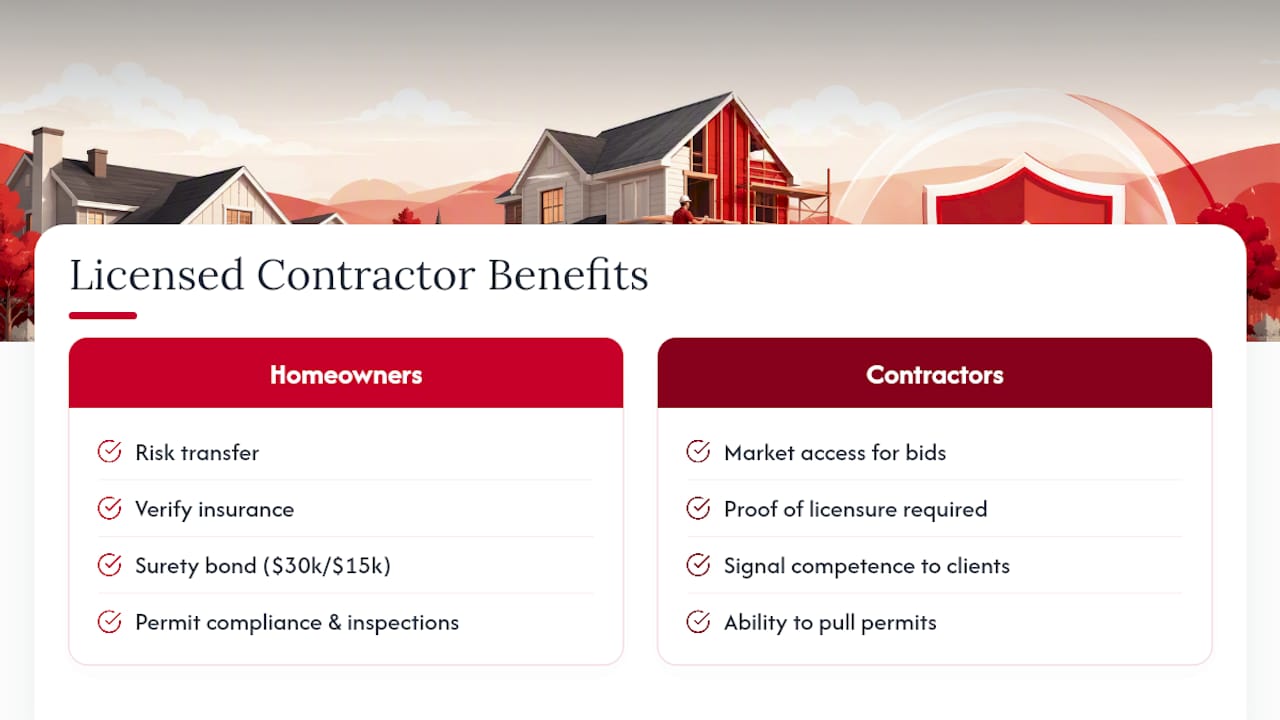
Permit authority matters more than most homeowners realize. Licensed contractors can legally pull permits and schedule the inspections that keep a project code-compliant. Unpermitted work can complicate a home sale, void parts of your insurance policy, and in some jurisdictions force you to tear out finished work to bring it up to code.
Contractor Recovery Funds act as a last-resort safety net in many states. According to Minnesota's Department of Labor & Industry, hiring a licensed contractor gives you access to a Contractor Recovery Fund if you win a judgment against the contractor and can't collect. Claim caps typically run between $20,000 and $75,000 per claim. Most states require a civil judgment before you can file. It's a backstop, not a substitute for due diligence.
Statistic Callout: Washington State's bond requirement jumped to $30,000 for general contractors and $15,000 for specialty contractors as of July 2024, a direct financial cushion homeowners can draw on if a licensed contractor fails to perform.
For contractors, licensing is the ticket to bidding on larger commercial and municipal contracts, many of which require proof of licensure before you can even submit a bid. It also signals to clients that you've cleared a real bar of competence, not just paid a filing fee.
What Happens When You Hire an Unlicensed Contractor?
The risks aren't hypothetical. They show up in insurance denials, voided contracts, and lawsuits that homeowners didn't see coming.
- Insurance gaps appear immediately. If an unlicensed worker is hurt on your property, some state rules can classify you as the "employer" by default, which means you could be personally liable for medical costs and lost wages, according to a legal analysis of unlicensed contracting penalties.
- Contracts can become void or unenforceable. Courts in several states have ordered unlicensed contractors to return money already paid, a remedy called disgorgement, which sounds good for the homeowner until you realize the project is now unfinished and the money may be hard to actually collect.
- Insurance claims get denied. If your homeowner's policy discovers unpermitted or unlicensed work caused the damage you're claiming, the insurer can refuse to pay.
- Resale and title problems surface later. Unpermitted additions or remodels can stall a home sale or force a price renegotiation when a buyer's inspector finds the work.
Watch for these red flags before you sign anything: a contractor who asks you to pull the permits yourself, a bid with no license number printed on it, or a request for an unusually large upfront deposit.
Pro Tip: If a contractor tells you pulling your own permit will "save time," ask why a licensed professional would rather you take on that legal responsibility instead of handling it themselves.
How Do You Verify a Contractor's License Before Hiring?
Verification takes fifteen minutes and can save you tens of thousands of dollars. Start with the state licensing portal, not the business registry. Boards like the California CSLB, Washington L&I, and Minnesota DLI all maintain public license lookup tools that show status, bond information, and any disciplinary history.
- Search the contractor's license number on the state board's official portal, not a link the contractor sends you
- Call the insurer directly to confirm the certificate of insurance and workers' compensation coverage are active, not expired
- Require the license number to appear on every written bid and contract
- Clarify in writing who is responsible for pulling permits, and confirm it isn't you
- Ask for three references from projects completed in the last two years, plus a payment schedule with legal caps on deposits
- Know how to reach your state's Contractor Recovery Fund and what a claim requires before you need it
Statistic Callout: Recovery fund claims commonly cap out between $20,000 and $75,000 per claim, and most states require a civil judgment against the contractor before you can file. Treat it as a backup plan, not your primary protection.
Our guide to finding a general contractor you can trust walks through this vetting process in more detail if you want a deeper checklist.
How Does an Integrated Licensed Contractor Reduce Homeowner Risk in Practice?
The paperwork side of licensing is only half the story. The other half is coordination, and that's where a lot of projects quietly go sideways.
When one licensed contractor manages every phase of a project, from permit application to final inspection, the homeowner doesn't have to chase down separate subcontractors for concrete, masonry, and landscaping, then hope their schedules line up. A to Z Construction handles permits, insurance verification, and inspection scheduling internally rather than farming it out piecemeal:
- One licensed point of contact tracks permit status instead of the homeowner juggling multiple applications
- Insurance and workers' comp coverage apply across every trade on site, not just whichever sub showed up that day
- Inspection scheduling happens in sequence with the work, cutting the dead time that comes from mismatched subcontractor calendars
- A single project record makes it easier to confirm what's licensed, permitted, and inspected when you sell the home later
If you're curious what that permit coordination looks like locally, our breakdown of getting Cedar City building permits faster shows the workflow in practice.
What Legal Protections Does Licensing Give Contractors Themselves?
Licensing isn't just a homeowner safeguard. It changes a contractor's legal exposure, too, usually for the better.
A licensed contractor operating as an LLC or corporation gets a layer of liability separation that an unlicensed sole operator doesn't have in the same way, since courts and insurers treat licensed, properly structured businesses as legitimate commercial entities rather than informal arrangements. That distinction matters when a dispute ends up in court: a licensed contractor can point to a paper trail of permits, inspections, and bonded work that shows good-faith compliance, while an unlicensed operator often has none of that to stand on.
Licensing boards also function as a support system, not just an enforcement arm. Contractors can escalate payment disputes, file complaints against difficult clients, or seek guidance on code interpretation through the same board that issued their license. That's a resource unlicensed contractors simply don't have access to, since they aren't part of the system in the first place.
There's a flip side worth naming honestly: licensing boards also investigate complaints against contractors, and a pattern of violations can lead to suspension or revocation. That accountability cuts both ways, but it's also part of why licensed status carries weight with clients. A license that can be taken away is a license that means something. Unlicensed work carries none of that oversight, which sounds like freedom until something goes wrong and there's no board, no bond, and no formal process to fall back on.
How Does Licensing Differ From State to State?
Licensing isn't a single national standard. It's a patchwork, and the differences change what "licensed" actually guarantees you.
Some states, like California, license contractors at the state level through a single board and require classification by trade specialty. Others, like Washington, combine registration with the bond requirements mentioned earlier, and set different bond amounts for general versus specialty contractors. Hawaii's licensing board pairs its requirements with an active Recovery Fund program that homeowners can draw on after a judgment, similar in structure to Minnesota's system but with its own claim procedures.
A handful of states don't require state-level general contractor licensing at all and instead leave it to counties and municipalities, which means the protections you're relying on can vary dramatically depending on the specific jurisdiction rather than the state as a whole. This is exactly why checking the actual license number on the actual state or county portal matters more than assuming "licensed" means the same thing everywhere.
Recovery fund caps differ too. Some states cap individual claims in the tens of thousands, others structure it as an aggregate cap per contractor across multiple claims. None of this is a reason to skip hiring a licensed contractor. It's a reason to check your specific state's rules rather than assuming they match what a neighbor or a blog post from a different state described.
How Do You Get and Keep a Contractor License?
Getting licensed generally follows a predictable sequence: pass a trade exam covering codes and business law, submit proof of experience, post the required bond, secure liability and workers' compensation insurance, then file the application with the state board along with any fees.

Keeping the license active is where a lot of contractors slip up. Most states require continuing education credits on a renewal cycle, typically every one to two years, covering updates to building codes, safety regulations, or business practices. Miss the renewal window or let insurance lapse, and the license can go inactive even though nothing on the surface looks different to a client reading an old bid sheet.
Bond and insurance renewals run on their own separate clocks from the license itself, which means a contractor can have an active license number while carrying an expired bond if they aren't staying on top of every piece independently. This is exactly why homeowner verification should check bond and insurance status directly with the issuer, not just confirm the license number shows up as active on a state lookup tool.
For contractors, the ongoing requirement is a feature, not a burden. It keeps the credential meaningful. A license that never required renewal or updated training would carry a lot less weight with clients and lenders than one that demonstrably tracks current codes and safety standards.
What Financial Advantages Come From Being a Licensed Contractor?
Licensing pays for itself in ways that show up on the bottom line, not just in legal protection.
Bonded, licensed contractors qualify to bid on municipal, commercial, and larger residential contracts that require proof of licensure as a condition of bidding at all. That's a category of work unlicensed operators are locked out of entirely, regardless of how good their craftsmanship might be.
Insurance rates often work in a licensed contractor's favor too, since insurers underwrite licensed, bonded businesses differently than informal operations with no verified safety record. A construction lending guide on bond and financing best practices notes that lenders and insurers alike treat verified licensing and bonding as a baseline signal of financial reliability, which can translate into better terms on both financing and coverage.
Client trust is the less quantifiable but arguably bigger advantage. A homeowner comparing bids will often pay more for the contractor who can show a license number, active insurance, and a bond, because that combination lowers the homeowner's own risk. Licensing effectively lets a contractor charge for reduced risk, not just labor and materials. Coordinating multiple trades under one licensed roof, the way A to Z Construction structures its projects, adds another layer of that trust: fewer handoffs, fewer subcontractor gaps, and one bonded entity accountable for the whole job.
When Is It Worth Paying More for a Licensed Contractor?
Pay for a licensed contractor without hesitation on anything involving permits, structural changes, or work that affects resale value. That's where the gap between licensed and unlicensed work shows up years later, usually during a home inspection or an insurance claim you didn't see coming.
Smaller, cosmetic jobs sometimes justify hiring a registered specialty contractor instead, as long as you still verify their credentials rather than taking their word for it. The line isn't really about job size. It's about what happens if it goes wrong.
One-sentence rule: if the job needs a permit, touches your home's structure, or could affect what you're liable for later, verify the license before anything else.
— Jake
Get a Licensed Contractor's Protections on Your Next Project
Some licensed contractors provide homeowners with protections including insurance coverage, bonding, permit authority, and a single licensed team accountable for project phases rather than multiple subcontractors. An integrated model can reduce the need for homeowners to manage separate insurance certificates for different trades by having one licensed general contractor coordinate the entire project.

Whether you're planning a structural remodel or an outdoor hardscape project, some licensed contractors handle permit filing, confirm insurance and bond status upfront, and provide a single point of contact from estimate to walkthrough. If your project involves structural changes, start with a look at structural remodeling services. For patios, retaining walls, or outdoor kitchens, request a free hardscape estimate and get a licensed, bonded team on your project before the first permit application goes in.
Sources
- Washington State Department of Labor & Industries — Register as a contractor
- Minnesota Department of Labor & Industry — Tips for hiring a contractor
- LegalClarity — Can a contractor work without a license? Laws and penalties
FAQ
What Benefits Do You Get as a Licensed Contractor?
Licensed contractors gain access to larger commercial and municipal bids, often qualify for better insurance rates, and gain credibility with clients that translates directly into more work and higher trust in competitive bidding situations.
Which Contractor License Tends to Pay the Most?
Specialty licenses in high-demand trades like electrical, plumbing, and structural work typically command higher project values than general handyman-level registrations, largely because those trades require more advanced testing and carry more liability.
What Are the Pros and Cons of Being a 1099 Contractor?
As an independent contractor, you control your schedule and can work with multiple clients, but you're also responsible for your own insurance, taxes, and licensing costs, none of which get subsidized by an employer the way a W2 position would.
How Much Does a General Contractor Make Per House?
Earnings per project vary enormously based on scope, region, and whether the contractor is managing the whole build or subcontracting pieces out, so there's no single reliable figure that applies across markets or project types.
Why Use a Licensed Contractor Instead of an Unlicensed One?
A licensed contractor carries insurance, posts a bond, and can legally pull permits, giving you financial recourse and code-compliant work that an unlicensed operator legally cannot offer, as outlined by the Minnesota DLI.