
Finding a reliable general contractor requires a systematic vetting process that covers credential verification, bid comparison, and contract review before you sign anything. Skip any of these steps, and you risk hiring someone who delivers shoddy work, blows your budget, or disappears mid-project. The industry term for this process is contractor due diligence, and 2026 best practices recommend allowing 2–4 weeks from initial contact to signed contract. That timeline gives you enough room to source candidates, verify licenses, collect written bids, and check references without rushing a decision that could cost you thousands.
How to find a general contractor: start with credentials
Verifying credentials is the first filter every homeowner should apply, and it goes well beyond a quick Google search. License and insurance verification signals professionalism, not just legal compliance. Contractors who skip proper licensing often also skip proper site management, communication, and cleanup.
Here is what to verify before you go any further:
- State contractor's license. Look up the contractor's license number on your state licensing board's online portal. Confirm the license is active, not suspended, and that it covers the type of work you need. A license valid for commercial work may not cover residential remodeling.
- General liability insurance. Ask for a certificate of insurance, then call the insurer listed on it. A certificate is a snapshot in time and can become outdated. Calling the insurer directly is the step most homeowners skip, and it is the one that prevents real liability.
- Workers' compensation insurance. If a worker gets injured on your property and the contractor carries no workers' comp, you could be held responsible. Verify this coverage the same way you verify general liability.
- Bonding. A surety bond provides a financial backstop if the contractor fails to complete the work or causes damage. It is not a substitute for insurance, but it adds a layer of protection.
Pro Tip: Ask the contractor for the insurer's name and policy number, then call the insurer yourself to confirm the policy is current. Never rely solely on the certificate they hand you.
Unlicensed contractors often underbid because they skip permits and proper materials. That savings disappears fast when a city inspector shuts down your project.
Where do you find reliable general contractor candidates?
The best source for finding a good general contractor is a personal referral from someone who hired that contractor within the last 24 months. Recent referrals are far more reliable than older ones because contractor quality, staffing, and ownership can change significantly over two or three years. Ask friends, family, and neighbors who completed similar projects recently, not just anyone who once had work done.
One referral source most homeowners overlook is the local building supply store. Suppliers see which contractors buy materials consistently, pay their accounts on time, and order quality products. Local supply stores carry insight on contractor reliability that no online review platform can replicate. Walk in, explain your project, and ask which contractors they see regularly and respect.
"The person behind the counter at your local lumber yard has watched dozens of contractors come and go. They know who pays their bills, who orders the right materials, and who disappears when a project gets complicated. That conversation is worth more than a hundred five-star reviews online."
Other sources worth using as supplements include trade associations like the National Association of Home Builders (NAHB), local builders' directories, and platforms like Houzz or Angi. Treat these as starting points, not final answers. Online platforms aggregate reviews but cannot verify the quality of every job listed.
One firm rule: never hire a contractor who shows up unsolicited after a storm or disaster. Storm chasers target vulnerable homeowners and often collect deposits before vanishing. Always initiate the search yourself.

How should you compare bids from different contractors?
Getting multiple written bids is the only way to make an informed decision. At least 3 written bids are recommended, but collecting more than 5 becomes counterproductive. Beyond 5, you spend more time managing the process than evaluating the results.
Follow these steps to compare bids accurately:
- Send the same written scope to every contractor. If each contractor bids on a different interpretation of your project, the numbers are not comparable. Write out your project scope in detail before you request a single quote.
- Require itemized written bids. Verbal estimates are unreliable and unenforceable. Every bid should break down scope, materials, labor, permits, and cleanup separately.
- Compare line items, not just totals. A low bid often omits demolition, permit fees, or cleanup costs rather than offering genuine savings. Low bids frequently skip scope items that mid-range bids include as standard.
- Ask each contractor to explain their bid. A contractor who cannot walk you through their numbers line by line is a contractor who does not fully understand the project.
- Evaluate payment schedules. A bid that demands 50% upfront is a warning sign. Payments should be tied to completed milestones, not calendar dates.
| Bid element | What to look for |
|---|---|
| Scope of work | Detailed description of every task, not a one-line summary |
| Materials | Specific brands, grades, or specs listed, not just "standard materials" |
| Permits | Explicitly included or excluded, with cost shown |
| Cleanup and disposal | Itemized, not assumed |
| Payment schedule | Milestone-based, with final holdback noted |
Pro Tip: When one bid comes in significantly lower than the others, ask the contractor to identify exactly which line items they excluded. The answer tells you whether the savings are real or just deferred costs.
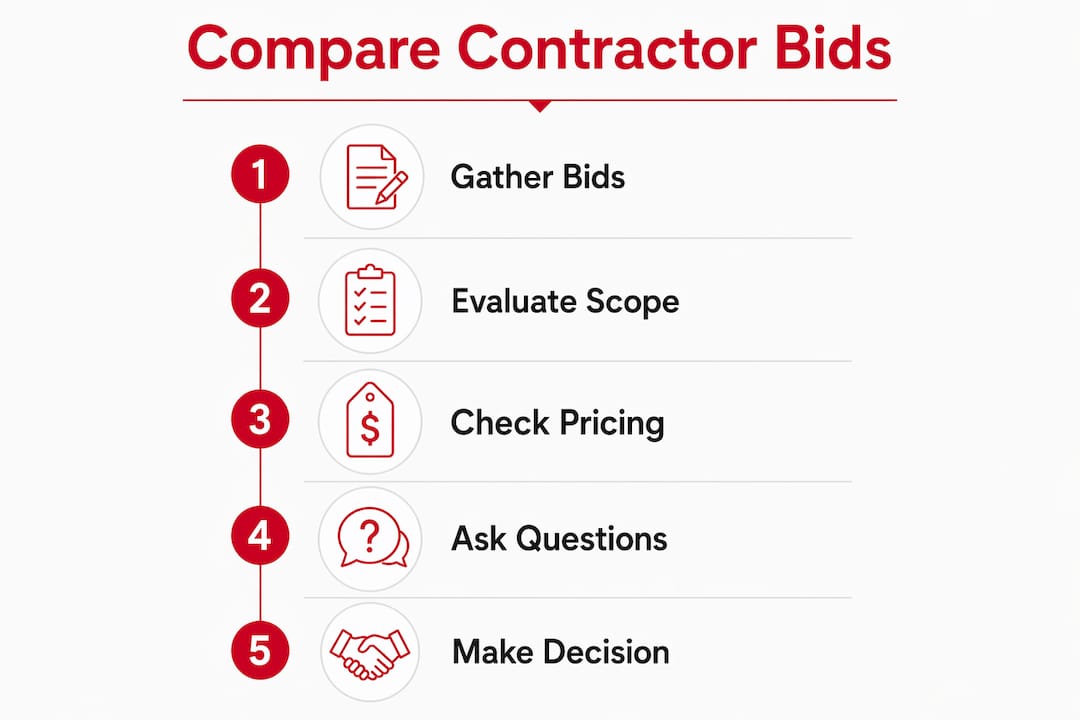
Different contractors interpret the same scope differently. That variation in interpretation is why the lowest number on paper rarely reflects the lowest actual cost to complete your project.
What should you ask when checking contractor references?
References are not a formality. They are your clearest window into how a contractor actually performs on the job. Ask for 3–5 references from projects completed within the last 12–24 months that are similar in type and scale to yours. References from similar recent projects give you the most accurate picture of what to expect.
When you call each reference, cover these points:
- Did the project finish on time? If not, what caused the delay, and how did the contractor handle it?
- Did the final cost match the original bid? If there were overruns, were they explained and documented through change orders?
- How was communication throughout the project? Did the contractor return calls promptly and keep you informed without being chased?
- Were there problems during the project? More importantly, how did the contractor solve them?
- Would you hire this contractor again? This single question cuts through polished answers and gets to the truth.
For a full list of questions to ask references, use a structured reference checklist so you cover the same ground with every contact.
Visiting a completed project or an active job site adds another layer of insight. A clean, organized job site reflects how a contractor manages your home. Repeated complaints about poor communication or missed deadlines across multiple references are disqualifying, not negotiable.
What contract terms protect you before work begins?
A signed, detailed contract is your primary legal protection. Never start a project based on a handshake or a verbal agreement. Every contract should include these elements:
- Scope of work. Written in plain language, covering every task the contractor is responsible for completing.
- Material specifications. Brand names, grades, and quantities where relevant, not vague references to "quality materials."
- Project timeline. Start date, key milestones, and expected completion date.
- Milestone-based payment schedule. Never pay more than 10–20% upfront. Tie each payment to a defined stage of completed work.
- Final holdback. Retain 10–15% of the total contract value until the project is fully complete and you are satisfied with the result.
- Change order process. Any scope change must be documented in writing and signed by both parties before work proceeds.
- Warranty terms. Know what the contractor guarantees and for how long.
- Permit responsibilities. The contract should state clearly who pulls permits and who pays for them.
Pro Tip: Never pay in cash. Pay by check or bank transfer so every payment is documented. If a contractor insists on cash only, walk away.
Vague contract language is not a minor issue. "Quality materials" and "timely completion" mean nothing in a dispute. Specificity protects you. If a contractor resists putting details in writing, that resistance tells you everything you need to know about how they will handle problems once work begins. Once you have a solid contract in place, managing your renovation project becomes far more predictable.
Key Takeaways
Hiring a trustworthy general contractor requires verifying credentials through official channels, collecting at least 3 itemized written bids, checking recent references, and protecting yourself with a detailed milestone-based contract before any work begins.
| Point | Details |
|---|---|
| Verify credentials officially | Confirm license status and call the insurer directly to check active coverage. |
| Use personal referrals first | Prioritize referrals from projects completed within the last 24 months. |
| Compare bids line by line | Low totals often hide missing scope items; compare inclusions, not just price. |
| Protect payments with milestones | Never pay more than 10–20% upfront; hold back 10–15% until final completion. |
| Get everything in writing | Vague contracts create disputes; require specific materials, timelines, and change order terms. |
What I have learned after watching hundreds of homeowners hire contractors
Most homeowners make the same mistake: they rush. They get one or two quotes, pick the contractor who seems friendly, and skip the reference calls because the project feels urgent. That urgency is almost always self-imposed, and it costs real money.
The homeowners I have seen come out ahead share one habit. They treat the selection process like a job interview, not a transaction. They ask hard questions, they call references, and they read the contract before signing it rather than after a problem surfaces. That investment of two or three extra weeks upfront saves weeks of stress and thousands of dollars on the back end.
One thing I tell every homeowner: trust your gut, but verify the facts behind it. If a contractor makes you feel confident, find out whether that confidence is earned. Call the insurer. Visit a past job site. Ask the reference the uncomfortable question about what went wrong. A contractor who has nothing to hide welcomes that scrutiny.
Local referrals and supply store contacts consistently outperform online platforms for finding reliable candidates. Online reviews are useful for spotting patterns, but they cannot tell you whether a contractor pays their suppliers on time or shows up when things get complicated. The people who work alongside contractors every day can.
— Jake
A-to-zconstruction: licensed, verified, and ready to build
When you are ready to move from research to results, working with a contractor who already meets every standard covered here saves you the vetting work.
A-to-zconstruction is a licensed general contractor based in Cedar City, Utah, with over 500 completed projects across residential and commercial work. Every project runs under a single point of contact, with milestone-based payment schedules and full permit management handled in-house. For homeowners considering a major renovation, the structural remodeling services cover everything from load-bearing wall modifications to full-scale additions. Contact A-to-zconstruction for a free project estimate and see what a fully credentialed, locally trusted team looks like in practice.
FAQ
How long does it take to properly vet a general contractor?
Allow 2–4 weeks from initial contact to signed contract. That window covers referral gathering, credential verification, bid collection, and reference checks without rushing the decision.
How many bids should I get for a construction project?
Collect at least 3 but no more than 5 written bids. Fewer than 3 limits your ability to compare; more than 5 creates diminishing returns and signals price shopping to contractors.
What is the safest way to structure contractor payments?
Pay no more than 10–20% upfront, tie each subsequent payment to a completed project milestone, and hold back 10–15% of the total until the work is fully finished and approved.
How do I verify a contractor's insurance is actually current?
Ask for the certificate of insurance, then call the insurer listed on it directly. Certificates can become outdated, so confirming active coverage with the insurer is the only reliable method.
What is the most reliable way to find a reputable contractor near me?
Personal referrals from neighbors or friends who completed similar projects within the last 24 months are the most reliable source. Local building supply stores are a close second, with direct insight into contractor payment habits and professionalism.