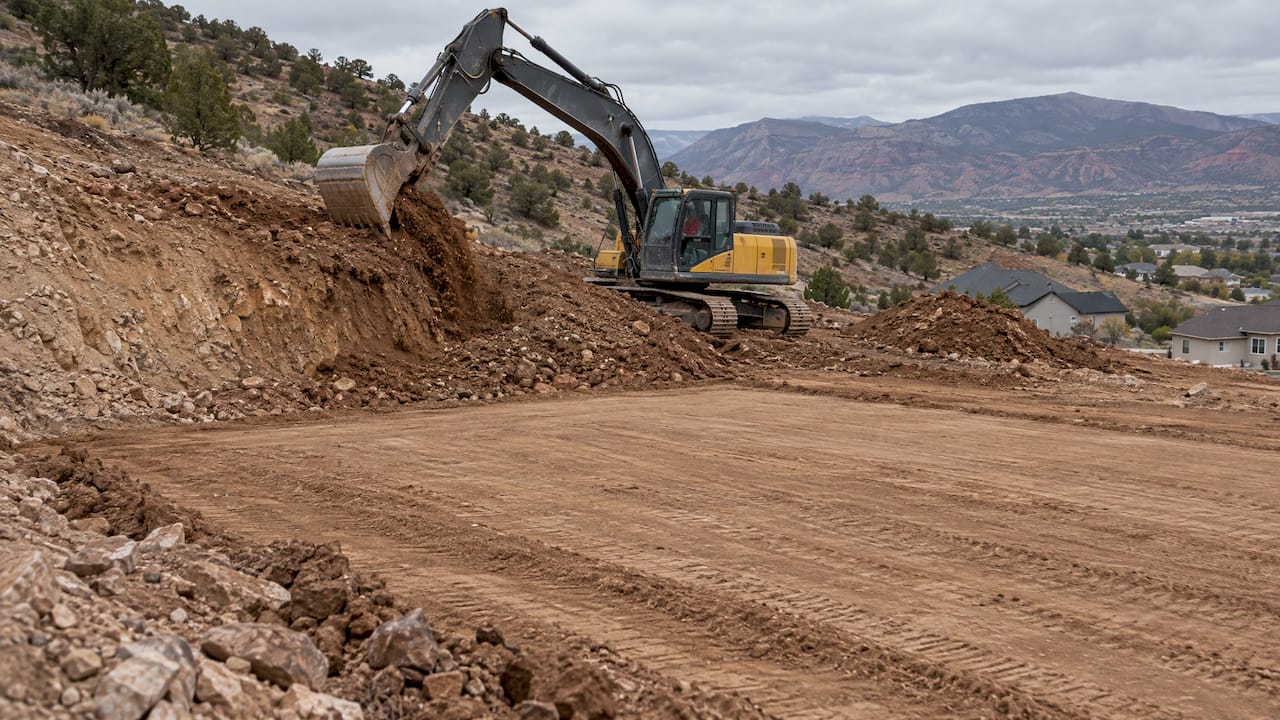
Excavation is digging: earth, rock or other material is moved out of the ground to make room for a foundation, a trench or a utility line. Grading is shaping: the surface is set to planned elevations and slopes so water runs away from your building instead of toward it. Most projects need both, in a set order, and the handoff between them is where schedules slip. At A to Z Construction in Cedar City, one in-house licensed crew handles earthwork from the first estimate to completion, so nobody waits on a separate subcontractor.
TL;DR
- Excavation removes soil and rock (foundation holes, trenches, footings). Grading reshapes the ground surface to a planned elevation and slope.
- Clearing comes first, then excavation and rough grading, then backfill, then final grading. Final grade is the last earthwork step before landscaping and paving.
- Grading is what protects your home from drainage problems. The standard design rule is a drop of about 6 inches over the first 10 feet away from the building.
- Call 811 (Blue Stakes in Utah) before any digging. It is the law, and it is free.
- Splitting the work across several companies is where delays happen. One crew doing both removes the handoff.
Table of Contents
- Excavation and grading, side by side
- What site grading is
- What excavation is
- Where lot clearing fits
- The order of work on a typical lot
- Which one does your project need?
- Why one crew beats a chain of subcontractors
- What to settle before the machines arrive
- Our perspective
- Start your earthwork with one crew
- FAQ
- Sources
Excavation and grading, side by side
The two words get used as if they were one job, and on many sites the same machines do both. The goal is what differs.
| Excavation | Grading | |
|---|---|---|
| What it does | Removes soil, rock or other material from below or on the ground | Shapes the surface to set elevations and slopes |
| Typical results | Foundation hole, footing trench, utility trench, basement | Level building pad, sloped yard, drainage swale, driveway approach |
| Main concern | Depth, utility locations, stable walls, where the spoil goes | Water flow, compaction, finished elevations |
| Typical equipment | Excavators, trenchers, haul trucks | Dozers, graders, skid steers, compactors |
| Where it fits | Early, then again for backfill | Rough grade early, final grade last |
Utah's own damage prevention law defines excavation broadly: any operation in which earth, rock or other material on or below the ground is moved or displaced by tools, equipment, explosives or demolition. That is why even a shallow fence-post hole counts for utility-locating purposes.
What site grading is
The EPA describes land grading as reshaping the ground surface to planned elevations shown on approved construction drawings. The goal is more suitable ground for buildings and facilities, and control of stormwater, erosion and sediment during and after construction.
A grading chapter by Matusik (2004) lists three basic purposes: making the land fit its intended use, setting up new drainage patterns, and shaping how the site looks. The drainage purpose is the one that costs homeowners money when it goes wrong. Poor grading leads to wet basements, damp crawl spaces, foundation damage and eroding slopes.
The slope numbers that matter
Two figures show up again and again:
- 6 inches of fall in the first 10 feet away from the foundation. Matusik gives this 5 percent drop as ideal for moving water away quickly.
- At least 2 percent across other non-paved areas, so runoff keeps moving toward an outlet.
A worked example: a house with a 40-foot-wide side yard needs the soil to fall about 6 inches within the first 10 feet from the wall. If your finished soil sits level with, or higher than, the top of your foundation stem wall, water has nowhere to go but toward the house. Local building departments set the exact requirement for your lot, so confirm it for your permit.
Rough grade and final grade
Grading happens twice. Rough grading is the heavy part: cutting high spots, filling low spots and shaping the pad and slopes close to the design. Final (finish) grading comes after the structure, utilities and backfill are in. It sets smooth, even surfaces with rock and debris removed, a standard HUD's lot requirements describe as fine grading of all unpaved areas.
Compaction belongs in the rough stage. Once finish grade is on, you cannot go back and compact what sits underneath. Fill that settles later takes your patio, slab or driveway down with it.
What excavation is
Excavation is the removal side of earthwork. On a residential lot it usually means:
- Digging the hole for a foundation, footings or a basement
- Trenching for water, sewer, gas, electric or irrigation lines
- Stripping topsoil from the building area
- Removing soil that is unsuitable to build on, then bringing in better material
Excavation produces spoil, the soil you dug out. Part of it gets stockpiled for backfill and topsoil. The rest has to be hauled off or reused somewhere else on the site. That is where cut-and-fill planning pays off: the more of your spoil that gets reused on site, the fewer truckloads leave. We cover the math in our guide on cut and fill volume conversions.
Safety comes before the first scoop
Call 811 before any excavation, however shallow. In Utah that request goes to Blue Stakes, which asks you to submit it no later than three business days before digging begins, and no sooner than 14 calendar days before. The Journal of Light Construction's sitework guide adds that digging within 24 inches of a marked utility must be done by hand. Marked lines are only the public ones. Ask about private lines on your property, such as a well pump feed or an irrigation main, before work starts.
Where lot clearing fits
The third term people mix up is clearing. It is the step before both.
Clearing removes what's on the surface: brush, trees marked for removal, rubbish and old debris. Grubbing pulls out the roots and stumps. Stripping takes off sod and poor topsoil. The CED Engineering site work guide describes this sequence as clearing, then grubbing, then stripping, with real earthmoving beginning at stripping.

Clearing is not grading, because it doesn't set any elevation or slope. A cleared lot is just a bare lot. The reason to do it properly is that a stable grade can't sit on roots, stumps or spongy organic soil, which rot and settle. The Journal of Light Construction recommends clearing at least 20 to 25 feet from the foundation, with trees cut up and hauled and stumps removed rather than pushed into a pile.
In short: clearing prepares the surface, excavation removes material, grading shapes the result.

The order of work on a typical lot
The sequence for a new build or addition usually looks like this:
- Survey and stake. The footprint, setbacks and elevations get marked. Good construction surveying and layout keeps excavation and grading tied to the same control points.
- Clear and grub. Vegetation, roots and debris come out.
- Strip and stockpile topsoil. It is set aside to go back on at the end.
- Excavate. Foundation, footings and utility trenches are dug to depth.
- Rough grade. The pad is cut and filled to near design elevation, with fill compacted in layers.
- Build the foundation and install utilities.
- Backfill. Soil goes back around the foundation, compacted in lifts.
- Final grade. Slopes, swales and the 6-inch-in-10-feet fall are set, topsoil goes back, and the lot is ready for driveway, patio or landscaping.
A sitework overview from a commercial contractor makes the same point in plain terms: nothing vertical can start until the pad is graded to elevation, the soil is compacted and tested, and utilities are in the ground.
Which one does your project need?
| Your project | Excavation | Grading |
|---|---|---|
| New home or garage | Yes: foundation, footings, utilities | Yes: pad, drainage, final grade |
| Concrete driveway or slab | Some: removing old base or soil | Yes: base prep and slope |
| Paver patio or retaining wall | Some: digging out for base and footings | Yes: base and drainage slope |
| Fence or gate | Post holes only | Sometimes, along the fence line |
| Landscaping or turf | Rarely | Yes: finish grade and drainage |
| Water pooling near the house | No | Yes, usually regrading |
If your problem is water, think grading. If your problem is a place to put something below ground, think excavation. If you are building anything new, you need both.
Why one crew beats a chain of subcontractors
The real risk in earthwork is the gap between steps. The excavator finishes and leaves. The grader shows up two weeks later. The concrete crew finds the base is a few inches off. Each handoff adds waiting time and a chance for blame.
Our approach is to run every phase ourselves, with no subcontractors, from the estimate through completion. You get a single point of contact, and the crew that digs your foundation is the one that sets your final grade. That matters most on projects where earthwork feeds straight into concrete, pavers, a retaining wall or a fence line.
We work in Utah, so we build for Utah's climate and codes. See our excavation and grading services, or the pages for site preparation, earthmoving and grading and foundation excavation and drainage.
What to settle before the machines arrive
Whoever you hire, get these answered in writing:
- Scope: does the bid cover clearing, excavation, rough grade and final grade, or only some of them?
- Spoil: is it reused on site or hauled off, and who pays for hauling?
- Drainage: what finished slope away from the house will be set?
- Utilities: who calls 811 and who handles private lines?
- Permits and plans: does your city or county require a grading plan? Plan reviewers often look for explicit drainage notes, such as spot elevations or a minimum fall within 10 feet of the foundation.
- Sequence: what is the order, and what follows grading (concrete, pavers, landscaping)?
Our perspective
Most grading and excavation problems we see on paper are not machine problems. They are planning problems: no one owned the whole job.
When a lot is split between an excavator, a grader and a concrete crew, each does their own piece. The person who suffers is the owner, who ends up as the coordinator. We built A to Z around not doing that to people. Our crew does the clearing, the digging, the grading and the concrete, pavers, walls or fencing that go on top, so the finish grade is set by the people who know what is being built on it.
For Utah lots, that means thinking about drainage from day one, not as an afterthought. Get the first 10 feet around the structure right, and a lot of other problems never start.
Jake
Start your earthwork with one crew
If you are planning a build, a driveway, a patio or a regrade, we can walk the lot with you and put the whole earthwork scope in one bid. Our concrete work includes driveways and approaches, listed at $4,000 to $15,000, and our hardscape work covers paver patios, retaining walls and outdoor kitchens. Tell us what you are building and we will line up the earthwork behind it.

For an estimate, start at a-to-zconstruction.com.
FAQ
Is grading part of excavation?
Often they happen on the same job with the same machines, but they are different tasks. Excavation removes material. Grading shapes the surface to set elevations and slopes. A foundation job typically includes both.
Which comes first, grading or excavation?
Clearing comes first, then excavation and rough grading, then the foundation and backfill, then final grading. Rough grading can happen before or after digging, depending on the site. Final grade is always last.
What is the difference between lot clearing and grading?
Clearing removes vegetation, roots, stumps and debris from the surface. Grading changes the shape of the ground, cutting and filling it to planned elevations and slopes. Clearing prepares the lot for grading.
Do I need to call before digging for a small project?
Yes. Utah's Blue Stakes service says to call no matter how shallow the dig, because many lines lie close to the surface. Dial 811 at least three business days before work begins.
Sources
- Blue Stakes of Utah: FAQs
- EPA: Land Grading fact sheet
- Matusik: Grading and Earthwork (2004)
- HUD 4145.1 REV-2, Appendix 8
- Journal of Light Construction: Sitework Field Guide
- CED Engineering: Basics of Site Work
- CrossBeam Permits: CRC R401.3 site drainage slope