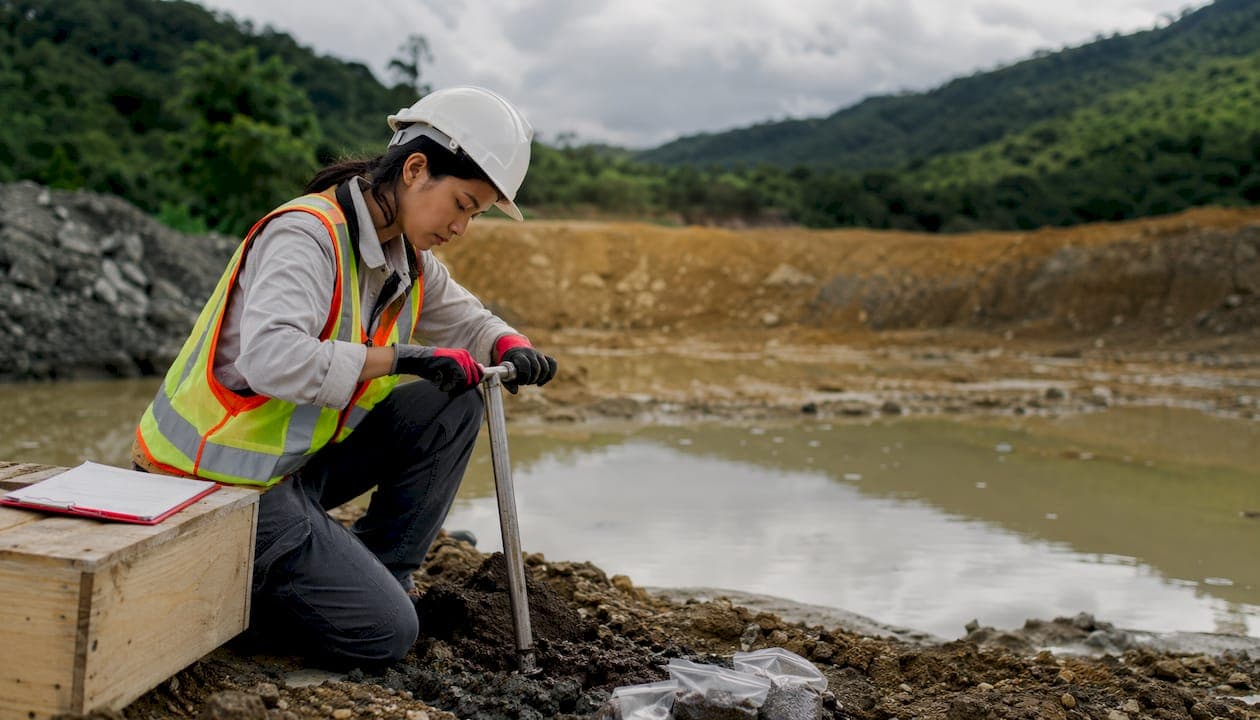
Granular borrow is a naturally occurring sand or gravel fill material specified for embankments, trench backfill, and subgrade raises when a controlled gradation envelope, limited fines content, and low plasticity index are required. Acceptance is governed by DOT specification language (such as Maine DOT Division 700) and verified through ASTM laboratory tests including sieve analysis (ASTM D6913), Atterberg limits (ASTM D4318), and Proctor compaction (ASTM D698/D1557). It is the right material when you need volume fill that performs better than common borrow but costs less than crushed stone base.
Three situations call for it specifically:
- Embankments and mass fills: Large-volume raises where controlled gradation prevents differential settlement and excessive fines cause long-term instability.
- Trench and utility backfill: Where the contract allows natural granular material and the fines/PI limits are met, avoiding the cost of processed aggregate.
- Subgrade and pad raises: Where the geotechnical report specifies a minimum bearing layer and the native soil is too weak or plastic to compact reliably.
Choose granular borrow over processed base when cost per cubic yard matters more than precise gradation control, and over common borrow whenever the spec requires a fines cap or PI limit. Before any delivery, require a current gradation report from the exact stockpile proposed and arrange pre-acceptance testing with a certified lab or your earthwork contractor.
Table of Contents
- What is granular borrow, and how does it differ from common borrow?
- What technical specs and ASTM tests apply to granular borrow?
- Where do you source granular borrow, and what drives the price?
- How do you write a granular borrow spec that actually holds up?
- How do you place and compact granular borrow correctly?
- What are the most common granular borrow failures, and how do you fix them?
- A-to-zconstruction project example: granular borrow done right
- Copy-ready spec language and gradation table for your project documents
- Key Takeaways
- The tradeoff no one talks about with granular borrow
- A-to-zconstruction handles granular borrow from sourcing through final compaction
- Useful sources
- FAQ
What is granular borrow, and how does it differ from common borrow?
Granular borrow is a naturally occurring granular soil — typically a sand-gravel blend — excavated from a borrow pit and placed as structural fill. The defining characteristics are hard, durable particles free from organic matter, lumps of clay, frozen material, and other deleterious substances. Gradation envelopes typically cap fines (material passing the No. 200 sieve) at roughly 8–15%, and plasticity index limits generally run 6–10 depending on the governing specification. Most standard granular borrow specs set the maximum fines (passing No. 200 sieve) at ≤15% and the maximum plasticity index at ≤10; select granular borrow typically tightens these to ≤8% fines and ≤6 PI. Those two numbers are what separate it from general fill.
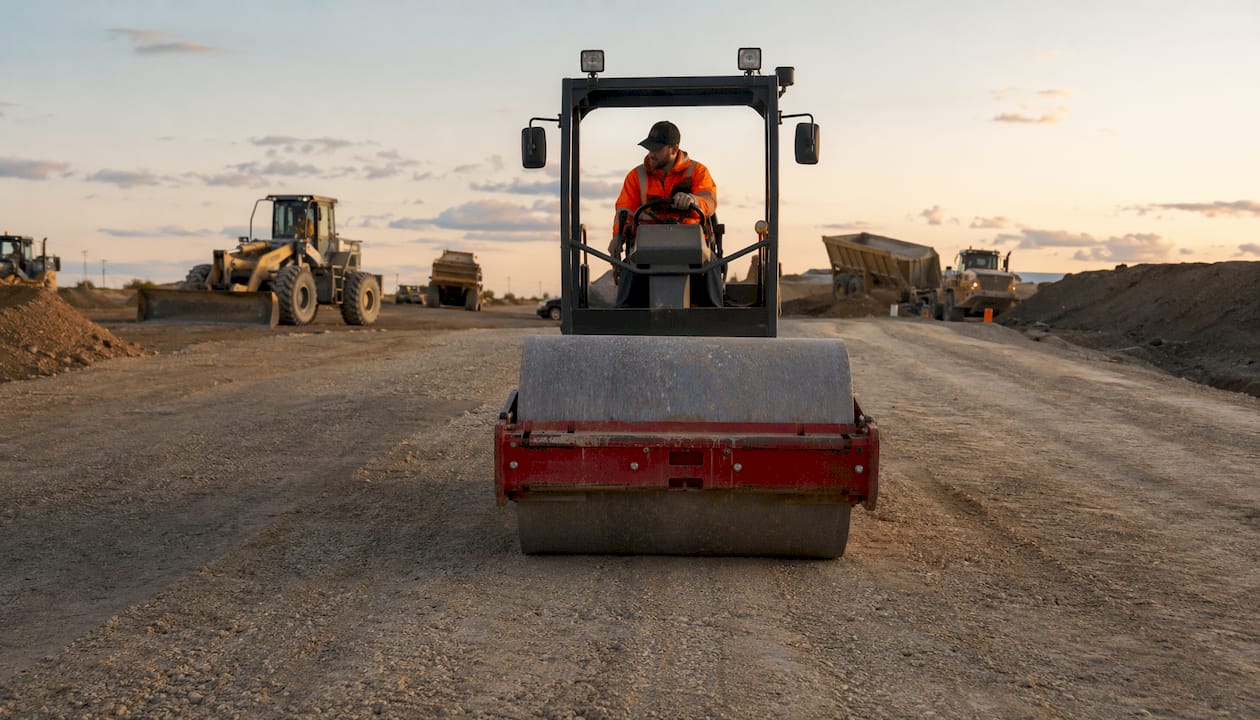
The table below shows how the four most common borrow categories compare across the dimensions that matter most in procurement and field acceptance.
| Material Type | Max Particle Size | Fines (% Passing No. 200) | Plasticity Index | Typical Use |
|---|---|---|---|---|
| Common borrow | Up to 6 in. | No cap (often >20%) | No PI limit | Mass grading, non-structural fills |
| Gravel borrow | Up to 6 in. | Loosely controlled | Low to moderate | Embankments, road shoulders |
| Granular borrow | Up to 3 in. | ≤15% | ≤10 | Embankments, backfill, subgrade raises |
| Select borrow | Up to 3 in. | ≤8% | ≤6 | Pavement-proximate zones, critical fills |
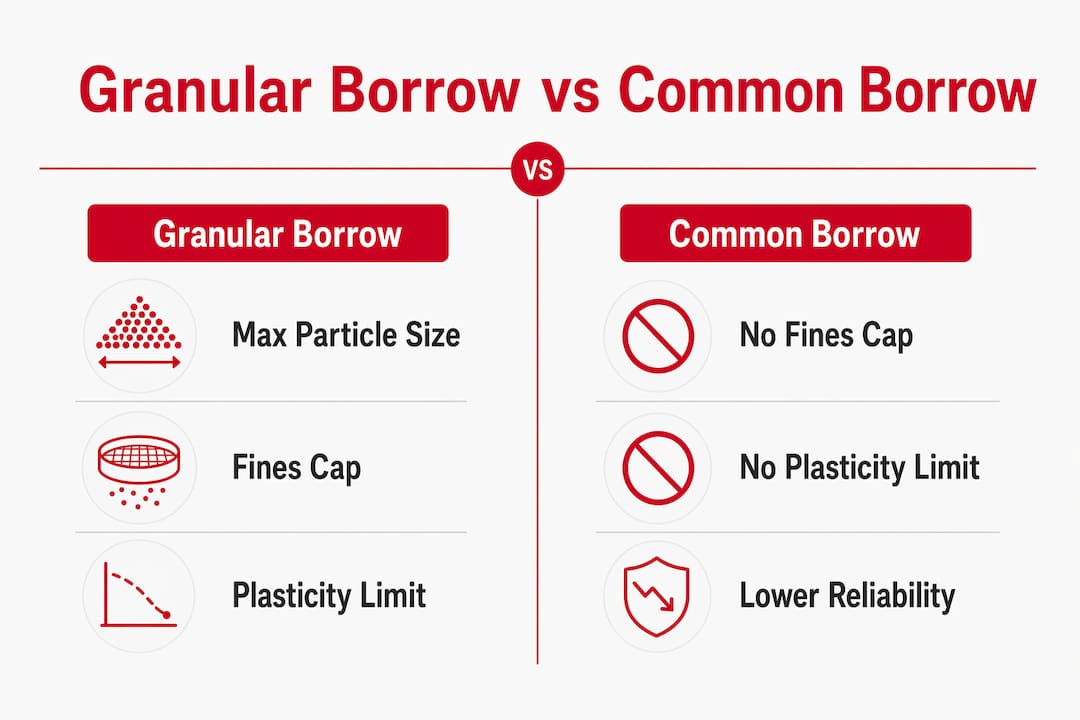
Common borrow carries no fines cap and no PI requirement, which makes it cheap but unreliable for structural applications. Gravel borrow sits between common borrow and granular borrow: the particle size ceiling is often higher (up to 6 in.) and fines control is looser. Select borrow is a tighter subset of granular borrow, with lower fines and PI limits reserved for zones near pavement structures or where settlement tolerance is minimal.
The practical procurement rule: match the bid item name to the project's gradation and plasticity envelope, not to whatever the supplier calls their product. A pit labeled "gravel borrow" by the supplier may or may not meet a granular borrow spec. Always verify against the lab report.
Pro Tip: When a geotechnical report recommends "select fill" near a foundation or pavement edge, write "select borrow" into the bid item with explicit sieve and PI limits — not "granular borrow." The distinction protects you if the material delivered falls in the looser envelope.
What technical specs and ASTM tests apply to granular borrow?
The spec language that actually holds up in the field combines a gradation table, a fines cap, a PI limit, a deleterious material exclusion, and a maximum particle dimension rule. Each element needs a corresponding ASTM test citation so the acceptance criteria are enforceable.
Gradation and fines limits
DOT specifications set explicit sieve limits and cap fines more strictly for underwater backfill (≤7.0% passing No. 200 sieve) than for standard granular borrow (≤15% for most project specs). The table below shows a representative gradation envelope you can adapt to your project's geotechnical requirements.
| Sieve Size | Typical % Passing | ASTM Test |
|---|---|---|
| 3 in. | — | ASTM D6913 |
| 1 in. (25 mm) | 70–— | ASTM D6913 |
| No. 4 | — | ASTM D6913 |
| No. 40 | 10–40% | ASTM D6913 |
| No. 200 | ≤15% (standard); ≤7% (underwater) | ASTM D6913 |
Label these as illustrative — require lab verification against your project's governing DOT or geotechnical specification.
ASTM tests to cite in every spec
- ASTM D6913 (formerly D422): Sieve analysis for particle size distribution. This is the primary acceptance test — run it on each delivered stockpile.
- ASTM D4318: Atterberg limits (liquid limit and plastic limit). Determines the plasticity index; required whenever a PI limit appears in the spec.
- ASTM D698 / D1557: Standard and modified Proctor compaction tests. Establishes the maximum dry density and optimum moisture content used as the compaction acceptance baseline.
- ASTM D2487 (USCS): Unified Soil Classification System. Classifies the material as SW, SP, SM, or GW/GP/GM; useful for confirming the material falls in the intended class before large-scale placement.
Maximum particle dimension rule
DOT specs require that no particle or fragment exceed the compacted thickness of the layer being placed. A 6-inch compacted lift cannot accept a 7-inch cobble. This rule prevents interlocking large fragments that impair compaction and cause post-construction settlement. Write it verbatim into your spec.
Representative DOT language to adapt
Maine DOT Division 700 defines granular borrow as "sand or gravel consisting of hard durable particles free from organic matter, lumps of clay, frozen material and other deleterious substances." That sentence, combined with your project's gradation table and the ASTM test citations above, gives you a complete, enforceable acceptance clause.
Where do you source granular borrow, and what drives the price?
Sourcing starts with identifying a pit whose material actually meets your gradation envelope — not just one that markets itself with the right name. Three source types cover most U.S. projects.
- Commercial borrow pits: The most common source. Request the pit name, location, and a recent lab gradation report on the specific stockpile proposed for delivery, not a general product sheet. Some suppliers, like those offering FDOT-approved granular borrow blends, provide pre-tested, approved mixes with documented source testing — that documentation should accompany every delivery.
- Pit-run (unprocessed) material: Cheaper per ton but more variable. Fines content and gradation can shift significantly between cuts at the same pit. Require a gradation test on each new stockpile, not just the first delivery.
- Underwater/dredged borrow: Retrieved from submerged sand banks, often unprocessed. Dredged granular material requires stricter acceptance limits for fines and organic contamination than land-sourced borrow. Expect lower No. 200 caps (often ≤7%) and additional testing for shell content and organic matter before acceptance.
Primary cost drivers
Haul distance is the single largest variable. A pit 5 miles from the site costs a fraction of one 50 miles away, and that gap widens fast when volumes exceed a few thousand cubic yards. Processing adds cost: screened or washed material runs higher than pit-run, but it delivers more consistent gradation. Permit and environmental mitigation costs at the pit — wetland buffers, stormwater controls, reclamation bonds — can be embedded in the supplier's price without being visible to the buyer. Ask directly.
Seasonal constraints matter in northern climates: frozen material is explicitly excluded from most DOT specs, so winter deliveries from shallow pits carry rejection risk. Plan pit selection and stockpiling before freeze-up.
Delivery logistics
Standard end-dump trucks carry 14–18 tons per load; tandem-axle trucks run roughly 10–12 tons. Weight-based pricing is more accurate than volume-based for granular material because in-truck density varies with moisture. Confirm site access for the truck type before ordering — a narrow residential street or a soft subgrade approach road can force smaller loads and more trips, raising the effective cost per cubic yard. Designate stockpile zones away from placement areas to avoid double-handling and segregation.
How do you write a granular borrow spec that actually holds up?
A spec clause that holds up in a dispute has five elements: a gradation table with sieve limits, a fines cap, a PI/LL limit, a deleterious material exclusion, and a testing protocol with rejection authority. Here is a numbered checklist for writing and enforcing it.
-
Define the material by gradation and plasticity, not by name. State the sieve envelope (reference the table in Section 3), the maximum fines percentage passing the No. 200 sieve, and the maximum plasticity index. Cite ASTM D6913 for sieve analysis and ASTM D4318 for Atterberg limits as the acceptance tests.
-
Exclude deleterious material explicitly. Write: "Granular borrow shall contain no organic matter, frozen material, lumps of clay, shale, or other deleterious substances." Paraphrase Maine DOT Division 700 language directly — it has been tested in contract disputes.
-
State the maximum particle dimension rule. "No particle or fragment shall have a maximum dimension in excess of the compacted thickness of the layer being placed." This prevents oversized cobbles from slipping through a gradation test that only measures percent passing.
-
Require a pre-delivery gradation report. The contractor or supplier must submit a current lab gradation report (ASTM D6913, dated within 90 days) on the specific stockpile proposed for delivery before the first load is accepted. A general product data sheet does not satisfy this requirement.
-
Set testing frequency for delivered material. One sieve analysis and one Atterberg limits test per 500 cubic yards placed, or one per day of placement, whichever is more frequent. Adjust downward (more frequent) when material comes from multiple pits.
-
Assign testing costs clearly. Owner-directed acceptance testing is typically at the owner's cost; retesting after a rejected load is at the contractor's cost. State this in the contract to avoid disputes.
-
Define the rejection threshold and hold point. Any load failing the gradation or PI limits is rejected and removed at the contractor's expense. Placement stops (hold point) until a passing test result is received on the replacement material.
-
Require split samples. For large-volume placements, require the contractor to retain a split sample from each acceptance test for 30 days. This gives the owner the ability to retest if a dispute arises after placement.
-
Address multiple-pit deliveries. When material comes from more than one pit, require a separate Proctor (ASTM D698 or D1557) for each source. Compaction targets derived from one pit's Proctor do not automatically apply to another source.
-
Reference ASTM D2487 for classification. Require the supplier to confirm the USCS classification (SW, SP, SM, GW, GP, or GM) on the gradation report. Material classifying as ML, CL, or CH fails the granular borrow spec regardless of the fines percentage.
How do you place and compact granular borrow correctly?
Field placement is where most granular borrow failures actually happen. The spec can be perfect; if lift thickness, moisture, and equipment selection are wrong, density tests will fail and remediation costs will exceed the material savings.
Lift thickness and equipment
The governing rule is that no particle may exceed the compacted layer thickness. For granular borrow with a 3-inch maximum particle size, a 6-inch compacted lift is the practical minimum. Most DOT specs and standard practice target 6–8 inch compacted lifts for granular borrow placed with vibratory rollers. Plate compactors work for confined areas (trench backfill, around structures) but require thinner lifts — typically 4–6 inches compacted — to achieve the same density.
| Max Particle Size | Recommended Compacted Lift | Preferred Equipment |
|---|---|---|
| 3 in. | 6–8 in. | Vibratory drum roller (smooth or padfoot) |
| — | 4–6 in. | Vibratory roller or jumping jack compactor |
| — | 3–4 in. | Plate compactor or jumping jack |
| Trench/confined | 4–6 in. | Jumping jack or plate compactor |
Moisture and Proctor testing
Optimum moisture content varies with fines percentage. A granular borrow with 12% fines has a meaningfully different optimum moisture than one with 5% fines, even from the same pit. Verify Proctor results (ASTM D698 for standard, D1557 for modified) for each distinct source before large-scale placement begins. Never assume one Proctor result covers all deliveries, especially when multiple pits are involved.
Field density testing (nuclear gauge or sand cone per ASTM D1556) should run at a minimum of one test per 500 square feet per lift, or per the project spec's frequency requirement. When a test fails, stop placement in that zone, investigate moisture and lift thickness, and retest after corrective action. Do not simply add another lift on top of a failing one.
Pro Tip: Pull your compaction test samples from the center of the lift, not the surface. Surface readings run high because the roller passes concentrate density at the top. A mid-lift sample gives you the true compaction picture and catches under-compacted zones before they are buried.
What are the most common granular borrow failures, and how do you fix them?
Most failures trace back to one of five root causes, and catching them early is far cheaper than remediation after the structure above is built.
- Wrong material specification: The bid item said "granular borrow" but the delivered material was pit-run with 25% fines. The fix is pre-delivery testing and a hold point before placement — not remediation after the fact. If material is already placed, test in place and decide between removal/replacement or stabilization with cement or lime.
- Excessive fines causing pumping or rutting: High fines content under traffic or load generates pore pressure, leading to pumping at joints and rutting under wheel loads. Symptoms appear quickly under construction traffic. Remediation options: remove and replace with spec-compliant material, or stabilize with Portland cement if the geometry allows.
- Inadequate moisture control: Placing material too dry or too wet of optimum produces low density even with correct lift thickness and equipment. Too dry: the material won't densify. Too wet: the roller shoves it laterally. Check moisture before each lift and adjust with water addition or aeration.
- Improper lift thickness: Oversized particles in a thin lift prevent full compaction of the layer below them. Field crews sometimes increase lift thickness to speed production — this consistently produces failing density tests in the lower half of the lift.
- Using granular borrow in drainage-critical layers: Granular borrow is not a drainage aggregate. With up to 15% fines, it does not provide free drainage. Using it where a drainage layer is specified (e.g., behind a retaining wall or under a French drain) will cause hydrostatic pressure buildup. Use clean crushed stone or open-graded aggregate for drainage functions.
Symptoms and remediation flow
Settlement and soft spots after placement: check density test records and Proctor source. Pumping under load: suspect fines content exceeding spec. Frost heave in northern climates: fines above roughly 8% make the material frost-susceptible; replace with lower-fines material in frost-depth zones.
When rejecting material on site, document with photos, record the truck number and load ticket, issue a written rejection notice to the contractor, and retain the split sample for potential retesting. Do not allow rejected material to be blended with accepted stockpiles.
A-to-zconstruction project example: granular borrow done right
The following example reflects the type of project A-to-zconstruction handles regularly in Cedar City and the surrounding Utah region, where subgrade conditions often require mass raises before structural work can begin.
Project scope: A commercial pad raise requiring approximately 1,800 cubic yards of granular borrow to bring a soft, high-plasticity native subgrade to design grade before foundation work. The geotechnical report specified a maximum PI of 8 and a No. 200 fines cap of 12% for the fill zone.
Sourcing and pre-acceptance testing: A-to-zconstruction required the supplier to submit a current ASTM D6913 gradation report and ASTM D4318 Atterberg limits test on the specific stockpile before the first load was approved. The initial report showed fines at 14% — above the 12% cap. The supplier resampled from a different cut in the same pit; the second report came in at 10% fines and PI of 6, both within spec. Placement proceeded only after written acceptance of the second report.
Placement and QA: Lifts were placed at 7 inches loose, compacted to 6 inches with a vibratory drum roller. Nuclear gauge density tests were run at one test per 500 square feet per lift, targeting 95% of standard Proctor (ASTM D698). All lifts passed on the first test. Total material cost came in below the processed aggregate alternative, with no remediation required.
Result: The client's foundation contractor reported a uniform, stable subgrade at design grade. The project came in on schedule, and no post-construction settlement was observed at the 90-day follow-up.
For projects requiring sourcing coordination, pre-delivery testing, and onsite compaction QA, contact A-to-zconstruction directly to discuss your scope.
Copy-ready spec language and gradation table for your project documents
The clauses below are illustrative templates. Customize the sieve limits and PI thresholds to match your project's geotechnical report and governing DOT specification before inserting them into contract documents.
Illustrative gradation table (require lab verification)
| Sieve Size | Standard Granular Borrow (% Passing) | Select Granular Borrow (% Passing) |
|---|---|---|
| 1 in. (25 mm) | 70–— | 75–— |
| No. 40 | 10–40 | 10–35 |
| No. 200 | ≤15 | ≤8 |
| Plasticity Index | ≤10 | ≤6 |
| ASTM Classification (USCS) | SW, SP, SM, GW, GP, GM | SW, SP, GW, GP |
Standard granular borrow clause
"Granular borrow shall consist of sand or gravel composed of hard, durable particles free from organic matter, frozen material, lumps of clay, and other deleterious substances. Gradation shall conform to the project gradation table. Fines (material passing the No. 200 sieve, ASTM D6913) shall not exceed %. Plasticity index (ASTM D4318) shall not exceed. No particle or fragment shall have a maximum dimension in excess of the compacted thickness of the layer being placed. Material shall be classified per ASTM D2487; classifications ML, CL, and CH are not acceptable."
Select granular borrow clause
"Select granular borrow shall meet all requirements of standard granular borrow with the following additional restrictions: material passing the No. 200 sieve shall not exceed %, and the plasticity index shall not exceed. Select granular borrow is required in all zones within of pavement structures or as noted on the drawings."
Acceptance testing and pay adjustment clauses
"Acceptance testing shall be performed at a frequency of one sieve analysis (ASTM D6913) and one Atterberg limits test (ASTM D4318) per 500 cubic yards placed, or once per day of placement, whichever is more frequent. Testing costs for owner-directed acceptance tests are at the owner's expense. Retesting costs following a rejected load are at the contractor's expense. Any load or stockpile failing the gradation or plasticity requirements shall be removed from the site at the contractor's expense. Placement shall not resume until a passing test result is received on replacement material."
Customization notes
Adapt the sieve limits to your state DOT's governing specification — Maine DOT Division 700 is a useful model, but Utah, California, Texas, and other states publish their own standard specifications with different envelope widths. When the geotechnical report specifies tighter limits than the DOT standard, the tighter limits govern. Always insert the ASTM test numbers explicitly; a spec that says "gradation test" without citing the standard gives the contractor room to argue about method.
Key Takeaways
Granular borrow performs reliably when the gradation envelope, fines cap, and PI limit are enforced through pre-delivery testing and consistent field QA — skipping any one of those steps is where projects go wrong.
| Point | Details |
|---|---|
| Define by spec, not name | Write sieve limits, a No. 200 fines cap, and a PI limit into every bid item. |
| Require pre-delivery testing | Demand a current ASTM D6913 gradation report on the specific stockpile before the first load is accepted. |
| Match Proctor to each source | Run ASTM D698 or D1557 for each distinct borrow pit; one Proctor result does not cover multiple sources. |
| Enforce the particle-size rule | No particle may exceed the compacted lift thickness — write this verbatim into the spec per DOT standard language. |
| A-to-zconstruction for earthwork QA | A-to-zconstruction handles supplier vetting, pre-delivery testing coordination, and compaction QC for granular borrow placements in Utah. |
The tradeoff no one talks about with granular borrow
Here is the honest version of the granular borrow decision that most spec guides skip: the material is cheap until it is not. The cost-per-cubic-yard advantage over processed aggregate is real, but it evaporates the moment you hit a rejected load, a failing density test, or a post-construction settlement claim. The economics only work when the QA process is tight from the first delivery.
What I see on projects that go sideways is almost always the same sequence: the contractor selects the nearest pit, the owner accepts the supplier's generic product name as proof of compliance, and the first gradation test happens after 800 cubic yards are already in the ground. At that point, the options are all expensive.
The smarter approach is to treat the pre-delivery gradation report as a non-negotiable line item, not a formality. Natural pit material varies by depth and cut location — a stockpile that passed last month may not pass today if the pit operator opened a new face. Require a report on the exact stockpile proposed for delivery, retain split samples, and run your own acceptance tests on the first few loads. That process adds a day or two of lead time and a few hundred dollars in lab fees. It is far cheaper than the alternative.
One more thing worth saying plainly: granular borrow is not a substitute for processed aggregate in pavement-proximate zones. The fines content that makes it economical for mass fill also makes it frost-susceptible and prone to pumping under repeated load. For the top 12–18 inches below a pavement structure, spend the extra money on select borrow or crushed stone base. The concrete road base comparison is worth reading if you are deciding where that boundary sits on your project.
A-to-zconstruction handles granular borrow from sourcing through final compaction
Sourcing the right material, getting it tested before it hits your site, and compacting it to spec are three separate problems — and most property owners and smaller contractors are managing all three without a clear process. A-to-zconstruction solves that by handling the full sequence in-house.
The earthwork services team at A-to-zconstruction vets suppliers, coordinates pre-delivery gradation testing, and runs nuclear gauge compaction QC on every lift. For foundation raises and subgrade improvements, the foundation excavation and drainage crew integrates borrow placement with drainage design so the two don't conflict. For landscape grading and landscape earthwork projects, the team matches material selection to the end use — no over-specifying, no under-specifying.
With over 500 completed projects in Cedar City and across Utah, A-to-zconstruction brings the spec knowledge and field experience to get granular borrow placements right the first time. Get a project quote by contacting A-to-zconstruction directly at a-to-zconstruction.com.
Useful sources
The following references are worth bookmarking for specification writing, procurement, and field QA on granular borrow projects.
- Maine DOT Division 700: The most commonly cited DOT model spec for granular borrow language. Covers gradation limits, deleterious material exclusions, underwater backfill fines caps, and the maximum particle dimension rule. Adapt the sieve table to your state's requirements.
- Project Infrastructure: Gravel Borrow: Practical overview of granular and gravel borrow definitions, typical gradation ranges, economic tradeoffs, and underwater borrow handling notes.
- One Source Materials: A1A Granular Borrow: Example of a commercial supplier product page showing FDOT-approved granular borrow specifications and the documentation that should accompany deliveries. Use as a model for what to request from any supplier.
- ASTM D6913: Sieve analysis (particle size distribution) — the primary acceptance test for gradation.
- ASTM D4318: Atterberg limits (liquid limit, plastic limit, plasticity index) — required whenever a PI limit appears in the spec.
- ASTM D698 / D1557: Standard and modified Proctor compaction tests — establishes the maximum dry density and optimum moisture content for field acceptance.
- ASTM D2487: Unified Soil Classification System (USCS) — confirms the material class (SW, SP, SM, GW, GP, GM) before large-scale placement.
- A-to-zconstruction earthwork services: Contact page for sourcing coordination, pre-delivery testing, and compaction QC services in Utah.
FAQ
What is granular borrow used for?
Granular borrow is used for embankment construction, subgrade improvement, foundation backfill, and utility trench backfill when the contract requires a controlled fines content and low plasticity index. It is accepted based on a gradation and plasticity envelope rather than manufactured precision.
What is gravel borrow?
Gravel borrow is a naturally occurring sand-gravel fill similar to granular borrow but typically with a higher maximum particle size (up to 6 inches) and looser fines control. Granular borrow is the more tightly specified subset, with a 3-inch particle cap and explicit No. 200 and PI limits.
What is a granular base?
A granular base is a processed, engineered aggregate layer placed directly beneath pavement structures, with tighter gradation control and lower fines than granular borrow. Granular borrow is not a substitute for granular base in pavement-proximate zones because its higher fines content makes it susceptible to pumping and frost heave under repeated load.
What is a borrow material?
Borrow material is any soil or aggregate excavated from a location outside the project limits and imported to fill a deficit on the project site. Granular borrow is one category of borrow material, distinguished by its gradation envelope, fines cap, and plasticity limits from common borrow, select borrow, and other fill types.
How do you test granular borrow for acceptance?
The standard acceptance tests are sieve analysis (ASTM D6913) for gradation, Atterberg limits (ASTM D4318) for plasticity index, and Proctor compaction (ASTM D698 or D1557) to establish the density baseline. Soil classification per ASTM D2487 confirms the material falls in an acceptable USCS group before large-scale placement begins.