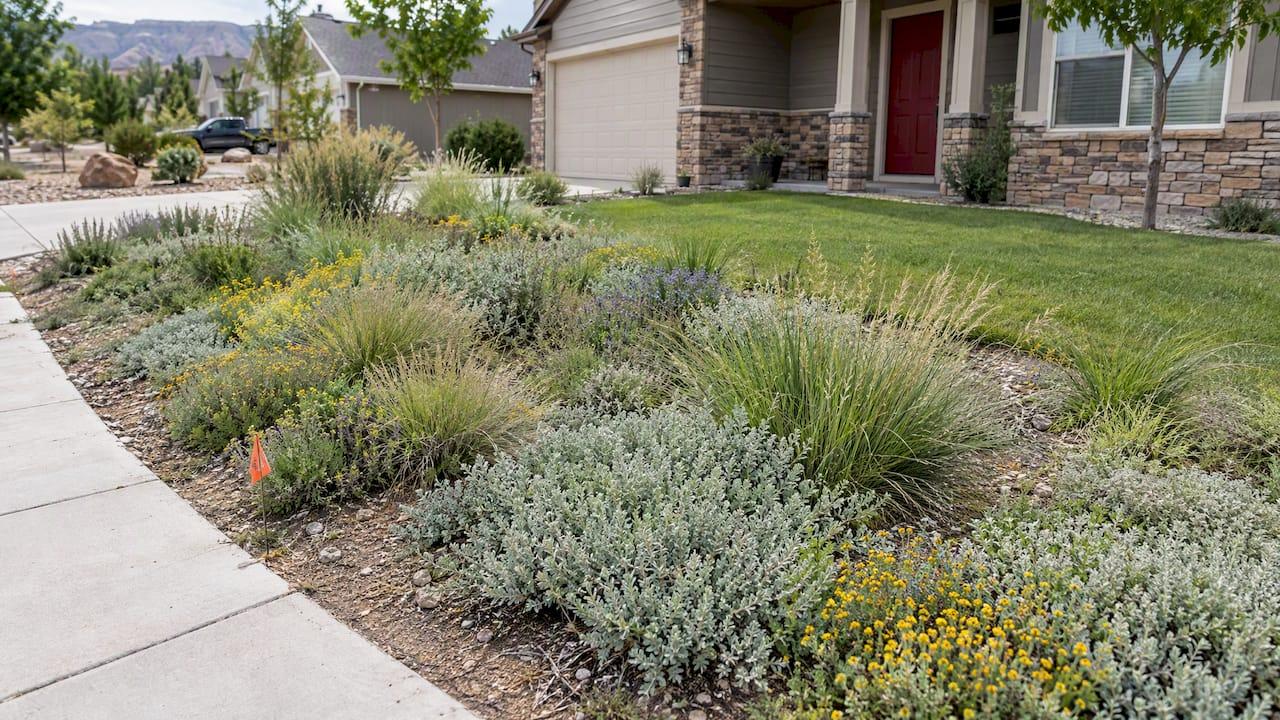
The best drought tolerant lawn alternatives are low-growing groundcovers such as clover, creeping thyme and yarrow, native grasses such as buffalograss, sedges, and mixed "ecolawns" that blend several of these. Which one fits depends on sun, soil drainage, foot traffic and how much mowing you are willing to do. Below we compare the main options, say what each one can't do, and walk through how to replace turf without wasting a season.
TL;DR
- No single plant wins everywhere. Match the replacement to sun, drainage, slope and how much the area is walked on.
- Mixes beat single species: an Oregon State ecolawn uses roughly one-quarter to one-third the water of a conventional lawn once established.
- Thyme and yarrow suit sunny, light-use areas. Clover and sedges handle more wear. Buffalograss suits hot, sunny sites.
- Most failures come from skipped prep: grass not fully killed, compacted or poorly drained soil, and too little water in the first year.
- Start small, then expand. A test patch costs little and shows what survives on your site.
Table of Contents
- What to put down instead of a thirsty lawn
- Drought tolerant lawn alternatives compared
- No-mow options that need the least water and upkeep
- The ecolawn: a mix instead of a monoculture
- Yarrow, thyme, clover and sedge: where each one fits
- Hardscape and artificial turf: when plants aren't the answer
- How to replace your lawn step by step
- Our perspective: where lawn replacements go wrong
- Plan your conversion with A to Z Construction
- FAQ
- Sources
What to put down instead of a thirsty lawn
University of Maryland Extension lists groundcovers, native ornamental grasses, edible gardens and meadows as the main ways to replace turf. It also suggests a modest first step: convert a small 4-by-4-foot area, see how it performs, and expand in later years.
That advice is worth taking even if you plan a full replacement. A patch tells you things a plant label can't: how your soil drains, where the afternoon sun really falls, and whether the dog treats it as a path.
The options fall into five groups:
- Low broadleaf covers: clover, yarrow, self-heal, chamomile.
- Creeping aromatics: thyme.
- Native and warm-season grasses: buffalograss and native lawn mixes.
- Sedges and fine fescues: for shade or low-mow areas.
- Hardscape and non-living covers: permeable pavers, gravel, decomposed granite, artificial turf.
Washington State University Extension adds an important caveat: selection depends on sun, slope, drainage, intended use and local rules. Rules matter more than people expect. HOAs and some municipalities regulate front yards, so check before you tear anything out.
Drought tolerant lawn alternatives compared
The table sums up what the extension and product sources say. Water savings and mowing figures are claims from the sources named in the sections below, not guarantees for your yard.
| Option | Best conditions | Mowing | Foot traffic | Watch out for |
|---|---|---|---|---|
| White clover / microclover | Sun to part shade | Optional to monthly | Moderate | Bees in bloom; may thin in deep drought |
| Creeping thyme | Full sun, well-drained | Little to none, occasional trimming | Low | Slow to fill in |
| Buffalograss (e.g. UC Verde plugs) | Hot, sunny, USDA Zones 8b to 13b | Low to none | Moderate | Needs 7 to 8 hours of sun |
| Yarrow | Sun, dry sites | Occasional | Low to moderate | Spreads aggressively in moist soil |
| Sedges (Pennsylvania sedge) | Full sun to heavy shade, by species | Once or twice a year, or never | Light to moderate | Species vary widely in drought tolerance |
| Ecolawn mix | Most sunny to part-shade sites | Every 2 to 3 weeks in growing season | Moderate | Takes time to establish |
| Meadow or native bunch grasses | Large, low-use areas | Occasional | Low | About three years to mature (Maryland) |
No-mow options that need the least water and upkeep
This is the question behind most searches for no-mow alternatives, and the honest answer is that "no-mow" and "no-work" are different things.
Buffalograss. The official site for UC Verde buffalograss plugs says it suits USDA Zones 8b to 13b with at least 7 to 8 hours of sun, and claims up to 75% less water, low-to-no mowing and no required chemical herbicides or fungicides. The listed price is $102.40 for a tray of 128 plugs, covering 128 square feet at 12-inch spacing or 200 square feet at 15-inch spacing. Those are the vendor's claims, and plugs take a season to knit together. Zone 8b and warmer also excludes much of the interior West at higher elevations, so check your zone first.
Native lawn mixes. Habiturf is a mix of native warm-season perennial grasses, and established stands can be left unmowed or mowed every three to five weeks while growing. It can be planted in spring after the last frost or in fall two months before the first frost.
Sedges. Pennsylvania sedge and its relatives can be mowed once or twice a year or left alone, and they work from full sun to heavy shade depending on species. Pick the species for your light, because "sedge" covers dozens of plants with very different water needs.
Clover. White clover and microclover fix their own nitrogen and tolerate moderate foot traffic. Mowing is optional for white clover, and many microclover lawns get mowed monthly or less, according to a 2026 comparison of clover, thyme and moss. University of Delaware notes that clovers and trefoil add diversity, durability and natural nitrogen when combined with native grasses.
Creeping thyme. Nebraska's Backyard Farmer program describes it as drought-tolerant, aromatic and suited to sunny, low-traffic areas, needing minimal mowing and an occasional trim.
For the least water and the least upkeep together, a mix of native grasses and sedges in a low-traffic area usually wins. It also needs the most patience.

The ecolawn: a mix instead of a monoculture
Oregon State University Extension defines an ecolawn as a low-input alternative to conventional perennial grass: a compatible mix of broadleaf and grass species that stays green through dry summers, uses less water and fertilizer, and is generally mowed every two to three weeks in the growing season. Once established, estimated water use is one-quarter to one-third that of a conventional lawn.
The logic is simple. When one species struggles in a hot spell, another carries the green. University of Delaware makes the same point: combining drought-tolerant, nutrient-efficient plants such as clovers, trefoil, sedges and fescues reduces maintenance better than betting on one plant.
OSU also flags the trade-offs in the mix. Yarrow is drought-tolerant and green through summer, but it can be invasive around lawn edges. Clover is drought-tolerant, summer-green and nitrogen-fixing.
Seed is cheap compared with plugs or sod. Retail catalogs list creeping thyme seed at $5.79 for 250 seeds, and Dutch white clover from $6.99 and creeping thyme from $23.99, with unit prices of $27.96 and $95.96 per 1,000 square feet. Prices change, so treat these as a sense of scale, not a quote.
Yarrow, thyme, clover and sedge: where each one fits
Sunny, hot, dry strips
Thyme and yarrow are the classic picks. A guide to native plants of the Intermountain region describes western yarrow as a 1 to 3.5-foot plant with white-to-cream flower clusters from spring through fall. Its dense foliage can be mowed and watered less often than a typical lawn, though it can spread aggressively in moist conditions. That last point matters next to irrigated beds.
Play areas and pet paths
Clover and microclover hold up to moderate traffic. Fine fescues do not tolerate heavy foot traffic, per the Maryland guidance, so don't use them where kids run laps. If the area takes real abuse, keep a small patch of conventional or buffalograss turf and put the alternatives around it.

Shade
Sedges are the standout. In Maryland, Pennsylvania sedge is recommended for shady sites, while switchgrass, little bluestem and yellow indiangrass suit sunny ones. Climate changes the list, so ask your local extension office which species are native to you.
Large properties
University of Maryland Extension advises keeping a small lawn near the house and leaving farther areas unmowed and naturalistic. This cuts mowing and water where you won't notice the difference.
Plants to avoid
Maryland's guide warns against invasive groundcovers such as periwinkles (Vinca major and Vinca minor), Japanese spurge (Pachysandra terminalis) and carpet bugleweed (Ajuga reptans). They escape into neighbors' yards and natural areas and are hard to remove.
Hardscape and artificial turf: when plants aren't the answer
Some spots shouldn't grow anything: side yards that never get water, steep strips, areas with heavy traffic. Permeable pavers, gravel and decomposed granite are common waterwise replacements, and they pair well with plantings.
Artificial turf is the other option. At A to Z Construction our published range is $8 to $20 per square foot for artificial turf, and the spread comes from base preparation, drainage and the product itself. If you plan turf over a patio slab or existing concrete, read our contractor's five checks for turf over concrete before you order anything.
We would rarely recommend turf for a whole yard. It makes sense for dog runs, tight side yards and play areas. Living groundcovers do better for cooling, pollinators and soil.
How to replace your lawn step by step
The sequence matters more than the plant choice.
- Read the site. Note sun hours, slope, where water pools and how much traffic the area gets. A soil test is worthwhile, and Colorado State Extension notes that most xeric plants need very well-draining soil and that compaction should be avoided.
- Kill the existing grass. Arizona's turf conversion guidance lists killing the grass, removing the dead turf and installing irrigation if necessary before planting. Skipping this step is how Bermuda and fescue come back through the new planting.
- Fix grade and drainage. Regrade low spots and slopes before planting, not after. Our landscape earthwork service handles this.
- Set up irrigation for establishment. Drip or zoned sprinklers let you water new plants deeply, then taper off.
- Plant in the right window. For native mixes, that is spring after the last frost or fall about two months before the first frost.
- Water regularly, then reduce. Colorado State advises regular water during establishment, then gradually reducing supplemental water.
- Weed in year one. Maryland's meadow guidance says plan on about three years to mature, with weeding during establishment and occasional mowing afterward.
One caution on warm-season grass replacements: Arizona Extension notes that weed control in Kurapia can be harder than in bermudagrass because the herbicide methods used for bermudagrass do not work to remove weeds from Kurapia. Ask how a product handles weeds before you commit.
For groundcover choice and keeping spreaders contained, planning a lawn conversion with edging and borders in mind will save you from replanting later.
Our perspective: where lawn replacements go wrong
We've completed more than 500 projects, and the lawn conversions that disappoint rarely fail because of the plant. They fail because the work was split across several people who never talked to each other. One crew strips the sod, another sets irrigation, a third plants, and nobody owns the grade. Then the new groundcover drowns in a low spot or dies on a dry slope.
Our approach is to run the whole project in-house: grading, irrigation, hardscape edging and planting, with one point of contact. We think that matters most for drought-tolerant work, because the first year of watering decides whether the planting survives.
Our advice for Utah homeowners:
- Choose plants for your microclimate, not the catalog photo. Utah's elevation, alkaline soils and freeze-thaw cycles change what survives. Our guides to Utah xeriscape plants and an 8-week establishment plan cover the details.
- Keep a small, functional patch of lawn if you use one. Replace the rest.
- Put hardscape where traffic is, plants where it isn't. Patios, paths and edging make a no-mow yard look intentional rather than neglected.
- Don't skip irrigation for "no-water" plants. Even tough species need drip lines in year one.
— Jake
Plan your conversion with A to Z Construction
If you want a yard that stays green on less water without managing five different trades, we handle it from estimate to final cleanup. Our landscaping services cover xeriscape design, softscape installation, artificial turf and irrigation. Irrigation and sprinkler systems are published at $3,000 to $8,000, and artificial turf at $8 to $20 per square foot. For planting-focused projects, you can request a free softscape estimate.
FAQ
What is the most drought-resistant lawn?
Buffalograss and native warm-season grass mixes are among the most drought-resistant true lawns, and vendor claims include up to 75% less water for buffalograss plugs. For the lowest water use overall, an ecolawn mix of drought-tolerant species can use one-quarter to one-third the water of a conventional lawn once established, per Oregon State Extension. Results depend on your climate and sun exposure.
What can I put down instead of grass?
You can use groundcovers such as wild ginger, alumroot, green-and-gold or sedges, or ornamental grasses. Groundcovers need no mowing and little maintenance, according to University of Maryland Extension. In sunny, dry spots, thyme, yarrow and clover are common choices, and gravel or permeable pavers work where nothing should grow.
Can a clover or thyme lawn take foot traffic?
Clover handles moderate foot traffic, and white clover mowing is optional. Creeping thyme suits low-traffic areas, so it works better as a border or between stepping stones than as a play surface. If the area is heavily used, keep some conventional turf or install a hard surface.
How long do lawn alternatives take to establish?
It varies by plant. Meadow-style plantings in Maryland take about three years to mature, and spreading groundcovers may need edging along the way. Plan on regular watering and weeding in the first season, then reduce water gradually.
Sources
- Lawn Alternatives, University of Maryland Extension
- Low-growing lawn alternatives, Washington State University Extension
- UC Verde Buffalograss
- Habiturf Native Lawn Mix, Douglass King Seeds
- Lawn Alternatives: Clover, Thyme and Moss Compared
- Introduction to Organic Lawns and Yards, University of Delaware
- Alternative Turf, Backyard Farmer, Nebraska
- Ecolawn: Less work and water, OSU Extension Service
- Lawn Alternatives, Hudson Valley Seed Company
- Flawn Seed kits
- Landscaping with Native Plants of the Intermountain Region
- Transforming Your Lawn into a Drought Tolerant Yard, Colorado State University Extension
- Conversion of Turf Areas in Arizona, University of Arizona Extension
- Lawn conversion planning and groundcover containment