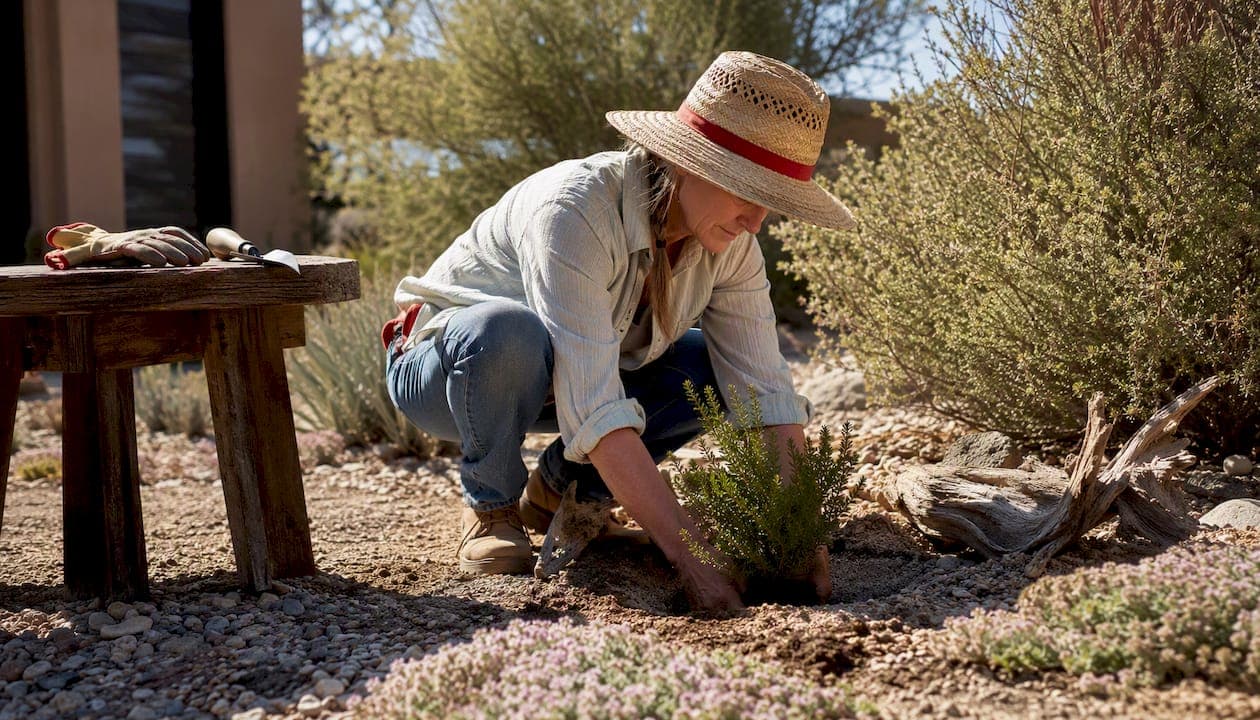
The best utah xeriscape plants for most homeowners are Russian sage, lavender, penstemon, sedum, Utah serviceberry, rabbitbrush, juniper, Apache plume, curl-leaf mountain mahogany, creeping thyme, little bluestem, mountain beebalm, Prince's plume, big sagebrush, and Mexican cliffrose. Utah State University Extension and USDA hardiness guidance confirm all fifteen thrive in Utah's alkaline soils and low-rainfall conditions. Converting turf to a well-designed xeriscape can cut water use by 30% to 75% depending on how much lawn you replace and how efficiently you irrigate.
- Russian sage (Perovskia/Salvia spp.) — mass planting; silver stems and violet flowers from July through frost
- Lavender (Lavandula spp.) — accent or low hedge; fragrant, bee-magnet, thrives in fast-draining alkaline soil
- Penstemon (beardtongue) — perennial accent; hummingbird favorite, dozens of Utah-native species
- Sedum (stonecrop) — groundcover or rock garden filler; nearly indestructible once rooted
- Utah serviceberry (Amelanchier utahensis) — small tree or multi-stem shrub; early white blooms, bird food
- Rabbitbrush (Ericameria nauseosa) — shrub mass; gold fall color, late-season pollinator hub
- Juniper (Juniperus spp.) — screening tree or low groundcover form; zero supplemental water after establishment
- Apache plume (Fallugia paradoxa) — shrub accent; feathery seed heads persist into winter
- Curl-leaf mountain mahogany (Cercocarpus ledifolius) — small tree or hedge; evergreen, wildlife browse
- Mexican cliffrose (Purshia mexicana) — shrub; fragrant cream flowers, deer-resistant
- Little bluestem (Schizachyrium scoparium) — ornamental grass; copper fall color, songbird seeds
- Mountain beebalm (Monarda fistulosa) — perennial; lavender blooms, native bee magnet
- Prince's plume (Stanleya pinnata) — perennial accent; tall yellow spikes, selenium-tolerant
- Big sagebrush (Artemisia tridentata) — shrub mass or native backdrop; iconic Utah scent, wildlife cover
- Creeping thyme (Thymus serpyllum) — groundcover between pavers; monitor spread in moist micro-sites
Pro Tip: Before buying a single plant, do a quick drainage test: dig a 12-inch hole, fill it with water, and check how fast it drains. If water sits for more than four hours, you have clay drainage issues that will kill many desert-adapted species without a fix first.
A-to-zconstruction handles xeriscaping installations across Utah, from plant selection through irrigation and hardscape, for homeowners who want the result without the guesswork.
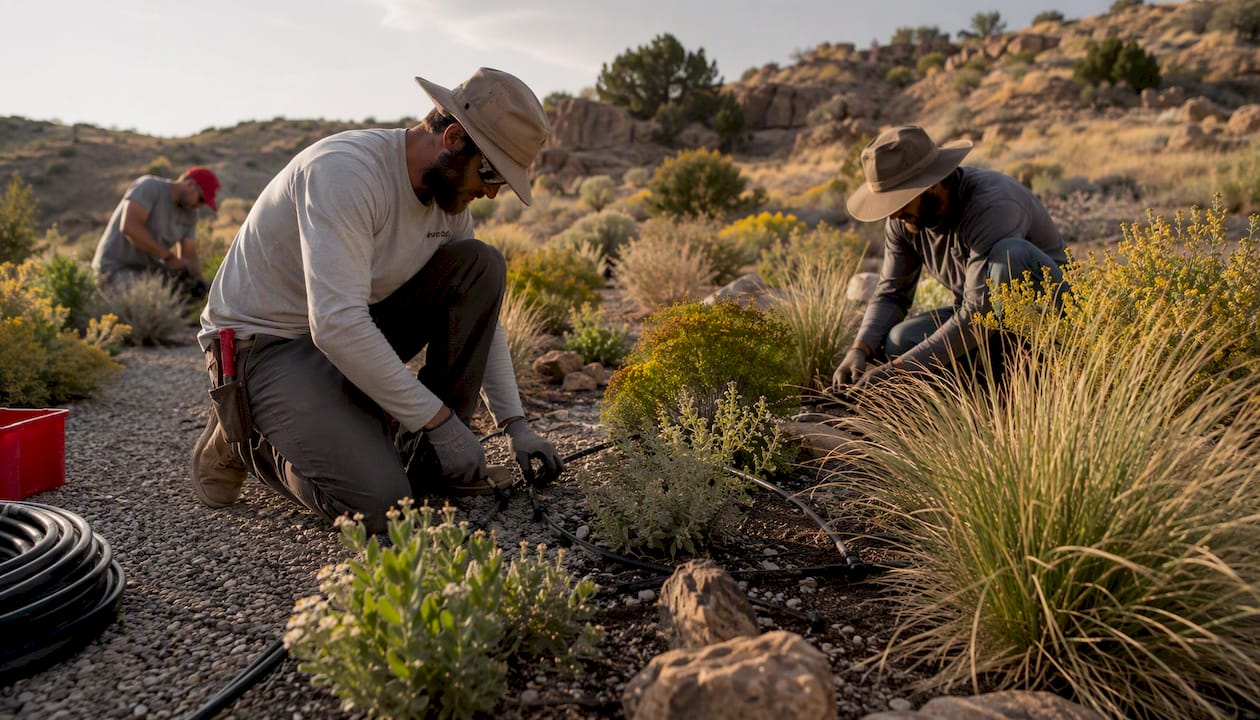
Table of Contents
- Which plants work best for Utah's dry climate, by category?
- How do Utah's regions and elevations change which plants will actually survive?
- What xeriscape design principles actually matter for Utah yards?
- How do you plant and water xeriscape plants through establishment?
- Should you choose Utah native plants or well-adapted non-natives?
- When does hiring a xeriscape contractor make more sense than doing it yourself?
- Key Takeaways
- The case for going native, and where most homeowners get it wrong
- A-to-zconstruction's xeriscape installation services for Utah homeowners
- Useful sources for Utah xeriscape plant research
- FAQ
Which plants work best for Utah's dry climate, by category?
Shrubs and woody accents
Utah's shrub layer does the heavy lifting in a xeriscape. These species provide structure, wildlife value, and color across multiple seasons.
| Plant | Water use | Sun | Soil/drainage | Mature size | Best use | Pollinator value |
|---|---|---|---|---|---|---|
| Russian sage | Very low | Full sun | Dry, alkaline, rocky | 3–5 ft × 3–4 ft | Mass planting, border | High (bees, butterflies) |
| Rabbitbrush | Very low | Full sun | Dry, sandy/rocky | 2–5 ft × 3–5 ft | Mass, wildlife hedge | High (late-season bees) |
| Apache plume | Very low | Full sun | Dry, rocky, alkaline | 3–6 ft × 4–6 ft | Accent, slope stabilizer | Moderate |
| Big sagebrush | Very low | Full sun | Dry, well-drained | 3–8 ft × 4–6 ft | Native backdrop, mass | Moderate (moths, beetles) |
| Mexican cliffrose | Very low | Full sun | Dry, rocky, alkaline | 4–8 ft × 4–6 ft | Accent, deer-resistant hedge | High |
- Lavender — low water once established; thrives in raised beds or slopes where drainage is sharp; USDA zones 5–8
A caution on rabbitbrush: it self-seeds readily on disturbed soil. Plant it where you want a naturalistic drift, not in a tight formal bed.
Perennials and flowering forbs
- Penstemon — choose species matched to your elevation: Penstemon palmeri for valley floors, P. strictus for higher sites; hummingbirds arrive the day they open
- Mountain beebalm (Monarda fistulosa) — spreads slowly by rhizome; give it room and it rewards with weeks of lavender bloom and a constant buzz of native bees
- Prince's plume (Stanleya pinnata) — tall, architectural, and tolerant of selenium-rich soils common in parts of southern Utah; a plant most nurseries overlook but worth tracking down
Ornamental grasses
Little bluestem (Schizachyrium scoparium) is the standout. It turns copper-orange in fall, holds its seed heads through winter for songbirds, and asks for almost nothing once it roots. It fits USDA zones 3–9, which covers nearly every Utah elevation band. Plant it in drifts of five or more for the best visual effect.
Groundcovers and low mats
- Creeping thyme — fragrant, foot-traffic tolerant in low-use areas; Utah State University Extension recommends monitoring it in wetter micro-sites where it can spread beyond its intended zone
Trees and screening plants
Juniper (Juniperus spp.) is the most drought-resistant tree option for Utah. Once past a multi-year establishment period, it requires essentially no supplemental water and provides year-round green structure. Rocky Mountain juniper (J. scopulorum) works as a screen; Utah juniper (J. osteosperma) fits a more naturalistic, open-canopy role. Both rank among the most drought-resistant woody plants for the state.
How do Utah's regions and elevations change which plants will actually survive?
Utah is not one climate. Salt Lake City averages roughly 15 inches of precipitation annually; St. George gets closer to 8 inches; mountain valleys above 6,500 feet can receive 20 inches or more, mostly as snow. Getting the region wrong is the single most common cause of plant failure.
Wasatch Front and valley floors (4,200–5,500 ft)
- Alkaline clay soils, hot summers, cold winters (USDA zones 6–7)
- Best picks: Russian sage, lavender, penstemon, little bluestem, Utah serviceberry, rabbitbrush, sedum
- Avoid: high-elevation mountain natives that need cold, moist summers
Southern Utah desert basins (2,700–4,500 ft)
- Very low rainfall, intense heat, rocky or sandy soils (USDA zones 7–9)
- Best picks: Mexican cliffrose, Apache plume, Prince's plume, big sagebrush, juniper, creeping thyme between pavers
- Yucca and agave also perform well here, though they are not on the core fifteen list
High plateaus and mountain-adjacent sites (6,000–8,000 ft)
- Shorter growing seasons, heavier snowpack, cooler summers
- Best picks: curl-leaf mountain mahogany, serviceberry, mountain beebalm, little bluestem, cold-hardy penstemon species
- Bristlecone pine and native willows suit these elevations but are outside typical residential xeriscape scope
Foothills and transition zones
- Variable drainage, often rocky with thin topsoil
- Best picks: Apache plume, big sagebrush, rabbitbrush, sedum, mountain mahogany
One rule that practitioners at USU Extension repeat: "native" does not automatically mean drought-hardy at your specific site. Aspen (Populus tremuloides) is a Utah native, but it needs consistent moisture and cool summers. Plant it on a hot valley lot and it declines within two or three seasons. Always verify elevation, drainage, and summer heat load before selecting.
Pro Tip: Pick up a basic soil pH kit at any garden center. Most Utah soils run pH 7.5–8.5. If yours tests above 8.0, prioritize species specifically listed as alkaline-tolerant — many adapted non-natives like lavender and Russian sage handle this better than some natives.
What xeriscape design principles actually matter for Utah yards?
USU Extension specialists frame xeriscaping as functional landscape design, not just "less water." The core principle is hydrozoning: group plants with similar water needs together so your irrigation delivers the right amount to each zone without over- or under-watering any of them.
Do:
- Use drip irrigation with pressure-compensating emitters; smart controllers can cut irrigation use by up to 30% compared to fixed schedules
- Apply 2–3 inches of organic mulch (shredded wood or bark) around perennials and shrubs to hold moisture and suppress weeds
- Use permeable pavers, decomposed granite, or terraced swales on slopes to slow runoff and let water soak in
- Keep a small turf pocket only where it genuinely gets used — a play area or pet run — and irrigate it separately from the xeriscape zones
- Choose river rock or gravel mulch thoughtfully; it works well in full-sun, high-heat spots but can raise soil temperature near foundations
Don't:
- Blanket rock mulch against house foundations without shading plants from reflected heat
- Mix high-water plants (annuals, traditional perennials) into low-water zones and then wonder why the zone fails
- Over-amend soil with rich compost; light amendments of 10–20% by volume help establishment, but heavy backfill can harm native root systems adapted to lean soils
Wildfire-wise planting: Utah's fire risk is real. Keep woody shrubs pruned and spaced at least 3 feet apart near structures. Favor low-fuel species like sedum, penstemon, and creeping thyme within 30 feet of the house. Big sagebrush and juniper are fire-adapted in nature but carry fuel load — keep them in the outer zones of your property.
Pro Tip: Reserve turf for the spots that actually need it. A 10-foot-wide strip of Kentucky bluegrass along a fence line uses more water per square foot than almost any other landscape choice. Replace it with a drift of Russian sage and little bluestem and you will not miss it after the first summer.
How do you plant and water xeriscape plants through establishment?
The best planting window in Utah is fall (September through October). Cooler temperatures and residual soil warmth let roots establish before winter without the stress of summer heat. Spring (March through May) is the second-best option. Avoid planting during July and August heat unless you can commit to daily monitoring.
Quick site prep:
- Clear existing vegetation and weeds thoroughly.
- Test drainage (the 12-inch hole test from the intro).
- Add light compost (10–20% by volume) only if soil is compacted clay; skip it for sandy or rocky desert soils.
- Dig holes twice as wide as the root ball, no deeper. Set the root flare at or slightly above grade.
- Backfill with native soil, water in deeply, and mulch immediately.
Establishment watering schedule
| Period | Very low water species | Low water species | Moderate (establishment only) |
|---|---|---|---|
| — | Daily or every other day | Daily | Daily |
| Weeks 3–8 | Every 3–4 days | Every 2–3 days | Every 2 days |
| First growing season | Every 7 days | Every 7 days | Every 5–7 days |
| Year 2+ | Rainfall only (drought soak if needed) | Occasional deep soak | Monthly deep soak in summer |
Sandy soils drain fast — water more frequently but for shorter durations. Clay soils hold moisture longer but can saturate crowns; water less often and deeper. Adjust the schedule by feel: if the top 2 inches of soil are still moist, skip the irrigation cycle.
Overwatering kills more xeriscape plants in Utah than drought does. Once a plant shows wilting, the instinct is to water more. But wilting in established drought-tolerant plants often signals root rot from too much moisture, not too little. Check the soil at 4–6 inches before reaching for the hose.
Ongoing maintenance tasks:
- Pest scouting: — Aphids on penstemon and spider mites on juniper are the most common issues. A strong spray of water handles most infestations without chemicals.
Should you choose Utah native plants or well-adapted non-natives?
Both categories have a legitimate place in a well-designed xeriscape. The choice comes down to your priorities.
Reasons to favor Utah natives:
- Lower long-term water use once established, because they evolved in local precipitation patterns
- Direct support for native pollinators, birds, and wildlife that co-evolved with these plants
- No invasive risk; they fit the local ecological balance
- Species like Utah serviceberry, big sagebrush, rabbitbrush, Apache plume, and mountain beebalm are all adapted to Utah's soil and climate and provide measurable habitat value
Reasons to use well-adapted non-natives:
- Wider aesthetic range — lavender, Russian sage, and sedum offer colors and textures that native palettes sometimes lack
- Better nursery availability; many Utah natives are harder to source in container form
- Extended bloom times that fill gaps between native flowering periods
- Cultivars bred for alkaline soils and cold hardiness (look for trial-tested varieties from Intermountain nurseries)
The practical rule: use natives where ecological function and low maintenance are the priority — slopes, wildlife corridors, large open areas. Use adapted non-natives where aesthetics or availability require them, and always match to your specific microclimate.
Pro Tip: When buying non-natives, ask the nursery whether the cultivar has been trialed in alkaline, cold-winter conditions. A lavender variety that performs in coastal California may struggle at 5,000 feet in Utah. 'Hidcote' and 'Munstead' lavender are the most reliably cold-hardy options for Wasatch Front gardens.
Avoid known invasive non-natives regardless of how drought-tolerant they are. And reiterate the creeping thyme note: it is not broadly invasive in Utah, but watch it in any micro-site that stays moist.
When does hiring a xeriscape contractor make more sense than doing it yourself?
DIY xeriscaping works well for small beds, simple plant swaps, and straightforward mulch-and-plant projects. The math changes fast when the project involves any of the following:
- Grading and earthwork — correcting drainage, cutting terraces, or moving significant soil requires equipment and expertise that most homeowners do not have
- Irrigation system design and installation — pressure-compensating drip systems, smart controllers, and backflow prevention need to be sized correctly for your water pressure and zone layout
- Large boulder or tree placement — wrong placement damages roots and creates drainage problems that are expensive to fix
- Wildfire mitigation near structures — defensible space planning near buildings has code implications in many Utah counties
- Permitting — some grading and irrigation work in Utah municipalities requires permits; a licensed contractor handles this
Typical cost factors a contractor will scope:
- Site evaluation and grading
- Irrigation hardware (drip lines, controllers, emitters)
- Plant palette and sourcing
- Mulch and hardscape materials (decomposed granite, boulders, pavers)
- Labor and equipment
- Warranty and service agreement
What a licensed crew delivers that DIY typically does not: coordinated sequencing from earthwork through planting, in-house trades that do not create scheduling gaps, and a single point of contact if something fails. A-to-zconstruction's landscaping services cover all of these phases under one roof.
Hybrid approach: hire a contractor for grading, drainage correction, and irrigation installation, then handle the planting yourself. This cuts labor cost while keeping the technically demanding work in professional hands. A-to-zconstruction offers excavation and grading as a standalone service for exactly this scenario.
Key Takeaways
The most effective Utah xeriscape starts with matching plants to your specific elevation and drainage, planting in fall, and watering to establish before tapering to near-zero supplemental irrigation by year two.
| Point | Details |
|---|---|
| Match plants to your microclimate | Elevation, drainage, and soil pH determine success more than drought tolerance alone. |
| Plant in fall when possible | September through October gives roots time to establish before summer heat stress arrives. |
| Water to establish, then taper | Most very-low-water species need only rainfall after their first full growing season. |
| Converting turf saves significant water | Replacing lawn with xeriscape can cut water use by 30–75% depending on scope and irrigation efficiency. |
| A-to-zconstruction handles full installation | From grading and drip irrigation to plant selection and hardscape, A-to-zconstruction covers every phase in Utah. |
The case for going native, and where most homeowners get it wrong
Most xeriscape articles hand you a plant list and call it done. What they skip is the honest part: a plant being "drought tolerant" is a relative claim, and it only holds true when the plant is in the right microclimate. I have seen lavender planted in a north-facing clay bed fail within a season, while the same variety thrives ten feet away on a south-facing slope with decomposed granite mulch. The plant did not change. The site did.
The bigger mistake I see is treating xeriscaping as a one-time installation. It is not. Mulch breaks down. Drip emitters clog. Weeds find bare soil. The maintenance load is genuinely lower than a traditional lawn, but it is not zero. Homeowners who go in expecting zero maintenance end up with a weedy, struggling planting that gives xeriscaping a bad reputation in their neighborhood.
The other thing worth saying: native plants are not automatically easier. Some Utah natives are finicky about drainage and soil chemistry in ways that well-adapted non-natives like Russian sage simply are not. The right answer is usually a mix, chosen by microclimate, not by ideology.
A-to-zconstruction's xeriscape installation services for Utah homeowners
Replacing turf with a drought-tolerant landscape is one of the highest-return projects a Utah homeowner can make, and the difference between a thriving xeriscape and a struggling one usually comes down to the first two steps: proper grading and a well-designed irrigation system. A-to-zconstruction is a licensed general contractor based in Cedar City that handles both, along with every phase in between.

Services include:
- Site evaluation and grading for drainage correction
- Drip irrigation design and installation with smart controllers
- Plant selection and installation matched to your region and soil
- Masonry and hardscape integration (retaining walls, permeable patios, boulder placement)
- Maintenance handoff with care instructions
A-to-zconstruction serves Salt Lake County, Cedar City, Cache County, Washington County, and surrounding areas. To get a project estimate, visit a-to-zconstruction.com/landscaping or contact the team directly for a site visit.
Useful sources for Utah xeriscape plant research
- Utah State University Extension — Water-Wise Plants — the most comprehensive Utah-specific plant list, organized by water use; includes establishment guidance and regional notes
- Utah Division of Water Resources — Waterwise Plants — state agency plant database with searchable species lists and water-conservation rebate program links
- Salt Lake City Sustainability — Xeriscape with Native Plants — city-level guidance on native plant selection and pesticide-free landscaping for Salt Lake County homeowners
- Sandy City Water-Wise Landscapes — municipal xeriscape guidance and rebate program information for Sandy and surrounding communities
- USDA PLANTS Database — authoritative species data including native range, hardiness, and ecological notes for every plant on this list
- USU Water-Wise Landscape Brochure (PDF) — printable plant list organized by water use, drawn from the USU demonstration landscape
Check your local water district's website for current rebate programs. Many Utah water conservancy districts offer cash rebates for turf removal and xeriscape conversion, and the programs change annually.
FAQ
What plants work well in a Utah xeriscape?
Russian sage, rabbitbrush, penstemon, sedum, juniper, lavender, Apache plume, and little bluestem are among the most reliable choices. All tolerate Utah's alkaline soils, low rainfall, and temperature swings across most elevation bands.
What plants are unique to Utah's native landscape?
Utah serviceberry (Amelanchier utahensis), curl-leaf mountain mahogany (Cercocarpus ledifolius), Apache plume (Fallugia paradoxa), Prince's plume (Stanleya pinnata), and big sagebrush (Artemisia tridentata) are all native to Utah and the Intermountain West, providing strong ecological and wildlife value.
Is creeping thyme invasive in Utah?
Creeping thyme is not broadly classified as invasive in Utah, but USU Extension recommends monitoring it in moist micro-sites where it can spread beyond its intended area. Use it in well-drained, low-foot-traffic spots for best results.
What is the most drought-resistant shrub for Utah?
Utah juniper and rabbitbrush are among the most drought-resistant shrubs for the state. Once past their multi-year establishment period, both require essentially no supplemental irrigation and provide year-round structure and late-season pollinator value.
When should I hire a contractor for a xeriscape project?
Hire a licensed contractor when your project involves grading, drainage correction, irrigation system installation, or large-scale hardscape. A-to-zconstruction handles all of these phases across Utah, from Cedar City to Salt Lake County.