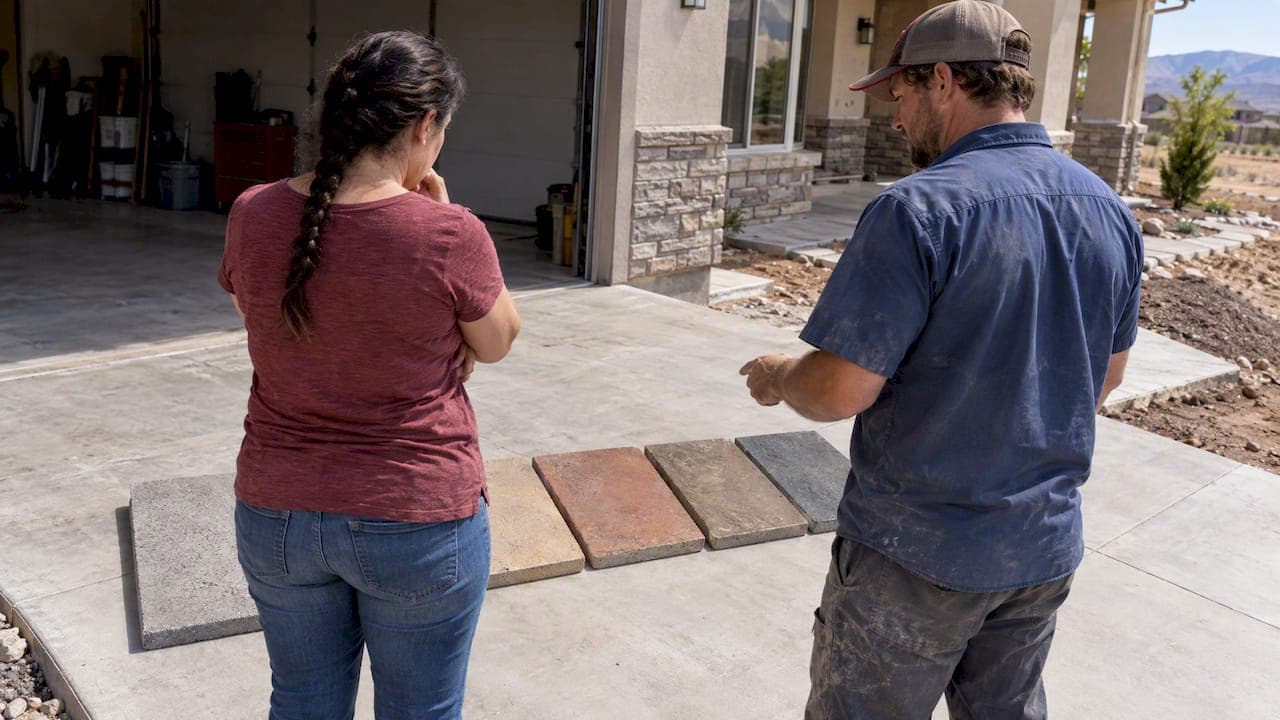
The main ways to color concrete are integral color, color hardener, reactive acid stain, water-based stain or dye, and surface paint or overlay. Integral color suits new pours that need uniform tone. Hardener works best on stamped or textured surfaces. Reactive stains give variegated, durable outdoor finishes. Dyes shine on interior or polished floors, and paints handle repairs or budget refreshes. Whatever you pick, test it on a mockup and seal it.
TL;DR:
- Integral color provides consistent, uniform pigmentation throughout the slab, making repairs easier and minimizing visible color variations over time.
- Acid stains bond chemically with concrete, producing durable, variegated finishes ideal for outdoor use with a wide, but narrower, color palette.
- Water-based dyes offer extensive color variety for interior floors but tend to fade quickly outdoors under UV exposure, limiting their outdoor longevity.
- Hardener products increase surface abrasion resistance, especially suitable for stamped patios and pool decks, but only protect the top layer.
- Proper sealing and testing a mockup in site lighting are essential for achieving expected color permanence and appearance, with sealing every few years extending pigment life.
Table of Contents
- 1. The main coloring methods and how they behave
- 2. Concrete color palettes: what the charts show versus what you get
- 3. Pros, cons and best uses for each method
- 4. How to pick a concrete color: a step-by-step checklist
- 5. Care, sealing and long-term color preservation
- 6. What contractors learn the hard way on colored concrete jobs
- 7. How lighting and time of day change the way colored concrete looks
- 8. How long each coloring method holds its color
- 9. Environmental and safety notes when coloring concrete
- 10. The one habit that separates good color jobs from disappointing ones
- 11. Where A to Z Construction fits into your color decision
- FAQ
- Sources
1. The main coloring methods and how they behave
Each method changes concrete color at a different stage, which is why they look and perform so differently once the job is done.
Integral color gets mixed directly into wet concrete before it's poured, so the pigment runs through the entire slab rather than sitting on top. Most professional-grade pigments are iron oxides that comply with ASTM C979/C979M, a standard covering light resistance, alkali resistance, and water solubility. Because the color is uniform throughout the slab, minor chips or wear don't expose a different-colored substrate underneath.
Color hardeners are dry-shake products broadcast onto the surface of fresh concrete and then troweled in. They concentrate pigment and hardening compounds right at the wear surface, which boosts abrasion resistance on stamped patios and high-traffic flatwork, though the color only runs a fraction of an inch deep.
Reactive acid stains work differently again: they chemically bond with the cement paste in cured concrete, producing variegated, marble-like coloring that becomes part of the slab itself and holds up well outdoors.
Water-based stains and dyes penetrate cured concrete without a chemical reaction, offering a much wider color range and more consistent coverage. They're often reserved for interior and polished floors because many dye formulations are UV-sensitive and can fade in direct sun.
Surface paints and film-forming overlays sit on top of the slab rather than bonding into it, making them a practical renovation option for covering stains or damage, though they wear and require more frequent upkeep.
Contractors frequently combine methods: integral color for a base tone plus a hardener for added vibrancy and surface toughness, or an acid-stain antiquing wash over a hardened stamped surface for depth.

2. Concrete color palettes: what the charts show versus what you get
Suppliers typically group concrete color charts into a handful of families: light, medium, and charcoal grays; earth tones like tan and chocolate brown; terracotta and red-brown shades; natural stone ranges meant to mimic flagstone or limestone; and accent colors used sparingly for borders or bands.
- Grays suit modern and commercial projects where a clean, understated look matters.
- Earth tones and terracotta fit rustic, Southwestern, or desert-landscape styles.
- Natural stone ranges work well for patios designed to pair with existing limestone color range in existing masonry.
- Accent colors are typically used in borders, bands, or scored sections rather than across a full slab.
The cement used and the aggregate in the mix both shift the final hue, sometimes significantly, which is why the same pigment loading can look different from one batch plant to the next. Printed color charts and on-screen chips are only approximations: lighting, printing, and screen calibration all distort true color, and chip samples are usually unsealed while your finished project won't be.
Pro Tip: Order your sample pour from the same batch plant and the same cement source you'll use for the real job, not just the same pigment brand.
For stamped or banded work, consider contrast carefully. A darker antiquing release over a lighter base color reads very differently than two similarly toned integral colors used for borders.
3. Pros, cons and best uses for each method
Matching a coloring method to a project means weighing durability, UV stability, repairability, color uniformity, and cost against what the space actually needs.
Integral color offers excellent uniformity since the pigment runs through the slab, moderate cost, and straightforward repairability because any exposed concrete matches. It's a strong fit for driveways, foundations, and large flatwork where consistency matters more than dramatic variation.
Color hardeners add real abrasion resistance at the surface, which makes them a natural match for stamped patios and pool decks that see foot traffic and occasional impact, but they cost more upfront and only protect the top layer.
Reactive acid stains deliver outstanding UV stability and become part of the concrete matrix, so they hold color well outdoors over years of sun exposure, though their palette is narrower and more unpredictable than integral or dye options.
Water-based dyes give the widest, most vivid color range, which makes them popular for polished interior floors, but many formulations lose vibrancy under direct UV exposure and are not the first choice for exposed exteriors.
Surface paints and overlays are the most affordable way to refresh tired or stained concrete, but they wear fastest and need the most frequent recoating.
Climate matters too. Freeze-thaw cycles and de-icing salts stress surface coatings more than integrally colored concrete, and darker colors raise surface temperature, which affects comfort around pool decks and lowers the solar reflectance index compared to lighter shades.
- Driveways and foundations: integral color for uniformity and durability.
- Stamped patios and pool decks: hardener plus antiquing stain for texture and depth.
- Polished interior floors: water-based dyes for vivid, consistent color.
- Renovation or repair jobs: surface paint or overlay for a budget-friendly refresh.
4. How to pick a concrete color: a step-by-step checklist
Choosing a color works best as a sequence rather than a single decision made from a chart.
- Define the project's function, sun and traffic exposure, and budget before looking at any color samples.
- Pick the coloring method first, based on whether you're working with a new pour or existing concrete, then narrow down a palette within that method.
- Account for your cement color, aggregate, any admixtures, and the finishing technique, since all four shift the final appearance.
- Produce a mockup or test slab in the actual site lighting, following the planning and mockup approach recommended in the ACI/ASCC 310-25 guide for decorative flatwork.
- Record the pigment dosage, mix notes, finishing method, and sealer used so the result can be repeated on future sections or repairs.
Pro Tip: Take a photo of your test slab at the same time of day the finished surface will get the most use, not just at midday when lighting is most forgiving.
Skipping the mockup step is the single most common reason homeowners end up disappointed with a finished color. A chart chip, a screen image, and a cured slab of real concrete are three different things, and only the last one tells you what you're actually getting.
5. Care, sealing and long-term color preservation
Decorative concrete needs a sealer to protect pigment from traffic, spills, and UV exposure, and sealing is part of the performance expectation built into professional pigment standards.
- Penetrating sealers soak into the concrete and leave a natural matte look with good breathability.
- Film-forming sealers sit on top and add sheen along with stronger stain resistance.
- Most exterior decorative concrete needs resealing every few years, with higher frequency in high-traffic or high-sun areas.
Iron-oxide pigments used in integral color and most hardeners resist UV fading well, while organic dyes are more UV-sensitive and better suited to shaded or interior applications. Spot repairs on integrally colored concrete tend to blend more easily than repairs on surface coatings, since the color runs through the material rather than sitting on top. Large or highly visible repairs are worth handing to a professional who can match batching and finishing technique.
6. What contractors learn the hard way on colored concrete jobs
Jake here, writing from A to Z Construction's field experience. The most common mistake is picking a color from a chart and skipping the mockup, then being surprised when the poured slab reads differently under real sun. Inconsistent batching between truckloads and overlooking how the local aggregate color blends with pigment are close behind.
Hiring a contractor makes the most sense for stamped and colored driveways, large slabs, or any job where mockups and consistent batching matter more than a weekend DIY timeline allows.
— Jake
7. How lighting and time of day change the way colored concrete looks
Colored concrete rarely looks the same at 8 a.m. as it does at 2 p.m. Direct overhead sun flattens texture and pigment variation, making integral colors look more uniform and muting the depth of acid-stain mottling. Low-angle morning or evening light, by contrast, throws shadows across stamped texture and can make the same surface look noticeably richer or more dimensional.
Shade changes the read entirely. A patio tucked under trees or an overhang stays cooler and often looks a shade or two darker than an exposed slab finished with the identical pigment, simply because it never gets the same direct light. Artificial lighting at night, especially warm-toned bulbs, can shift grays toward tan and mute reds and terracottas.
This is one more reason a mockup matters: a sample viewed only in a showroom or under a cloudy afternoon sky won't tell you how a color performs at dusk by the pool, or at noon on an unshaded driveway. Walk the test slab at different times of day before committing, especially for exterior spaces where lighting conditions vary constantly through the seasons.
8. How long each coloring method holds its color
Longevity depends almost entirely on which method you chose and how exposed the surface is to sun and traffic.
Integral color, because the pigment runs through the slab, tends to hold its tone for the life of the concrete, with surface wear simply revealing more of the same color underneath. Reactive acid stains become part of the cement matrix rather than sitting on the surface, which gives them strong outdoor longevity even under years of sun exposure.
Color hardeners hold up well against abrasion since the pigment is concentrated at the wear layer, but that layer is thin, so heavy, repeated surface grinding or aggressive de-icing chemicals can eventually expose less-pigmented concrete underneath.
Water-based dyes are the most vulnerable to fading outdoors; many formulations aren't built for sustained UV exposure, which is part of why they're favored for interior and polished floor work instead. Surface paints and film coatings fade and wear fastest of all the options, since the color sits entirely on top of the slab rather than bonding into it, and they typically need recoating on a shorter cycle than any penetrating or integral method.
Sealing extends the working life of every method by shielding pigment from UV, foot traffic, and chemical exposure, but it doesn't change which pigments are inherently UV-stable to begin with.

9. Environmental and safety notes when coloring concrete
Acid-reactive stains use strong acidic solutions that require gloves, eye protection, and good ventilation during application, and the runoff should be neutralized to protect soil, storm drains, and landscaping. Integral pigments and dry-shake hardeners are generally less hazardous to handle but still produce fine particulate dust during mixing, so a dust mask is worth wearing when adding dry pigment on site.
Water-based stains and dyes are typically lower-odor and easier to handle than solvent-based coatings, though manufacturer safety sheets should guide ventilation and disposal regardless of the product. Any leftover acid stain, sealer, or paint should be disposed of according to local hazardous waste guidelines rather than poured down a drain.
Carbon black pigment, sometimes used for darker integral colors, can affect air entrainment in a concrete mix, which is one more reason a test batch from your actual supplier matters before a full pour. Checking a product's safety data sheet before application protects both the person doing the work and nearby landscaping, pets, or waterways.
10. The one habit that separates good color jobs from disappointing ones
Test first, seal second, this is the whole game. Every method on this list can look great or fall flat depending on cement color, aggregate, lighting, and maintenance, so chasing a perfect-looking chip without weighing climate and upkeep is how projects go wrong. The best results often come from combining methods rather than picking just one.
— Jake
11. Where A to Z Construction fits into your color decision
Once you've narrowed down a method and palette, the harder part is making sure the poured result matches what you picked. We handle concrete driveways, stamped patios, flatwork, sealing, and sample pours as part of one coordinated process.

- We can produce a mockup or test slab in your actual site lighting as part of the estimate process.
- We track pigment dosage and mix notes so repairs or additions match years later.
- One team handles the pour, the finish, and the sealing.
If you're ready to see how a color choice looks on your own site before committing to a full pour, reach out through our concrete services page to set up a mockup or get an estimate.
FAQ
What is the best color for concrete?
There's no single best color since it depends on your project's style, climate, and surrounding materials. Light and medium grays suit modern and commercial spaces, while earth tones and terracotta shades work well with rustic or Southwestern landscaping, and all of them read differently once poured than they do on a chart.
What is the 10/20/30/40 rule for concrete?
This isn't a standardized industry rule referenced in concrete coloring or mix design literature, so definitions you may encounter vary by source and aren't backed by a recognized standard. If you've seen it cited for a specific context like curing times or mix ratios, it's worth confirming directly with the source rather than treating it as an established guideline.
Should I seal colored concrete?
Yes, sealing protects pigment from UV exposure, traffic wear, and spills, and it's considered part of the expected performance for professionally pigmented concrete under ASTM C979/C979M. Most exterior decorative concrete needs resealing every few years depending on traffic and sun exposure.
What's the difference between stained and colored concrete?
"Colored concrete" usually refers to integral color or hardeners mixed or applied during placement, giving uniform or surface-level tone, while "stained concrete" refers to acid or water-based stains applied after the concrete cures. Stains react with or penetrate the cured surface, producing variegated or translucent effects that integral color and hardeners don't achieve.
Do I need a test slab before choosing a concrete color?
Yes, a test slab or mockup poured with your actual cement, aggregate, and pigment is the only reliable way to see the true finished color, since printed charts and screen images are approximations. The ACI/ASCC 310-25 guidance on decorative concrete planning recommends mockups specifically to avoid this kind of mismatch before a full pour.
Sources
- Concrete color guide — Solomon Colors
- ASTM C979/C979M — Standard Specification for Pigments for Integrally Colored Concrete
- ACI/ASCC 310-25 guide (preview) — Decorative concrete planning and mockups
- Concrete Coloring Comparison Chart — ConcreteNetwork