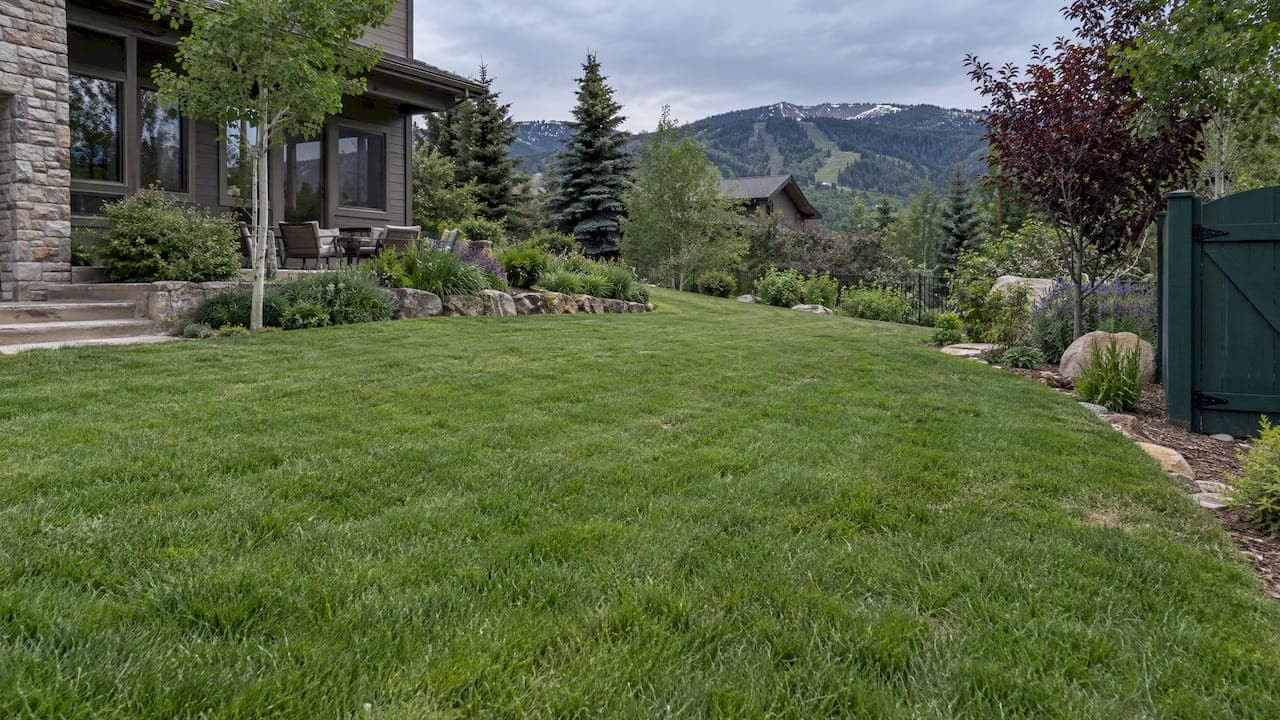
For most Utah lawns, the best grass is a cool-season type: tall fescue for an all-around, heat-tolerant lawn, Kentucky bluegrass for high-traffic sunny yards, and fine fescue for shade. If you want the lowest water bill and can live with a lawn that browns at the edges of the season, buffalograss is the low-water option. The right pick depends on how much sun, shade, foot traffic and irrigation your yard really gets.
Below, we walk through each grass, match it to common Utah yard conditions, and cover seed quality, mowing, watering and when turf is simply the wrong tool for a strip of yard.
TL;DR
- Kentucky bluegrass is the most widely used landscape grass in Utah and handles traffic well, but it wants more water.
- Tall fescue is a strong general-purpose choice: deep roots, good heat tolerance, and often a bit less irrigation than bluegrass.
- Fine fescue is the pick for shade and low fertilizer use; buffalograss is the pick for the lowest summer water use.
- Buy a mix of named varieties and skip seed blends that contain annual ryegrass, Kentucky 31 tall fescue or Linn perennial ryegrass.
- Strips, slopes and spots where nothing grows well are better served by xeriscaping or artificial turf than by forcing sod.
Table of Contents
- Why cool-season grasses dominate in Utah
- The main lawn grasses compared
- Match the grass to your yard
- Choosing seed that will actually perform
- Seed, sod or something else?
- Water, mowing and care that make any grass better
- Perspective
- What a Utah lawn project can cost with us
- Planning a new lawn or yard? We can handle it
- FAQ
- Sources
Why cool-season grasses dominate in Utah
Utah's yards swing from hot, dry summers to hard winters, with a short growing season in the mountains. Utah State University (USU) Extension says cool-season grasses are the usual fit, and that they can be seeded from midspring to early fall, with late summer being the best seeding window in northern Utah. Soil is still warm then, which helps seed germinate, and cooler air follows.
Water is the other big factor. State legislative materials note that choosing drought-tolerant species and cultivars is essential in Utah because of ongoing water resource challenges. So the question is rarely just "what looks best?" It is "what looks good on the water I am willing to use?"
The main lawn grasses compared
The comparison below draws on USU Extension's turfgrass guidance for Utah.
| Grass | Best for | Strengths | Trade-offs |
|---|---|---|---|
| Kentucky bluegrass | Full sun to partial shade, heavy use | Recovers well from frequent use, dense classic look | Generally higher water demand |
| Tall fescue | General-purpose lawns, hot spots, some shade | Heat tolerance, deep roots, may need somewhat less irrigation | Older varieties were coarse, though most modern ones look close to bluegrass |
| Fine fescue | Shade, low-maintenance areas | Low fertilizer needs | Not meant for heavy traffic |
| Perennial ryegrass | Formal look, fast cover | Establishes quickly when mixed with Kentucky bluegrass | Best as part of a mix |
| Buffalograss | Low-water lawns | Needs much less summer water | Brown in early spring and much of fall |
Kentucky bluegrass
Kentucky bluegrass is the grass most Utahns picture when they say "lawn." USU's Kelly Kopp has explained that it stays dominant because it is functional, recovers from drought and has been well researched for lower-input varieties. Kids, dogs and backyard games are what it does best.
The catch is that it takes longer to establish from seed than some alternatives, and it needs consistent irrigation to stay green through July and August. If you have a sunny yard that gets used daily and you are happy to water properly, it is still hard to beat.
Tall fescue
USU calls tall fescue a good general-purpose turfgrass for Utah. It often tolerates heat better than Kentucky bluegrass, copes with more shade, and its deep roots mean it may get by on somewhat less irrigation.
There is also a disease angle. USU plant health specialists have described tall fescue as a viable disease-resistant alternative to Kentucky bluegrass in home lawns, particularly where summer patch or necrotic ring spot shows up. If you have had those patches in a bluegrass lawn before, fescue is worth a hard look.
Fine fescue
Fine-leaf fescue is the one to choose under mature trees and on the north side of the house. USU describes it as ideal for shady areas with low fertilizer requirements. Use it where you want green without much upkeep, not where the soccer games happen.
Perennial ryegrass
Perennial ryegrass gives a fine, formal appearance and germinates fast. USU notes it establishes quickly when mixed with Kentucky bluegrass. That is the best role for it: a quick-cover partner in a blend, not a stand-alone lawn.
Buffalograss and other low-water options
Buffalograss needs much less summer water, but USU is clear about the trade-off: it is brown in early spring and much of the fall. Wheatgrasses suit unirrigated areas and go dormant in dry summers. If a golf-course look is not your goal, these can cut your water use sharply.

Match the grass to your yard

Sunny, high-traffic lawns
USU's recommendation for lawns with lots of use and full sun to partial shade is Kentucky bluegrass. A bluegrass-dominant mix with a little perennial ryegrass for quick cover is a classic combination.
Hot, exposed yards and southern Utah
In the hottest parts of the state, heat tolerance matters more than that deep-green bluegrass look. Tall fescue is the natural candidate. In southeast Utah, USU also advises that mowing higher improves resilience to hot weather, with a minimum height of 2.5 to 3 inches, and that you irrigate early in the morning to avoid evaporative losses. Those habits help every grass in this guide.
Shady lots
Fine fescue first, tall fescue second. Pair either with realistic expectations: shade lawns thin out faster, and some areas under dense evergreens will never be a good lawn. That is a landscaping problem, not a seed problem, and groundcovers or planting beds often solve it.
Mountain and high-elevation yards
In places like Park City, the growing season is short. Hardy cool-season mixes and fine fescue blends are the usual starting point there. Whatever you pick, seed early enough that roots establish before the first hard freeze.
Low-water yards
If your goal is to cut irrigation, start with tall fescue, then consider buffalograss or a low-water alternative. A Salt Lake City turf trade project described in Utah legislative materials shows that choosing specific low-water varieties can significantly reduce annual irrigation needs. Seed type is a water decision as much as a looks decision.
For a deeper look at turf-free and reduced-turf choices, see our guide to drought-tolerant lawn alternatives and our list of Utah xeriscape plants. If you like the idea of a mixed, meadow-style look, an alternative lawn seed mix can suit low-traffic corners of a water-wise yard.
Choosing seed that will actually perform
Seed quality matters as much as species. USU's advice for most Utah lawns is that seed from a reputable garden center or nursery usually works, as long as you look for a quality mixture of named varieties and avoid blends with annual ryegrass, Kentucky 31 tall fescue or Linn perennial ryegrass.
A practical way to read a seed tag:
- Look for named varieties, not generic "tall fescue" or "lawn mix."
- Check the species percentages against your yard: more bluegrass for sun and traffic, more fescue for shade or heat.
- Scan the ingredient list for annual ryegrass and the varieties USU says to avoid.
- Check the test date and weed seed percentage.
The cheapest bag is usually cheap for a reason. A lawn is a ten-year decision, so a modest premium on seed is a small part of the total cost.
Seed, sod or something else?
Seed is the lowest-cost route and gives you the widest choice of varieties, but it needs steady watering for weeks and is best done in late summer or early fall. Sod gives an instant lawn and works well for slopes, erosion-prone areas and anyone who wants a finished yard this season. Our team installs sod and other softscape for homeowners who want it done once and done right.
For spots where grass struggles, you have other options:
- Xeriscaping, with water-wise plants, rock and mulch, designed to look intentional rather than bare. See our xeriscaping service.
- Artificial turf, for play areas, pet runs, side yards and anywhere that needs to look green year-round without mowing. See our artificial turf installation page.
Water, mowing and care that make any grass better
Even the best grass fails with poor care. A few habits do most of the work:
- Mow high. Keep cool-season lawns at roughly 2.5 to 3 inches in summer, in line with USU's guidance for hot conditions.
- Water early. Morning irrigation reduces evaporation, according to USU.
- Water deeply, not daily. Deeper, less frequent watering encourages deep roots, which is what makes tall fescue so resilient.
- Check your sprinklers. Dry spots and soggy spots are usually an irrigation layout issue, not a grass issue.
That last point is where many lawns go wrong. If heads are mismatched, mis-aimed or old, the best seed in the world will still look patchy. A properly designed irrigation and sprinkler system is often the real fix.
Perspective
We build and rebuild a lot of Utah yards, and the pattern is consistent: people pick a grass first and think about the ground, the water and the layout second. It should be the other way around.
Before seed or sod goes down, the grade has to drain away from the house, the soil needs to be ready, and the irrigation has to cover the lawn evenly. Because we handle excavation, grading, irrigation and landscaping with our own crew rather than passing pieces between subcontractors, those steps happen in the right order and one person is accountable for the result.
Our honest advice is to put real turf where you will use it, such as play areas and the main backyard, and to use xeriscaping or artificial turf for the odd strips, slopes and side yards that eat water without giving anything back. That mix looks better and costs less to maintain over the years.
Jake
What a Utah lawn project can cost with us
If you decide that part of your yard is better off as turf-free landscaping, these are our published ranges:
- Artificial turf: $8 to $20 per square foot.
- Irrigation and sprinkler systems: $3,000 to $8,000.
Actual pricing depends on your site, the size of the area and the materials, so we quote each project individually.
Planning a new lawn or yard? We can handle it
A to Z Construction is a licensed general contractor in Cedar City, Utah, and our in-house crew handles grading, irrigation, sod, xeriscaping, artificial turf, hardscape and fencing. That means a single point of contact from the first estimate to the last cleanup, with no handoffs between separate companies.

If you want a lawn that fits your yard and your water budget, take a look at our landscaping services and request an estimate.
FAQ
What is the most common lawn grass in Utah?
Kentucky bluegrass is the most popular grass on Utah landscapes, according to USU Extension reporting. It is common because it is durable, recovers from wear and has been widely researched. Tall fescue is a growing alternative where heat, disease or water use is a concern.
What is the best grass seed for shade in Utah?
Fine fescue is the usual choice. USU describes fine-leaf fescue as ideal for shady areas with low fertilizer needs. Tall fescue also tolerates more shade than Kentucky bluegrass. In very dense shade, consider groundcovers or mulch beds instead.
When should I plant grass seed in Utah?
Cool-season grasses can be seeded from midspring to early fall, but late summer is the optimum time in northern Utah. Warm soil speeds germination and cooler weather follows. Check your local extension calendar for your area's specifics.
What is the most drought-tolerant grass for Utah?
Buffalograss needs much less summer water, though it is brown in early spring and much of the fall. Wheatgrasses suit unirrigated areas but go dormant in dry summers. Among conventional lawn grasses, tall fescue may need somewhat less irrigation than Kentucky bluegrass.
Which seed blends should I avoid?
USU advises avoiding mixtures that contain annual ryegrass, Kentucky 31 tall fescue or Linn perennial ryegrass. Look for a quality mixture of named varieties from a reputable garden center or nursery instead.
Sources
- Turfgrass Cultivars for Utah, USU Extension
- Lawn Care, USU Extension
- Southeast Utah Turfgrass Management Calendar, USU Extension
- USU Extension Testing Grass Varieties For More Efficient Landscapes, Utah Public Radio
- Turfgrasses in Utah, Utah State Legislature
- UTAH PESTS News, USU Extension