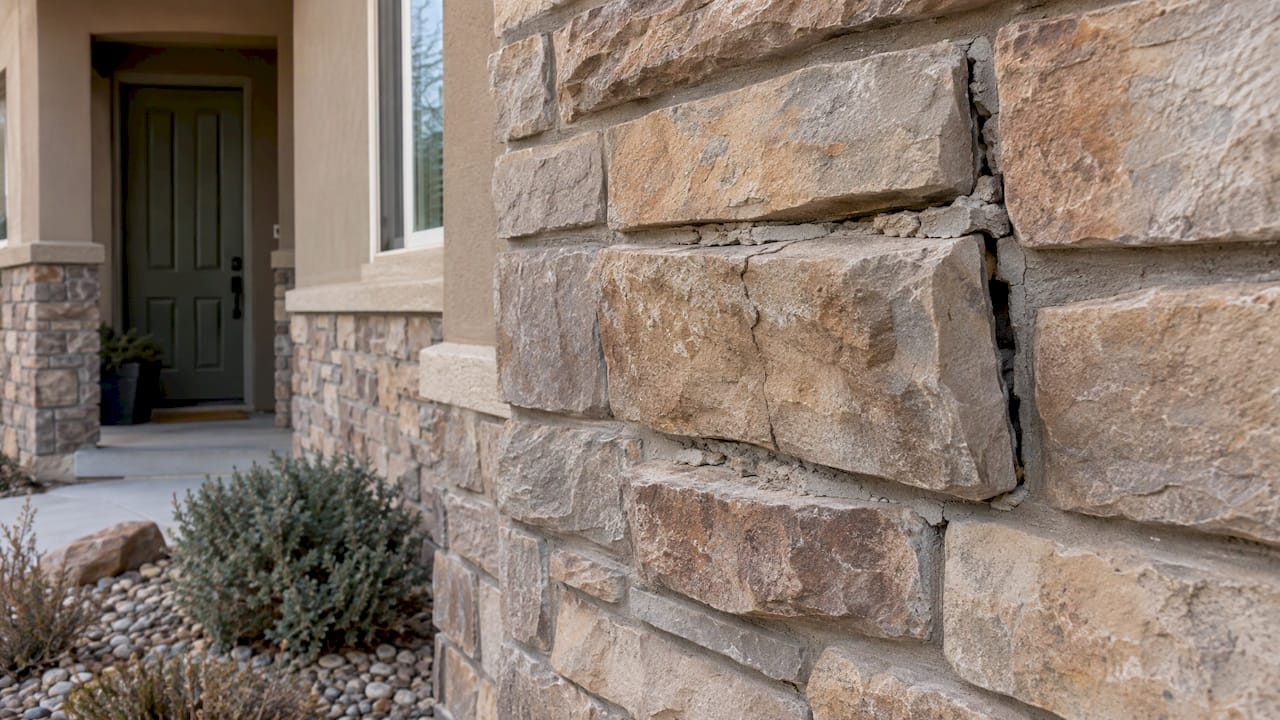
Stone veneer fails for a small set of reasons, and almost all of them come down to water and how the wall was built: how well the stone is bonded, and whether moisture that gets behind it has a way out. If stones are loose, cracks keep returning or stains show on the wall, the fix is to find where the water is going and correct that first. At A to Z Construction, a licensed general contractor in Cedar City, Utah, one in-house crew handles the masonry and the work around it, so the stone, the flashing and the finishes are coordinated by a single point of contact rather than passed between subcontractors.
TL;DR
- Most stone veneer failures start with water: poor bond, no drainage path or missing flashing, not with the stone itself.
- Hairline cracks on a dry wall are often cosmetic. Loose stones, growing cracks, stains and efflorescence (white mineral deposits) call for a closer look.
- Damage behind the stone can be invisible from the outside, so a clean-looking wall does not prove the framing is dry.
- A lasting repair corrects the cause, such as flashing, weeps (small drainage openings) or grade clearance, before any stone goes back.
- Photograph and date what you see, then have the wall assessed by a masonry contractor who can also handle what lies behind the stone.
Table of Contents
- What stone veneer is, and why it depends on water management
- The main causes of stone veneer failure
- Reading the signs on your own wall
- Why the worst damage is often invisible
- What to do when you find a problem
- How a repair or new installation should be built
- Perspective
- Getting your wall repaired or rebuilt
- FAQ
- Sources
What stone veneer is, and why it depends on water management
Stone veneer is a thin layer of natural or manufactured stone attached to a wall. It is a finish, not a structural element. The wall behind it carries the load, which is why repeated detachment or widespread cracking often points to something underneath rather than to the stones.
The common form on US homes is adhered veneer, where stone is bonded to the wall with mortar. An ASCE paper on adhered masonry veneer failures by Kimball Beasley, who has investigated wall failures for more than 40 years, describes how widely this cladding has spread across US exterior walls in the past two to three decades. It names loss of bond, cracking and displacement as typical failures. It also says that keeping rainwater out of the wall is the greatest challenge, and that costly failures continue despite improved codes.
The Brick Industry Association's description of veneer as a drainage wall is a useful way to think about it. Any water that gets through the face is supposed to run down behind it and leave at the bottom through flashing and weeps. Everything below follows from that idea: when the water has an exit, veneer performs. When it does not, problems show up.

The main causes of stone veneer failure
Incomplete or poorly prepared bond
A veneer unit needs a full setting bed, meaning mortar across its whole back. The IIBEC paper on manufactured stone veneer notes that ASTM C1780 requires full coverage. Voids behind a stone collect penetrating water, which freezes and thaws and pushes the stone off the wall. That matters in Utah, where winter nights regularly cycle through freezing.
Material choice matters as well. If you are curious how mortar mixes differ, our short guide to mortar types and which mix fits a project explains the basics.
Water trapped at the bond line
Joseph Lstiburek of Building Science Corporation explains in BSI-113 that bond failures almost always occur at the interface between the stone and its setting mortar. A lumpy stone surface holds rainwater in its nooks, and that water concentrates at the interface. Failures cluster where rain exposure is greatest, and they get worse when the stone sits over sheathing with no drainage.
No place for water to leave
The wall needs a water-resistive barrier behind the stone, flashing at openings and transitions, and a weep path at the base. InterNACHI points out that manufactured stone is not installed with an air space, so when it is saturated it holds rainwater directly against the framed wall, with little room to drain or dry. Serious water damage can follow under ordinary weather.
The usual suspects are:
- missing weep screed (a metal strip that lets water out at the base) at the bottom of the wall
- no flashing above windows, doors and at the top of the veneer
- flashing laid in reverse so water runs behind it, which the IIBEC paper calls the most common flashing failure
- stone touching soil, pavement or roofing
- continuous caulk where a drainage gap should be
Freeze-thaw, movement and impact
Water that freezes inside mortar joints expands and stresses them. Settlement or movement between different building materials can also crack the veneer, and a hard impact can chip or dislodge individual stones. These are real, but they are easier to tell apart from a water problem once you have looked at where the cracks are and whether the wall is wet.
Corroded lath on plastered systems
Where expanded metal lath is not fully embedded in the plaster layer, it can rust. The IIBEC paper describes the expansive corrosion forces popping stone off the wall, especially in salty coastal air, and notes the falling-debris risk. This is mainly a coastal issue, but it shows how a hidden material can drive visible failure.
Reading the signs on your own wall
You can learn a lot with a walk-around. The ASHPI home inspector article on anchored masonry veneer inspection identifies efflorescence as a common sign: minerals left behind as moisture evaporates through masonry. Heavy deposits you can pick off in your hand may indicate significant moisture movement.
Look for:
- Stains and white deposits on the stone or mortar, especially below windows and at roof intersections.
- Loose, hollow-sounding or missing stones, and mortar that is soft or crumbling.
- Cracks wider than a hairline, cracks that visibly grow, or cracks paired with movement elsewhere in the house.
- Rust marks on or near the stone.
- Interior clues: damp patches, musty smells, or baseboards pulling away at the foot of a wall behind stone.
- Where stone meets siding: a swollen or soft bottom course of siding, or peeling paint on its lower edge.
- Base of the wall: stone closer to the ground than it should be, with no visible weep path.
None of these alone proves the wall is failing. Together, or when they keep coming back, they tell you the wall needs assessing.
Why the worst damage is often invisible
The visible stone is only the outer layer. Behind it sit the barrier, sheathing, insulation and framing. A forensic engineering paper from the Forensic Engineering 8th Congress reports that after hundreds of water-intrusion investigations, damage to structural framing often was not revealed by distress at the interior finishes or the exterior facade. Confirming it frequently takes destructive testing, which means opening the wall.
The American Society of Home Inspectors makes a similar point in its article on adhered masonry drainage: damage hidden behind adhered stone is often not visible in a standard inspection, and the wall may need a specialized one. Typical visible clues it lists are moisture stains where water enters and missing kickout flashing or missing flashing above shingles.
So a wall that looks fine can still be wet behind. When you are weighing a diagnosis, ask for one that rests on measurement rather than guesswork. The same principle applies to damp problems in any building, as this overview on measurable moisture diagnosis explains.
What to do when you find a problem
Document it. Mark the ends of any crack with a pencil, take dated photos, and compare after heavy rain, a freeze or a big temperature swing. A stable, dry hairline crack is a very different situation from one that moves.
Keep water out of the equation until it is understood. Do not fill an active crack with rigid mortar and do not seal a wall that is wet. Either can trap moisture inside and make later repair harder.
Find the source before choosing the repair. The Penn State research on thin stone facade failures frames repair around five considerations: safety, aesthetics, feasibility, cost and serviceability. It stresses that the causes of the original distress must be remedied or the failure will repeat, and that the cost of repair should be weighed against removal and replacement.
Decide the scope. A few stones that were knocked loose are a small job. Where flashing and drainage were never installed correctly, the sound choice is often to take the stone off the affected area, correct the layers behind it and set the stone again. Patching around a wall that is wet behind simply moves the failure to the next season.
Get it assessed. If you see loose or falling stone, cracks admitting water, or signs of movement, have the wall evaluated. Where there are signs of structural movement, bring in a structural engineer.
How a repair or new installation should be built
The good news is that the details that prevent failure are well established, and they are the same ones a repair restores.
| Detail | What it does | Where it goes wrong |
|---|---|---|
| Water-resistive barrier, lapped correctly | Sheds water that gets through the stone | Reverse laps direct water behind the flashing |
| Flashing at openings, roof and deck intersections, and top of wall | Sends water outward | Missing or unsealed at the top of the veneer |
| Drainage layer and weep screed at base | Lets water leave the wall | Stone run down to grade with no exit |
| Full setting bed with the right mortar | Keeps the stone bonded | Voids that collect water and freeze |
| Clearance from soil, paving and roofing | Keeps splash and moisture off the stone | Veneer touching the ground or a roof |
The International Residential Code, in its 2021 edition, calls for weepholes above the base flashing at no more than 33 inches apart, according to a 2026 guide citing it. Local codes and amendments vary, so a contractor who works under Utah's codes every day is the one to confirm what applies on your wall.
The IIBEC paper adds that the IBC and IRC call for flashings at window and door perimeters, penetrations and where walls meet roofs, chimneys, porches, decks and balconies. Those are the places to scrutinize on any stone project, new or repair.
Perspective
Homeowners usually call us about the stone, but the stone is rarely the real story. A veneer wall is a system: barrier, flashing, drainage, bond and finish. When one layer is skipped, the others take the blame.
That is why we think the strongest answer to a veneer failure is a single crew that sees the whole wall. Our masonry, concrete, remodeling and exterior work are done in-house by a licensed crew, without handing pieces to subcontractors. You deal with one point of contact, and the person who plans the stone also plans how the water leaves the wall, how the grade meets it and how it ties into the siding, roof and patio next to it.
We build for Utah's climate and codes, where freeze-thaw and sudden weather are part of every wall's life. Our advice is simple: fix the cause, then rebuild the finish.
Jake
Getting your wall repaired or rebuilt
If your veneer is loose, stained or cracking, we can look at the wall and plan the repair around its cause. Our masonry repair and restoration service covers existing masonry, and our stone veneer installation service covers new or rebuilt stone. Because we manage every phase internally, the same crew can coordinate the exterior work around the wall, from exterior remodeling to hardscape. You can reach us through A to Z Construction to start with an estimate.

We serve homeowners and business owners in Cedar City and across Utah, and have completed more than 500 projects.
FAQ
Why does my stone veneer keep falling off?
Usually because the bond between the stone and its mortar has been weakened. Common reasons are incomplete mortar coverage, trapped water that freezes and thaws, or movement in the wall behind. If stones keep detaching, the cause sits underneath, so the wall should be assessed before more stone is reset.
Is a crack in stone veneer a sign of water damage?
Not always. A dry, stable hairline crack can be cosmetic. Cracks that widen, let water in, or appear with stains, efflorescence or interior dampness point to moisture. Mark the ends and photograph them over a few weeks to see whether they move.
Can water damage behind stone veneer be seen from outside?
Not reliably. Forensic investigators report that framing damage often shows no distress at the exterior or interior finishes. Soft siding above the stone, musty smells inside and staining at the top courses are the clues worth acting on.
Can failed stone veneer be repaired?
Yes. Minor, dry damage can be repaired by a mason. Where water is involved, the repair has to correct the source first, which can mean removing stone in the affected area, restoring the layers behind and resetting the stone.
Sources
- Adhered Masonry Veneer Failures, ASCE
- Manufactured Stone Veneer: Common Pitfalls in Design and Installation, IIBEC
- BSI-113: Stoned, Building Science Corporation
- Inspecting Manufactured Stone for Water Damage, InterNACHI
- Anchored Masonry Veneers Inspection, ASHPI
- Adhered Masonry Drainage, American Society of Home Inspectors
- The Importance of Destructive Testing, Forensic Engineering 8th Congress
- Thin Stone Facade Problems and Causes of Failure, Penn State
- Stone to Siding Transition: Flashing, Gaps and Rot