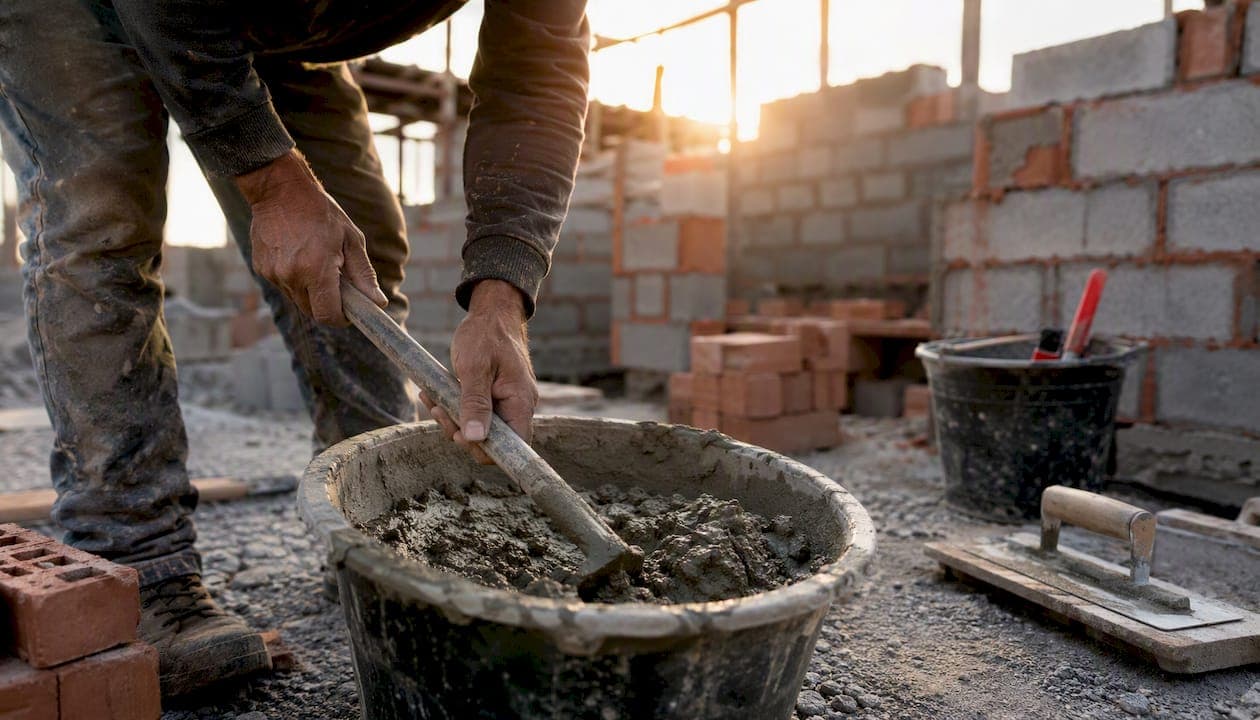
The five mortar types recognized under ASTM C270 are M, S, N, O, and K, ranked from strongest to weakest. The selection rule that matters more than any spec sheet: pick the lowest-strength mortar that still meets your project's structural and durability needs. Stronger isn't automatically better. A mortar harder than the brick or stone around it can crack the masonry unit instead of flexing with it.
Here's the quick version for common jobs:
- Foundations, retaining walls below grade, heavy load-bearing structures → Type M
- Retaining walls, driveways, exterior walls exposed to high winds or seismic load → Type S
- General residential brick veneer, chimneys, above-grade walls → Type N
- Interior partition walls, non-load-bearing repairs → Type O
- Historic restoration, soft stone, and repointing pre-1900 masonry → Type K
Pro Tip: If you're not sure whether your wall is load-bearing, assume it is until an engineer or your local building department confirms otherwise. Guessing wrong here costs a lot more than a mortar bag.
Key Takeaways
The single most important rule in mortar selection: choose Type M, S, N, O, or K based on structural need, always defaulting to the lowest strength that meets the job's requirements.
| Point | Details |
|---|---|
| Five ASTM types exist | Types M, S, N, O, and K run from roughly 2,500 PSI down to 75 PSI minimum compressive strength. |
| Lowest strength wins | Select the weakest mortar type that still meets structural and durability requirements for the job. |
| Match brick and mortar | Compare brick Initial Rate of Absorption to mortar water-retentivity before finalizing a mix. |
| Historic work needs soft mortar | Use Type K or lime-rich mixes on pre-1900 masonry so the mortar, not the brick, absorbs stress. |
| Professional installation matters | A-to-zconstruction's in-house masonry crew selects, mixes, and installs mortar matched to each project's brick and structural load. |
Table of Contents
- Mortar Types Explained: PSI, Mix Ratios, and Uses at a Glance
- What Sets Each Mortar Type Apart
- How to Choose the Right Mortar for Your Job
- Mixing Mortar: Ratios, Water Control, and Onsite Cautions
- When You Need Something Outside the Standard Types
- Why the Strongest Mortar Isn't Always the Best Choice
- What Contractors Check Before They Order Mortar
- Get the Right Mortar and Installation From a Local Masonry Crew
- Sources
- FAQ
Mortar Types Explained: PSI, Mix Ratios, and Uses at a Glance
Compressive strength tells you how much load a cured mortar joint can carry, measured in pounds per square inch. The ASTM minimums run from roughly 2,500 PSI down to 75 PSI, a large spread that surprises most people the first time they see it laid out.
| Type | Min. Compressive Strength (PSI) | Typical Mix Ratio (Cement:Lime:Sand) | Best Applications | Workability / Water Retentivity | Grade Suitability |
|---|---|---|---|---|---|
| M | around 2,500 | 1 : 1/4 : 3.5 | Foundations, heavy stone, below-grade walls | Low, stiff mix | Above and below grade |
| S | around 1,800 | 1 : 1/4 : 3.5 | Retaining walls, reinforced block, high-wind areas | Moderate | Above and below grade |
| N | around 750 | 1 : 1 : 6 | Brick veneer, chimneys, general above-grade walls | Good, easy to tool | Above grade (exterior) |
| O | around 350 | 1 : 2 : 9 | Interior partitions, non-load-bearing repairs | Very workable, high water retention | Interior only |
| K | around 75 | 1 : 3 : 11–12 | Historic repointing, soft stone or brick | Highest, very forgiving | Above grade, restoration only |
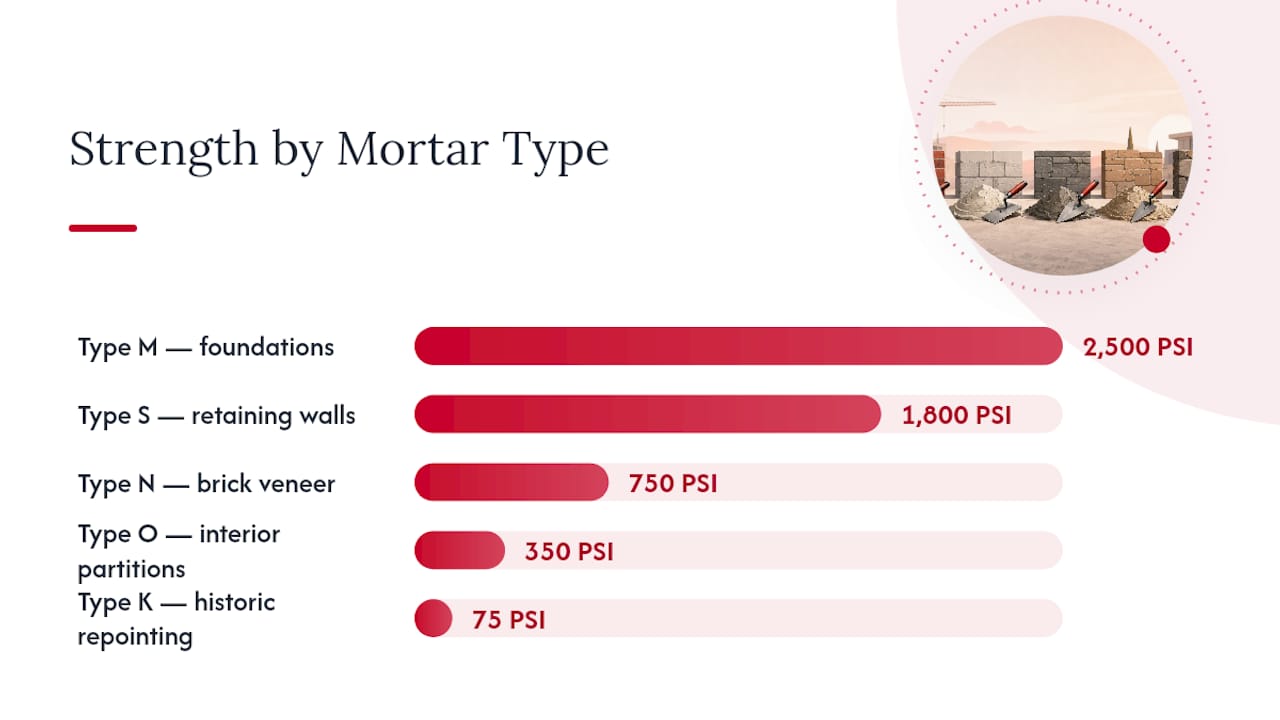
These minimum PSI values come from ASTM C270 laboratory testing, not from bagged product labels. A bag of Type N masonry cement mixed with sand on-site will typically exceed 750 PSI by a good margin, since manufacturers build in a safety cushion. The ratios above are representative examples that vary by manufacturer and region, and many contractors substitute pre-blended masonry cement bags for the traditional cement-lime-sand recipe to simplify batching.
What Sets Each Mortar Type Apart
Each type trades strength for flexibility in a different place, and that tradeoff is the whole story once you understand it.
Type M: the heavy lifter
Type M mortar starts at 2,500 PSI, matching or exceeding many concrete masonry units. It's dense, stiff, and doesn't tool as easily as softer mixes. Contractors reach for it on foundation footings, retaining walls carrying heavy earth loads, and masonry sitting in constant contact with soil or water. The downside: that stiffness means less give, so it's a poor match for brick veneer or anything above grade where movement is normal.
Type S: the structural workhorse
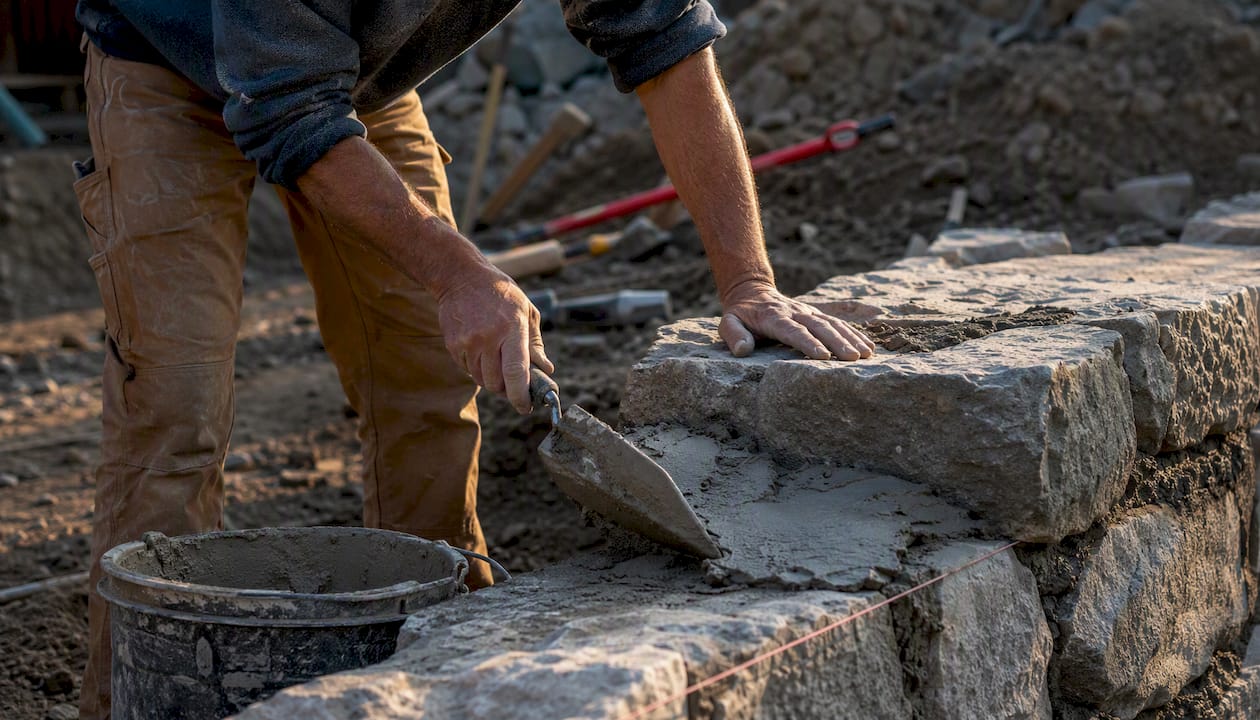
At roughly 1,800 PSI minimum, Type S handles jobs where both compressive strength and bond strength matter. Think retaining walls, exterior walls in high-wind or seismic zones, and reinforced block construction. It has better tensile bond than Type M while still standing up to real structural stress. Masons often reach for Type S on projects where lateral loads, not just vertical weight, are a design factor, which is why it shows up so often in retaining wall specs.
Type N: the all-purpose default
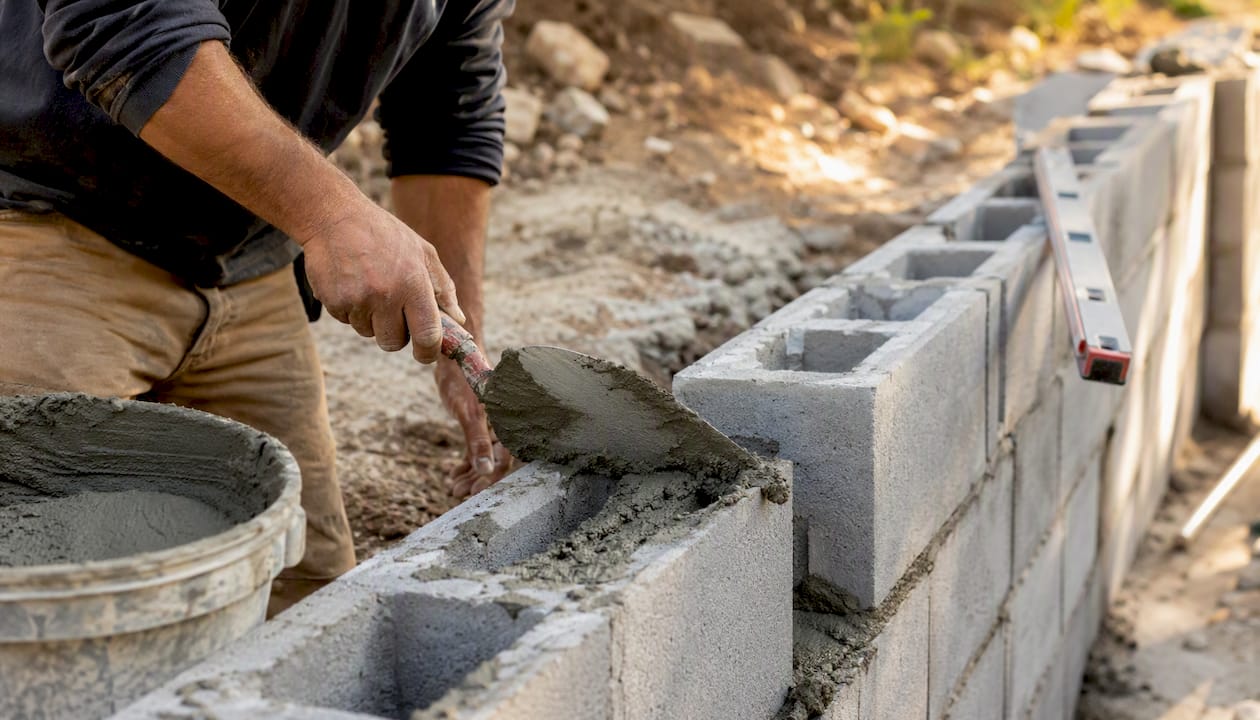
Type N, at 750 PSI minimum, covers the majority of residential brick veneer, chimneys, and above-grade walls most homeowners will ever deal with. Its higher lime content gives it better workability and water retention than M or S, which means it seals joints more completely and is easier to tool into a clean profile. Masons frequently default to Type N for exterior above-grade work because it strikes the best balance between strength and flexibility.
Type O: the low-stress interior mix
Type O sits at just 350 PSI, intended for interior, non-load-bearing applications: partition walls, cosmetic repairs, tuckpointing where structural demand is minimal. Its high lime content makes it extremely workable, but it has no business outside on an exterior wall exposed to freeze-thaw cycles.
Type K: the historic specialist
Type K bottoms out at 75 PSI, barely stronger than the loose sand it's mixed from. That's the point. Historic brick and soft stone from the 1800s and early 1900s were often made with lime mortars weaker than modern standards, and repointing them with a stiffer modern mix can trap moisture and cause the original masonry to spall. Type K, or a straight lime-rich mix, acts as the sacrificial joint, absorbing stress and moisture cycling so the irreplaceable original material doesn't take the damage.
How to Choose the Right Mortar for Your Job
Work through this before you buy a single bag:
- Identify the application. Is it above or below grade? Load-bearing or veneer? New construction or historic repair?
- Check local code and project specs. Some jurisdictions specify minimum types for certain structures regardless of what "seems" adequate.
- Compare required compressive strength against ASTM minimums. Don't round up "just to be safe."
- Match mortar water-retentivity to the masonry unit's Initial Rate of Absorption (IRA). A brick with high IRA pulls water out of the mortar too fast for a proper chemical bond to form, which technical guidance from the Masonry Advisory Council identifies as a leading cause of premature joint failure.
- Select the lowest-strength mortar that satisfies both durability and bond requirements.
The most common mistake in that list is skipping straight to step 5 and picking Type S "to be safe" on a job that only calls for Type N. It doesn't add durability. It adds stiffness the brick has to absorb every time the building expands or contracts with temperature.
- Red flag: a contractor recommends Type M or S for above-grade residential veneer without a structural reason.
- Red flag: nobody has checked the brick's absorption rate before ordering mortar.
- Red flag: the mortar color and texture weren't sampled against the existing wall on a repair job.
Pro Tip: Before a full repointing job, lay a test joint on a hidden section of wall and let it cure for a few days. It's the fastest way to catch a suction mismatch or a color problem before it's on the whole facade.
Mixing Mortar: Ratios, Water Control, and Onsite Cautions
Getting the ratio right on paper doesn't guarantee a good batch. Sand moisture content shifts volume more than most people expect. Damp sand can bulk up by 20 to 30 percent compared to dry sand, which throws off a mix measured by loose volume instead of weight. That's one reason experienced crews measure sand consistently and adjust water incrementally rather than dumping it in all at once.
A few practical notes for the mix itself:
- Type M mixes stiff (1:1/4:3.5 cement:lime:sand); Type K mixes noticeably looser and creamier (1:3:11–12).
- Bagged masonry cement is a legitimate substitute for site-mixed cement-lime-sand blends and reduces measurement error for smaller crews, though the exact ASTM Type equivalence should be checked against the bag label.
- Overwatering is the single most common on-site error. It weakens final compressive strength even when the wet mix looks workable.
- Mix in the same sequence every batch (dry materials first, then water) so different crew members produce consistent results across a job, a habit BIA Technical Note TN-8B recommends as part of routine quality assurance.
- If the masonry units contain integral water repellents, confirm the mortar admixture is compatible. Mismatched repellents can prevent proper bonding at the joint interface.
- Quality washed sand matters more than most DIYers assume. Silt or clay contamination weakens the cured joint regardless of how carefully you measure the cement and lime.
Pro Tip: In hot weather, mortar can flash-set before you've tooled the joint. Keep a spray bottle handy to remoisten mortar boards, and never add water back into mortar that's already started to stiffen. Retempering weakens the final cure.
When You Need Something Outside the Standard Types
Not every masonry job fits neatly into M, S, N, O, or K. A handful of jobs call for specialty formulations built for conditions the ASTM classification never anticipated.
- Refractory mortar withstands sustained high heat and is required for fireplace fireboxes, pizza ovens, and chimney liners. Standard masonry mortar breaks down under repeated thermal cycling.
- Epoxy mortar resists chemicals and moisture penetration, used where standard mortar would degrade from exposure to acids, oils, or constant water contact.
- Thinset mortar bonds tile to a substrate and has nothing to do with structural masonry joints. It's a different product entirely despite the name similarity.
- Lime-only mixes skip Portland cement altogether and are used almost exclusively in historic preservation, where authenticity and extreme softness matter more than strength.
- Lightweight and heavyweight mortars adjust aggregate composition for specific structural or acoustic requirements, more common in commercial specifications than residential work.
According to The Spruce's overview of mortar mix selection, the rule of thumb is simple: reach for a specialty mix only when the environment demands a property standard mortar doesn't have, not as an upgrade on a normal job.
Why the Strongest Mortar Isn't Always the Best Choice
The Brick Industry Association and NCMA both stress the same principle: select the lowest compressive strength mortar that satisfies the job's requirements. That guidance runs against most people's gut instinct, which assumes more strength always means more durability.
The mechanics explain why the opposite is often true. Softer mortars flex with thermal and moisture movement instead of resisting it. When a wall expands in summer heat and contracts in winter, that stress has to go somewhere. In a properly matched wall, the mortar joint absorbs it. In an overspecified wall, the harder mortar refuses to give, and the brick or stone cracks instead. Home Depot's mortar selection guide puts it plainly: mortar is meant to be the sacrificial component of the wall system, not the strongest.
This shows up most dramatically in restoration work. Repointing a 1920s brick facade with modern Type N or S mortar, instead of a lime-rich Type K mix, routinely accelerates deterioration of the original brick because the new joints won't yield the way the old ones did. Efflorescence, the white mineral deposits that appear on brick surfaces, often traces back to trapped moisture from exactly this kind of mismatch, a pattern discussed in Oscar Onsite's technical piece on efflorescence. Matching mortar water-retentivity to brick absorption isn't a nice-to-have detail. It's the difference between a joint that lasts decades and one that fails in five years.
What Contractors Check Before They Order Mortar
Most mortar problems trace back to decisions made before the first bag is opened, not mistakes during mixing.
Overspecifying strength is the most common error, and it usually comes from good intentions. A homeowner asks for "the strongest mortar available" thinking they're future-proofing the wall, when what they actually need is the type matched to the brick. The second most common issue is skipping the brick absorption check entirely. Crews sometimes assume any brick will bond fine with any mortar type, then wonder why joints crumble within a few seasons.
Color and texture matching gets overlooked too, especially on repair jobs. A repointed section that structurally performs fine but visually clashes with the original mortar joints undermines the whole repair. Experienced masons run a small test batch and let it cure before committing to the full wall, comparing both color and joint profile in daylight, not under shop lighting.
Bagged masonry cement versus a full site mix is a tradeoff worth weighing honestly. Bagged mixes are more consistent and faster for smaller jobs. Site-mixed cement-lime-sand blends give more control over exact proportions, which matters more on large commercial pours where batch-to-batch consistency has real cost implications.
Some situations call for outside expertise beyond a mason's judgment call. Anything touching a load-bearing wall, a foundation, or a structure in a seismic zone deserves a structural engineer's sign-off on mortar specification, not just a contractor's experience. Historic buildings with irreplaceable original masonry often warrant a restoration specialist who can identify the original mortar composition before any repointing begins.
Get the Right Mortar and Installation From a Local Masonry Crew
Picking the correct mortar type is only half the job. Mixing it consistently, matching it to your brick or stone, and tooling the joints cleanly is where most DIY attempts fall apart. A-to-zconstruction handles all of it in-house, so the same crew that selects your mortar also mixes and installs it, with no guesswork handed off between subcontractors.
A-to-zconstruction's licensed masonry team in Cedar City, Utah works on everything from new brick and stone masonry installations to masonry repair and restoration projects that call for a historically appropriate mortar. If your project involves retaining walls or block construction, the team also handles CMU block walls where Type S or M mortar selection affects long-term structural performance. Reach out through the masonry services page to get a project estimate and let a licensed crew match the mortar to your masonry, not the other way around.
Sources
- How to choose the right mortar type (Type N, S, M, O, K) — The Home Depot
- Understanding and specifying mortar with brick — Masonry Advisory Council (technical brief)
FAQ
Should I use Type S or Type N mortar?
Use Type N for most above-grade residential brick veneer and chimneys, since it offers good workability and adequate strength for typical loads. Reserve Type S for retaining walls, high-wind exposure, or anywhere added lateral bond strength is structurally necessary.
What are the five different types of mortar?
The five ASTM C270 mortar types are M, S, N, O, and K, classified by minimum compressive strength from roughly 2,500 PSI down to 75 PSI. Each type also differs in mix ratio and typical application, from foundations down to historic repointing.
What are the three types of mortar most commonly used?
For everyday construction, Types N, S, and M cover the vast majority of jobs, with N handling general above-grade work, S handling structural and retaining applications, and M reserved for foundations and heavy loads. Types O and K serve narrower interior and historic-restoration niches.
Is Type S mortar stronger than Type M?
No. Type M has a higher minimum compressive strength at roughly 2,500 PSI, compared to Type S at roughly 1,800 PSI. Type S does offer strong bond characteristics, but Type M remains the stronger mix by compressive strength standards.
What's the biggest risk of choosing the wrong mortar type?
A mortar mismatched to the masonry unit, especially one too strong for soft brick or stone, can transfer stress into the unit and cause cracking instead of absorbing movement in the joint. Working with a licensed masonry contractor like A-to-zconstruction helps ensure the mortar matches both the structural load and the masonry material.