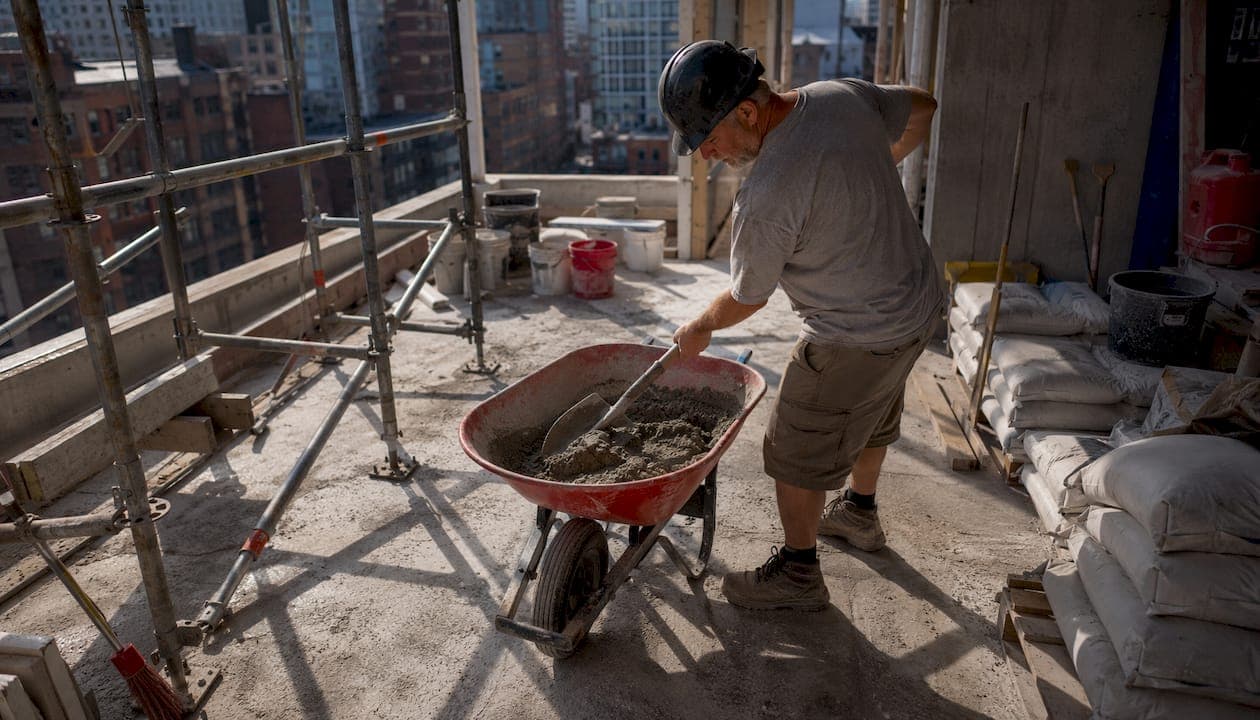
Washed masonry sand is a clean, finely graded sand processed to remove silt, clay, and organic debris — look for "washed and graded" language plus an ASTM C144 reference before using it in mortar or under pavers. That one spec check separates a reliable product from marketing language.
Quick BLUF:
- Mortar work: Requires ASTM C144-compliant, washed and graded fine sand for consistent bond strength.
- Paver bedding and joints: Washed masonry sand levels and locks pavers; confirm the sub-application (bedding vs. jointing) before ordering.
- Landscaping and playground fill: Works well for leveling and play areas; not the right choice for turf topdressing (a different particle-size blend is needed there).
- Not for abrasive blasting — this exclusion appears on every major product listing.
- Size rule of thumb: Bagged options (50 lb) suit small repairs; bulk bags (1,000 lb or 1 cu yd) make more sense for anything covering more than a few dozen square feet.
Table of Contents
- What is washed masonry sand, and why does "washed" matter?
- What can you use washed masonry sand for?
- How does washed masonry sand compare with other sand types?
- Where can you buy washed masonry sand in the U.S.?
- How do you choose the right washed masonry sand?
- How much washed masonry sand do you need?
- Storage, handling, and installation tips
- DIY vs. hiring a contractor: when does it make sense to call A-to-zconstruction?
- Key Takeaways
- A contractor's honest take on buying masonry sand
- A-to-zconstruction handles the material and the installation
- FAQ
What is washed masonry sand, and why does "washed" matter?
Masonry sand starts at a quarry, where granite, limestone, or quartz is crushed to a fine, uniform particle size. From there, the material goes through two critical steps: washing and screening. Washing agitates the sand in water to flush out clay, silt, and organics. Screening then filters out oversized particles, producing the consistent gradation that defines a quality product.
Why does that matter in practice? Clay and silt particles coat sand grains and prevent cement paste from bonding to them. Untreated sand with excess fines produces weak joints that crack under load and weather. Washed sand gives mortar a clean surface to grip.
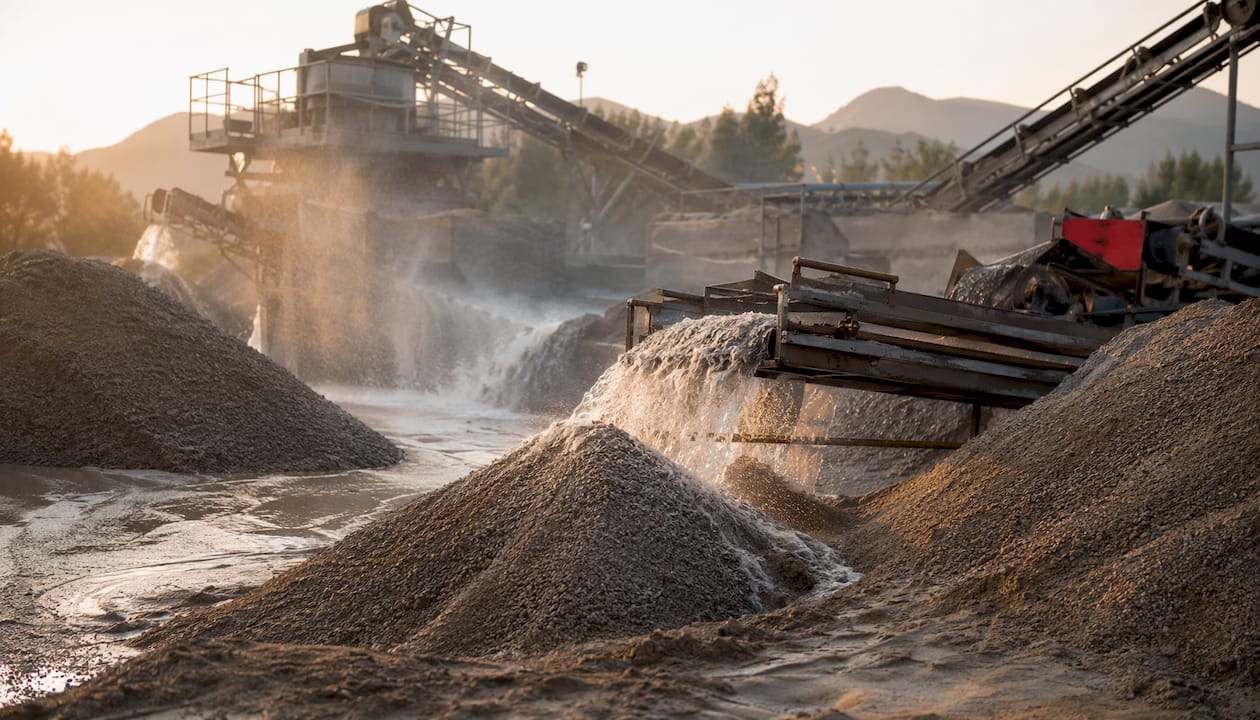
QUIKRETE's Mason Sand data sheet explicitly references both ASTM C144 (aggregate for masonry mortar) and ASTM C270 (mortar for unit masonry). Those two standards together are what contractors look for when specifying sand for structural mortar work. If a product page lists neither, ask the supplier for a gradation report before you commit.
Pro Tip: "Washed" without a spec reference is marketing. Look for ASTM C144 on the data sheet or product page — that's the number that tells you the gradation is controlled, not just that someone ran water over it.
What can you use washed masonry sand for?
Primary uses:
- Masonry mortar — mixed with Portland cement and lime per ASTM C270 for brick, block, and stone work
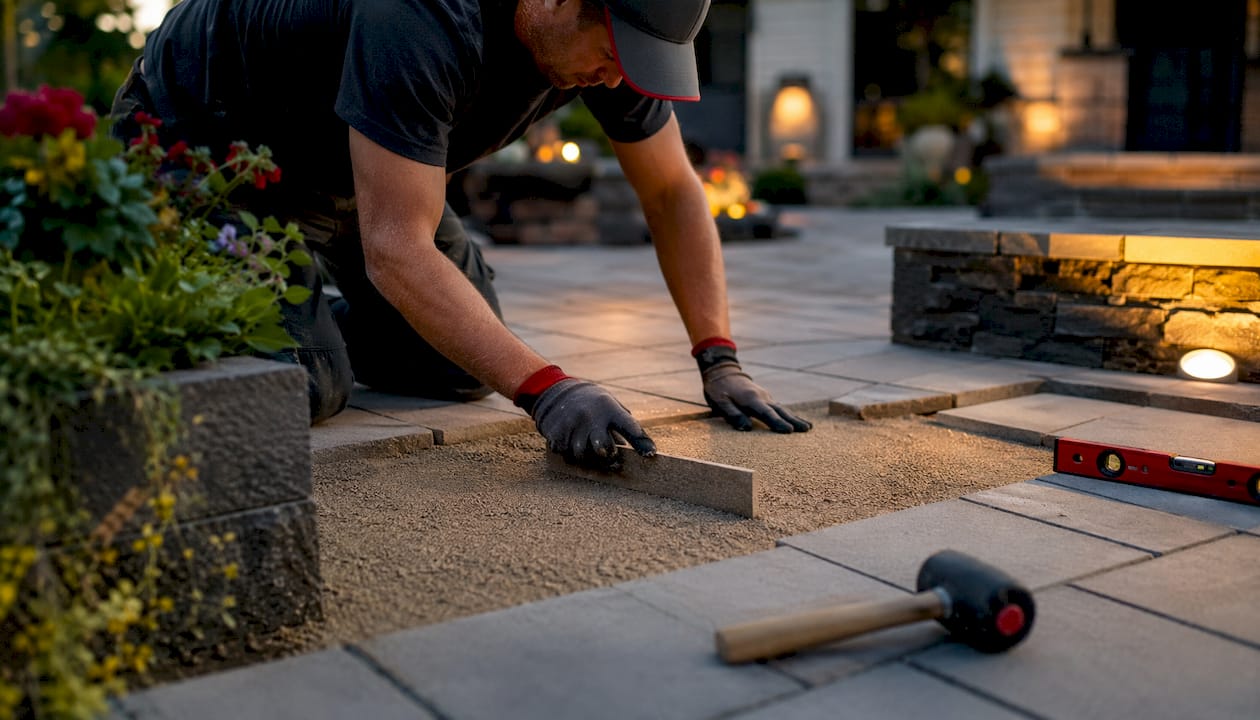
- Paver bedding layer — screeded to a 1-inch depth beneath concrete or natural stone pavers
- Paver joint filling — swept into joints to lock pavers and resist lateral movement
- Plastering and stucco base coats — fine gradation produces smooth, workable mixes
- Playground fill and recreational surfaces — volleyball courts, track and field pits, arena footing
- General leveling — small-scale grade corrections in landscaping
Exclusions and cautions:
- Not for abrasive blasting. Sakrete's product listing explicitly calls this out, and it applies across the category.
- Not ideal for turf topdressing. Masonry sand can be used for basic lawn leveling, but topdressing sand for turf uses a different particle-size blend engineered for root penetration and drainage. Using masonry sand long-term on a lawn can compact the surface and impede drainage.
- Not a substitute for concrete sand in structural concrete mixes — the gradation is too fine and the mix will be weak.
For paver work specifically, match the sand to the sub-application. Bedding requires a coarser, more stable layer (sometimes concrete sand is preferred); jointing uses the finer masonry sand to fill narrow gaps. Buying one product for both without checking the paver manufacturer's spec is a common mistake.
How does washed masonry sand compare with other sand types?
Substituting the wrong sand type is one of the most common jobsite errors. Here's how the main categories stack up:
| Sand Type | Best For | Gradation / Washed | Typical Packaging | Notes |
|---|---|---|---|---|
| Washed masonry sand | Mortar, paver joints, leveling | Fine, uniform; washed; ASTM C144 | 50-lb bags; 1,000-lb bulk bag; 1 cu yd bulk | Not for blasting or turf topdressing |
| Concrete sand (C33) | Concrete mixes, paver bedding screeds | Coarse, angular; washed | Bulk by ton or cu yd | Better drainage; too coarse for mortar joints |
| Play sand | Playgrounds, sandboxes | Very fine; cleaned for safety | Small bags (50 lb) | Not spec'd for mortar; may contain additives |
| Paver sand / polymeric | Paver joints (locking) | Fine; may include polymer binder | 50-lb bags | Hardens when wet; not for mortar |
| Beach / river sand (unwashed) | Avoid for masonry | Variable; unwashed | Bulk | Salt, organics, and inconsistent gradation cause bond failure |
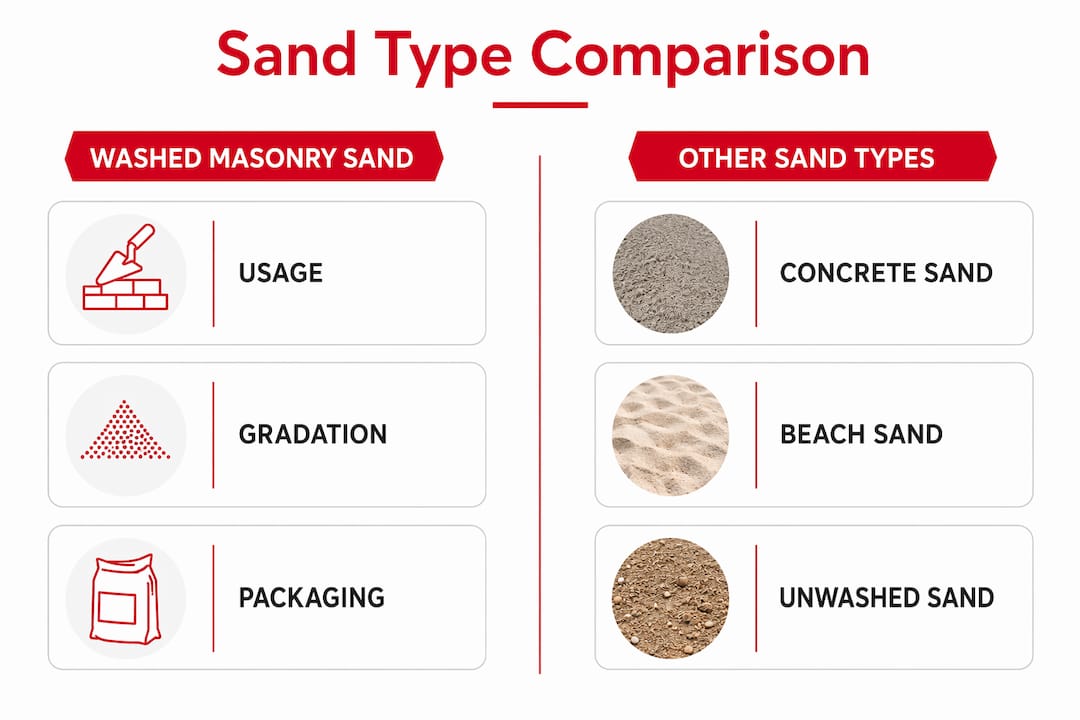
The risk of substitution is concrete: using beach sand in mortar introduces salt and organics that break down the cement matrix over time. Swapping concrete sand into a mortar joint produces a mix that's too coarse to fill narrow gaps cleanly and won't achieve the workability the mason needs.
Where can you buy washed masonry sand in the U.S.?
The market splits into two channels: retail bagged products and bulk supply. Which one fits your project depends on volume, access, and whether you're doing the work yourself.
A-to-zconstruction is the option for Utah homeowners and contractors who want material procurement and installation handled together. Rather than sourcing sand separately and coordinating delivery, A-to-zconstruction manages staging, offload, and masonry installation as a single contracted scope. That matters on jobs where bulk delivery access is tight or the finish quality needs to meet a warranty standard.
Sakrete Mason Sand (50-lb bag) is the go-to retail option for small repairs and DIY mortar mixes. Available at Lowe's and other home improvement stores, it's marketed as a graded and washed sand for custom mortar mixes, with explicit notes on landscaping and paver base use. The 50-lb bag covers a small volume suitable for homeowner-scale work.
QUIKRETE Mason Sand is the contractor's reference product. The data sheet ties it directly to ASTM C144 and ASTM C270, making it the right choice when a spec sheet is required for a bid or inspection. Available at Home Depot and through contractor supply channels.
Home Depot 1,000-lb bulk washed masonry sand covers approximately 9 cu ft per bulk bag and offers delivery or store offload. It's the middle-ground option: more volume than bagged, less commitment than a full cubic yard from a landscape supplier.
Universal Hardscapes offers a 1 cu yd / 2,700-lb bulk bag described as thoroughly washed and screened. That's the professional-scale reference point for large patio or wall projects.
Bagged vs. bulk at a glance:
- Bagged (50 lb / ~0.5 cu ft): Easy to transport in a car or truck, no delivery required, minimal waste risk, higher cost per cubic foot. Best for repairs and small projects.
- Bulk bag (1,000 lb / ~9 cu ft): Retail delivery available, manageable for medium jobs, requires a truck or delivery service.
- Full cubic yard (2,700 lb): Lowest unit cost, requires delivery access and offload equipment. Bulk delivery often has minimum order requirements and offload fees — confirm both before ordering.
Lowe's and Home Depot both carry bagged options in-store. For bulk cubic-yard supply, local landscape suppliers and masonry yards typically offer better pricing and more flexible delivery scheduling than national retailers.
How do you choose the right washed masonry sand?
Use this checklist before placing an order:
- Define the intended use. Mortar, paver bedding, jointing, and landscaping each have different gradation needs. Don't buy one product and assume it covers all four.
- Confirm ASTM C144 compliance. For mortar work, this is non-negotiable. Check the product data sheet, not just the bag label.
- Choose your packaging. Under roughly 10 cu ft, bagged is usually more practical. Over that, bulk saves money and reduces trips.
- Check delivery access. Bulk bags require a truck with offload capability or a crane. Confirm the supplier's offload method before scheduling delivery.
- Inspect on arrival. Color should be consistent and light. Rub a sample between your fingers — it should feel gritty, not sticky or silty. Visible dark specks or organic debris are red flags.
- Request a data sheet. Any reputable supplier will provide one. If they won't, that's a reason to look elsewhere.
Questions to ask your supplier:
- Does this meet ASTM C144?
- Is it washed and screened, and what's the silt/clay content?
- What's the bulk density, and what coverage can I expect per bag or cubic yard?
- What are your delivery minimums and offload requirements?
- Can you provide a gradation report?
Red flags: sticky texture, inconsistent color, visible organics, or a seller who can't confirm the spec or produce a data sheet. Those are signs of poorly processed material that will underperform in mortar and may cause joint failure in pavers. For brick and stone masonry work, a bad sand choice shows up in cracked joints within a season.
How much washed masonry sand do you need?
Get the math right before ordering. Here are the key conversion references:
| Package | Weight | Volume | Typical Use |
|---|---|---|---|
| Standard bagged (Sakrete, QUIKRETE) | 50 lb | ~0.5 cu ft | Small repairs, DIY mortar |
| Home Depot bulk bag | 1,000 lb | ~9 cu ft | Medium projects |
| Professional bulk bag (Universal Hardscapes) | 2,700 lb | 1 cu yd (27 cu ft) | Large patios, walls |
Conversion: To convert volume between cubic feet and cubic yards, note that 1 cubic yard equals 27 cubic feet. Compute volume in cubic feet and convert as needed.
Example calculations:
- Paver patio bedding (1-inch layer, 200 sq ft): 200 × (1/12) = 16.7 cu ft = 0.62 cu yd. One 1,000-lb bulk bag (9 cu ft) won't quite cover it; two bags or a partial cubic yard from a landscape supplier works.
- Brick wall mortar (100 sq ft of wall, standard joint): Mortar volume varies by brick size and joint thickness; a rough rule is 6–8 cu ft of sand per 100 sq ft of wall face. Confirm with your mortar mix design.
- Paver jointing (200 sq ft, 3/8-inch joints): Joint volume is small — a single 50-lb bag often covers 200–400 sq ft of jointing depending on joint width and depth.
Always order 5–10% extra to account for compaction, waste, and any grade variation. Confirm coverage figures with the supplier because bulk density varies between products and sources — a 1,000-lb bag from one supplier may yield slightly more or less than 9 cu ft depending on moisture content and particle density.
Storage, handling, and installation tips
Storage:
- Keep sand covered with a tarp when stored outdoors; rain introduces moisture and can wash fines out of a bulk pile.
- Store bags off the ground on pallets to prevent moisture wicking and bag degradation.
- Keep bulk piles away from runoff paths and organic debris (leaves, mulch) that can contaminate the material.
Handling and offload:
- Bagged sand is straightforward to transport in a pickup or SUV. Stack bags on a pallet for easy handling.
- Bulk bag delivery requires confirming whether the supplier uses a crane truck, forklift, or store-side offload. Mismatched equipment causes delays and sometimes damage to the delivery site.
- For hardscape projects with restricted access, plan the staging location before the truck arrives.
Installation:
- For mortar, add water gradually. Masonry sand mixed too wet produces a weak, shrink-prone joint.
- For paver bedding, screed to a consistent 1-inch depth and avoid disturbing the layer after screeding. Foot traffic before paver placement causes low spots.
- For joint filling, sweep dry sand into joints, compact the pavers, and repeat until joints are full.
Pro Tip: Rub a small handful between your fingers when the delivery arrives. Good washed masonry sand feels gritty and slightly coarse — not smooth or sticky. Stickiness means clay is still present, and that load should be questioned before you use it in mortar.
DIY vs. hiring a contractor: when does it make sense to call A-to-zconstruction?
Small projects — a few bags for a repair, a modest patio under 50 sq ft — are reasonable DIY territory. The math is simple, bagged product is easy to source, and the stakes are low if something needs to be redone.
Larger jobs shift the calculus. Structural masonry, retaining walls, and patios over a few hundred square feet involve bulk material logistics, mortar mix design, and finish quality that's hard to replicate without experience. Bulk delivery access, offload equipment, and proper compaction all become variables that compound quickly.
A-to-zconstruction handles the full scope: material sourcing, delivery coordination, staging, installation, and cleanup. One point of contact instead of coordinating a sand supplier, a delivery truck, and a mason separately. For Utah readers, masonry and hardscape services cover Cedar City and Salt Lake County.
Questions worth asking any contractor you're evaluating: What mortar mix design do you use for this application? How do you handle bulk delivery and staging on my site? What's your warranty on joint work? Can you show me comparable completed projects? For more guidance, review these essential questions to ask your concrete contractor.
Key Takeaways
Washed masonry sand is the right choice for mortar and paver work only when it's confirmed as washed, graded, and ASTM C144-compliant — the spec check is the single most important step before buying.
| Point | Details |
|---|---|
| Confirm ASTM C144 | Always verify spec compliance on the data sheet, not just the bag label, before using in mortar. |
| Bag vs. bulk rule | Under ~10 cu ft, use bagged (50-lb bags); over that, a 1,000-lb or 1 cu yd bulk bag lowers cost per volume. |
| Inspect on delivery | Rub a sample between fingers — gritty is good, sticky means excess clay; reject loads with visible organics. |
| Order 5–10% extra | Add a waste and compaction buffer to every quantity estimate, and confirm coverage figures with the supplier. |
| A-to-zconstruction option | For medium to large Utah jobs, A-to-zconstruction handles material sourcing, staging, and installation under one contract. |
A contractor's honest take on buying masonry sand
Most product listings make buying sand sound straightforward. In practice, the problems almost always show up at delivery, not at the store. A bulk bag arrives, the driver has a crane truck but your gate is 8 feet wide, and suddenly you're rescheduling a half-day of work. Or the sand looks fine in the bag but feels sticky when you start mixing — and you're already two hours into a mortar job.
The fix is boring but reliable: call the supplier before you order, confirm the offload method, ask for the data sheet, and request a small sample if you're buying a full cubic yard from a new source. Order a little more than your calculation says — 5–10% extra covers compaction and the inevitable spill. And when the load arrives, check it before the driver leaves. A quick finger-rub test takes 10 seconds and can save you from using a substandard material on a job that's supposed to last decades.
A-to-zconstruction handles the material and the installation
Sourcing the right sand, coordinating bulk delivery, managing offload, and then actually installing the masonry or hardscape work is a lot to coordinate on your own — especially when the project is large enough that mistakes are expensive.
A-to-zconstruction is a licensed general contractor based in Cedar City, Utah, serving Cedar City and Salt Lake County. For masonry and hardscape projects, the team handles everything from material procurement and delivery staging to brick and stone installation and final cleanup. No separate sand supplier to schedule, no offload logistics to figure out, no warranty gaps between the material and the labor. If you're planning a paver patio, retaining wall, or structural masonry project and want a single point of contact from estimate to completion, request a quote from A-to-zconstruction to get started.
FAQ
Is masonry sand the same as washed sand?
Not exactly. All masonry sand should be washed, but not all washed sand is masonry sand. Masonry sand is specifically graded to meet ASTM C144, which controls particle size distribution for mortar performance — "washed sand" without that gradation spec may be too coarse or inconsistent for mortar work.
What is washed concrete sand, and how is it different?
Washed concrete sand is a coarser aggregate, sometimes called C33 sand, used in concrete mixes and as a paver bedding screed layer. It's washed to remove silt and clay like masonry sand, but its larger, more angular particles provide drainage and structural strength rather than the smooth workability masonry sand delivers in mortar joints.
Is there a real difference between washed and unwashed sand?
Yes, and it matters structurally. Unwashed sand retains clay and silt that coat the grains and prevent cement paste from bonding properly, producing weak mortar and joints that crack under load. Washed sand removes those fines, giving the cement a clean surface to grip.
Is washed masonry sand good for lawns?
It can work for basic leveling, but it's not the best choice for turf topdressing. Topdressing sand for lawns uses a different particle-size blend designed for root penetration and drainage. Using masonry sand repeatedly on turf can compact the surface layer over time and reduce drainage performance.
Where can I buy washed masonry sand near me?
Bagged options from Sakrete and QUIKRETE are available at Lowe's and Home Depot nationwide. For bulk supply, check local landscape material yards or masonry suppliers. In Utah, A-to-zconstruction can source and deliver material as part of a full masonry or hardscape installation — no separate supplier coordination needed.