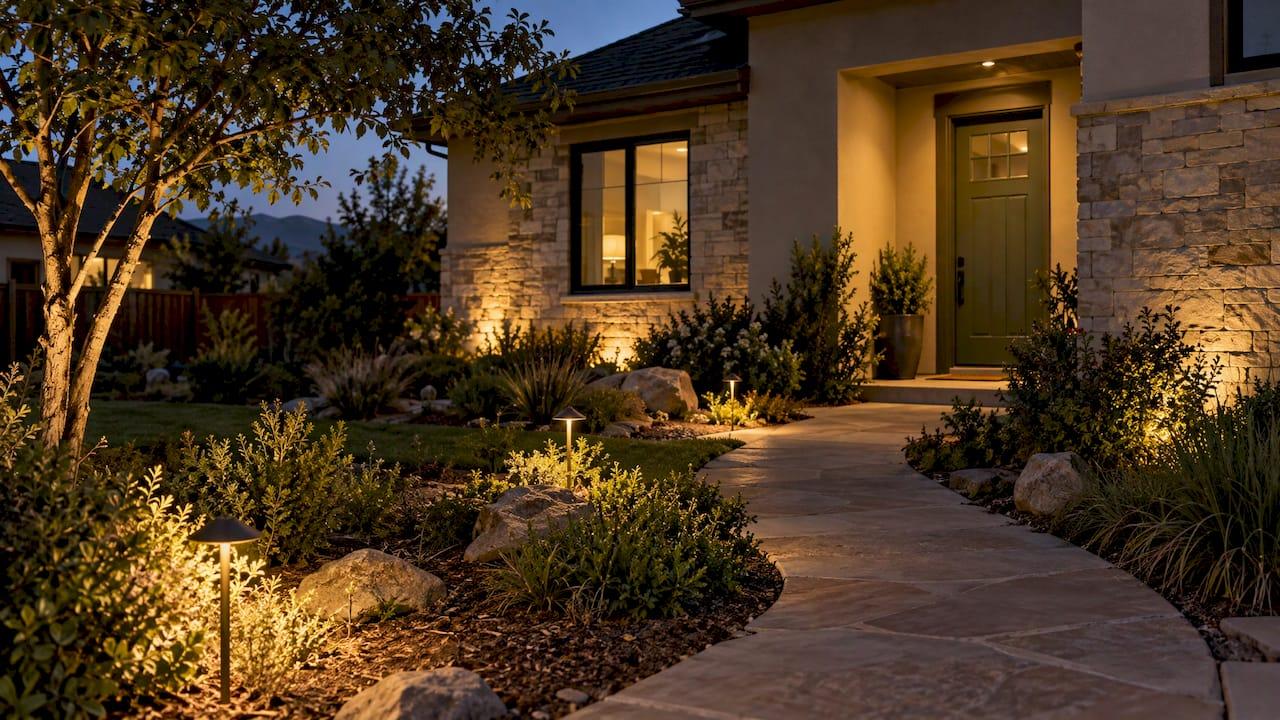
For most homes, the right landscape lighting color temperature is 2700K or 3000K. Choose 2700K for traditional, warm-toned homes: brick, natural stone, wood and mature planting. Choose 3000K for lighter, more contemporary surfaces such as stucco, white paint and pale masonry. Go above 3000K only for a specific, limited job. Kelvin describes the color of the light, not its brightness, so you set the mood with Kelvin and the amount of light with lumens, spacing and aiming. Our crew installs landscape lighting across Utah as part of the same project as your patio, walls and planting.
TL;DR
- Lower Kelvin means warmer, more yellow light. Higher Kelvin means cooler, bluer light.
- 2700K suits brick, stone, wood and traditional architecture. 3000K suits white, gray, stucco and contemporary homes.
- Kelvin does not measure brightness. Fixture output, spacing and shielding decide how much light you get.
- For dark skies and wildlife, DarkSky International advises 3000K or lower, fully shielded and only where needed.
- Pick one color temperature for the whole yard so the scenes match.
Table of Contents
- What Kelvin means in landscape lighting
- 2700K vs 3000K: how to choose for your home
- Best Kelvin by area of the yard
- Is 4000K warm or cool, and where does it fit outdoors?
- Security lighting: color matters less than aim
- Dark skies, wildlife and neighbors
- How to test the color before you commit
- Why color temperature should be planned with the whole project
- Plan your lighting with A to Z Construction
- FAQ
- Sources
What Kelvin means in landscape lighting
Color temperature is the warm or cool character of a light source, measured in degrees Kelvin. The scale feels backwards at first. A higher Kelvin number means a cool, blue-white light, and a lower number means a warmer, yellow light. Values above 5,000K read as cool, and anything below that reads as warmer and more yellow.
In practice, outdoor residential lighting lives in a narrow band:
| Kelvin | Appearance | Typical outdoor role |
|---|---|---|
| 2200K | Deep amber | Sensitive sites near wildlife habitat |
| 2700K | Warm, golden, soft | Patios, paths, brick, stone, wood |
| 3000K | Warm white, cleaner | Contemporary homes, light masonry, entries |
| 4000K | Neutral white | Utility areas, roadways, special accents |
| 5000K+ | Cool, daylight-like | Rarely suited to a home landscape |
The key point: this number tells you the tint of the light. It does not tell you how bright a fixture is. A 3000K lamp is not automatically brighter than a 2700K lamp. Lumens and beam spread control brightness. Mixing those two ideas up is the most common reason a yard looks wrong after installation. If you want a planner's view on separating light appearance from fixture brightness, this overview of lighting planning basics walks through the logic.
2700K vs 3000K: how to choose for your home
These two sit only 300K apart, but on a house wall the difference is visible. 2700K looks softer and slightly more golden. 3000K is still warm, but it looks cleaner and less yellow.
A professional trade article from the lighting industry puts the dividing line plainly: a 2,700K source suits traditional architecture such as stone and brick and residential landscapes, while the slightly cooler 3,000K source matches contemporary architecture and public spaces. The same piece cites the RP-47 recommendation of a color rendering index of 80 or higher, which keeps colors looking natural under LED.

Match the color to your materials
Walk your property at dusk and look at what the light will actually hit:
- Red brick, cedar, warm sandstone, rustic timber: 2700K. A landscape lighting professional quoted in Irrigation & Lighting says that lighting a red brick house with 3,000K can wash out the color.
- White stucco, gray siding, pale limestone, modern lines: 3000K. The same professional says that on a contemporary house with whites or grays, 3,000K is probably fine while 2,700K can look dead.
- Mixed materials: Pick the color that flatters the largest surface people see from the street and the patio, then keep every fixture at that temperature.
Here in southern Utah, red rock tones, warm stone and tan stucco are common, which is why 2700K is a frequent starting point for local homes. Many newer builds with pale exteriors and clean lines look better at 3000K. Regional taste varies across the country too: the same professional notes that preference is strongly regional, with California leaning 3,000K and the mountain states to the east leaning 2,700K.
Plants matter as much as walls
Foliage reacts to color temperature. Warm light enriches red, orange and yellow tones and deepens greens. Slightly cooler light brings out blue-green and silver foliage. If your beds lean toward xeriscape plants with silvery or blue-gray leaves, 3000K can make them stand out. If they are mostly greens, bark and warm gravel, 2700K feels more natural.

Best Kelvin by area of the yard
Use this as a starting plan, then adjust for your materials.
| Area | Starting point | Why |
|---|---|---|
| Patio and outdoor dining | 2700K | Relaxed, flattering to skin and food |
| Garden beds and ornamental planting | 2700K | Enriches warm tones and greens |
| Paths and steps | 2700K or 3000K | Match the nearest wall and paving |
| Entry and front door | 3000K for light facades, 2700K for brick and stone | Crisp but welcoming |
| Tree uplighting | 2700K or 3000K | Depends on leaf color |
| Garage and utility areas | 3000K to 4000K | Task visibility matters more than mood |
For paths, the Kelvin choice is a design decision about how the surroundings look. How much light the walkway receives comes from lamp output, fixture spacing and shade style. A path through warm mulch, stone and beds suits 2700K. A path beside a pale modern facade often looks better in 3000K.
Pavers, walls and outdoor kitchens
Hardscape surfaces take light differently by material. Warm travertine and tan pavers glow at 2700K. Gray concrete and light block look crisp at 3000K. If you are planning a paver patio, a retaining wall or an outdoor kitchen, choose the lighting color at the same time as the stone and paver color. Wall lights and step lights are far easier to run before the surface is finished than after.
Is 4000K warm or cool, and where does it fit outdoors?
4000K is neutral white. It is neither warm nor cool in a lab sense, but beside 2700K lamps it looks distinctly bluish and clinical. Roadway lighting often uses 4000K, and most state departments of transportation prefer it for non-residential roads and highways, while 3000K is becoming popular for decorative post-top and residential area lighting.
That tells you where 4000K belongs: wide public roads, not the front yard. Two practical reasons to keep it out of the landscape:
- The professional quoted earlier notes that streetlights typically run 4,000 to 5,000K and that you do not want to compete with them. Landscape lighting reads best when it is warmer than the street.
- Cool light beside warm light makes a yard look patchy. A single temperature across the property looks planned.
If you want a cooler accent, such as moonlighting effects or a blue spruce, use it sparingly and keep it on a timer.
Security lighting: color matters less than aim
Homeowners often assume cooler light is better for security. Brightness, coverage, beam pattern and motion activation do the work, and color temperature does not. A well-aimed warm floodlight with enough lumen output performs like a cool one at the same output, while very bright cool fixtures can create harsh glare that reduces visibility nearby.
The U.S. Department of Energy studied this for pedestrians. Its Pedestrian Friendly Outdoor Lighting report found that people preferred a warm color of light, 2700K to 3000K, and recommended warmer luminaires, usually below 4000K, for pedestrian-focused areas. The same research found that diffused fixtures such as frosted lenses felt less glaring even when measured brightness was high. That is a design argument for shielding and soft light patterns around your entry and walkways.
The most common mistake the Irrigation & Lighting professional sees is using far too much light, and he says less is better in landscape lighting. Layer a few well-placed fixtures instead of flooding the yard.
Dark skies, wildlife and neighbors
Utah has some of the best night skies in the country, and color temperature affects them. Higher Kelvin light contains more blue, which scatters more and has a bigger effect on wildlife and sleep.
DarkSky International gives homeowners a simple rule: look at the CCT and make sure it is 3000K or lower, point the light where it is needed, avoid generating more light than you need, and do not leave lights on all night. It suggests timers for porch lights and occupancy sensors for security lights. Its home lighting program guide adds that good options exist at 2700K or less, that motion sensors should be set to 5 minutes or less, and that dusk-to-dawn sensors are strongly discouraged.
For protected areas, the bar is stricter. The National Park Service's Grand Teton assessment found exterior lighting compliant with dark sky park guidelines when the fixture is fully shielded and the lamp is 3000K or lower, and it recommended low-lumen 2700K lamps for historic areas. Near sensitive habitat, the International Dark-Sky Association recommends 2200K or amber sources with no blue light.
Shielding matters as much as Kelvin. Eaton's design guidance makes the point that fixture installation and lighting design are the important factors for light pollution: fixtures should light the ground instead of throwing light upward. A warm, shielded, well-aimed fixture is good for your neighbors and good for the night sky.
How to test the color before you commit
Never choose from a catalog photo. Screens and packaging misrepresent color. A better process:
- Look at your house at dusk. Note the dominant material and plant colors.
- Pick a starting Kelvin from the tables above: 2700K for warm and traditional, 3000K for light and contemporary.
- Decide the lighting layers. Path, accent, wash and downlight each need different fixtures but the same color temperature.
- Check the CRI. Look for 80 or higher so stone, wood and plants keep their real colors.
- Plan shielding and controls. Fully shielded fixtures, timers and sensors keep the light where you want it.
- Confirm electrical and trenching routes before hardscape or sod goes in.
On step 6, a low-voltage system needs wire runs under paving, through beds and around irrigation lines. Our guides on low voltage landscape lighting and fixture types explain how fixtures and layouts fit together, and our warm 2700K lighting ideas show what the warm option looks like at home.
Why color temperature should be planned with the whole project
Light color depends on stone, paver, concrete, paint and plant choices. When one company handles those pieces separately, nobody owns the final look. We run every phase with an in-house, licensed crew and a single point of contact, so the lighting color, the hardscape and the planting are chosen together. That avoids the typical delays of coordinating multiple subcontractors.
Our view on color temperature
Most color temperature mistakes we hear about come from picking a number in isolation. The Kelvin rating only makes sense next to the surface it lights, the plants around it and the amount of light the space needs.
Our approach is to treat lighting as part of the build. We manage every phase of a project internally, without subcontractors, which gives you one point of contact and coordination between concrete, masonry, landscaping and lighting. For Utah homes, we start from warm light, since 2700K flatters the stone, brick and warm-toned materials common here, and we move to 3000K when the surfaces are light and contemporary.
Choose one temperature, keep fixtures shielded and use less light than you think you need. That is the formula for a yard that looks good at night and stays friendly to the night sky.
Jake
Plan your lighting with A to Z Construction
We are a licensed general contractor in Cedar City, Utah, with more than 500 projects completed. Our landscaping work covers sod, xeriscaping, artificial turf, irrigation and landscape lighting, delivered by our own crew from the first estimate to final completion. If you are building a patio, wall, driveway or kitchen, we can plan the lighting into the same project.

See our landscaping services or go straight to landscape lighting to request an estimate.
FAQ
Is warm white or cool white better for landscape lighting?
Warm white is the better choice for almost every home landscape. The U.S. Department of Energy found that pedestrians preferred warm light between 2700K and 3000K, and DarkSky International also advises 3000K or lower. Reserve cooler light for utility areas.
What is the difference between 2700K and 3000K outdoors?
2700K is softer and more golden, and it flatters brick, stone, wood and traditional homes. 3000K is cleaner and less yellow, and it suits stucco, white or gray surfaces and contemporary architecture. Neither is brighter by itself, because brightness comes from lumens and beam spread.
Is 4000K light warm or cool?
4000K is neutral white, but next to 2700K it looks cool and bluish. It is common on roads and highways, not on residential landscapes. In a yard it can look clinical and compete with the streetlight color.
What Kelvin is best for outdoor lighting overall?
Start at 2700K for warm, traditional or natural surroundings and 3000K for light, modern ones. Keep every fixture at the same temperature, aim lights downward and shield them, and use timers or sensors so lights are not on all night.
Sources
- Color by numbers, Irrigation & Lighting
- Landscape Lighting Guidance, Electrical Contractor Magazine
- Pedestrian Friendly Outdoor Lighting, U.S. Department of Energy
- Responsible home outdoor lighting, DarkSky International
- Dark Sky Friendly Home Lighting Program guide, DarkSky International
- Grand Teton National Park exterior lighting assessment, National Park Service
- International Dark-Sky Association Board Policy
- How to select the best correlated color temperature, Eaton
- Best Color Temperature for Outdoor Lighting: 2700K vs 3000K